PROMPT: First Day

Daily writing prompt
Tell us about your first day at something — school, work, as a parent, etc.

Today is the first day of the rest of this week.

PROMPT: Book

Daily writing prompt
What book are you reading right now?

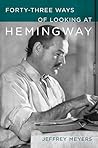
Forty-Three Ways of Looking at Hemingway by Jeffrey Meyer; a biography of Ernest Hemingway that is written in an interesting and creative way. Rather than a chronological telling of life events, the book relates Hemingway’s life to a series of other individuals and events.
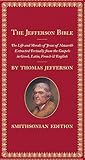
BOOK: “The Jefferson Bible” by Thomas Jefferson

The Jefferson Bible: The Life and Morals of Jesus of NazarethThe Jefferson Bible: The Life and Morals of Jesus of Nazareth by Thomas Jefferson
My rating: 5 of 5 stars

PDF available online [Public Domain]

Thomas Jefferson (yes, the same one who wrote the Declaration of Independence) produced this book by cutting and pasting excerpts from the Gospels so as to produce a distillation of who he believed Jesus was and what Jesus’s essential teachings were. It mixes parables and other New Testament teachings with biographical description.

There is an introduction which offers the reader more specific insight into Jefferson’s thinking than can be gleaned merely from what he includes and what he trims. The Introduction also discusses the similarities and differences between Christian philosophy and that of the Jews, the Greeks, and the Romans.

If you’re looking for a condensed version of the New Testament, I’d highly recommend this book. Jefferson was obviously a sharp guy who looked at the Bible from the perspective of Enlightenment-era thinking.

View all my reviews

BOOKS: “John Brown” by W.E.B. Du Bois

John BrownJohn Brown by W.E.B. Du Bois
My rating: 5 of 5 stars

Available free online at Project Gutenberg

“John Brown’s Raid on Harpers Ferry” is one of those historic events like the “Teapot Dome Scandal” that American kids have to memorize a rote fact about to regurgitate on an American History test a couple times during their scholastic lives, never to be thought of much again, forever a familiar name lacking all depth of understanding. (At least that’s how it was in my day.) Unlike the Teapot Dome Scandal, which I suspect is not learned about in detail because it was somewhat complex and boring, I think the minimalist coverage of John Brown might reflect a bit of national embarrassment. For Brown’s tale is not complicated, and it’s certainly not boring. Brown thought slavery was an abomination, and he devoted his life to freeing slaves by whatever means he could, which culminated in a raid on an arsenal at Harper’s Ferry, West Virgina, at the convergence of the Potomac and Shenandoah Rivers, a raid intended to liberate weapons to the cause of arming freed slaves and other abolitionist fighters.

It’s a shame that more is not learned about John Brown because he was such a fascinating and principled individual, and in a sense his story isn’t just an embarrassing tale of a sparse few virtuous people against a mainstream that was — at best — indifferent to slavery. But there is a potential for pride in the fact that Brown and those who fought with him were able to see slavery for what it was and to stand strong against that mainstream, to make the fight of the oppressed their fight and — in the case of Brown and others — to pay the ultimate price in the conduct of that fight.

W.E.B. Du Bois’ biography of John Brown came out in 1909 and may not be written in the novel-esque style that a writer today would write it, but it is well-written and readable. Du Bois’ book is a full biography of Brown, if focused on his abolitionist aspect. Du Bois tells a little of Brown’s backstory and of his work life and then explores his experiences fighting in Kansas. However, this book does really shine in its account of the Harpers Ferry Raid and its aftermath.

Readers interested in American History or the biographies of virtuous individuals are urged to read this account of the life of John Brown.

View all my reviews

PROMPT: Name

Daily writing prompt
Where did your name come from?

I wasn’t consulted on the matter. Like most, I labor under the impression that it came from my parents, but for all I know it was just a random person off the streets who scribbled it on the clipboard hanging off the hospital bassinet. If there even was a hospital…

PROMPT: Describe Yourself

Daily writing prompt
How would you describe yourself to someone?

Of middling tallishness, perpetually perplexed, and independently impoverished.

PROMPT: Nickname

Daily writing prompt
What’s the story behind your nickname?

It’s a shortened version of my proper name. I was born before “Weekend at Bernie’s” and before legendary comedian Bernie Mac became a comedian (at least before he became a celebrity,) and so – contrary to popular stock responses upon mention of my name – it derives from neither.

BOOKS: “Lost in the Twentieth Century” by Albert Szent-Györgyi

Lost in the Twentieth Century (Annual Review of Biochemistry Book 32)Lost in the Twentieth Century by Albert Szent-Györgyi
My rating: 5 of 5 stars

Available Online – NIH National Library of Medicine

This is the very brief autobiography of a fascinating man. Szent-Györgyi is most famous for work in biochemistry involving Vitamin C, work that won him a Nobel Prize. However, his life is not only notable for science before and after the Nobel (after he worked on the physiology of muscular activity, on electron activity in physiology, and on cancer.) He also performed important works outside the laboratory, notably he conducted an espionage / diplomatic mission during the Second World War (“Espionage” in that he traveled to Turkey under false pretenses, under cover of giving a lecture at a university, “diplomatic” in that the trip’s true objective was to negotiate with the Allied powers.)

Szent-Györgyi has some interesting quips and insights that make it worth reading this pamphlet-scale book, even though his Wikipedia page probably contains as much information. He had an interesting way of thinking about matters, both scientific and not, and was politically and socially engaged in the world.

If you’re curious about Szent-Györgyi or enjoy biographies, in general, I’d highly recommend reading this one.

View all my reviews

PROMPT: Taglines

Daily writing prompt
If humans had taglines, what would yours be?

30% More Nuts.

BOOKS: “George Bernard Shaw: A Very Short Introduction” by Christopher Wixson

George Bernard Shaw: A Very Short Introduction (Very Short Introductions)George Bernard Shaw: A Very Short Introduction by Christopher Wixson
My rating: 4 of 5 stars

Publisher Site – OUP

This concise guide to George Bernard Shaw is an exploration of the works of the prolific playwright and how his philosophy and life experiences influenced the stories he created. The book is arranged by periods of Shaw’s own determining, including: Unpleasant, Pleasant, Puritan, Political, Extravagant, and Farfetched. The book does mention Shaw’s novels, literary criticism, and some of his major non-literary activities, but largely in the context of the comedies, tragedies, and histories he wrote for the stage.

If you are interested the works of George Bernard Shaw and how they came to be, I’d recommend this book. It’s a quick read and offers some fascinating insights.

View all my reviews