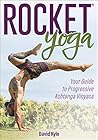
BOOK: “Rocket Yoga” by David Kyle

Rocket® Yoga: Your Guide to Progressive Ashtanga VinyasaRocket® Yoga: Your Guide to Progressive Ashtanga Vinyasa by David Kyle
My rating: 5 of 5 stars

Publisher Site – Human Kinetics

This book provides an overview of Rocket Yoga, which is newcomer to yoga’s ranks that adapts from the Ashtanga Vinyasa school of Pattabhi Jois. The objective of Rocket is to make the practice more adaptable, both in terms of being suitable for a broad range of students and for individual students to adapt the practice in ways that would fit their objectives, strengths, and limitations. There are also adjustments made in the sequence to streamline the flow.

For those unfamiliar with Ashtanga Vinyasa, it is a fixed form flow style. Fixed form means that at a given level one is repeating the same sequence the same way every session until one bumps up to the next level. This offers great advantages for building fitness, muscle memory, and connection to the practice, but many find it tedious and the threat of burnout is ever-present. Rocket attempts to keep the benefits of fixed form practice but to mitigate the burnout factor by having three sequences that can be interspersed in one’s practice, as well as by allowing more room for individual variation. Ashtanga Vinyasa is also often perceived as daunting because as a flow form it involves a lot of vigorous transitional movement and also because even some of the preliminary series asana (postures) are challenging for your average practitioner. While Ashtanga Vinyasa generally allows for modification, Rocket leans into this a bit more. (That said, the Rocket system also has ways to step up the challenge as well.)

As with many system-centric yoga books, much of the book is description of the asana (postures) that make up the system as well as elaboration on how they are sequenced. However, the book does open with philosophical and historical background and ends with discussion of how the practice might be adapted (e.g. there is a section for pregnancy.)

The book has a lot of color photographs that are clear and well captured (if of limited perspective.)

If you are an Ashtanga Vinyasa practitioner (or perspective practitioner) and are curious about how the basic concept might be adjusted to mitigate potential burnout or make the system more flexible, I’d recommend giving this book a look.

View all my reviews

True Balance [Senryū]

standing on one leg,
steadfast while squirrels mistake
 one for a tree.

BOOK REVIEW: The Stories Behind the Poses by Raj Balkaran

The Stories Behind the Poses: The Indian mythology that inspired 50 yoga posturesThe Stories Behind the Poses: The Indian mythology that inspired 50 yoga postures by Raj Balkaran
My rating: 4 of 5 stars

Amazon.in Page

Released: July 26, 2022

Yoga practitioners will be aware that — while some posture names are banal, straightforward descriptions (e.g. Utthita Hasta Padangusthasana, or “standing hand-to-big toe pose –”) many others invoke animals, sages, or deities for historical, mythological, or symbolic reasons. As this book’s title suggests, it presents the mythological backstories for fifty yoga postures. The vast majority of these fifty poses are common ones that will be readily familiar to most Hatha Yoga practitioners, though a few are advanced or obscure and aren’t likely to come up in your run-of-the-mill studio class. (And a couple may be familiar to some individuals by another name.)

The book is cleanly organized with five sections (Shiva poses, Vishnu poses, Devi / goddess poses, God story poses, and sage poses) each containing writeups for ten poses. Each pose is presented via colorful artwork in the Indian style (typically with the deity or sage in question performing the posture.)

I found the entries to be well-written and clear (Hindu Mythology can be extremely complicated and some authors get lost in the weeds by including too much minutiae or unnecessary details, but that wasn’t the case here.) The full-page artistic renderings of the poses are also clear and tidy, such that anyone familiar with the pose should readily recognize it.

The one thing I think could have been done better (though probably not without messing up the aforementioned clean organizational scheme) would be to cut some of the redundancy in the stories. In a few instances, the same story appeared in multiple chapters. To the author’s credit, these weren’t just copy / pasted, they were written uniquely, sometimes with additional information or a different focus. Still, it was a bit distracting to find myself in the middle of the same story and wondering whether I’d zoned out or lost my place. This might have been dealt with by putting multiple poses with one story and not repeating the tale one or more times. For example, the stories about Vasisthasana and Visvametrasana are inherently coupled, and the poses might be as well. (Perhaps even referencing the fact that the story had already been told might have been helpful and less distracting.)

All-in-all, I thought this book did a fine job of presenting the myths and relating them to the postures. I learned a great deal from reading the book and would recommend it for yoga practitioners and those interested in Hindu Mythology.


View all my reviews

BOOK REVIEW: Yoga Anatomy, 3rd Ed. by Leslie Kaminoff and Amy Matthews

Yoga AnatomyYoga Anatomy by Leslie Kaminoff
My rating: 5 of 5 stars

Amazon.in Page

This book has several competitors, and so this review will focus on a few of the features that I believe make it one of the best books on yoga anatomy, and the most appropriate for many users. To clarify, H. David Coulter’s “Anatomy of Hatha Yoga” has some advantages over this book, but Coulter’s book is also denser and will send neophyte readers to the glossary / internet / library much more often. On the other hand, some of the other yoga anatomy books fixate entirely on postural yoga and treat it entirely as a matter of skeletal alignment and muscular engagement. While a lot of this book (and any such book, really) focuses on skeletal alignment and muscular engagement, I appreciated the books exploration of breath and the nervous system – topics that are often neglected. In short, this book offers a mix of reader-friendliness and detail that makes it at once approachable and tremendously informative.

One important feature of this book is that it avoids the dogmatism of some yoga texts, encouraging experimentation and recognizing that a one-size-fits-all approach to bodies is bound to fail. This can best be seen in the “Cueing Callout” boxes that explore the pithy adjustment directives for which yoga teachers are famous (and often satirized,) advice that is often misunderstood in ways detrimental to a student’s progress.

A second key feature involves keeping anatomy and physiology distinct from the folk science of yoga / ayurveda. While Kaminoff and Matthews do refer to ideas like prana and apana, they do so in a broad, conceptual way that doesn’t conflate said ideas with science. A common problem in yoga texts is conflation of science with folk science such that confused readers are left with a muddle of puzzle pieces that don’t belong to the same puzzle.

Finally, as one who’s found pranayama (breathwork) to be one of the most profoundly transformative elements of a yoga practice, I appreciated that the book not only had a chapter on breath dynamics, but that all the posture discussions included a “breath inquiry” section that encouraged readers to reflect upon the effect of the posture on breathing, as well as suggesting ways in which a practitioner might experiment to improve one’s breathing.

The only criticism I have is that many of the text-boxes in the early chapters seemed to contain random information that could have been incorporated into the text, into footnotes, or edited out altogether. [In contrast to the aforementioned “Cueing Callout” boxes that had a clear and distinct purpose.] If you’re a yoga teacher or dedicated practitioner without a deep scientific background, you’d be hard-pressed to do better than this book for learning about the anatomy of yoga.


View all my reviews

5 Seated Meditation Postures & How to Choose the One Right for You

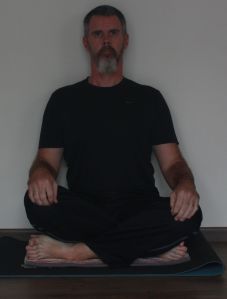
Sukhasana (Easy Pose)

5.) Sukhasana (Easy Pose): One simply folds the legs so that each leg rests on top of the opposite foot. This is a popular crossed legged seated posture. For reasons to be explained, it’s usually not considered a meditative posture.

Pros: As the name suggests, it’s an easy seat for most people to assume. Because the leg is resting on the opposite foot, the knees don’t have to (re: can’t) lay flat on the floor, and so this is pose is more comfortable for practitioners with tight glutes or who otherwise can’t open their hips — for short time periods at least.

Cons: The downside of not putting the knees down, is that the posture is not nearly so stable as the others that will be mentioned. Instead of a big triangle running from one’s sit-bones out to the knees and between each knee, one is resting on a small triangle with the gap between the sit-bones as its base. Furthermore, there will be a pronounced tendency to slump in the back in this pose, and this makes Sukhasana not ideal for sitting more than a few minutes.

Notes: As I mentioned, this isn’t a good meditative posture because it’s unstable and prone to back pain over relatively short periods. I mention it here because many beginners can only manage to do this pose. If that is the case for you, you will probably want to look at using props to achieve a comfortable position (e.g. lifting the hips), if you intend to practice more than five minutes or so.
 

Swastikasana (Auspicious Pose)

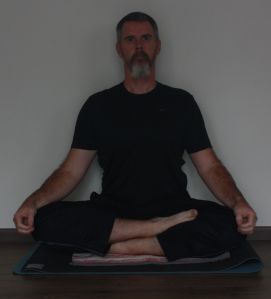
4.) Swastikasana (Auspicious Pose): Note: this pose and the next (Siddhasana – Accomplished Pose) are quite similar, and it’s hard to see the difference in photos, but I’ve added a couple pictures and some text description to try to clarify the difference. Bend the left knee and place the left sole against the inside of the right thigh. One will then bend the right leg and, squeezing the left foot into the space at the crook of the right leg, tuck the right foot into the space between the left thigh and calf muscle. Tucking the feet in is important to making the posture comfortable — particularly the bottom one, which can be compressed if not positioned properly.

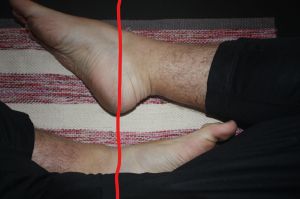
The difference between this pose and Siddhasana is simply that the heels aren’t aligned on one’s center-line, but rather the left heel will be to the right side of one’s center-line and the right heel will be to the left. If one’ imagines the line below were straight and on the body’s center-line, one can see how Swastikasana has the heels / ankles offset.
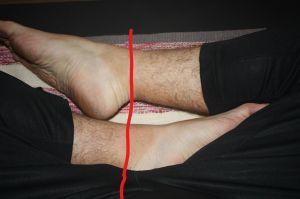
Pros: The posture is much more stable than Sukhasana and, while not quite as wide a the base as Siddhasana, it avoids Siddhasana‘s disruption of circulation caused by the bottom heel being pressed against the perineum / genitals (depending upon gender.) That makes Swastikasana‘s strength its position on the middle ground. It’s stable enough for meditation but doesn’t require as much flexibility in externally rotating the thighs as does Padmasana (Lotus Pose.)

Cons: Some people (including the author) have troubles squeezing the feet into the gaps between thigh and calf — i.e. if one has thick legs, it can be problematic. Both this pose and Siddhasana are contra-indicated for those with sciatica or sacral infection (Sacroiliitis.) Some traditionalists would say that the lack of stimulation to the moola bandha / perineum is a con as well.

Notes: Both this posture and Siddhasana can be practiced with either leg folded first, and many teachers recommend alternating for those students who spend a lot of time in meditative poses, because the postures aren’t symmetrical and muscular asymmetries may develop if one always does it on the same side.
 

Siddhasana (Accomplished Pose)

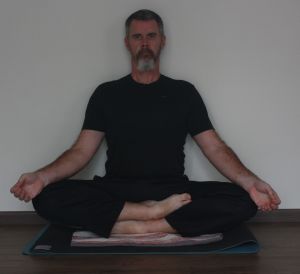
3.) Siddhasana (Accomplished Pose): As mentioned, the gist of this pose is the same as Swastikasana, except that the bottom heel will be aligned on one’s center-line, pressing into the perineum lightly, and the heel of the top foot will be in alignment with the bottom foot. (Note: Males will probably have to do some genital re-positioning to make this position comfortable.)

The picture below shows how the heels are aligned on the body’s center-line.
Pros:  While not without controversy, many teachers propose that having the heel pressing into one’s body has advantages in stimulating the moola bandha – including helping the practitioner be chaste.

Cons: The aforementioned controversy involves potential damage done by long-term disruption of blood flow in the area. It should be pointed out that there’s no reason to think that short term pressing of the heel into the groin — as is done in janu shirshasana (head-to-knee pose) — is problematic. However, meditation may involve much longer disruption in blood flow. So while some opponents of Siddhasana would agree that it helps attain chastity, they might argue that potentially causing impotence is not an ideal way to achieve that control over one’s sexuality — if control is even needed in the first place. 

Note: When practiced by women, this posture is sometimes referred to as Siddha Yoni Asana, which just reflects that contact point with the heel is a bit different owing to differences in anatomy in the region.
 

Ardha Padmasana (Half Lotus Pose)

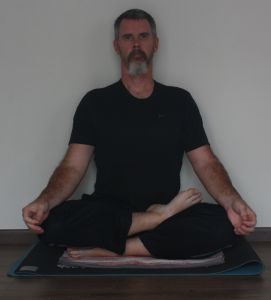
2.) Ardha Padmasana (Half Lotus Pose): The left foot will be folded in so that the left sole rests on the right inner thigh, much as in Swastikasana, and the right foot will be folded up into one’s left hip crease with the left heel as close to the navel as possible. One may need a prop (e.g. block or rolled up towel) under one’s elevated knee — especially for long term sitting. As mentioned with regards the previous two poses, this pose can be practiced on either side, giving one the opportunity to work out the asymmetries.

Pros: Half lotus offers some of Padmasana‘s (Lotus Pose) advantage in terms of stability in the lower back, without having to have quite as much flexibility in external rotation of the thigh. As a person with thick legs, but flexible hips, I find ardha padmasana and padmasana tend to be more comfortable than the preceding poses for me, personally.

Cons: The asymmetry of this pose is considerable, and failure to balance it out will be problematic. Also, if one doesn’t have sufficient hip flexibility, one may end up putting a dangerous torque onto the knee joint.
 

Padmasana (Lotus Pose)

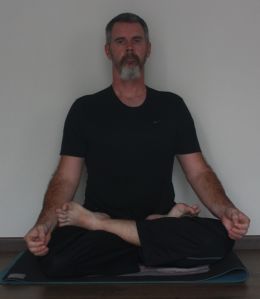
1.) Padmasana (Lotus Pose): One will take the left leg and fold it so as to put the left foot into the crease of one’s right hip with the left heel as close to the navel as possible. One will then take the right foot and folding it over the top of the left so that it comes to rest at one’s left hip crease. One may want to (or need to) press both knees inward to get the legs into a stable position.

Pros: This posture is not only very stable; the lower back achieves a tension that allows one to keep one’s back upright for much longer periods of time without the back starting to slump — leading to the back pain inherent in that slump.

Cons: This takes: a.) a fairly high level of hip flexibility; b.) strong knees that will not become damaged by the torque of getting into or maintaining the pose; c.) the ability to live with discomfort, because it will be somewhat uncomfortable at first even if one has flexible hips and strong knees.

Note: For meditations of less than 30 – 40 minutes, I find padmasana to be the most comfortable and stable pose. However — at least with my thick legs — disruption of circulation of both blood and lymph becomes problematic for longer practices, and in longer meditations I tend to use poses with hips elevated and legs loosely crossed.


This is by no means a comprehensive list of seated poses used in meditation. Notably, there is the posture vajrasana (thunderbolt pose), in which one is seated back on one’s heels with the knees pointing in front of one. Since this pose puts the entire body weight onto the lower legs, circulation disruption can be substantial over long periods. Virasana is similar, but one sits down between the feet, which is challenging for the knees. While both of these postures may be hard to hold in their classic form for extended periods of meditation, variations using props — e.g. a bolster — may be the perfect solution for students who have trouble with all of the poses listed above.

5 Challenging [Int.] Standing Balances

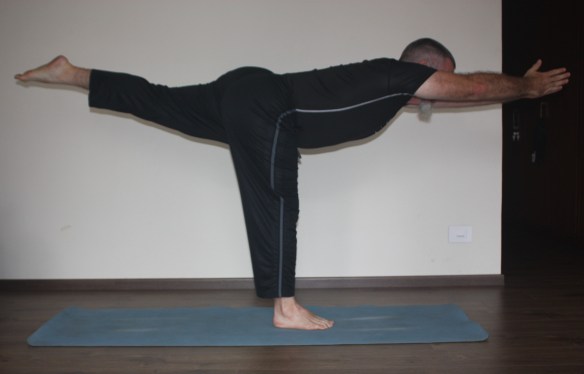
Vīrabhadrāsana III (Warrior III)

5.) Vīrabhadrāsana III (Warrior III):

What makes it challenging?

Substantial core strength is needed to obtain the capital “T” position. Straightening the lifted leg and getting it in line with the torso is the first challenge. Also, there is a tendency for the hip of the lifted leg to angle upward into an position in between Warrior III and Half Moon Pose (see below.) The front of the pelvis should be squared toward the floor. The drishti (focal point) at the extended hands also creates more of a challenge than looking straight down at the floor.


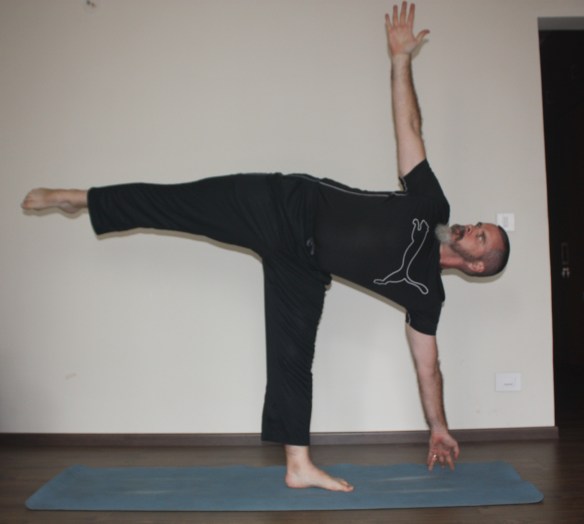
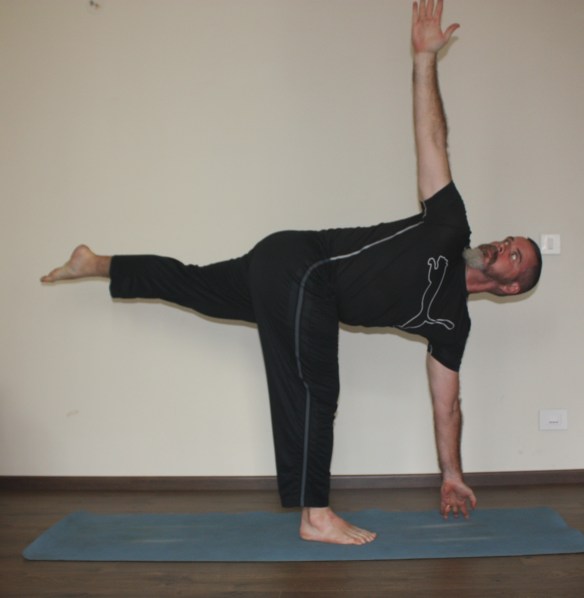
Ardha Chandrāsana (Half Moon Pose)

4.) Ardha Chandrāsana (Half Moon Pose):

What makes it challenging?

Largely, the same challenges that make Warrior III difficult. However, “stacking the hips,” i.e. getting the front of the pelvis squared to the wall (not the floor or at a downward angle) requires a high degree of hip flexibility. Hip openers may be necessary to be able to stack the hips without the torque of lifting the top hip up throwing one off balance.


Parivrtta Ardha Chandrāsana (Twisted Half Moon Pose)

3.) Parivrtta Ardha Chandrāsana (Twisted Half Moon Pose):

What makes it challenging?

Again, this posture shares challenges with Warrior III and Half Moon. While it’s less difficult than Half Moon in that it doesn’t require hip stacking, it makes up for it in that twisting motions tend to make staying on balance difficult. This is because one has to remain stable on the standing foot as the torso rotates and if one can’t stack one’s shoulders the weight distribution may be hard to keep balanced. Also, achieving the drishti (looking at the upper hand) without breaking balance is no easy feat.


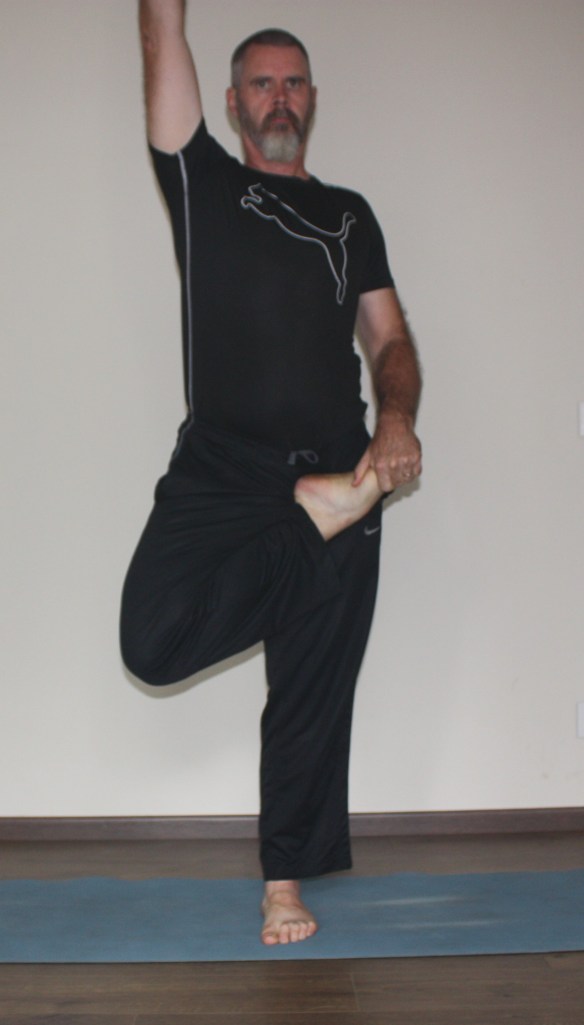
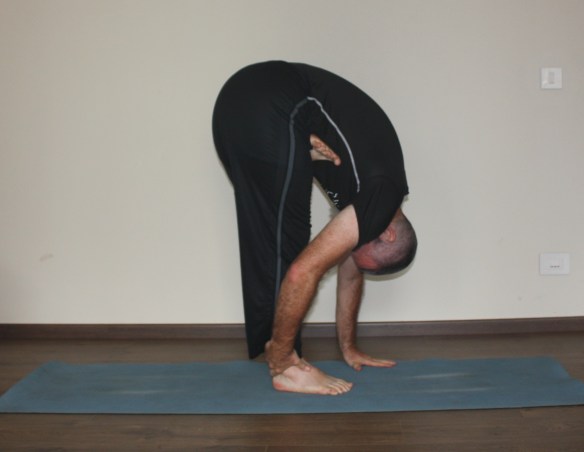
Ardha Baddha Padmōttānāsana (Bound Half Lotus Pose) [Standing]

Ardha Baddha Padmōttānāsana (Bound Half Lotus Pose) [Folded]

2.) Ardha Baddha Padmōttānāsana (Bound Half Lotus Pose):

What makes it challenging?

The knees should be next to each other, but the knee of the folded leg wants to be forward and to the outside. Also, one must get the heel aligned on one’s centerline (below the navel) so that when one folds the foot is in a position where it can compress into the soft, fleshy tissue rather than being wedged between bones.


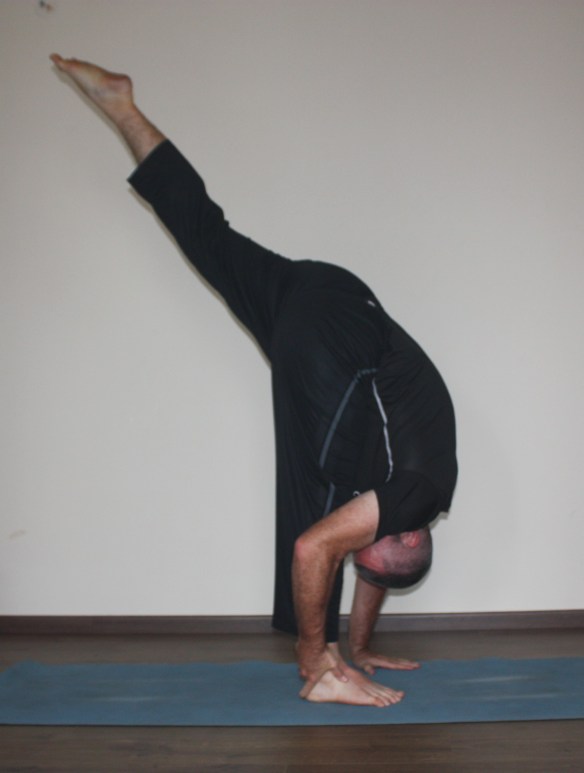
Ūrdhva Prasārita Ekapādasana (Standing Split)

1.) Ūrdhva Prasārita Ekapādasana (Standing Split):

What makes it challenging?

Straightening the lifted leg without throwing oneself off balance is the big challenge. It’s possible to put both hands around the support leg ankle, to make it even more challenging, but one must have an exit strategy in case one loses balance.

5 Fun Arm Balance Transitions

5. Eka Hasta Bhujasana to Astavakrasana


4. Adho Mukha Svanasana to Eka Pada Koundinyasana


3. Bakasana to Salamba Shirshasana II


2. Utthita Ardha Padmasana to Eka Pada Galavasana


1. Parivrtta Utkatasana to Parivrtta Eka Pada Koundinyasana

5 Exercises to Wed Your Yoga and Calisthenic Practices

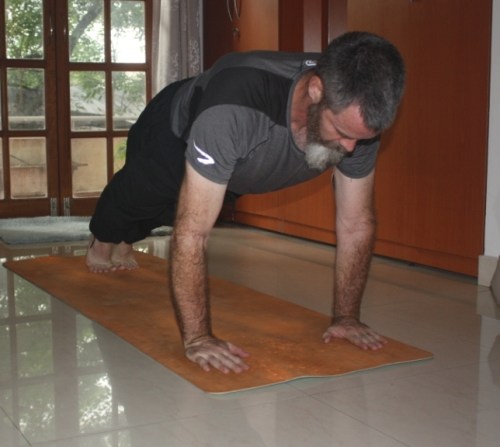
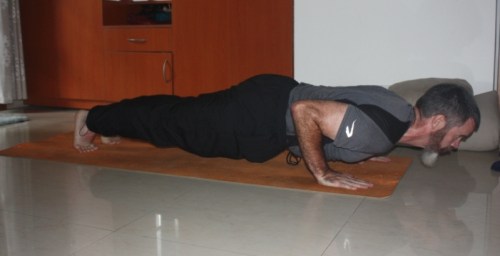
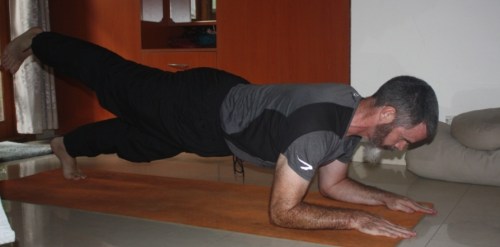
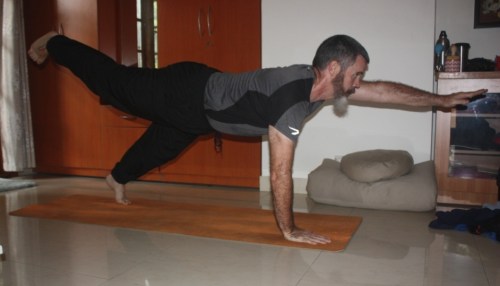
5.) Anything plank (a.k.a. adho mukha dandasana / santolanasana): Who knows how long planks have been a feature of yoga? Plank postures are a fixture in Hatha Yoga, playing a role in most versions of Surya Namaskara (sun salutations), and being used to both to build core strength and to prepare for arm balances.

Planks have also gained immense popularity with calisthenic practitioners. In my gym class days, sit-ups and crunches were the go to ab exercises. No more. Now many bodyweight fitness practitioners are ditching sit-ups and crunches altogether for a number of exercises deemed more effective–include many variations on the plank.

High plank (adho mukha dandasana)


Low plank (chaturanga dandasana)


Forearm plank variation with leg up


High plank variation with alternating limbs extended


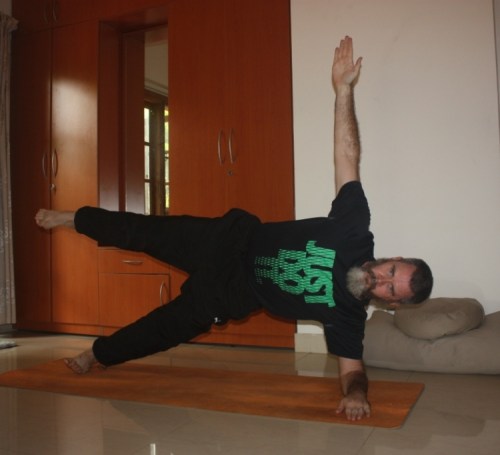
Side plank (vasisthasana)


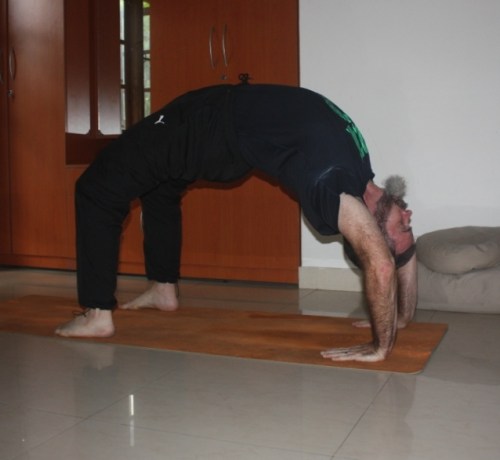
4.) Back bridge (a.k.a. Chakrasana): This is another yoga classic that’s being brought into calisthenics training in a big way. You may note a recurring theme in my selections for this post, exercises and postures (asana) that help to build shoulder joints that are strong, stable, and yet sufficiently flexible. This is a big challenge for bodyweight workout practitioners. One can get stability by bulking the muscles up, but if you don’t have the range of motion to achieve proper alignment, it’s not going to do one a lot of good.

The back bridge (chakrasana, or “wheel pose”)


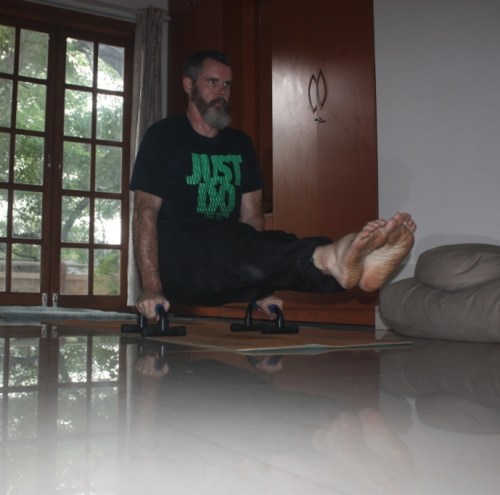
3.) L-sit (a.k.a. Bramcharyasana): Of course, the other recurring theme (besides building shoulder stability) is core strength. This exercise is both a yoga classic and is probably as old as gymnastics itself. Its Sanskrit name, Brahcharyasana, means celibate’s pose–but as far as I’m concerned that’s purely optional.

L-sit (Bramcharyasana)


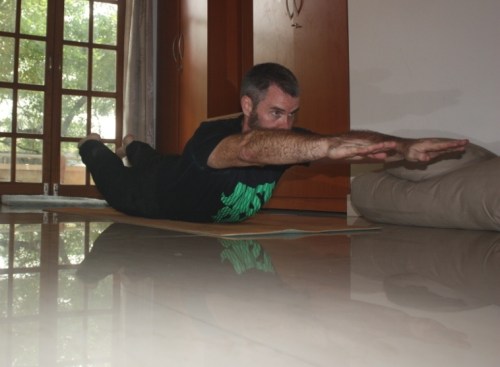
2.) “Supermans” (a.k.a. shalabasana [locust pose]): Another core exercise, but one that strengthens the back muscles.

“Supermans” (shalabasana)


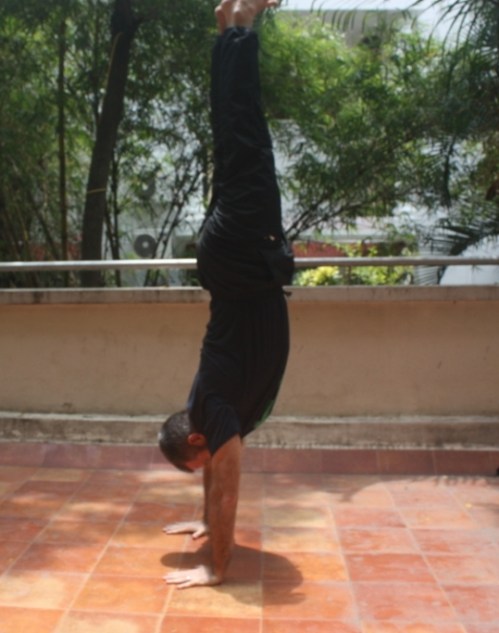
1.) Handstands and Handstand Preppers (a.k.a. adho mukha vrksasana): This practice isn’t just about looking impressive. As mentioned above, it’s hard to build shoulder joints that allow enough stability and range of motion to have the command of one’s body that one would like. Our shoulders are optimized to maximum mobility. That helped our ancestors to be awesome throwers of spears and rocks, but it makes it tough to support our weight in an inverted position. The handstand is a good way to build stability in the shoulders.

Handstand (adho mukha vrksasana)


If it’s too hard, use your legs to stabilize you (but still try to get that straight up-and-down arm position)


If it’s too easy, start doing push-ups

5 Courage Building Yoga Practices

Learning to manage and moderate one’s fears and anxieties needn’t involve strapping on a parachute, cold quitting a job, or bare-knuckle boxing in a back alley. In fact, it may be best to begin by quietly watching those anxieties at the other end of the spectrum, the one’s so subtle that conscious awareness of them can be blotted out by the noise of living–but which nevertheless have a physiological impact.


The ability to quietly and non-judgmentally witness one’s emotional state–as is taught in yoga and related practices such as Buddhist meditation–is crucial (and, in my opinion, is one of the most valuable lessons that these systems have to teach.) Crushing or repressing emotions is a demonstrably losing strategy. At best these feelings are tamped into one’s subconscious mind, still adversely affecting one’s outlook and, therefore, indirectly casting a pall over one’s life.


You’ll note that I’ve mentioned courage and moderating fear, but have not mentioned defeating emotions or quelling fear. Wrongly, our archetypes of fearlessness are characters like John McClane (i.e. the “Die Hard” movies), Katniss Everdeen (i.e.”The Hunger Games” trilogy),  or Yoda (i.e. the “Star Wars” movies.)  But neurologists who study patients whose brains have been damaged such that they are literally fearless tell us that the defining characteristic of such individuals is “paralysis by analysis.” In other words, Sheldon Cooper (i.e. “Big-Bang Theory”) is a more apt model. Also, the fearless tend to live short lives because they eventually do something fatally inadvisable.


We need our fear. However, while fear can keep us from doing stupid things, it can also turn us into the worst version of ourselves. Therefore, our fear needs to be moderated with courage and reason (to these, some would add “faith.”)


You may note that I tend toward the intermediate / advanced with the practices I mention. This is, in part, because that’s probably more likely the point at which one is ready to take this on. In beginning a practice, one may have one’s hands full to grasp the basics of alignment and breath.


Without further ado, here are a few yoga practices that I’ve used to help me witness my anxieties and learn to moderate them:


1.) Nauli (and other external breath retention [i.e. bāhya kumbhaka] techniques.): Breath retention can produce a subtle anxiety, even when one has full control of the timing of release and the next breath. In fact, subtle anxiety may cause one to have a less robust retention than one might otherwise. Truth be told, this practice has probably been more fundamental than any of the āsana practices that will follow, for me personally.  

Note: external retentions are relatively advanced practice and should only be added to one’s sadhana after one has been taught by an experienced teacher and is somewhat experienced with pranayama.

practicing nauli

practicing nauli


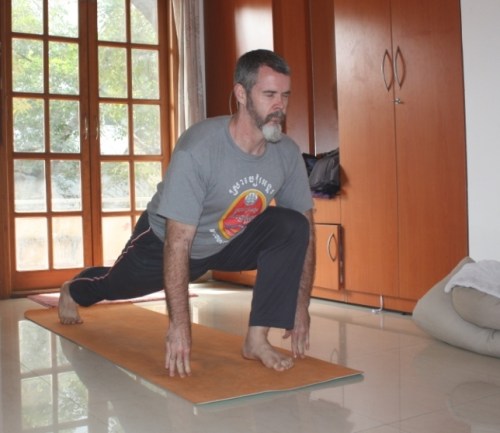
2.) Eyes closed: This is particularly effective with Surya Namaskara (Sun salutations), standing poses, and–at an advanced level–balancing poses. One should make sure that ones balance is solid throughout before attempting with one’s eyes closed. We have redundant systems to help achieve balance (i.e. inner ear, proprioceptive, and visual), but–for the sighted–going without vision can be nerve wracking.

ashwa sanchalanasana in Surya Namaskara

ashwa sanchalanasana in Surya Namaskara


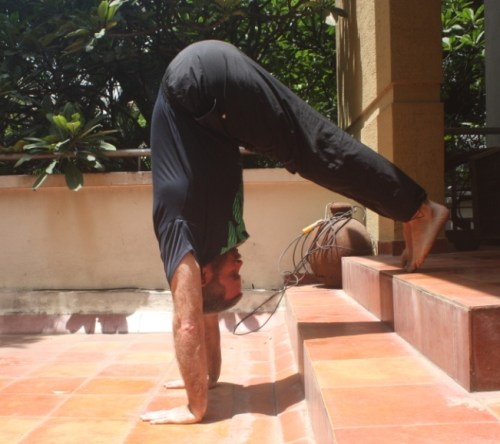
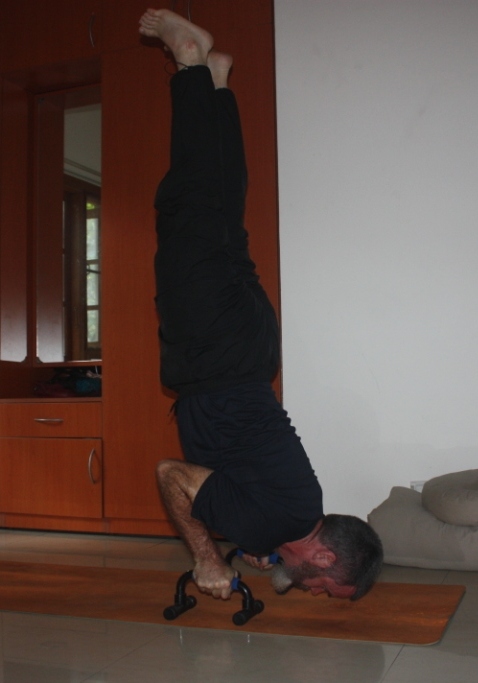
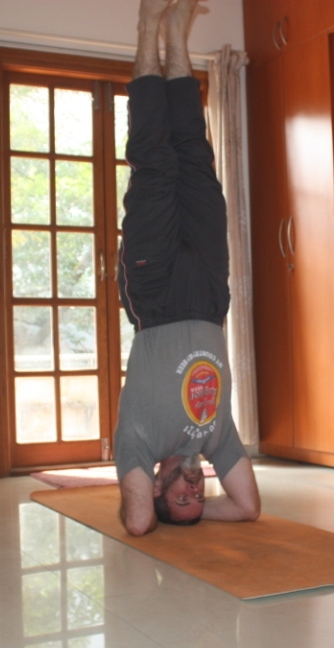
3.) Inversions: Inversions are meant to be calming because when the blood pressure to the head increases, it triggers reactions in the body to reduce it. However, it may take some time before that promised is reached. I’ve done a more extensive post on inversions that can be read here.

shirshasana (headstand)

shirshasana (headstand)


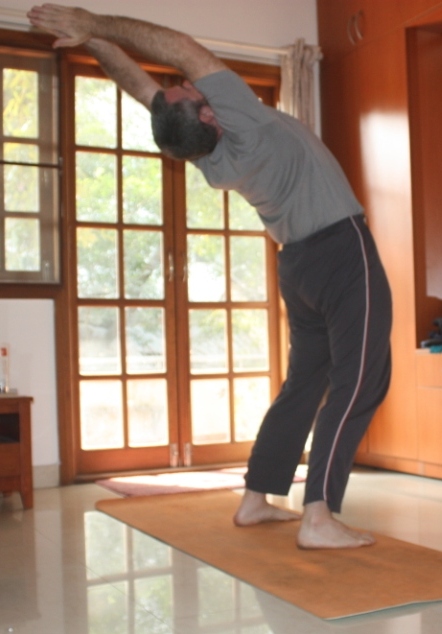
4.) Standing Back-bends: (Ardha Chakrasana / Urdhva Triangmuktasana / full Urdhva Dhanurasana) Simple back-bending can create the feeling that one is about to fall back onto one’s head. One may want to begin with a simple back-bend as one might do in Surya Namaskara before advancing to the complete Urdhva Dhanurasana in which one moves into a wheel pose (Chakrasana) from a standing position. (Urdhva Triangmuktasana is an intermediary in which one’s knees are more deeply bent, and one reaches back towards one’s Achilles tendon.)

ardha chakrasana

ardha chakrasana


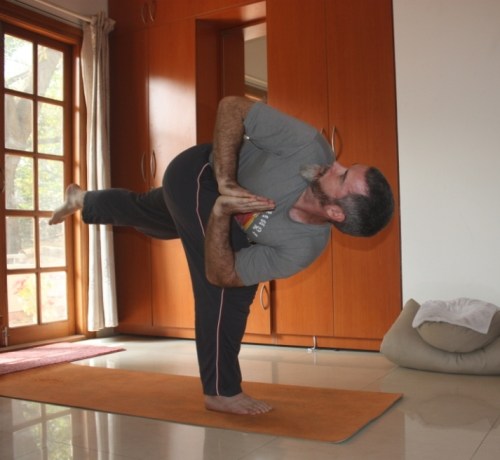
5.) Standing Balances: Depending on one’s level, anything from tree pose (vrksasana) to bound twisted half-moon pose (baddha parivrtta ardha chandrasana) may be applicable. I’ve shown the unbound version of the latter (parivrtta ardha chandrasana.) Twisting and balancing at the same time provides a great challenge, if one is already confident with balances generally.

parivrtta ardha chandrasana

parivrtta ardha chandrasana


Happy practice.

BOOK REVIEW: Yoga Body by Mark Singleton

Yoga Body: The Origins of Modern Posture PracticeYoga Body: The Origins of Modern Posture Practice by Mark Singleton

My rating: 3 of 5 stars

Amazon page

I was excited to stumble across this book because it proposed fresh insights into the history and development of posture-centric yoga. Singleton’s premise is that yoga as it’s practiced in studios around the world today (i.e. practices focused heavily on asana, or postures) has almost nothing to do with historic yogic traditions and is to a large extent European (or Western) fitness practices fed back to the world with a patina of Indian-ness instilled by a few Indian fitness teachers (e.g. T. Krishnamacharya and students.) This is a bold and stunning hypothesis. The problem is that Singleton leaves plenty of room to doubt his thesis. I’m not saying that I’m certain Singleton is wrong, but after reading the book I’m no more inclined to believe his hypothesis than when I first read the book blurb.

The book consists of nine chapters:
1.) A Brief Overview of Yoga in the Indian Tradition
2.) Fakirs, Yogins, Europeans
3.) Popular Portrayals of the Yogin
4.) India and the International Physical Culture Movement
5.) Modern Indian Physical Culture: Degeneracy and Experimentation
6.) Yoga as Physical Culture I: Strength and Vigor
7.) Yoga as Physical Culture II: Harmonial Gymnastics and Esoteric Dance
8.) The Medium and the Message: Visual Reproduction and the Asana Revival
9.) T. Krishnamacharya and the Mysore Asana Revival

One can see the flow of the book in this chapter listing. It begins by describing the ancient yogic traditions (e.g. Jnana yoga, Bhakti yoga, and Karma yoga.) Singleton then goes on to put immense weight on very few voices that were speaking globally about yoga in the late 19th century—largely European but notably including Swami Vivekananda. (This, by the way, is where I noticed the most glaring weaknesses of the book. There seems to be an assumption that what the most vocal people were saying during this time was the truth, the whole truth, and nothing but the truth.) One will note that the late 19th century is an arbitrary point to make the critical juncture for a study of yoga—this era’s sole importance seems to be in that that’s when Europeans started entering the scene (and documenting it in English and Western languages to a large extent.) I understand that there may have been a dearth of information previously; however, I’m also skeptical of equating the sum of truth with the sum of what is documented.

The book then shifts into the early 20th century when Singleton proposes the proto-postural yoga is beginning to coalesce with both Western and indigenous Indian influences. Singleton writes extensively about this period, and presents what he believes is the path by which postural practice evolved over a short time into modern yoga as we know it. The book ends in the mid-20th century with an extensive discussion of T. Krishnamacharya and his pack of brilliant students (i.e. B.K.S. Iyengar, Pattabhi Jois, T.V.K. Desikachar, and Indira Devi) who are responsible for a lot of how yoga is practiced today (for virtually all of modern yoga by Singleton’s reckoning.)

It should be noted that this book is put out by an academic press, Oxford University Press, and there’s all the front and post matter that one would expect of a scholarly press publication. This includes an introduction, notes, and a bibliography.

So, you might be wondering how I could have so much doubt about the veracity of the book’s central claim—a book written by a Cambridge educated scholar and published by Oxford University Press. It’s, after all, chocked full of facts that are designed to bolster Singleton’s argument. I’m certainly not suggesting that Singleton lied or presented false facts (however, I have–and will further–argue that he frames facts throughout the book to diminish those statements and facts that run counter to his argument while wholeheartedly accepting statements that validate his argument—even when the people whose statements he leaves unchallenged would seem to have their own agendas. I don’t know, perhaps T. Krishnamacharya was—as Singleton intimates though never explicitly accuses—lying when he claimed to have received his sequence and approach from a scripture he was taught by a Himalayan master. However, interestingly, he would be lying to minimize his role in the development of yoga rather than to increase his fame. This stands in contrast with the European authors who Singleton readily accepts who were seeking to build their bona fides as experts in the esoteric systems of India and the Himalaya, who arguably had a lot to gain from being seen as having a full understanding of these systems.)

The best way to understand the root of my skepticism is to tell a make-believe story. Imagine a race of aliens came down to Earth. For whatever reason, they want to understand (presumably among many other things) the Roman Catholic Church. One astute alien scholar notes that, after having reviewed not only the entire Bible but a vast canon of theologian discourse, there is scant mention of sitting or kneeling. However, when cameras came around, there came to be clear evidence of pews and kneelers in the church. The aliens conclude that Catholics had always stood during worship, but with the advent of the camera they began to sit and kneel. The aliens, having big and bulbous butts, conclude that the Catholics have become concerned that their own big, bulbous butts will be captured for posterity (pun intended) by the cameras and have, thus, opted to adopt postures that would more adequately provide cover. In the present day, sitting and kneeling are the bulk of what Catholics do with their bodies when [overtly] practicing their religion, and so it must be those postures–rather than abstract notions like achieving “grace” are now the most critical part of the practice. (Besides, the earliest photos of kneelers came from Protestant churches, so perhaps Anglicans taught Catholics how to kneel.)

If you haven’t figured it out, in my little scenario, the late 19th century Europeans who were writing the English language tracts that formed the heart of Singleton’s research material are the aliens with big, bulbous butts. I would propose that the Europeans aren’t viewing yoga completely objectively but through the lens of their own experience and desires. Furthermore, they are also only giving weight to what they see and hear (which may or may not be a full picture.) I would further argue that just like Catholics don’t devote much text to discussing sitting and kneeling in the documents of the Vatican library doesn’t mean there isn’t a long history of those practices. Postural practice is:

a.) not the critical end result that everyone is concerned with even if it takes up the bulk of one’s time in [overt] practice. It’s certainly true that there are a vast number of yoga practitioners whose only interest is in the fitness aspect of the practice. However, there are also many who spend most of their yoga reading time learning from Vedas and reading yogic philosophy even though the bulk of their practice time is asana.
b.) extremely difficult to convey via text but readily conveyed through demonstration and hands-on teaching. If you were a Catholic and wanted to teach someone kneeling, would you write them a three paragraph text description of the process, or would you just demonstrate how to kneel and correct any glaring (albeit unlikely) deficiencies in form.

At no point does Singleton get into the postural details of individual asana. He mentions another scholar that supposedly has done some of that work, but Singleton feels it’s not critical. However, it’s very hard to prove what he’s trying to prove without getting into that level of detail. Yes, there will be similarities between various systems of stretching because of the nature of the body. For example, European stretching systems had a forward bend that looks reminiscent of paschimottanasana (the body folds that way and stretching the hamstrings is one of the most important functions in any stretching regimen), and it shouldn’t be surprising or revealing if the first photograph of this posture was in a European gym (the fact that Scandinavians had cameras before Himalayan yogis isn’t a sound basis to conclude that Himalayan yogi’s learned to bend forward from Scandinavians.) A there are a lot of postures that two systems might reasonably independently discover, but one also can’t rule out that the Indian yogi taught the Europeans and not the other way around. (I know it’s hard to comprehend in the era of FaceBook, but failure to be documented does not equal failure to be true. The farther one goes into the past, the less of what happened is going to be documented, and some cultures are going to be more likely to document events than others. e.g. Would our aliens be right or wrong if they concluded that 85% of humans are females between the age of 12 and 24 years old because 85% of the selfies posted on the internet are among that group. )

Singleton’s book does have some graphics. They didn’t always help his case, however. I was struck by how few of the fine details of the European postures correspond to practice as we know them, while some of the very old paintings look almost exactly like present day asana. (If one accepts that the fact that they didn’t have the greatest grasp of capturing perspective back then isn’t indicative of how flat the postures and people were back then.) I’ll readily admit that I wouldn’t definitively count Singleton wrong on my subjective observation of the pictures, but it does leave me with a lot of room for doubt.

I suppose the next question is why I didn’t completely pan the book. Three stars isn’t a tragic rating. I thought the book contained a lot of good information and food for thought (even if it fell far short of proving its central hypothesis.) I particularly enjoyed the chapter on T. Krishnamacharya and his now-famous student body. I’ll also say that part of why I came away from the book with such a muddled perception of this history is that Singleton doesn’t hide facts that are damning to his case, but rather presents them and then tries to marginalize them. A prime example would be the Hatha Yoga Pridipika (HYP), a 15th century text that mentions a number of the asana considered classic yoga postures today (some of which form the core of a Hata practice)—though admittedly HYP emphasizes the importance of only four seated postures.

I can’t say that Singleton didn’t help give me pause to wonder about the truth of the received understanding of yoga’s evolution. I’ve practiced yoga in places as varied as India, the U.S., Thailand, and Hungary, and I found it shocking how similar the practice is around the world. This bodes well for the argument that yoga as it’s practiced today has coalesced recently. By way of contrast, there are many myths about how one martial art is the ancestor of another but the two systems often look nothing alike. (e.g. I’ve studied Kalaripayattu, which many believe was the ancestor art taken to China by Bodhidharma through Southeast Asia, but which today looks nothing like Kung fu or Muay Thai. Furthermore, Kung fu styles usually look quite unlike the Korean and Japanese martial arts that they are said to have inspired.) If the latter among these martial arts did come from the earlier, they evolved apart quickly. While the evolution into different martial art forms is quite possible, it raises the question of why yoga should be so similar internationally. A skilled yoga teacher would likely give a given student the same alignment adjustments for, say, Warrior I, regardless of whether the teacher was in Prague, Manila, Tokyo, or San Diego.

I can’t say that I’d endorse Singleton’s argument. It would take much more precise information for me to buy it (and it’s likely that said detailed historical information doesn’t exist.) However, if you’re interested in the history of yoga, you might want to check out this book. Your conclusions may differ from mine, but even if they don’t I suspect you’ll learn a thing or two of interest. Yoga Body was reasonably priced as a Kindle book when I bought it.

View all my reviews