
Taken in October of 2014 at Daulatabad, Maharashtra



sitting in the stillness
contemplating sadness
kick it in the cojones
til you love your madness


Silence
Ears ring
Inventing a monotonous tone
to thwart
Silence
on inner eyelids
a dragon dance plays out
in purple & black
a flower scent
too faint for a human nose
swells to a garland market
and becomes
the taste
of
rosewater on the tongue
as the mind wonders,
was it a real
flower
or a
phantosmia?

Taken at Amboseli National Park in May of 2017

bitter stories writ in circuit fire
rifling down the pipes
can you imagine:
“You’re the worst!”
as a tale slung on electron backs
couriers spew into tiny chasms
floating forward to light the next fire
nothing chiseled in granite
but each time electrons dance that line
it makes fast the path
change the dance
change your story
Werner Heisenberg famously said, “Not only is the Universe stranger than we think, it is stranger than we can think.”
5.) Ancestor Simulation: The idea that we could be in a simulation isn’t only a staple of science fiction–e.g. The Matrix. It’s been given serious thought by thinkers who aren’t exactly on the lunatic fringe–most famously inventor /entrepreneur Elon Musk. The core of the argument goes like this. 1.) We are getting better and better at making simulations ourselves. 2.) At some point we will achieve a simulation indistinguishable from reality. 3.) If 2 is true, then it’s vastly more likely that we are already simulations because if it can be done, it probably already has been done many times over. (Thus, we’re more likely to be in one of the simulations than so-called “base reality.”)
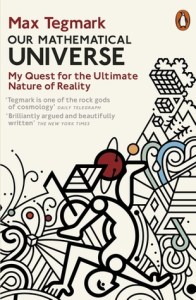
4.) Mathematical Universe Hypothesis: Max Tegmark proposes that the universe may be–at its core–a mathematical structure, making us self-aware substructures. This may sound like a different way of stating the preceding hypothesis, but not necessarily. The simulation hypothesis suggests certain motivations of a simulation creator. MUH doesn’t require a creator or an objective. It could be the nature of reality at it’s most basic.
3.) A Holographic Universe: This idea sprang from thinking about what happens to the information when something falls into a black hole. The idea being that the information is trapped on the outside of the event horizon–i.e. information for a three dimensional entity stored in two dimensions. As physicists pondered this, some concluded that it might be that we are a projection of data, or–alternatively–much of what we see when we look out into space is.
2.) One of Myriad Universes: The idea that our universe is one of many (or an infinite number of) universes comes in several flavors and is a prediction of several theories widely given credence. In some versions, all the universes have different sets of laws and constants such that many flash in and out of existence and only a small proportion are capable of hosting life (but the math of infinity is weird and a small proportion of the infinite may also be infinite. I don’t know, I’m not a mathematician and the infinite never mattered in economics because ground zero is that everything is limited but desires.) This answers the Goldilocks zone issue nicely–i.e. we couldn’t exist if the equations and constants that govern our universe were very much different, but if there are many universes with many sets of laws then we just happen to be in one of the ones we can be in–hence, credulity remains unstrained. Other versions propose universes with the same laws such that there could be an infinite number of you living out lives that may be slightly different than yours (or–for that matter–in which you might be the Supreme Galactic Overlord.)
1.) Time is slowing: A couple Spanish physicists have suggested that the universe might not be expanding at an accelerating rate (as is the consensus view in physics,) but rather time may be slowing. This slowing would be anticipated to continue until one final moment is captured frozen in time–note: said point would be long after the Sun swallows the Earth.

Taken in October of 2015 in Khajuraho
 TED Talks Storytelling: 23 Storytelling Techniques from the Best TED Talks by Akash Karia
My rating: 4 of 5 stars
This is a brief guide to storytelling and story building, particularly as it pertains to public speaking. Its emphasis on TED Talks is just to capitalize on the popularity of that forum as well as to draw widely known examples. There are no novel insights offered in this book. It’s the same information one could find from many other sources. However, it’s concise, well-organized, and uses examples pulled from popular TED Talks, and so readers may get some synergies from familiarity with a given speaker’s delivery.
The book is organized into nine chapters. The first introduces the topic by explaining why stories are so much more effective than other approaches to public speaking. The second chapter is about hooks and conflict. The third chapter is about the twist or element that makes the story interesting—as opposed to a straightforward accounting of events. Chapters four through six are all related in that they deal with providing the sensory and other details necessary to make the story come alive for the audience member. Chapter seven is about the effectiveness of stories with a positive message. Chapter eight steps back and examines the overall flow of the story with key way-points of consideration. Chapter 9 is a summation of key points. It’s mostly a list of the 23 bullet points that were made throughout the book, each of which is also located at the end of its respective chapter.
I’d recommend this book for anyone preparing for a public speaking engagement. However, I should point out that the price seems to be higher at the moment than when I bought it. I wouldn’t recommend spending a lot on the book because the information is so widely available.
 Publish on Amazon Kindle with Kindle Direct Publishing by Kindle Direct Publishing
My rating: 4 of 5 stars
This is a short guide to self-publishing using Kindle Direct Publishing (KDP) that was put out by KDP. I’m not sure this particular e-book exists any more, though all the information in it will be on the KDP website. There are about a billion (exaggeration, maybe) Kindle books that have taken this information and made their own book, using similar names. I can’t comment on any of them. I’m sure some include helpful tips for increasing your sales and making your product more appealing, and some of those tips are likely much better than others.
This is a straight up guide to using KDP. It covers topics like how to set up an account, what formats are accepted (several) and which is best (HTML), royalty options (there are two, and the lesser royalty allows one greater freedom of pricing one’s book, i.e. if you want to sell it at cut-rate to get some sales volume or if you’re a narcissist who thinks their self-published masterwork is worth $200 USD per copy), and how / when payments are made (varies by EFT [electronic funds transfer] v paper check options.)
This guide provides all the information needed to get your book up on Amazon. However, if you want insight into other topics (how to market your book, covers, etc.) you’ll need to look elsewhere.
If you can find it, I’d recommend this handy guide. But it may be quicker to just go to the KDP website.


