BOOK REVIEW: Van Helsing vs. Dracula’s Daughter

Van Helsing vs. Dracula's DaughterVan Helsing vs. Dracula’s Daughter by Raven Gregory
My rating: 3 of 5 stars

Amazon.in Page

Out: July 13, 2021

This comic book imagines the daughter of the Van Helsing character (from Bram Stoker’s) pitted against the daughter of Dracula in what appears to be more-or-less the present day. It is action-packed, if juvenile and prone to rely on hackneyed dialogue and story points. To clarify, it’s a small team of scantily clad supermodel vampire hunters taking on a scantily clad supermodel Vampiress and her army of expendables. I liked it in the way that one likes movies that one picked on Netflix while mentally exhausted and uninterested in anything mentally or emotionally draining, but rather just some vapid entertainment.

It’s part of a serialized universe of stories, and so, while it can be understood as a standalone story, it is not optimally organized to be read in a standalone fashion. It sort of begins with some action that the [standalone] reader has no context for, and which will not be circled back to in the way a story opening in media res typically would. Put in another way, in the second half of the story, I had to consciously reflect back and try to piece together what the opening material had to do with the overall story being told. I suspect (but cannot confirm) that if one binge read the whole collection, it would probably make more sense.

Besides the ridiculously untactical (virtually painted on) outfits, there is some reverse villain monologuing – which is to say the hero interjects into the action to explain her plot to snatch victory from defeat. Granted that victory would be completely deus ex machina, i.e. out of the blue, otherwise, but that’s not really a redeeming point. [The most (I presume) unintentionally hilarious line involves Van Helsing telling Dracula’s Daughter that VH can’t blame the vampire progeny for missing VH’s super-stealth colleague as the reader sees a pictures of one of the aforementioned supermodels with her skirt slit up two inches above her pelvic crest operating a spade with one leg bare from toes to waist, standing as models do to accentuate the shapeliness of the calf. It’s the most conspicuous ninja operation one could possibly imagine.

As I say, I found this an okay story for a mindless read, but I wouldn’t have too high of hopes for it beyond that.


View all my reviews

Hawk Kyōka

I watch the hawk
as it sits, watching me
It turns away first,
knowing I can't reach it
nor see it as it sees me

DAILY PHOTO: Foo Dog Closeup [in Profile]

Taken in Hanoi in December of 2015

POEM: Fairy Tale Wisdom

We watch the naked emperor
like nothing is amiss,
and recoil upon sight of frogs
wise of what lies in a kiss.

We trust the familiar too much,
and the odd too little.
We love a beauty even when 
she's selfish or she's brittle.

There is a Jack for each giant,
and many clever cats,
and, sometimes, we cheat the man who
takes out all our rats.

The other foot will always fall,
even when blinded by hope.
Sometimes it pays to play dimwit,
but not be an outright dope.

Each tale tells us of ways to be
a better, kinder soul
in a world filled with all manner
of monster, fiend, and troll. 

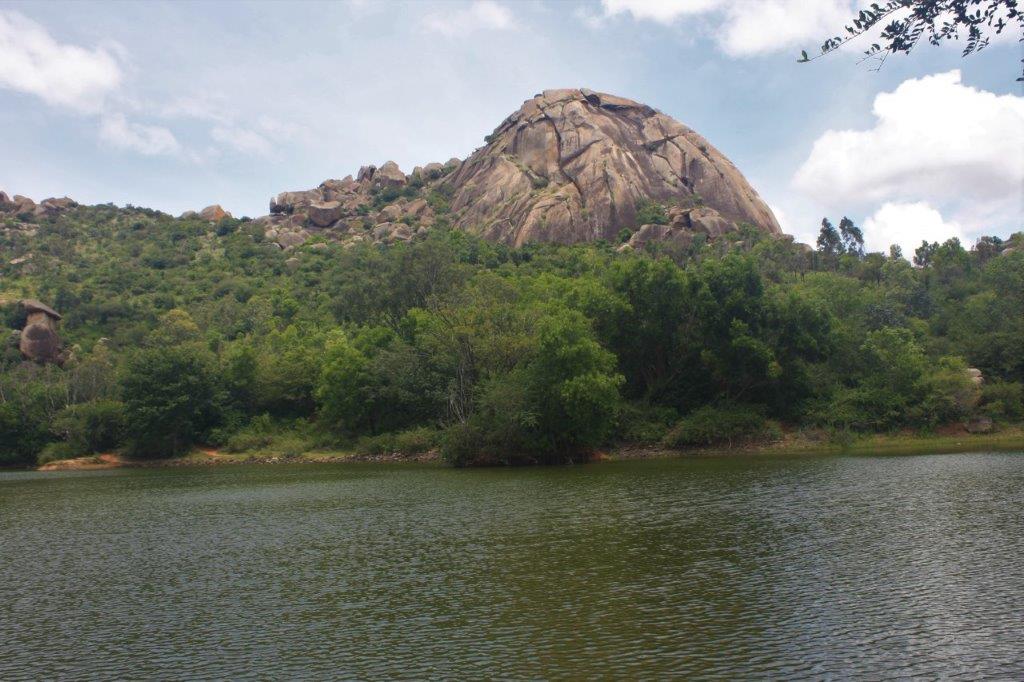
POEM: Below the Stone Dome

The stone dome
bubbled from the jungle
stands stern
like a knob of nothing.

The green growth
that girds that whole hump
is living, like 
some hallowed habitat --

filled full 
of all forms of flora,
with big bugs, and
 all the creepy creatures.   

DAILY PHOTO: Hanging Hibiscus

Taken in Coorg in May of 2017

POEM: Knee-Jerk Speciesism

Photo Source: Ken-ichi Ueda – 
https://www.inaturalist.org/photos/121 [via Wikipedia]
I glimpsed the red hourglass,
vibrating in a stone wall --
a Black Widow spider,
bouncing on a thin web
spun within the void
of an absent rock --
that gap forming the
 spider's recessed hide.

And instead of being happy
that the spider 
had found a fine shelter,
I worried that a child would
stick a careless mitt 
deep into that wall hole,
and be bitten on the hand.

In retrospect,
this seems so unfair 
to the spider.

BOOK REVIEW: Dreaming Eagles by Garth Ennis

Dreaming EaglesDreaming Eagles by Garth Ennis
My rating: 5 of 5 stars

Amazon.in Page

New Edition Out: June 1, 2021

This graphic novel by the author of “The Boys” and “Preacher,” tells a story based on the experiences of the Tuskegee Airmen, and does so as a story within a story. The framing story is set in 1960’s America and finds a World War II veteran (a pilot of the Tuskegee Airmen) trying to talk his teenaged son down from getting too entangled in the Civil Rights movement — for reasons that are only revealed as he completes the telling of his experiences at war. Through flashbacks, the protagonist depicts not only the thrilling exploits of air-to-air combat over Europe and the visceral tragedies that occur when hot lead meets with aluminum high above the world, but it also shows the unique tribulations experienced by these particular military men – such as “leaders” who wanted to see them fail and widespread discrimination.

The story-in-story approach is an excellent one because it allows for a character arc in which the protagonist grows. Without getting into spoiling details, as the protagonist revisits his story, he comes away with a new and changed perspective (which is always a valuable feature in storytelling.) The frame also breaks up the history and helps maintain reader attentiveness by showing the influence the story has on the attentive son. (Young men not being famous for being interested in the life stories of their parents.) I don’t mean to suggest that the war story is not interesting. It’s full of action, heroism, and the tension of interpersonal conflict. However, for those who aren’t history buffs and are acclimated to Ennis’s more popular fare [i.e. full of superheroes and random acts of violence and titillation,] the story may feel a bit flat only by virtue of the fact that it is constrained by actual historical events.

I found the art to be well-crafted. The chaos of air combat is conveyed without being so chaotic that one can’t tell what is happening, and the graphics offer a great sense of setting and era.

This volume is definitely worth giving a read. It tells a compelling story of the combative exploits and the political / social travails of these groundbreaking and heroic pilots, while holding a mirror to the rank societal biases of the era.


View all my reviews

DAILY PHOTO: Atlanta Skylines from Centennial Olympic Park

Coke Museum in the fore; GA Pacific and Westin in back
Taken in February of 2012 in Atlanta

BOOK REVIEW: We Live by Inaki & Roy Miranda

We LiveWe Live by Inaki Miranda
My rating: 4 of 5 stars

Amazon.in Page

Out: May 19, 2021

In a dystopian future on the verge of the Earth’s doomsday, aliens send humanity an opportunity to preserve itself on a limited scale. Bracelets (gauntlets, really) are dispersed around the planet, and any child [no adults allowed] wearing one who can get to the closest beacon site can be rescued.

Hototo is an orphan boy (preschool to kindergarten-aged) who has one of the bracelets, and his sister, Tala (early elementary school-aged,) is to be his escort to the beacon. [Hototo thinks they will both remain together, but Tala knows that she will drop him off and will stick around on the planet to witness the end of the world.] The story told in this volume is essentially their perilous journey from home to the beacon site.

What I liked most about his story is that it creates the visceral scenario of these two vulnerable kids traveling together through a landscape laden with all manner of threats, and – as in any story worth its salt – one thing after the other goes wrong for them. I also found the art appealing. It creates an intriguing story world. (Though the fantastical story world did rely heavily a popular, if overused, idea in sci-fi of late that some combination of toxins, radiation, and high-speed evolution spurred by rapid environmental change will create super-powered, super-intelligent predatory species. And in this case, they are in explicably conspicuous species – making them more visually interesting, but less sensible.)

The biggest problem with the story is that our two protagonists, while generating a lot of angst in the reader about their well-being, have no agency. Tala and Hototo show braveness, particularly Tala, but they must be rescued every single time. That’s realistic, because Kindergartners who could deal with the threats that they do would either have to be superpowered or put into question how serious the threats really are. [Either of which would damage the tension of the story.] There is a secondary character, Humbo, who is (or seems) slightly older than Tala, who is much more interesting than the sister/brother protagonists. In fact, Humbo is one of the primary rescuers of the two children throughout the story. The only other problem I had with the story is that the pacing at the end is so rapid that it makes it hard to track whether the story is making sense – i.e. being internally consistent.

As for recommendations, I think some will love this story and others will loath it, because it is an experimental piece. Hopefully, I’ve provided sufficient information for the reader to make their own decision. I did enjoy reading it, and found the interesting story world and events of the story to counterbalance the fact that the protagonists were leaves on the wind. (Though I probably would have preferred a story that centered on Humbo.)

View all my reviews