
BOOK REVIEW: Detective Story by Imre Kertész

Detective StoryDetective Story by Imre Kertész

My rating: 5 of 5 stars

Amazon page

Hungarians have won their fair share of Nobel Prizes–more than most for a country of Hungary’s size. However, these awards are overwhelmingly in the hard sciences, and so you’ll be forgiven for not being familiar with the country’s sole Nobel Prize winner in Literature to date. If you’ve read Imre Kertész, you probably read Fateless (Sorstalanság.) Fateless (aka Fatelessness) is his semi-autobiographical novel about a boy in Auschwitz.

Detective Story is a short novel (some might call it a novella) whose protagonist is a rookie torturer for the secret police of an unnamed Latin American dictatorship. As the novel begins, we find that the protagonist, Antonio Martens, is on death row. The novel is written as his death row journal of how he came to be in this predicament. It tells how Martens came to have his despicable job, but mostly it describes the one case that was his undoing. That case involved the arrest of the son(Enrique Salinas)of a powerful, wealthy, and well-connected merchant, and the subsequent arrest of the merchant himself (Federigo Salinas.)

Being a Holocaust survivor, Kertész is intimately acquainted with the mixed bag that resides within all of us. It’s hard to imagine a more detestable person than one who would torture confessions out of people who are either political dissenters or who are altogether innocent. Kertész subverts our expectations by showing us a perfectly ordinary and likable chap who has a distaste for his work, but thinks that he is defending his country. As they say, Hitler was probably a likable enough fellow in his own mind. So we see Martens’ rationalizations that allow him to do what he does. We also see how he is trapped by the system. He wants to be reasonable, but, once inside, the system won’t let him be.

This theme of being trapped is not applied to the main character alone. The idea that underlies the entire story-line is that an authoritarian regime’s secret police has one shot to get it right, and that’s before the arrest is made. Once they made the arrest, the men involved (the protagonist’s boss and his boss’s boss)felt compelled to move in one direction, even once they realized that they were wrong and that each additional step was only digging their grave deeper. At one point Martens’ boss’s boss, the Colonel, asks what they should do, and the rookie interrogator unwisely suggests that they should let both the father and son go–even given their tortured appearance. However, a dictatorship is built on a fiction of infallibility, and to admit being mistaken is to become vulnerable.It’s like Machiavelli’s advice to the prince that while it would be nice to be both loved and feared, if one has to make a choice, it’s safer to be feared.

There is another character into which we gain insight, and that is Enrique Salinas. Most of this insight comes from excerpts of Enrique’s journal that Martens presents us. We see that Enrique is badly depressed and is questioning whether there is even a point to living. We find out from the interrogation of Federigo that Enrique’s “suspicious activities” are really just wild-goose chases designed to satiate Enrique’s need for adventure and purpose in a safe manner. We also find out that Enrique longs for the authorities to put him to death–suicide by authoritarian regime, if you will. So the idea that the secret police will be punishing the young heir by putting him to death is just another way in which expectations are turned on their head in this novel.

If you only read one book by Imre Kertész, perhaps it should be Fateless, but I’ll contend you have room for this short work as well.


View all my reviews

DAILY PHOTO: Indianapolis City Market

Looking down from the top of the stairs.

Looking down from the top of the stairs.

CLASSIC WORKS: Bushidō by Inazo Nitobe

Bushido: The Soul of JapanBushido: The Soul of Japan by Inazo Nitobe

My rating: 4 of 5 stars

Amazon page 

On the whole, people are ambivalent about feudal times. On the one hand, it was a horrible time to be alive for 99.5% of the population. Chances are that if you’d lived during that time you’d be toiling ceaselessly on the land with no hope of improving your lot in life. Everything was determined by heredity, with merit having little to do with anything. This added insult to injury because that person you’d have had to suck up to was as likely to be putz as not.

On the other hand, there is widespread nostalgia for those times because one can’t help but feel that they were the golden days of virtue. As Ralph Waldo Emerson said, we think that society is ever advancing, but, in reality, we advance like a wave–losing as much on the backside as we gain on the front.

Inazo Nitobe’s book gives us an accounting of the chivalric virtue practiced by the samurai, the warrior class of feudal Japan. Bushidō means the way of the warrior. Nitobe lived after Japan’s feudal era, in the late 19th and early 20th centuries. Nitobe was an educator, and the book has a feel of erudition. Interestingly, the author was a Quaker and received education in the West, and, therefore, is able to contrast the Japanese worldview with that of Westerners.

The book is built around discussion of the seven virtues of bushido: justice, courage, benevolence, politeness, sincerity, honor, and loyalty. Each of these virtues has a chapter devoted to it (Ch. 3 through 9.) But first the book introduces bushido as an ethical system, and then it explains the effect that Buddhism, Shintoism, and Confucianism played in the development of this system.

Later chapters outline the education and training of a samurai, the importance of stoicism, the institution of suicide (seppuku), the symbolism of the sword in Japanese society, the role of women, the role of bushido as an ethical system in the present-day (his present), and its proposed role in the future. It is interesting that the book begins by discussing those things that influenced the development of bushidō, and it ends with discussion of how bushidō influences the larger world.

Our views of virtue have changed, but at some level remain consistent. The seven virtues are all still considered virtuous, but we don’t regard them in the same way today. In some cases we are undoubtedly better off with today’s views, but that’s not always the case.

Consider the seventh precept, loyalty. We still value loyalty, but in today’s world the rule of loyalty has an ever-present Shakespearean addenda: “to thine own self be true.” In other words, we no longer believe in loyalty that is blind as was valued in the days of old.

Sincerity, by which Nitobe generally means honesty, is also seen in a different light today. As depicted in the Jim Carey movie, Liar Liar, there’s a widespread view that it’s better to fib and make someone feel better than it is to tell the truth and hurt that person’s feelings.

One of the most intriguing chapters is the one that deals with seppuku. This is a concept that has never been well-understood in the West, and it’s a major point of cultural disconnect. While the Japanese have tended to see suicide as a means to restore honor that was lost in failure, in the West we tend to see it as a more pathetic and cowardly affair. I’ve recently been reading Ian Fleming’s You Only Live Twice, and this is one of many points of diverging attitudes between “Tiger” Tanaka and James Bond.

Bushidō is definitely worth a read. It’s thought-provoking, and is one of those books to be read slowly and conscientiously.

View all my reviews

DAILY PHOTO: Cabins at Seurasaari Island

Rustic cabins in the woods

Rustic cabins in the woods

BOOK REVIEW: Einstein’s Dreams by Alan Lightman

Einstein's DreamsEinstein’s Dreams by Alan Lightman

My rating: 4 of 5 stars

Amazon page

One might think that a novel written by a physicist would make for dreadful reading–and most of the time one would probably be correct. However, Lightman’s Einstein’s Dreams is a fascinating read. The arc of the book–what makes it a novel rather than a series of short scenes–is conveyed by a prologue, a few interludes, and an epilogue. These brief sections show an Albert Einstein as he went about life trying to work out his special theory of relativity.

In between the interludes are a series of written sketches that depict dreams that might have been had by Albert Einstein between April 14th and June 28th of 1905. Each of these dreams depicts an alternative universe in which time is not experienced as we experience it: that is, as an inexorably flowing river with a clearly defined arrow. In one dream, time is circular. In another, a lifetime is compressed into a day. In another, there is no flow of time; the world is a snapshot. In another, immortality is the norm. In the latter dreams of the book, we see a convergence on time as we know it–though in dream-like abstraction.

This short book is both creative and well-written. Lightman excels at creating scene through vivid description. His approach to structure is unique.

One thing that might have improved the book is if the author had been a little bolder. Lightman feels the need to explicitly state what is going on in each dream world. However, his description is strong enough that such discussion is generally anti-climactic–one already knows how time is working (or not working) in a given universe before the author states it explicitly. Thus, these explicit descriptions succeed only in taking one out of the dream.

View all my reviews

DAILY PHOTO: Buddha in Phnom Penh

Taken on the grounds of the Royal Palace in October 2012

Taken on the grounds of the Royal Palace in October 2012

CLASSIC WORKS: Slaughterhouse-Five by Kurt Vonnegut

Slaughterhouse-FiveSlaughterhouse-Five by Kurt Vonnegut

My rating: 4 of 5 stars

Amazon page

If you’re like me, you had to read this in high school. I reread it as an adult because the first time its awesomeness was tarnished by the fact that it was mandatory. Being a pessimistic youth, my thought was, “How good could it be if they are making me read it?” They don’t make you read Batman; they make you read Moby Dick. I’m glad I reread it as an adult. Little did I realize, my knee-jerk rejection of the book as something forced upon me, beyond my control, was mirrored by the theme of the book.

Slaughterhouse-Five tells the story of Billy Pilgrim, an optometrist who survived the Dresden fire-bombings was abducted by an alien race and became “unstuck in time.” If you didn’t get this impression, the book is strange. As the term “unstuck in time” suggests, there isn’t a chronological sequencing of events. Instead, the story leaps around from Pilgrim’s adult life as an optometrist to his time as a young soldier in the military to his time as an exhibit in a Tralfamadorian Zoo.

While the novel covers a lot of life, many of the important themes are seen in protagonist’s war experience. It should be noted that there is an autobiographical component to this book. Vonnegut was a prisoner of war who was ordered to help dig for survivors in the wake of the fire-bombing of Dresden. This gave Vonnegut a unique perspective of war and how similarly it is experienced by the enemy. An important line of tension in the book is between Pilgrim’s character and that of the jingoistic Roland Weary.

The Tralfamadorian subplot has a lot to do with being out of control, and learning that perceptions of control are illusory. This is exemplified by the time jumps, which leave Pilgrim completely unable to predict what will happen next. Then there is Pilgrim’s experience being exhibited in an alien zoo, what  could be less in control than that.

Like most of Vonnegut’s work, Slaughterhouse-Five is a dark comedy. There is humor throughout, but humor wrapped in the macabre. For example, whenever anyone dies there is a chorus of “So it goes.”

Everyone should read this, and reread it if necessary.

View all my reviews

DAILY PHOTO: Jekyll Island Live Oak

The underside of a Live Oak.

The underside of a Live Oak.

There’s nothing that creepifies a place more than live oaks and Spanish moss. Live oak is a tree species whose limbs stretch out impossibly far, like serpents or gnarled grasping fingers. Spanish moss is the shaggy vegetation that drapes down from the limbs. It isn’t actually a moss. The two grow together throughout much of the coastal Southeast.

DAILY PHOTO: Jack Daniel’s Distillery Original World Headquarters

Taken Summer 2012 Jack  Daniel's Distillery Tour

Taken Summer 2012 Jack Daniel’s Distillery Tour

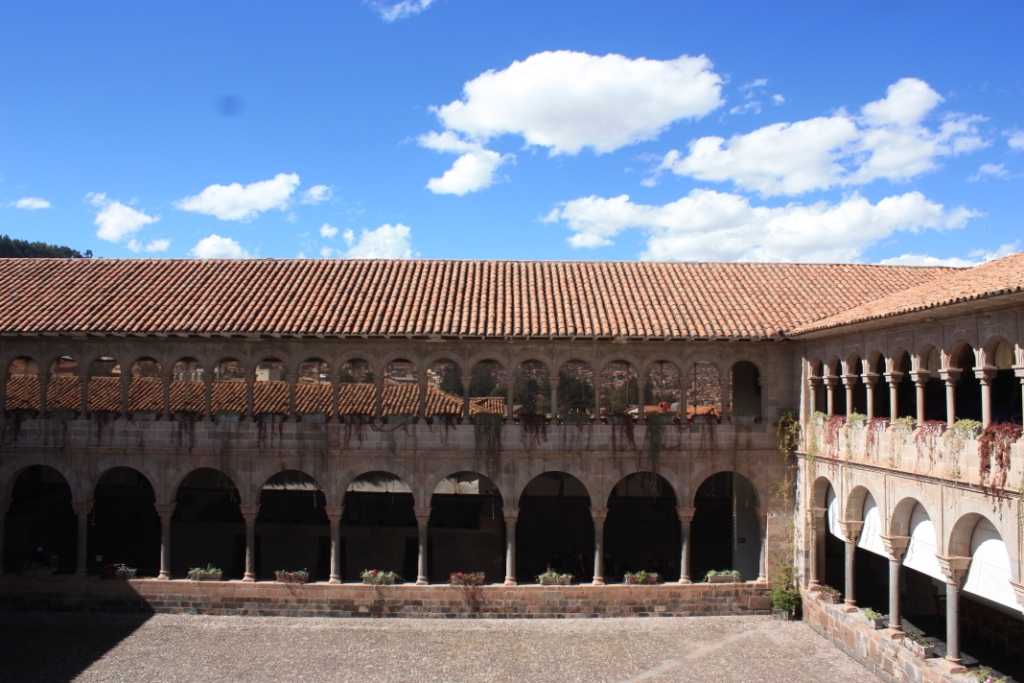
DAILY PHOTO: Qorikancha, Cuzco, Peru

Convento De Santo Domingo / Qorikancha; Taken 2010

Convento De Santo Domingo / Qorikancha; Taken 2010

A Roman Catholic Convent, Convento De Santo Domingo, was built over an important Incan site, Qorikancha (alt. sp. Coricancha.)