
Taken in January of 2014 in Phuket Town.
There will be no Daily Photo tomorrow as I am going out-of-town to learn Toksen–a variant of Thai Yoga Bodywork that involves the use of a wooden mallet and wedge (chisel.)
Taken in January of 2014 in Phuket Town.
There will be no Daily Photo tomorrow as I am going out-of-town to learn Toksen–a variant of Thai Yoga Bodywork that involves the use of a wooden mallet and wedge (chisel.)

Taken in February 2014 in Bangalore.

Taken in October of 2012 in Ayutthaya, Thailand

Taken in March of 2014 in Coorg.
 Dirk Gently’s Holistic Detective Agency by Douglas Adams
My rating: 3 of 5 stars
Dirk Gently’s Holistic Detective Agency [DGHDA] is the opening book in Douglas Adams’ second series of novels (what would have been a trilogy—at least–had Adams not passed away.) DGHDA was followed by The Long Dark Tea-Time of the Soul, and that would have been followed by The Salmon of Doubt—though the manuscript was released in its incomplete form along with other random works in a collection by the same name—as publishers are want to make their cash cows rage after the dying of the light.
Adams is most famous for the Hitchhiker’s Guide to the Galaxy [H2G2] series. DGHDA shares the British absurdist humor of H2G2, but is a more genre-bending a work. While H2G2 crosses humor and sci-fi, DGHDA takes those two genres and throws detective and supernatural fiction into the works. The book was billed by the author as a “detective-ghost-horror-who dunnit-time travel-romantic-musical-comedy-epic.” Of these, “horror” is dubious given the fundamental silliness, “epic” is a little grandiose for a work of 300 pages, and the “romantic” and “musical” parts are rather thin.
The title refers to a detective agency owned by Dirk Gently, who believes in the fundamental interconnectedness of all things and is a bit of a con man. Gently is the lead character in a comedic sense, but his straight man–Richard MacDuff–has at least equal claim to being the book’s overall lead. (Just as straight man Arthur Dent leads in the H2G2 books.) Gently gets involve when he discovers Richard engaged in the inexplicable activity of breaking into the window of his (Richard’s) girlfriend’s apartment—a girlfriend with which he has a favorable relationship. This convinces Gently that Richard has either been hypnotized or possessed, either of which makes him a prime customer of Gently’s agency.
The mystery part of the novel revolves around the new owner and editor of a magazine—Gordon Way–who dies, and whose ghost continues to be active in story (even having PoV chapters in this shifting PoV novel.) Richard comes to believe he’s a suspect, although the bungling former editor of the magazine—Michael Wenton-Weakes–is the lead suspect. Of course, the fact that the deceased is the father of Richard’s girlfriend, Susan Way, does encourage the notion that Richard could be involved. Of course, it wouldn’t be much of a who-dun-it if it was a straightforward case of one of these men with motives having done it.
As would be expected of a book by Douglas Adams, it has its moments of hilarity, but it wasn’t as funny as the best of the H2G2 books. The best absurdist device introduced into the book is the Electronic Monk. In an era in which no one has time for believing in things, one can purchase or rent a robot to believe things for one—particularly those outlandish notions that are unsupported by evidence and thus are least worthy of the effort of belief.
The main characters are all sufficiently quirky to be memorable, likable, or both. The characters are one of the strengths of this book. The story is a bit disheveled, probably purposefully so, but it doesn’t make for the easiest work to follow–particularly early in the story when one hasn’t yet got a firm grasp of who’s who and who’s doing what. That said, it’s a decent enough plot, all things considered.
I’d recommend this for those who like humorous speculative fiction.

Taken in March of 2014 in Madikeri.
My rating: 5 of 5 stars
This is anachronism done right by Neil Gaiman. The title gives one the jist of this graphic novel’s theme. It’s the Marvel Universe circa 1602. There’s a big cast of Marvel characters in this collection of eight comics. However, those who don’t follow comics might not recognize some of the characters because they are decidedly less comic-esque in this take. The characters mostly go by their given names rather than their superhero nom de guerre and not one of them wears spandex—and even capes are fairly few and far between. While the cast is large, there’re just a few main players and some major Marvel superheroes play only minor or unheroic roles.
The principal heroes in this book are Nicholas Fury (as head of the Queen’s Intelligence Service), Carlos Xavier (principal of a school for mutants), Virginia Dare (the first girl born in the Roanoke Colony), Rojhaz (the–decidedly Caucasian but–Native American protector of Dare), Stephen Strange (close to his modern-day namesake), Matthew Murdoch (think Daredevil), and a smattering of other X-men, Avengers, and Fantastic 4 members.
The principal villains are King James I (as himself), Count Otto Von Doom (similar to the modern character), The Inquisitor Enrique (a Magneto-esque character), David Banner (advisor to James I and–it would appear–the gray Hulk), and Natasha (think Black Widow). Before one bemoans the fact that the slate of heroes seems much stronger than the slate of villains, it should be noted that there is a threat that far exceeds the likes of Von Doom.
The world of Marvel 1602 is quite similar to Earth 1602, but there are differences such as the existence of pterodactyls and dinosaurs in some locales. The plot includes political intrigue in the form King James I of Scotland’s desire to nudge an ailing–but beloved—Queen Elizabeth I out-of-the-way. We soon find out that three assassins have been dispatched to target Fury, the Queen, and Virginia Dare, but finding out who hired them and why takes up a fair piece of story line. There’s a substory that features Matthew Murdoch and Natasha on a mission to retrieve what can only be described as a McGuffin (a highly sought after artifact whose value and purpose remain completely unknown until a big reveal, but for which characters are none-the-less willing to lay their lives on the line on pure faith) that offers its own intrigue. There is also the matter of strange weather that increasingly comes to be considered a harbinger of doom (not Von Doom the character, but actual doom.) Ultimately, this is a bigger threat than is presented by any of the human villains, and it can only be overcome through a combination of Richard Reed’s brilliance, Nicholas Fury’s courage, and Rojhaz’s sacrifice of what matters most to him.
I enjoyed this graphic novel. First, having a top-rate writer like Gaiman was certainly a help. There was none of the juvenile / poorly written dialogue that usually plagues comic writing. Gaiman is his usual clever, witty self. Second, while the anachronisms often border on silly (e.g. 1602 Reed’s noodling out Einstein’s discovery of 300+ years later), they are intriguing and recognize real science. Third, the last being said, there’s a lot of effort put into making the comic appropriate for the era in which it’s set. It’s not just putting frilly shirts on modern-day characters. The blending of fact into the fiction is thought-provoking.
If you read graphic novels–even sparsely–this is one that you should definitely check out.
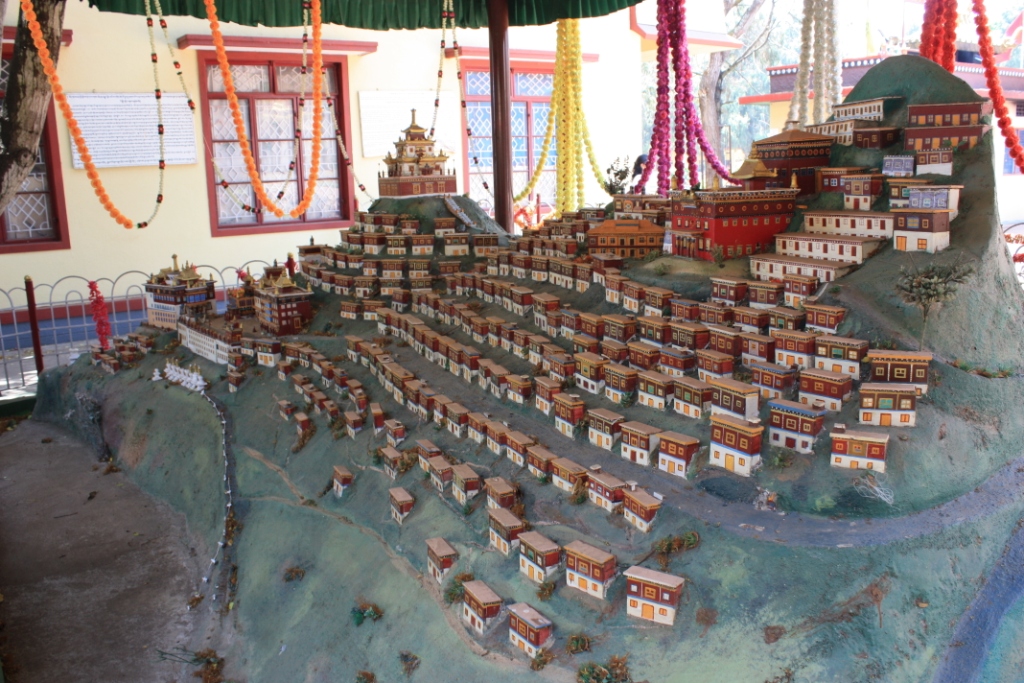
Taken in March of 2014 at the Namdroling Monastery
This model of the Palyul Monastery and its environs is located at Namdroling Monastery in Bylakuppe, India. Palyul is the parent monastery of Namdroling. It is one of the six major monasteries of the Nyingma branch of Tibetan Buddhism.

Taken April 27, 2014 in Cubbon Park.

Just as New Jersey’s state name has made it the butt of many a joke, Bangalore catches a lot of flack (both from residents and outsiders) for retaining the title of “Garden City” in the wake of the recent decade of unrestrained growth. (If anything tells one about present day Bangalore it’s that its size doubled in little more than a decade from almost five million to close to ten. Even under the best of governance that would result in a bit of chaos–re: and this is not the best of governance.)
That said, Bangalore has some awesome trees. (As I’ve mentioned, this results from the lack of proclivity to destroy everything that stands in one’s way or that presents the slightest bit of risk or inconvenience that is the modus operandi in the developed world.)

Taken in April of 2014 in Bangalore.
I took this photo at the Swiss Consulate in Bangalore the other night. The consulate was all lit up, and this tree looked preternaturally and suspiciously green. First, I thought that this might be the Bruce Banner of trees, but then I figured it’d bulk up more when it got all ragey. Then I realized it looked a little like a huge sprig of parsley–perhaps exactly what a sprig of gamma-injected parsley would look like if it were rage-filled.


