Swimmingly [Lyric Poem]

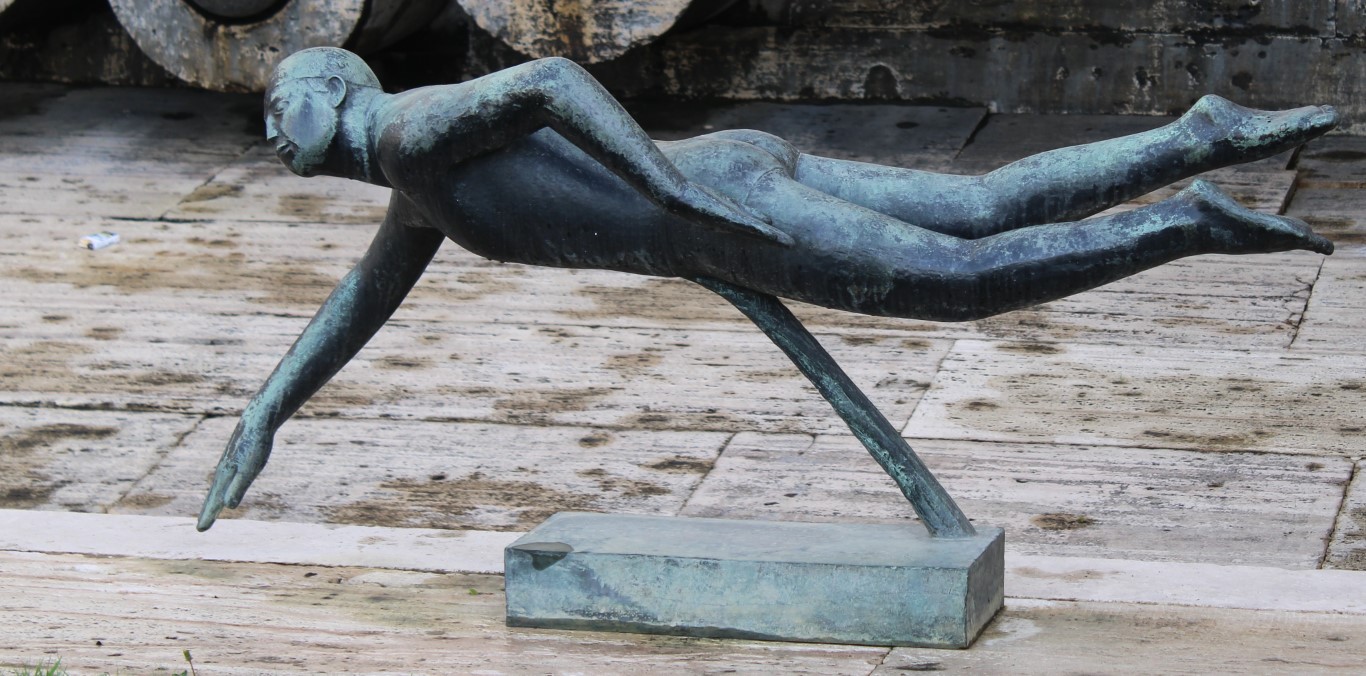
Moving at a glide --
No strain, no effort,
Rolling side to side,
No lord or escort.

Things are going SWIMMINGLY.

“Absolute” [Poetry Style #1] by Sikong Tu [w/ Audio]

With wear you will decay outside,
But inside resides the vital force.
Approach the Absolute through the Void:
One's strength will grow, and vim will course.
You can know the world and its Way,
Across space and time -- to the Source.
To desolation range hang dark clouds,
Air still as latitudes of the horse,
Move beyond all one knows by sight,
And gain the Center -- but not by force --
Hold onto this strength by hook or crook,
And flow the Endless by watercourse.

NOTE: The late Tang Dynasty poet, Sikong Tu (a.k.a. Ssŭ-k‘ung T‘u,) wrote an ars poetica entitled Twenty-Four Styles of Poetry. It presents twenty-four poems that are each in a different tone, reflecting varied concepts from Taoist philosophy and aesthetics. Above is a crude translation of the first of the twenty-four poems. This poem’s Chinese title is 雄浑, and its translated titles include: “Energy – Absolute” [Giles] and “Vigorous.”

“Fluid” [Poetry Style #24] by Sikong Tu [w/ Audio]

Like water spilling over rocks?
Like a bead's roll across the floor?
Cliches, they fail to tell the story,
As no doll shows life's splendor.
But the Earth' unsupported spin through space,
As the heaven's pivot and sprawl for more...
If you could find how it all began,
You'd see it'll be as it was before.
The high and bright realm of the gods
Returns to nothing and nevermore.
And if you lived ten-thousand years,
You might find yourself in days of yore.

NOTE: The late Tang Dynasty poet, Sikong Tu (a.k.a. Ssŭ-k‘ung T‘u,) wrote an ars poetica entitled Twenty-Four Styles of Poetry. It presents twenty-four poems that are each in a different tone, reflecting varied concepts from Taoist philosophy and aesthetics. Above is a translation of the twenty-fourth of the twenty-four poems. This poem has been alternately titled “The Flowing Style,” “Fluid,” “Motion,” etc. by varied translators from its Chinese title of 流动.

“Abstract” [Poetry Style #22] by Sikong Tu [w/ Audio]

Lonely and longing to travel;
All alone and lacking a tribe.
Like the crane up on the mountain,
Or the cloud that enshrouds its peak.
Like the portraits painted by past
Masters, of souls you couldn't have known.
Like a leaf drifting on swift winds,
Bounding through the boundless spaces.
You'll never be able to hold it,
But can hear the song it dances to,
Those who accept this can tune in,
And the signal will only get stronger.

NOTE: The late Tang Dynasty poet, Sikong Tu (a.k.a. Ssŭ-k‘ung T‘u,) wrote an ars poetica entitled Twenty-Four Styles of Poetry. It presents twenty-four poems that are each in a different tone, reflecting varied concepts from Taoist philosophy and aesthetics. Above is a translation of the twenty-second of the twenty-four poems. This poem has been alternately titled “Abstraction,” “Elegance,” and “Drifting Aloof” by varied translators, but its original title is 飘逸.

The Dao Keeps Rolling [Tanka]

one character, Dao,
looks like a road that rounds
some great attraction,
but keeps moving onward
to undiscovered country.

“Form” [Poetry Style #20] by Sikong Tu [w/ Audio]

Quit seeking to firm up the soul;
Return to the unadorned truth.
One can seek the shape of water;
One can write of a pleasant spring.
Winds shift the shapes of clouds,
Flowers stand tall, and flowers droop.
The great waves of a sprawling sea,
The mountain's craggy ruggedness...
They all emulate the Great Way.
Every wonderful thing is dust.
Find semblance beyond shape or form.
In this person, the multitudes.

NOTE: The late Tang Dynasty poet, Sikong Tu (a.k.a. Ssŭ-k‘ung T‘u,) wrote an ars poetica entitled Twenty-Four Styles of Poetry. It presents twenty-four poems that are each in a different tone, reflecting varied concepts from Taoist philosophy and aesthetics. Above is a translation of the twentieth of the twenty-four poems. Translated titles vary. This one has been titled “Descriptive” and “Form and Feature” by varied translators.

“Real” [Poetry Style #18] by Sikong Tu [w/ Audio]

Plain and simple words are chosen,
Even to express tangled thoughts.
Then one comes upon a hermit,
And one glimpses the heart of Dao.
The clear stream burbles its soft song
Amid the shady ancient pine grove.
A woodsman passes with his cordwood;
A stranger listens to a lute song.
A strong feeling takes one over,
Bringing with it bliss and wonder,
And one's easy link with heaven
Is tender as the sound of water.

NOTE: The late Tang Dynasty poet, Sikong Tu (a.k.a. Ssŭ-k‘ung T‘u,) wrote an ars poetica entitled Twenty-Four Styles of Poetry. It presents twenty-four poems that are each in a different tone, reflecting varied concepts from Taoist philosophy and aesthetics. Above is a translation of the eighteenth of the twenty-four poems. Translated titles vary — e.g. Herbert A. Giles titled this translation “Actualities.”

“Fascinated” [Poetry Style #16] by Sikong Tu [w/ Audio]

The scent: copper-carpeted pine forest;
A stream rushes through: swirling, burbling;
Blue sky and snowcaps peek through the treetops.
In the distance, fishermen are trawling.
A young lady with flowing hair and gown
Passes gracefully through the thick woodlands.
Eyes move when she moves and stop when she stops,
Following her transit down the valley.
The mind shows not its usual chaos,
But is effortlessly anchored to her.
As if to a huge rising moon.
As if to blazing autumn hues.

NOTE: The late Tang Dynasty poet, Sikong Tu (a.k.a. Ssŭ-k‘ung T‘u,) wrote an ars poetica entitled Twenty-Four Styles of Poetry. It presents twenty-four poems that are each in a different tone, reflecting varied concepts from Taoist philosophy and aesthetics. Above is a translation of the sixteenth of the twenty-four poems.

“Finely Woven” [Poetry Style #14] by Sikong Tu [w/ Audio]

The building blocks of everything --
Too fine to feel or see or smell --
Dance their way into hardened shapes
Via forces, invisible.
And so water flows, flowers bud,
But - also - dew evaporates.
This expansive path stretches on --
It's slow-going through dark lands.
It can't be spoken of smartly.
It can't be pondered fruitfully.
It's Early Spring green in sunlight,
Or like the snow seen by moonlight.

NOTE: The late Tang Dynasty poet, Sikong Tu (a.k.a. Ssŭ-k‘ung T‘u,) wrote an ars poetica entitled Twenty-Four Styles of Poetry. It presents twenty-four poems that are each in a different tone, reflecting varied concepts from Taoist philosophy and aesthetics. Above is a translation of the fourteenth of the twenty-four poems. Translated titles vary: Giles calls it “Close Woven” and others have titled it, “Fine.”

“Natural” [Poetry Style #10] by Sikong Tu [w/ Audio]

Stoop anywhere and pluck it up,
But if you look 'round - it's not there.
Any path may lead you to it.
A stroke of the brush becomes Spring,
And the flowers are in full bloom. --
It's like seeing a new year dawn:
Snatch at it and you won't have it.
Seize it by force and you'll be poorer.
Be like the old mountain hermit --
Like duckweed gathered by stream flow.
Find calm amidst storms of feeling
By knowing Heaven's harmonies.

NOTE: The late Tang Dynasty poet, Sikong Tu (a.k.a. Ssŭ-k‘ung T‘u,) wrote an ars poetica entitled Twenty-Four Styles of Poetry. It presents twenty-four poems that are each in a different tone, reflecting varied concepts from Taoist philosophy and aesthetics. Above is a translation of the tenth of the twenty-four poems.