BOOK REVIEW: The Finger by William S Burroughs

The FingerThe Finger by William S Burroughs
My rating: 4 of 5 stars

Amazon page


This is book #25 in Penguin’s “Modern” series. These short books (less than 100 pages) feature short works (poems, short stories, essays, speeches, and even a novella or two) from 20th century luminaries. In this case, the book consists of six short stories by the Beat Generation writer William S. Burroughs, who’s most famous for his novel “Naked Lunch” and for his affinity for heroin. I mention the latter not to besmirch Burroughs’ character, but because drug use (and the vices that sometimes travel hand-in-hand) is a fixture in Burroughs’ writing, and this collection is no exception.

Many, if not all, of these stories are in the same fictional universe, as suggested by repeated characters and locations — most notably the junky William Lee of “Naked Lunch” fame. [These stories were previously published in a collection entitled, “Interzone,” and the titular piece had an even earlier first publication in the book, “Early Routines.”] However, the stories are all stand-alone pieces and a couple of them show no evidence of being related. The one’s that do share common features don’t tell an overarching tale.

The six stories are:

1.) “The Finger”: An addict, Lee, cuts off his own finger (just the top joint) and is surprised by the reaction it incurs.

2.) “Driving Lesson”: An individual with no experience driving is asked to take the wheel, and given some bad advice to boot.

3.) “The Junky’s Christmas”: The spirit of Christmas overcomes an addict’s yearnings.

4.) “Lee and the Boys”: Lee and his various [non-sexual] interactions with young male prostitutes.

5.) “In the Café Central”: This isn’t so much a story as sketches of the various meetups simultaneously transpiring at a café. There is a table with: a.) a guide and a tourist, b.) a German expat and the annoying gossip who he uniquely tolerates, c.) a beautiful woman with bad teeth who is a wee bit sensitive about them.

6.) “Dream of the Penal Colony”: This hazy, little story is part a dream of being in a penal colony and part slurry of reality and the hallucinations of drug-addled drifter.

I enjoyed this little collection and would recommend it for someone who wants to sample Burroughs before diving into one of his novels. While the first story may have gotten the title role by virtue of its bizarre subject matter, I’d argue that “The Junky’s Christmas” is narratively the strongest. It’s not too hard to follow these pieces despite the fact that the stories virtually all feature unreliable narration by virtue of being told through the eyes of someone in the grips of substance abuse. Burroughs presents that mix of reality and drug-distorted world-view vividly and intelligibly. That said, if you’re expecting the world through sober eyes, you’re in the wrong place.

View all my reviews

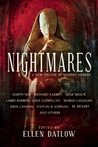
BOOK REVIEW: Nightmares ed. by Ellen Datlow

Nightmares: A New Decade of Modern HorrorNightmares: A New Decade of Modern Horror by Ellen Datlow
My rating: 5 of 5 stars

Amazon page


This is an anthology of 24 horror short stories. Horror is a simplification; there are several cross-genre pieces (e.g. dark sci-fi, dark historical fiction, tales of the weird, etc.) as well as stories that have a realistic—but dark—tone. However, it’s all fiction linked by a visceral darkness.

These stories have all been previously published in various magazines or collections, and they were all written during the decade between 2005 and 2015.

1.) “Shallaballah” by Mark Samuels: A celebrity awakens in a hospital after a drunken crash that necessitated reconstructive surgery. It slowly dawns on him that the clinic isn’t what it seemed. This is an intriguing and distinctive tale.

2.) “Sob in the Silence” by Gene Wolfe: A horror writer has the family of an old friend to his house. He tells them that it’s the “least haunted house in the Midwest,” despite a gruesome history that suggests a place where evil comes to play. This was among my favorites. The horror writer character is well-developed.

3.) “Our Turn Too Will One Day Come” by Brian Hodge: It’s never good when someone calls you in the middle of the night and asks you to bring a shovel. But sometimes it’s even worse than expected. I’ve read this one before. It’s a great premise and an engaging story. This anthology includes both stories that feel like they are realistically set in the world we know, as well as speculative fiction pieces. This feels like the former, but makes a shift.

4.) “Dead Sea Fruit” by Kaaron Warren: There’s a myth among anorexics of the Ash Mouth Man, whose kiss robs its victims of the ability to taste pleasant flavors. A dentist of a different ilk takes up with this mythical man. I’d place this one more as a tale of the weird than horror, but it’s on the dark side of that sub-genre. It’s well-written.

5.) “Closet Dreams” by Lisa Tuttle: An abduction and abuse victim tells her story of being locked in a closet, but no one believes the part about her fantastic escape. This is a gritty and evocative piece.

6.) “Spectral Evidence” by Gemma Files: This is an unconventional approach to story. The information content is conveyed by way of a file from a parapsychology institute after a coroner’s inquest of a psychic medium’s death proves inconclusive. I sometimes like this approach. Reading through a file fills a kind of voyeuristic pleasure, and offers the challenge of piecing together events oneself. This story was solid, but not my favorite of the bunch.

7.) “Hushabye” by Simon Bestwick: A man out walking in the middle of the night stumbles onto the scene of a young girl under attack. Strangely, there seems to be a metallic substance pouring between the girl’s mouth and that of her attacker. This is crime fiction with a supernatural twist.

8.) “Very Low-Flying Aircraft” by Nicholas Royle: A Royal Air Force air crew in Zanzibar shows off for some ladies with dire consequences. This one is in the realist vein. It feels like a story one might be told in a bar by a particularly gifted storytelling veteran.

9.) “The Goosle” by Margo Lanagan: This tale seems to take place in the Hansel and Gretel universe. An unsavory merchant of the illicit woos a witch, and, surprisingly, it doesn’t work out as he’d hoped. This is a compelling story in the dark fairy tale sub-genre.

10.) “The Clay Party” by Steve Duffy: This one has a 19th century vibe, not only because that’s when it’s set, but because it’s conveyed through documentation as was a popular approach of the era. In this case it’s a newspaper’s reprinting of the diary of an individual from an ill-fated cross-continental convoy. (i.e. “Clay Party” as in Donner Party.) The diary approach worked well, being both easy to follow and having an authentic feel.

11.) “Strappado” by Laird Barron: Two hip and cosmopolitan lovers attend the performance art event of an artist deemed trendy and edgy by the in-crowd. The performance doesn’t work out for everybody. This was evocative, and was, perhaps, a cautionary tale about being too up for trendy and edgy activities.

12.) “Lonegan’s Luck” by Stephen Graham Jones: A snake-oil salesman knows something that the locals don’t, and it’s not about the efficacy of his product. This is another of my favorites. It’s a Western with a supernatural twist.

13.) “Mr Pigsny” by Reggie Oliver: A Professor with some mobster relatives attends the funeral of one such gangster. The Professor is willed a Ming vase that he’d once admired, but ends up tangled up in the dealings between the deceased and a mysterious “spiritualist.” The spiritualist, Mr. Pigsny, is masterfully portrayed as both a quiet professional and spine-tinglingly creepy.

14.) “At Night, When the Demons Come” by Ray Cluley: A big, strong man and a little girl meet, and team up with, a party of four survivors in a demon-infested dystopian wasteland. Whether the odd pairing are truly allies, or, if not, what type of threat they present is not as was expected and made for a thought-provoking piece. I found this tale to be clever, and it revealed an unexpected theme.

15.) “Was She Wicked? Was She Good?” by M. Rickert: A little girl makes enemies by cruelly dispensing with little forest creatures–fairies, perhaps. Her parents debate what they should do to stave off the wrath of their neighbors of another species. The title says it all. This is one of those stories that tactically reveal information to keep the reader wondering.

16.) “The Shallows” by John Langan: It’s not so easy for me to describe this story. There’s a lot going on. It’s what I’d call busy. The part of the story that resonated with me was about a stray dog that a family adopts only to have its (apparently-negligent) owner come and retrieve it. This was among my least favorite entries, but it was solidly written.

17.) “Little Pig” by Anna Taborska: A newly-wed man waits at Heathrow airport for the grandmother of his Polish wife. That present-day event brackets a flashback from the grandmother’s youth that helps to explain what seems like inexplicable old-world behavior. This is one of the shortest pieces, but it’s an endearing tale–even with the dark events of the flashback.

18.) “Omphalos” by Livia Llewellyn: This is an intense story about a family of four who go on a vacation that’s a sham. The mom and dad pretend they are taking the kids to Canada in their RV only to detour into remote parts of the Pacific Northwest. The depravity quotient of this family is high. Much of the story is brutally realistic, but there is a supernatural element with regards maps, which appear to be marked up differently to each member of the family. The maps play an important role in the unfolding of the story. This story is well-written and gripping, but, unlike the bulk of the works herein, it’s not PG-13.

19.) “How We Escaped Our Certain Fate” by Dan Chaon: This is the story of a father and son living in a zombie apocalypse-ish—after the mother died. That may make this sound like one of the more derivative stories in the bunch, but the author creates a unique zombie “apocalypse.” This isn’t the dark and gritty world of Cormac McCarthy’s “The Road.” Here, the zombies are more of an inconvenience—like wild animals that get into one’s garden–rather than a swarming threat to life and limb. This is both an interesting take on the sub-genre, and an intriguing commentary on humanity.

20.) “That Tiny Flutter of the Heart I Used to Call Love” by Robert Shearman: A girl requires the execution of her dolls from both her brother and later her new husband. She says she cannot love them fully as long as the dolls are there taking in her love. Creepy, that’s the word for this one. It has a lower body count (of living things) than many of the stories, and yet it’s as disturbing as they come.

21.) “Interstate Love Song” by Caitlin R. Keirnan: A couple of homicidal girls pick up a hitchhiker as they ride cross-country. There are some interspersed flashbacks that show that this isn’t their first rodeo, but, still, it doesn’t go like the others. This is a page-turner.

22.) “Shay Corsham Worsted” by Garth Nix: Wouldn’t it suck to die because the post-Cold War bureaucracy didn’t have institutional memory of one of its doomsday technologies—especially one that lived next door? This is one of my favorites. Besides the fear factor, this story has a dry humor that I found amusing. Like a few of the others, this story manages to make a commentary without detracting from its entertainment value.

23.) “The Atlas of Hell” by Nathan Ballingrud: A bookstore owner / occultist who used to work for a crime boss is strong-armed back into the life. What he stumbles into is even worse than he expected, but he makes a decision that will dramatically change his life. This was also an engaging story as well as a strong entrant in the anthology.

24.) “Ambitious Boys Like You” by Richard Kadrey: A couple of burglars badly overestimate the ease of robbing an old man and what will come of it. It starts out a bit like a creepy version of “Home Alone”–with an old man instead of an eight-year-old, but then takes a turn into territory darker than Wild Bill of “Silence of the Lambs” fame.

This is a strong collection. There are several stories that have that cinematic quality that make for gripping reading. There weren’t any pieces that I didn’t at all care for, and there were several that hooked me.

I’d recommend this collection for those who like dark fiction.

View all my reviews

BOOK REVIEW: I Have No Mouth & I Must Scream by Harlan Ellison

I Have No Mouth and I Must ScreamI Have No Mouth and I Must Scream by Harlan Ellison

My rating: 4 of 5 stars

Amazon page

This collection of short fiction by Harlan Ellison consists of only seven stories. It was originally published in the late 1960’s and a second edition was released in 1983—the latter being the edition I read. Despite a bit of Cold War zeitgeist–most notably in the title story—this collection holds up well to time.

I’ll proceed by discussing each of the seven stories.

1.) I Have No Mouth & I Must Scream: It’s after World War III, the Soviets, Americans, and Chinese had built artificial intelligences (AIs) to help prosecute the war. The AIs ganged up against humanity and exterminated all humans—excepting five individuals (4 men and 1 woman.) The AI finds a way to indefinitely extend the lives of the five so that it can keep its playthings around. The AI is kind of like a sadistic child with an ant farm. The story is told from the perspective of one of the five remaining humans.

2.) Big Sam Was My Friend: A folksy narrator tells the tale of how a fellow interstellar circus performer met his ends. The deceased, Big Sam, was capable of teleportation, like the character Nightcrawler (Kurt Wagner) in the X-men. Ellison does an excellent job of creating a unique character and tone in this story.

3.) Eyes of Dust: On a planet of beautiful people, there remains a family of uggos–and the child is the ugliest of all. However, ugliness isn’t the boy’s only unique trait. This is one of the weaker stories of the collection in my opinion, but it’s not bad.

4.) World of The Myth: The three-person crew of a spaceship crashes on an unfamiliar planet. The planet is inhabited by ant-like creatures that can form complex shapes, and through such displays the creatures can reflect the essence of who a person is back at them. This proves more than the despicable captain of the small crew can bear.

5.) Lonelyache: This story is more realism than speculative fiction—or at least I interpreted it that way. It’s about a guy who’s gone through a divorce recently, and is living alone. The story intersperses recurringly-themed dreams in which men are trying to kill the lead character, with waking sequences which revolve around the man’s troubled relationships with women.

6.) Delusion For a Dragon Slayer: In the Introduction, we are told by Theodore Sturgeon that the description in this story is very much how people on hallucinogens experience the world. I can see what Sturgeon is saying. The story begins with a series of vignettes about people who died for no logical reason and at the least likely times. The story then tells an extended tale of one such death, that of the lead character, in a way that mixes dream and reality in a way that’s hard to differentiate.

7.) Pretty Maggie Moneyeyes: A man in Las Vegas hits the jackpot on a slot machine. He feels compelled to engage in the very sucker-like behavior of playing the same machine again, but he wins again and then keeps winning. The casino obviously suspects foul play with the second jackpot, but they can’t find anything wrong with the machine or any way in which the man might be cheating. All their investigation reveals is that a woman had died playing that machine some time before.

I’d recommend this book for those who like short speculative fiction. The best of the stories are outstanding, and the worst of them are still intriguing and readable. I will say that it’s not a collection for readers with delicate sensibilities–including young readers. (e.g. Rape is a theme that repeats in a couple of stories.)

View all my reviews

BOOK REVIEW: 999 ed. by Al Sarrantonio

999: Twenty-nine Original Tales of Horror and Suspense999: Twenty-nine Original Tales of Horror and Suspense by Al Sarrantonio

My rating: 4 of 5 stars

Amazon page

999 is a collection of 28 short stories and one novella that are all in the genre of horror and dark suspense. The collection includes some superstar authors such as Stephen King, Joyce Carol Oates, Neil Gaiman, and David Morrell, but all of the authors are established writers and most will be familiar to readers in this genre.

I won’t go into each story in-depth, but will list and briefly describe each. A few of the stories stuck with me, while others were quite forgettable—so I’ll point out which were which. Your results may vary.

1.) “Amerikanski Dead at the Moscow Morgue” by Kim Newman: This is a Cold War Zombie story. It was intriguing.
2.) “The Ruins of Contracoeur” by Joyce Carol Oates: The family of a disgraced Judge move to a remote area to stay out of the limelight, and faceless monster sightings ensue. How bad could a Joyce Carol Oates’ story be? It’s solid and well-written. It wasn’t among my favorites.
3.) “The Owl and the Pussycat” by Thomas M. Disch: An “inanimate” stuffed owl and plush-toy cat converse about their wicked, spouse-abusing owner. Creepy, but not one of the strongest entries. The stories in this collection range from realism to far-fetched speculative fiction. This work is toward the latter end of the spectrum.
4.) “The Road Virus Heads North” by Stephen King: A mutating “killer” picture is obtained at a yard sale. This is among the stronger stories.
5.) “Keepsakes and Treasures: A Love Story” by Neil Gaiman: About a collector of the “exotic.” While Gaiman is my favorite author of this bunch, I can’t say this is story was among my favorites of the collection. I will say that it has some of the cleverest wording of any of the stories (as one would expect of Gaiman), but maybe that humor works at right-angles to the story. You decide.
6.) “Growing Things” by T.E.D. Klein: About a husband / Mr. Fixit and his following of advice columns on a growth. This is a short piece, but not among the more memorable stories. It’s innovative, but not the least bit intense.
7.) “Good Friday” by F. Paul Wilson: A vampire story set in a convent. A good story, but obviously not particularly innovative. However, if you like the idea of nuns battling vampires, here’s your story.
8.) “Excerpts from the Records of the New Zodiac and the Diaries of Henry Watson Fairfax” by Chet Williamson: A swanky dinner club that rotates hosts and each host tries to outdo the last in the presentation of “exotic delicacies.”
9.) “An Exaltation of Termagants” by Eric Van Lustbader: I’ll have to be honest; this was the least memorable of these stories. When I flipped back through to write this review, I found that I’d completely forgotten the piece. I think its lack of memorableness speaks for itself. It’s about an unappealing man and his sucky life that’s tied to his poor relationships with women. I think the problem is two-fold. First, it’s one of the longer stories in the collection. Second, unlike Joe R. Lansdale’s “Mad Dog Summer,” it’s a long short story without memorable characters or a taut story arc. In short, if you’re going to go long, you’ve got to give us characters we can either love or despise, and you’ve got to give us a pace that keeps us intrigued. This story does neither. I know it’s all subjective, but I think this collection without this story would be improved.
10.) “Itinerary” by Tim Powers: A mysterious caller asks the protagonist to tell an unknown woman caller that said caller “just left” in response to her inquiry. From there the story meanders into personal tragedy before bringing it all back together in the end. It was so-so. I liked the premise, but it didn’t have that x-factor in execution.
11.) “Catfish Gal Blues” by Nancy A. Collins: A river catfish mermaid story. This was a weird but highly memorable story.
12.) “The Entertainment” by Ramsey Campbell: Man thinks he’s checked into a hotel, but it’s really some sort of asylum. Not the most memorable, but not the least either.
13.) “ICU” by Edward Lee: Man awakes in an ICU, and is informed that he’s a gangster involved in pedophilia and other hardcore taboo pornography. Vivid and well-crafted.
14.) “The Grave” by P.D. Cacek: A young woman with a horrible mother discovers a grave in the woods that she’s never seen before. This one is eery and visceral.
15.) “The Shadow, The Darkness” by Thomas Ligotti: About a tour group promised “the ultimate physical-metaphysical excursion.” This paranormal story is just OK.
16.) “Knocking” by Rick Hautala: Remember Y2K? It was the idea that the entirety of the world of computing would come to a screeching halt because their little (inadequately programmed) computer minds would be blown by a date starting in “20?” This story is based on that notion.
17.) “Rio Grande Gothic” by David Morrell: A cop keeps finding shoes left in the same section of road, and eventually begins to wonder if someone isn’t trying to tell him something. This story does a good job of capturing one’s curiosity and keeping one’s attention.
18.) “Des Saucisses, Sans Doute” by Peter Schneider: This is one of the shorter stories in the book, and it’s also an almost absurdist dark piece. You may laugh or you may vomit, either way the writer had an effect.
19.) “Angie” by Ed Gorman: This story is white-trash gothic. It’s about a couple that are “stuck” with this kid, and are concerned that the child has learned their dirty, little secret and will turn them in. It was one of the stories that stuck with me most intensely. The unlikable character development is exceptional.
20.) “The Ropy Thing” by Al Sarrantonio: A couple of kids in a neighborhood assaulted by a thing that is… well, ropy (rope-like.) Not one of the better pieces, but it has the virtue of being short.
21.) “The Tree is My Hat” by Gene Wolfe: A man befriends an outcast on island in the South Pacific. It’s a solid piece.
22.) “Styx and Bones” by Edward Bryant: A cheating man comes down with a mysterious ailment. This is a well-executed story.
23.) “Hemophage” by Steven Spruill: Another vampire story, this one set inside a detective story.
24.) “The Book of Irrational Numbers” by Michael Marshall Smith: It’s about a guy from Roanoke, Virginia who is obsessed with numbers. As there aren’t many math short stories, if you are a big fan of math fiction you may find this interesting. The writing style is fun. If you aren’t a math fan, you may lose the story.
25.) “Mad Dog Summer” by Joe R. Lansdale: A man recounts a story of murder from his youth living in a rural community. This is one of the strongest stories in the collection. It’s also one of the longest, but the author does an outstanding job of keeping one’s attention throughout.
26.) “The Theatre” by Bentley Little: A clerk at a bookstore ventures into a forbidden floor above the store to find a creepy theater that will change his life. It’s a good, creepy story.
27.) “Rehersals” by Thomas F. Monteleone: I don’t know that I would have put this in the same genre as the other stories, but it’s an excellent story—and so I can see why the editor was eager to include it. It is speculative fiction, as opposed to being realist, but I wouldn’t count it as either horror or suspense. It’s about a man handling props in a community theater who is given glimpses into what his life could have been like if he’d stood up to his abusive father. It’s one of the best stories in the collection.
28.) “Darkness” by Dennis L. McKiernan: A man moves into a beautiful house willed to him by an eccentric uncle. The problem is that the lights in the house are so bright as to be an assault on the eyes—leaving not a shadow or dark space in the house. The lights are wired to be either all on or all off. It doesn’t occur to the nephew that the lights might be that way for a reason.
29.) “Elsewhere” by William Peter Blatty: This is the longest piece–a novella / very short novel and not a short story. It’s about a realtor who’s trying to sell a house that’s haunted. She brings together a writer and a couple “experts on the paranormal” to debunk the haunting so that the house will become salable. But everything is not as it appears.

This is a good collection of stories. Some are better than others, but the best are extraordinary. I’d highly recommend it for anyone who likes horror, dark suspense, or the macabre. Within that genre, it’s an eclectic mix of stories in form, substance, and style.

View all my reviews

BOOK REVIEW: Futureland by Walter Mosley

FuturelandFutureland by Walter Mosley

My rating: 4 of 5 stars

Amazon page

As suggested by the subtitle, this is a collection of nine short stories about a dystopian world. What makes it a particularly intriguing read is that the stories take place in one world, and the events all exist within a greater context that could qualify the book as a loosely plotted novel had the writer not defined it as a story collection.

Some characters recur in different stories. For the most part the recurring characters are cameo appearances (e.g. Folio Johnson, a detective and the lead in one story, commiserates at a bar in another). However, the character of Ptolemy “Popo” Bent is a critical character in both the first and penultimate chapters.

Race and politics aren’t subtle in this book. Given the [sad] proclivity of American readers to only read / enjoy politically charged works with which they agree (unless the book in question is making fun of the opposition), it’s safe to say that—on the whole–those at the left-end of the political spectrum will find this book more palatable and on-point and those to the right-end will find it unbelievable and overbearing in its message.

Having said that, I’m of the persuasion that finds Mosley’s dystopian vision strains credulity, and yet I thoroughly enjoyed this collection of stories. This book’s dystopia is characterized by global domination by a corporation and a religion called the “Infochurch,” both led by the same man. The corporate control of the world storyline is a little hard to swallow. A monopoly can’t enslave people (or even enforce its monopoly status) unless it has a monopoly on force, and it’s hard to imagine a path by which a private business gets the people to give them a monopoly on force. That being said, Mosley’s stories are engrossing, creative, and readable.

The nine stories are as follows:

1.) Whispers in the Dark (6 Chapters): A man makes the ultimate sacrifice to help nurture a brilliant child’s special gift.

2.) The Greatest (9 Chapters): A female boxer becomes the world champion while seeking to help her father, whose addition to a drug called Pulse has left him in dire health. (The father’s story, Voices, appears later in the collection.)

3.) Dr. Kismet (4 Chapters): The man who is, for all intents and purposes, Emperor of the World tries to co-opt the co-chair of the 6th Radical Congress—a leading member of his opposition.

4.) Angel’s Island (5 Chapters): A hacker, sent to prison for Antisocial Behavior, has a device called a snake-pack installed that can control him by administration of drugs and shocks. But the ultimate hacker might not be the most easily controlled using technology.

5.) Electric Eye (4 Chapters): Folio Johnson, a private eye with an electronic eye, is hired to find out why young International Socialists are dropping dead left and right. Johnson learns that any hardware, even his eye, can be hacked.

6.) Voices (8 Chapters): Professor Jones, father of the female boxer from The Greatest, undergoes a transplant of neural matter to repair damage from his Pulse addition. After having dreams and memories that are not his own, Jones discovers that his treatment is not all that it seemed.

7.) Little Brother (3 Chapters): Frendon Blythe is on trial before a computer that acts as both judge and prosecutor. He pleads his own case, and finds he was a pawn.

8.) En Masse (12 Chapters): A worker gets sent to a new division only to find that it’s nothing like his previous divisions. Instead of strict rules, GEE-PRO-9 has no rules. He wonders if it might be a test by the management. It turns out that it is a test–just not of the type he imagined.

9.) The Nig in Me (6 Chapters): After a plot to destroy certain races backfires, a surviving man finds himself missing those with whom he was closest.

There’re no stinkers among these stories. They are all intriguing and readable, but a few of them stood out as being particularly good. These were: Whispers in the Dark, Angel’s Island, Voices, and En Masse.

I’d recommend this for readers of soft science fiction.

View all my reviews

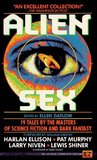
BOOK REVIEW: Alien Sex Ed. Ellen Datlow

Alien Sex: 19 Tales by the Masters of Science Fiction and Dark FantasyAlien Sex: 19 Tales by the Masters of Science Fiction and Dark Fantasy by Ellen Datlow

My rating: 4 of 5 stars

Amazon page

Alien Sex is an anthology of 19 works of short fiction that revolve around sex, attempted sex, or sex-like behavior with non-human entities. While the title leads one to believe the book is specifically about sex with aliens from outer space, that’s not the case in all these stories. There are also stories where the object of affection is a lesser primate, an incubus, a new species, and a biologically-modeled robot. As one would expect with life forms from other worlds, the “sexual” act is not always what we would recognize as sex. (e.g. One planet’s whoopee might be another’s mundane act.) As a last warning about what the book is not, it’s not—on the whole—a collection of sci-fi erotica. A number of the stories probably wouldn’t be arousing to the freakiest of super-freak, and I can only assume weren’t meant to be.

While there’s a unifying theme, the works included cover a lot of ground in terms of style and format. It’s not even true to say it’s 19 short stories because there’s one poem and one chapter that reads more like an essay (i.e. lacks a narrative structure.) Some of the works are written in the language, tone, and style of erotica, but others aren’t. A few of them read like thinly veiled commentary on problems in the author’s own love life—i.e. cheating spouses, feeling a lack of attentiveness, or porn addiction. (Each work has a brief author commentary at the end, and a couple of the authors suggest that what was going on in their own life or those close to them shaped the idea.)

While the appeal of the works varied significantly, overall this was a fun and intriguing read. The works included are as follows:

1.) Her Furry Face by Leigh Kennedy
A primate handler who is in a waning marriage falls for one of his super-intelligent orangutan students.

2.) War Bride by Rick Wilbur
The world is going to end tomorrow unless you’ve been taken as a pet by one of the aliens.

3.) How’s the Night Life on Cissalda by Harlan Ellison
A man sent to investigate an alien race becomes inextricably sexually entangled with one of the aliens. Eventually, he’s forcibly separated from the alien—of a race that are apparently thin-skinned—and lives to see the descent of mankind.

4.) The Jamesburg Incubus by Scott Baker
A teacher in a Catholic school finds that he can make out-of-body nocturnal visits to some of his more attractive female students.

5.) Man of Steel, Woman of Kleenex by Larry Niven
This reads more like an essay than a short story. The work delves into the physics of why sex with Superman would be fatal for Lois Lane.

6.) The First Time by K.W. Jeter
This is a variation on the old coming of age story in which a young man is taken to a brothel for his first sexual encounter. It’s just that this encounter is of the 3rd kind.

7.) The Jungle Rot Kid on the Nod by Philip José Farmer
The premise behind the story is what if William S. Burroughs (author of Naked Lunch) had written the Tarzan stories instead of Edgar Rice Burroughs. In essence, it’s a risqué take on Tarzan.

8.) Husbands by Lisa Tuttle
After the extinction of husbands, a woman develops a new species to serve the companion role.

9.) When the Fathers Go by Bruce McAllister
A husband confesses to his wife that while she was in stasis waiting for him to come back from interplanetary travel, he sired a child with an alien. Furthermore, the child is coming to live with them. But wait there’s more…

10.) Dancing Chickens by Edward Bryant
This story reads more like an overly elaborate joke than a short story. It begins with the question, “What do aliens want?” and ends with a pun punch line. That being said, the lead is an unappealing but intriguing character.

11.) Roadside Rescue by Pat Cadigan
A stranded motorist is made an indecent proposal by a chauffeur on behalf of his alien employer.

12.) Omnisexual by Geoff Ryman
This is about an intergalactic brothel, but it’s the story in the collection that reads most like literary fiction—meant in both the best and worst possible ways.

13.) All My Darling Daughters by Connie Willis
While there are several really good works in this anthology, I’d have to rank this as my favorite—if only by a narrow victory. A sassy, sexually-liberated co-ed has her sex life torn asunder when all the young men come back from break with little, furry creatures in their possession and no interest in the female student body. Besides a neat concept for a story (though it may be implying that men are overwhelmingly rapey), the author does a great job of character development making the lead character both interesting and likable, while juxtaposing her with her apparently goodie two-shoes roommate.

14.) Arousal by Richard Christian Matheson
A woman who cheats on her husband with a stranger is cursed with permanent post-coital euphoria that swamps all interest in her family and life in general.

15.) Scales by Lewis Shiner
A woman’s husband is having an affair with what she thinks is a student assistant, but who turns out to be a soul-sucking seductress from the netherworld.

16.) Saving the World at the New Moon Hotel by Roberta Lannes
A woman waiting for her spouse to meet her at a bar to apologize for his infidelities decides to get a little herself. The man she hooks up with turns out not to be a man at all.

17.) And I Awoke and Found Me Here on the Cold Hill’s Side James Tiptree, Jr.
An experienced man offers advice to a newbie to get away before he ends up seduced by the aliens. This story talks about sex, but is about something much broader.

18.) Picture Planes Michaela Roessner
This one is a poem about alien sex, rather than a story. It stands alone as the only non-prose entry.

19.) Love and Sex Among the Invertebrates Pat Murphy
In a post-apocalyptic world, a dying scientist–who no longer believes in science–creates robots capable of engaging in the act. The creatures she makes are based on a range of real animals which are written about interspersed with the story-line.

I’d recommend this book for those who enjoy science fiction. One need not be into erotica to enjoy the stories and, the more one is seeking erotica, the less appeal the book may have. It’s a collection of big name writers in science-fiction, and the anthology’s diversity makes it particularly interesting.

View all my reviews

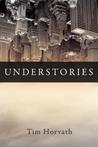
BOOK REVIEW: Understories by Tim Horvath

UnderstoriesUnderstories by Tim Horvath

My rating: 4 of 5 stars

Amazon page

Two traits of Tim Horvath are rapidly revealed in reading the collection of stories entitled, Understories. First, he’s an academic to the core. Second, he loves words and the way they can be jigged around to create not only meaning but feeling. Combined, these characteristics yield both positive and negative outcomes.

On the positive side, Horvath writes what he knows, and this can be seen in tales like: The Understory, The Discipline of Shadows, Tilkez, and even Circulation. Horvath paints a vivid picture of life in academia with The Understory and The Discipline of Shadows in particular, replete with scholarly rivalry and interdepartmental politics. While that may make the book sound stunningly boring, those two stories are among the strongest–in part because the author knows how to build tension and character in this domain. His bookish characters are constructed with wit and depth.

On the other hand, this book is for the ones who love language more than they love story. The readability isn’t high. Horvath peppers the text with words that many of us memorized to take our GRE test but never used after receipt of our acceptance letter. Many avid readers never learned such words in the first place. This is where the Kindle edition, and its capability for instantaneous word lookup, comes in handy. (Though, the author does manage to stymie Kindle’s internal dictionary on a number of cases.) The shorter pieces tended to leave me wondering if Horvath had a point other than to dazzle with verbiage. To be fair, it’s not just monosyllabic and pretentious words that Horvath loves. He has a taste for all sorts of words that are evocative and powerful, be they whimsical, sexual, or emotional.

Understories consists of 21 short stories, but I use the term “story” loosely. Some of the chapters are stories in a conventional sense. That is, they have a beginning, a middle, and an end, and a character who takes some sort of personal journey. Other pieces are the literary equivalent of the masturbatory orgasm; they’re pleasant to experience but beg the question of what the objective is. The contents of the book are below. I’ll restrict my commentary to the more substantial pieces, and leave the reader to figure out what Horvath was trying to get at with the others.

1. The Lobby: This is really an artistic introduction and rules for reading the book.

2. Urban Planning: Case Study #1: This is the first of 8 such “case studies.” With the exception of one, they’re all flash pieces.

3. Circulation: If I had to pick a best story of the anthology, it would be this one. It’s about a man whose eccentric father is in the hospital with mind and body that aren’t what they used to be. The man is Director of Circulation for his hometown library, and the father has one published book and spent much of his life working on an unfinished Atlas of the Voyages of Things. The sub-story about the books as a reflection of the man is what gives this something extra beyond the usual “Cats in the Cradle” (Harry Chapin reference) narrative.

4. Urban Planning: Case Study #2: Another brief piece.

5. The Understory: This is one of the full length stories, and is one of the best pieces. It’s about the bringing together and falling apart of a platonic relationship between two scholars. Set in pre-war Germany, the story opens with a scholarly rivalry between two professors who become good friends. However, one of the men is a Jew and the other is promoted to a Deanship because he has appeal with the Nazis.

6. Urban Planning: Case Study #3

7. The Discipline of Shadows: This is the story of a professor in the Department of Umbrology. What’s Umbrology? It’s the study of shadows. An interdisciplinary department with a unifying theme of shadows provides and intriguing background for a story that’s not so out of the ordinary. The story delves into scholastic politics and a sordid intradepartmental love triangle.

8. Urban Planning: Case Study #4

9. Planetarium: This is story proper. It’s about the reunion of two high school buddies, and their differing recollections of a seminal event of their youth involving shenanigans at a planetarium. The story is an odd sort of confession.

10. The Gendarmes: This story will appeal to lovers of the surreal. It’s about a man who discovers that a team of scientists are playing baseball on his roof.

11. A Box of One’s Own: An eloquent tale of the curiosity inspired by boxes.

12. Internodium: This is another short piece.

13. Urban Planning: Case Study #5: This one probably ties for my favorite flash piece. It’s about a city that evolves into all restaurants.

14. Runaroundandscreamalot!: There’s a lot of humor sprinkled throughout this book, but this is the one story one might put in the humor genre. It’s funny from the title onward, which is the protagonist’s pet name for a generic Chuck-E-Cheese-esque place called “Playalot”—which is a medieval-themed kid’s play palace. The protagonist, a divorced man, takes his daughter there and meets a woman that he proceeds to try to get to know better despite only knowing her as “Hanh’s Mom” for most of the story.

15. Urban Planning: Case Study #6: This is the other tie-holder for best flash piece. It’s about a city in denial.

16. Pocket: A flash piece on, well… pockets.

17. Altered Narrative: A short and experimental piece.

18. Urban Planning: Case Study #7: This is the only one of these “Urban Planning Case Studies” that is a short story in the usual sense. It’s about a [grown man] film projectionist who abandons his post after seeing his wife with another man.

19. The Conversations: There’s a fair amount of surrealism sown throughout this book, but this is one of the more speculative pieces. That said, it’s really just about the death and resurrection of the conversation—along with “mint.” The sci-fi component revolves around speculation about precisely caused it and what the difference is between a “Conversation” and a “conversation.” The latter being what we normally think of (i.e. and informal discussion), and the former being the subject of the story.

20. Tilkez: The protagonist is a creepy little man who writes down everything and the story is about his relationship with both a female and language (I think. The female might be symbolic.)

21. Urban Planning: Case Study #8: One last flash piece.

View all my reviews

BOOK REVIEW: Rashōmon and Other Stories by Ryūnosuke Akutagawa

Rashomon and Other Stories (Tuttle Classics)Rashomon and Other Stories by Ryūnosuke Akutagawa

My rating: 5 of 5 stars

Amazon page

Six stories make up this brief collection. All six are intriguing, well-written, and shine a light onto the dark side of mankind. The works of Akutagawa collected herein are all morality tales, but aren’t written in a moralistic tone. In fact, it’s not clear that the author wishes to convey lessons on virtue and vice as he’s intrigued with the instant at which an ordinary person turns bad. That instant, and the inflamed passions that often inspire it, is a prevailing theme throughout most of this small anthology. Akutagawa beats AMC by the better part of a century in showing us how bad breaks.

The first story is entitled In a Grove. This is a murder mystery in which we are given conflicting accounts of a man’s murder through the process of the investigation of the act. The final account that we are offered is that of the victim himself–as presented by a psychic medium. [Only two of these stories contain supernatural elements–this one and the last. Most of the collection involves realist premises. One must remember that Akutagawa was writing in the early part of the 20th century, and scientific rationality hadn’t yet gotten as strong a hold as it does today.] In this case, the use of a psychic is really just a plot device to give the reader insight into a truth which couldn’t otherwise be revealed. Having heard the perspectives of the murder and the dead man’s wife, one is left with questions owing to the self-serving nature of those statements. Of course, the final section reveals a twist–that I won’t spoil.

The second story is the title story, Rashōmon. The title is the name of a gate in Kyōto, the largest gate of Kyōto, in fact. However, Kyōto has fallen on hard times, and our protagonist is a newly masterless samurai who has sought the gate’s shelter from the rain. There, he contemplates whether he should take up a life of crime, which seems to be his only means of survival in the current economy given his skill set. The gate has become a repository for the corpses that are amassing as victims of the hard times accumulate. Within the gate, he finds an old hag who loots bodies for a living. His interaction with the old woman helps him to decide his own destiny.

The third story is called Yam Gruel. While “yam gruel” (or anything with the word gruel in it) might not sound appealing given today’s usage, a fact one must know is that during the time of the story it was a highly-prized and rare dish. The story follows a milquetoast administrator who leads a rather pathetic life in which he has but one ambition, to eat his fill of yam gruel. As a member of the samurai class, he’s invited to an Imperial banquet each year. However, because of his low status and the high-value of yam gruel, he never gets more than a taste. One year he openly bemoans the fact that he never gets his fill. A powerful samurai overhears this complaint, and it puts a seed of mischief in his mind. While this tale isn’t about breaking bad, it is about inflamed passions.

The fourth story sticks out as different from the others. While the bulk of the stories center on that moment at which a more-or-less good person goes bad, The Martyr tells us about a protagonist that never goes bad, despite having every right to. This might seem like a sea change in theme, but in reality it’s just another way of shining a light on the dark seed that resides in people. Only this time it does it by way of contrast. All of the other characters are deeply flawed, and we see that most vividly when contrasted against the one who always behaves virtuously. In this case, that virtuous character is Lorenzo, a novice monk who is accused of a severe breach of good conduct. Lorenzo becomes an outcast and a vagrant due to these allegations. Yet, despite all this, he acts heroically–even to assist those who’ve betrayed him.

In the fifth story we revisit the theme of breaking bad. In Kesa and Morito we are presented with two regret-filled accounts of the instant at which an adulterous couple decides to kill the husband of the woman involved in the affair. Each member of the cheating couple thinks that the other desperately wants the killing to go forward. In reality, both consider it a foolish decision driven by a brief moment of passion. This is another tale about letting one’s passions get out of control.

The final work is a retelling of the story of a monk named Hanazō who decides to prank his fellow monks because they chide him about his huge nose. Hanazō sets up a sign that says a dragon will appear from the local lake at a certain time and day to fly up into the heavens. The joke doesn’t turn out at all as the monk intended. I won’t go into the moral of the story to avoid giving too much away, but suffice it to say there is a moral.

I highly recommend this collection. As I’ve suggested, the collection isn’t just a disparate collection of tales, but has an integrating theme. Akutagawa was truly one of the masters of the short story. He wrote 150 stories before dying at the age of 35 in a suicidal drug overdose.

For those who like to see how literature is portrayed in, below one can watch the film version of Rashōmon.

View all my reviews

MICRO-FICTION: Julia Doesn’t Know How Lucky She Is

IMG_2555“Have you completed your mission? The Council grows impatient,” The thought occurred in Safrom’s mind as if he had a split personality rather than an angry disembodied consciousness in his head.

“No, we were very close to planting it last night, but the cat came in squawking and making racket. It woke her up just before we could get it set. Those damn cats will be the death of me.  The preceding night we managed to keep one out all night, but the other slept on the subject maintaining constant vigilance,”  Safrom said aloud as he paced around the sterile white space of his station.

“The subject travels, why don’t you just do it then?” The thought formed.

“Believe me, I would love to, and we make great efforts to do so. But it is not as easy to track a person through thought-space as it is in the physical world. If we can ever get the damn implant installed, that will, of course, change immediately. Most of the time she is not gone long enough for us to find her, and on the few occasions she has been, or we’ve been lucky, she hasn’t slept deeply.”


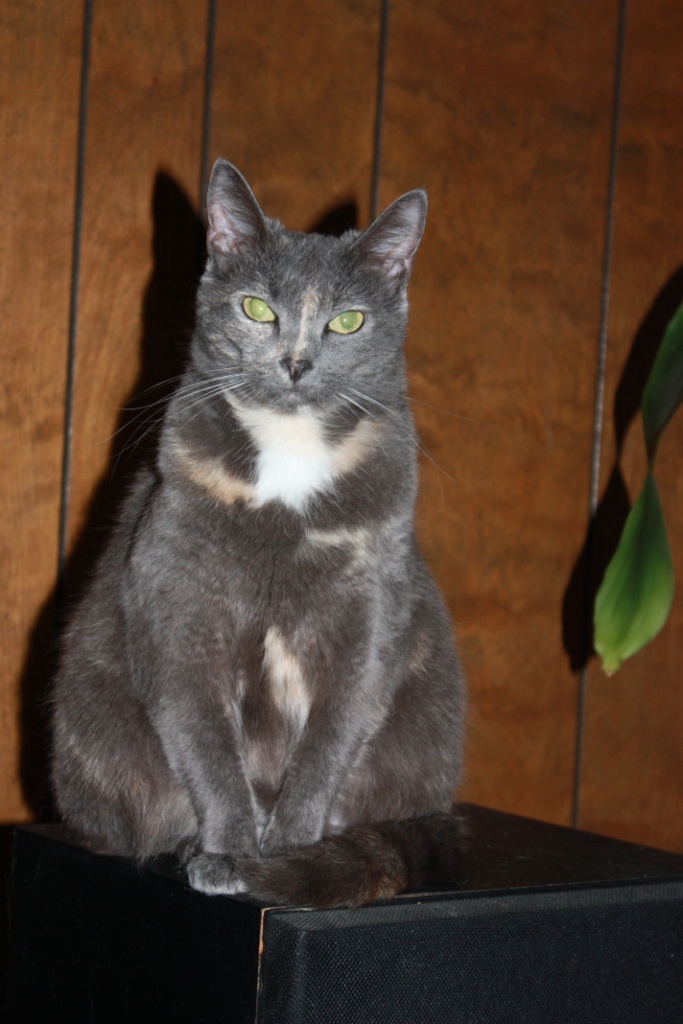
“RRRrrrarr-eeeow …  RRRARRrrr-eeeow… RRArrra-eeeow,” the noise came from floor level.

Julia pushed herself upright groggily and swept a shock of black hair out of her face. She stared at the gray cat illuminated by a shaft of streetlamp glow that slanted in through her bedroom window, and said, “Really! You’re really waking me up from a sound sleep in the middle of the night?”

The cat stopped its bellowing and sat back on its haunches, looking at Julia indifferently. Then the shorthair trotted out of the room and down the hall.

Julia lay back down melting into a down pillow and drifted back to sleep while wondering what made her cat do that. What makes a cat that has been fed and is never let out at night, repetitively caterwaul until its owner wakes up, and then it just goes back to its indifferent self?


Julia yawned aloud. “Excuse me. My cat woke me up in the middle of the night three times for no apparent reason.”

“Does it do that a lot?” Erma asked.

“It comes in waves, but, it seems to have it down to a science. It always seems to do it when I’m in the deepest sleep, usually in the middle of a weird dream.” Julia elaborated.

“What was your dream about?” Erma asked.

“Ah, you know, it was a dream. It didn’t make much sense. I was being chased?

“Being chased by whom?”

“I don’t know. I never see them, but it always feels as though they are just about to catch me.”

“Maybe the cat is doing you a favor.”  Erma said in a completely somber tone.

“Yeah, right, maybe.” Julia replied with a grin. She assumed Erma was joking, although there was nothing in the older woman’s expression to indicate that she might be.

Erma changed the subject, “So how is your research coming?”

Julia shrugged and said, “I don’t know. I’m feeling a little overwhelmed as of late. I keep pulling up new material, but, as I do analysis, I don’t seem to be converging on an explanation.”

“It’ll come, you’ve just got to keep at it, and never up. If you never give up, a solution will always present itself.” Erma said with a smile.

“I suppose.”

“You know the thing about cats is…” Erma began.

“What’s that?” Julia inquired.

“Aww, never mind.” Erma said.

Evangelists Meet Max Their Match

BING-BONG.

Without even looking up from his computer, Max knew it was church people. They came around trying to sell him a religion now and again. No one sold aluminum siding, encyclopedias, or ice cream door-to-door anymore. Evangelic proselytizers were the last bastion of door-to-door salesmanship. The sect varied; the approach did not. They were the only ones who ever disturbed his peace.  Well, the only ones who didn’t use the phone.

He went to the door. It was a zaftig woman and a clean-cut young man–both dressed in funeral-like attire.

“Hello!” the pair said with practiced exuberance.

“Hello,” Max parroted with a decided lack of exuberance. Then he added, “May I help you?”

Max didn’t feel like being helpful, but there was the off-chance that it was  a couple of his neighbors who were just looking to borrow a cup of sugar so they could bake cookies for whatever wake they were attending. If so, he’d help them out, but as far as he knew such a request hadn’t happened since 1955. Then he saw their name tags, and not the paper kind. These were black plastic bordered in gold with white letters.

“We’d like to talk to ya ‘bout the Bible,” the woman said.

“Unless it’s the racy bits, I don’t think you’ll hold my interest,” Max said.

“Excuse me?”

“Never mind.”

“Have you ‘cepted Jesus as your personal Lord and Savior?” the woman asked. The young man was silent, apparently just there in case the woman knocked on the door of a Jeffery Dahmer-type.

Max was distracted by the words “personal lord”, and how odd the phrase seemed. Can I get my Messiah in Mocha with a burgundy robe?

After an awkward pause, he said,  “No, I’m an atheologist.”

They gave a coordinated grimace as if he’d dropped a deuce at their feet. “You’re an atheist?”

“No. I said atheologist. An atheist is one who does not believe in God. I believe in God. I just don’t believe in religion.”

“You cain’t have Gawd without religion.” The woman said.

“I beg to differ.”

“How’d ya know Gawd, elsewise?” The woman continued.

Max swept his hand outward in a gesture meant to draw the pair’s attention to the flowering dogwood in his front yard and the sky beyond. Their forehead creases indicated that they were both perplexed. The meaning of his gesture was lost on them.

“You cain’t know Gawd without religion,” the woman repeated, as if Max just hadn’t heard her the first time and if she said it more emphatically he would get it.

“You can repeat a gratuitous assertion ad infinitum, and it will remain an assertion,” Max said.

Neither evangelist gave any indication that they understood what Max was saying.

He sighed, stepped out onto the porch with them, and said, “Look. First, let’s ask what God gives us.” He leaned out under the eaves to look at an azure sky feathered by white wisps of cirrus clouds. This time they followed his gesturing arm and looked out with him at the bounty of nature. “Now, let’s consider what religion offers us. May I?”  He said as he reached for the thin little magazine that they had prepared to leave with him.

Max was taking a risk. He couldn’t know exactly what it the magazine would contain, but he’d seen enough of them to make an educated guess. There it was, right on the cover. He didn’t even have to flip through in search of it. The cover artwork was a dark sketch of a treeless city with brooding clouds drifting at the tops of buildings. The buildings were in ruins, and there were human-shaped lumps on the ground –meant to be either corpses or homeless people. It was a story about the fall of man or the coming apocalypse or some doom upon whose cusp humanity sits.

“Here we have it. Religion doesn’t show us beauty. It wants me to be afraid. It wants to scare me. It wants carnage and chaos to be my lodestar. It shows me horrors so that it can be my life-preserver. It wants to be my life-preserver so that I’ll substitute its will and wisdom for my own. It wants me to believe its leaders are infallible so that I’ll feel good about giving up control. It wants me to behave as its people behave. Most insidiously, it wants me to hate the people who it hates… This is why I don’t believe in religion. Thank you for your time,” Max said as he handed the Doomsday Gazette back to the woman and walked back into his house, leaving the two slack-jawed proselytizers in his wake.