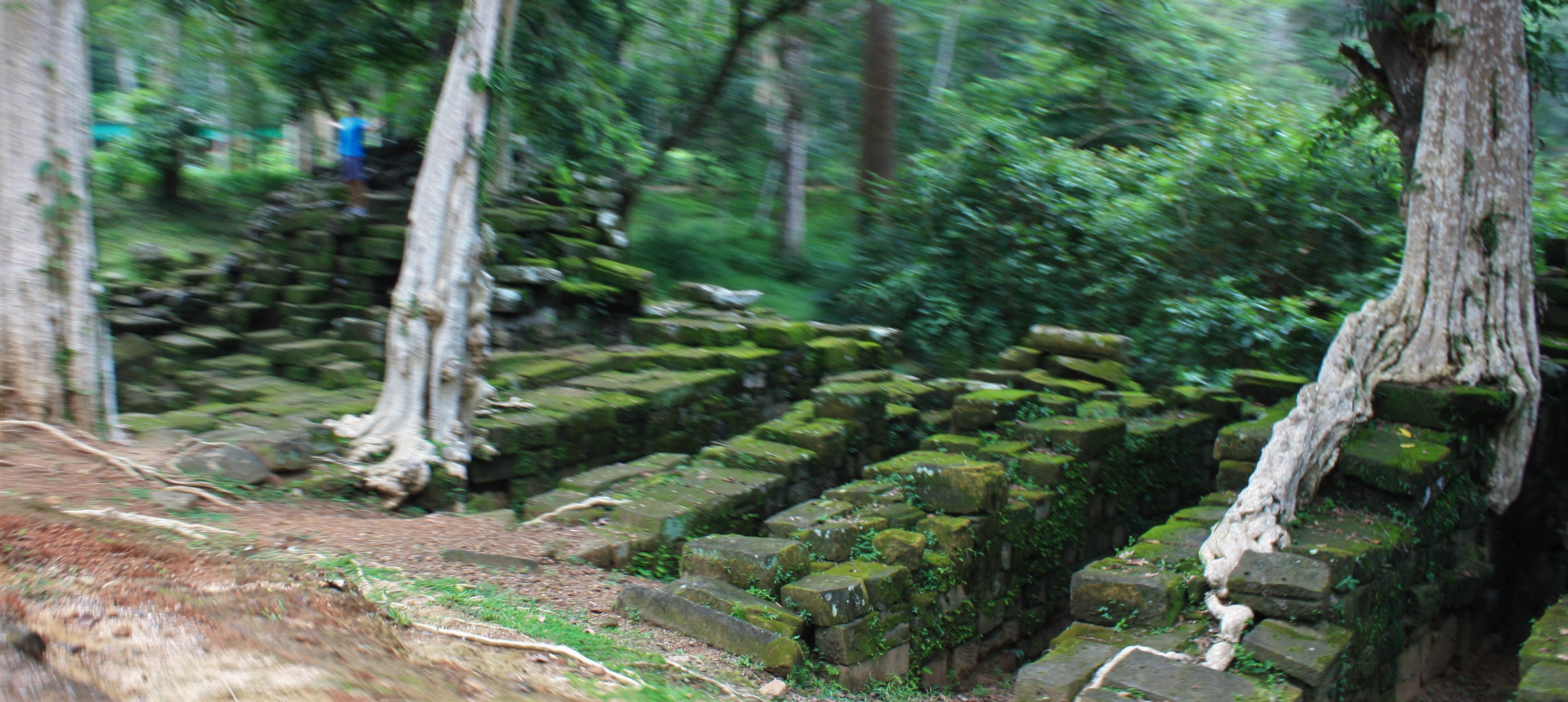
Three Takes on a Lotus Haiku

I
lotus viewing:
still blossom, changing light;
countless sights
II
a still lotus,
a static eye, and shifting
light; boundless hues
III
view one lotus
until the changing light
makes a new bloom

POEM: Ghosts in the Darkness

I have walked in deep, dark places,
and crawled through darker, still --
gas-lit slums long after the dusk,
where lamplight failed to spill.

So surprised by fleeting faces
that faded in and out --
like visions from the sleep-drift, they
never loiter about. 

They come, they see, and then they pass --
these alien observers.
They pass with just a fleeting glance,
like someone else's server.

They care not what you think you need,
or who you think you are.
You're just an automaton shopper
within the grand bazaar. 

POEM: A World of Loathing

a cat abhors a vacuum
vacuums abhor tangled hair
tangled hair abhors a hairbrush
hairbrushes abhor Victorian Spanking Fetishists
Victorian Spanking Fetishists abhor Victorian prudism
prudism abhors immodesty
immodesty abhors modesty
modesty abhors whores
whores abhor cheapskates
cheapskates abhor expenses
expenses abhor ledgers
ledgers abhor ink pens
ink pens abhor writers
writers abhor synonyms
synonyms abhor antonyms
antonyms abhor continuums
and so on...

it's true that Eddie Rabbitt
loves a rainy night,
but who loves Eddie Rabbitt?

[the Coalition for 
Names with Double-Letters,
that's who!] 

Montreal Limerick

There was a hungry man from Montreal
who ate Poutine 'til he could only crawl
the snack in question
gave him indigestion,
and sealed his colon like a stonewall.

POEM: Hypnagogic Voices

I hear voices --
a cold burble of voices --

too dim and distant
to extract meaning,

too inexplicable not
to inject a rationale,

or a slate of reasons:
-madness
-conspiracy
-expectation
-the impulse 
toward void filling

minds despise quiet,
filling it with 
puzzling prattle,
and making any 
hash of sound
into cryptic natter,

until sleep descends

POEM: The Mind of Urban Cattle

What's a city
through the eyes
of a mid-city cow?

Growing up on a farm,
I can't say I ever questioned
how a cow perceived 
the pasture --
vast tracts of 
green, green grass
seemed like a natural habitat,
though I recognize 
that a philosophical cow 
might see nothing natural 
in its circumstance, either way.

What of the fast moving vehicles?
the horns?
the best grass fenced off?
the rush of humanity?
the bright, white lights?
the stink of human life?

Can they tune it all out
as well as they seem to?

Zen mind / cow mind?

I wonder?

BOOK REVIEW: The Narrative Poems by William Shakespeare

The Narrative Poems (The Pelican Shakespeare)The Narrative Poems by William Shakespeare
My rating: 5 of 5 stars

Amazon.in Page

While William Shakespeare is overwhelmingly known as a playwright who also wrote a collection of sonnets, back in his day some of his poetic stories were quite well-received. This volume collects the five narrative poems that Shakespeare is believed to have authored (or partially authored.)

Venus and Adonis: This is one of the two long-form narrative poems of Shakespeare. It tells the tale of the goddess Venus’s obsession with Adonis, her many attempts to woo the hunky lad, and the tragedy that befalls him, breaking her heart. It’s written in six-line stanzas of iambic pentameter with a quatrain of alternating line rhymes and an end couplet of a third rhyme.

The Rape of Lucrece: This is the other long narrative poem of Shakespeare. Lucrece’s husband, Collatine, is off on campaign and brags about how perfect is his wife, Lucrece. The “gentleman” he is telling this to is Tarquin, and the high-praise of Lucrece sets the seed of obsession in Tarquin’s mind. When he then finds himself in Collatine’s neighborhood (with Collatine still off to war,) he pays Lucrece a visit and is invited to stay over. That night he breaks into her bedchambers and – after threatening to kill her and a random male servant whose corpse he’ll shove into bed with her – Tarquin rapes her. After mulling over her options, Lucrece calls for Collatine’s return and after getting the promise of Collantine and his fellow soldiers to have revenge for her, she tells them who raped her immediately before ending her own life by dagger.

It’s written in the rhyme royal seven-line stanzas of iambic pentameter made famous by Chaucer.

The Phoenix and the Turtle: This is a very different poem from the others. In terms of format, it abandons iambic pentameter in favor of shorter, punchier lines. Stylistically, it’s a bit more obscure and allegorical than most Shakespearean poetry.

The gist of the tale is the description of a funeral for the perfect couple. [I guess that an important thing to know is that “Turtle” is used as short for turtledove, and so it’s not a tale of bestial interspecies lovin’.] Besides the lines being shorter, the entire poem is short and sweet, ending with a philosophical lament about truth and beauty.

The Passionate Pilgrim: While we’re back to iambic pentameter (and mostly sonnets) this work is a departure other ways. First, rather than being a narrative poem proper, this is really a love poetry collection. Second, while the collection consists of twenty poems, Shakespeare is believed to have only written five of them (I, II, III, V, and XVI.) Of those, the first four are sonnets, and the last is an eighteen-line poem. Third, this is not new or exclusive material. The first two sonnets came to be included in the 154-sonnet collection of Shakespeare (138 and 144,) and the other verse is from “Love’s Labour’s Lost.”

A Lover’s Complaint: The weeping of a maiden attracts the attention of a passerby, who she tells her tale of woe, having been wooed by a young man who got his milk and high-tailed it before he was forced to buy the cow. Besides being a woman’s tale of woe, it also shares with “The Rape of Lucrece” the fact that it is written in rhyme royal. It’s much shorter than “The Rape of Lucrece.”

I would highly recommend poetry readers dig into these lesser know Shakespearean works.


View all my reviews

Step Stone Senryū

a rock that looks like
the perfect stepping stone
is where danger lies

POEM: A Leak in the Sunny Side

Rounding through the pass,
I crossed from the cold
to the sunny side.

But while I transited
from the damp & mossy
to the dry grass
side of the mountain,
I carried the cold with me.

The ubiquitous sun 
would not warm me,
but rather I seemed
to suck the warmth 
out of the world --
as if I were a portal,
and the light landing
upon my skin was shunted
to some parallel universe.

I was the world's window
left open with the heater on,
and the temperature
differential pulled a steady
breeze in my direction,
to who knows where?