5 Classics of Martial Arts Cinema

Martial arts cinema ranges from the horrible through the campy to the excellent. There is one ever-present risk facing this genre. That is, like porn, movie makers may conclude that viewers aren’t watching for character or plot so they might as well just focus on the action. When they do that and then they blow the action– well, that’s when it’s painful to watch. By numbers, most of this genre probably falls into that category. However, sometimes they get it right.

Of course, it’s not always clear what should be categorized as a martial arts film, given many cross-genre romps. The Matrix is science fiction, but it’s also a kung fu flick. The Bourne trilogy films are spy thrillers, but their characteristic gritty hand-to-hand combat sequences are integral to the films. I’ve tried to focus on films that one would unambiguously categorize as martial arts cinema (though anything by Kurosawa is likely to be considered mainstream cinema.)

I also, admittedly, display several of my own biases. I prefer films that avoid over-the-top superhuman choreography. I don’t want to say that I prefer realism. None of it is realistic, but there’s a vast difference between Jackie Chan’s choreography and that of The Curse of the Golden Flower. Still, I do include Crouching Tiger Hidden Dragon and Kung Fu Hustle, which both rely heavily on wires and superhuman feats. I also like period pieces as opposed to modern-day films. Of course, characters with charisma also get my attention, but I don’t think I’m unique in that regard.

5.) Enter the Dragon

Enter the Dragon is Bruce Lee’s last film, and features Lee as a Shaolin practitioner cum secret agent. The film reminds me of the Ian Fleming novel You Only Live Twice in that it’s about a person being tasked to infiltrate an evil mastermind’s sprawling lair not because it makes logical or reality-based sense, but rather because the proposed infiltrator is just that damn good.


4.) Crouching Tiger Hidden Dragon

This is undoubtedly the most critically acclaimed of the films on the list. It was nominated for a Best Picture Oscar in 2000, and while it did not win in that category, it did take four Oscars that year. It’s in a class of film that includes Curse of the Golden Flower and Hero that are known for stunning cinematography and historical settings. (Unfortunately, these films are also marked by an insanely excessive use of wire-work for my taste.) This film includes a romantic component as well as the fight to possess a sword called Green Destiny. As is mandatory for Kung fu films, there’s a martial arts master whose death must be avenged.


3.) The Legend of Drunken Master (aka Drunken Master II)

Jackie Chan plays a bumbling young man who is, ironically, a master of Kung fu when completely inebriated. The plot revolves around a mix up between an agent who is trying to steal a valuable artifact and Chan’s character who is trying to smuggle ginseng to avoid paying duty on it. Incredibly, the artifact and ginseng are packaged identically, and the thief ends up with the ginseng and Chan’s character with the artifact. It’s Chan at his best, with all the comedy and creative choreography that one would expect.


2.) Hidden Fortress

I’m not including this just to prevent a Chinese sweep. (On that note: I’ve heard the Thai Ong Bak films are quite good, but I haven’t gotten around do seeing any of them.) Anyway, there are some excellent Japanese period films that involve many combat sequences that are not over-the-top. Of course, Akira Kurosawa dominates in this realm. There are other Kurosawa films, such as Seven Samurai, Yojimbo, or Ran that could equally well be included. Hidden Fortress is probably best known to American movie buffs as a major influence on George Lucas in the making of the first Star Wars film. Hidden Fortress is a about a General (played by portrayer-of-samurai-extraordinaire Toshiro Mifune) who must escort a princess and her family fortune cross-country to safety. Of course, as in every hero’s journey, there are many challenges to be confronted.


1.) Kung Fu Hustle

This comedy is set in the gang-ridden slums of 1930’s Shanghai. A tenement complex is assailed by the gangs. However, the residents offer some surprising resistance in the form of unexpected apartment-dwelling kung fu masters. Unlike Jackie Chan’s down-to-earth comedies, this one is almost cartoon-esque. It features a cast of anti-heroes that keeps the film interesting, and the protagonist has a strong narrative arc.

BOOK REVIEW: Solaris by Stanislaw Lem

SolarisSolaris by Stanisław Lem

My rating: 4 of 5 stars

Solaris is the  best known work of the Polish sci-fi writer Stanislaw Lem. It’s the story of the planet Solaris’s super-intelligent ocean and the humans that are observing it from an orbiting space station. Scientists discover that the ocean is intelligent because the planet orbits two stars, and the ocean must redistribute itself as ballast to keep Solaris from flying off out of its star systems.

Having had no luck in learning about this ocean, the scientists begin more invasive operations–bombarding the ocean with electromagnetic radiation. The ocean then begins to project human beings into the space station, using blueprints in the minds of the scientists. Each of the scientists begins to see, and eventually interact with, someone from his past. Each “guest” is physically indistinguishable from the person in the respective scientist’s past, but the simulacra are “off.”  These simulacra stir up bad memories.

The most extensive interaction we see between a crew member and one of these manifestations is that of the protagonist, Dr. Kris Kelvin, and his ex-wife. Dr. Kelvin is a psychologist and is the most recent crew edition. (The novel actually starts with him as a new arrival, we learn of the earlier incidents as he does.) His “visitor” is the spitting image of his wife, a woman who committed suicide after the couple broke up.

The novel plays with an intriguing question. What if a person you loved and lost came back from the dead, but you would only be able to experience them as they existed in your mind? In some sense, they’d be more real to you than the actual person. But you’d know they were just a fabrication, and you could never learn anything new about them. At first Kelvin rejects, even banishes, his wife’s doppelgänger, but when she inexplicably returns he finds it hard to maintain his distance.

I enjoyed this book. The translation seemed skilled to me (though I don’t read Polish, and hence didn’t read the original.) I’d recommend it.

View all my reviews

There have been three film adaptations of this novel. I haven’t seen any of the movies, but this is the trailer for the most recent one. The trailer emphasizes the love relationship more and the sentient ocean less than the novel (though the interaction of the protagonist with his imagined wife is central to the work.)

I Always See the Wrong Movies: or, Post-Oscars Watcher’s Remorse

The one Oscar-Winner I saw

The one Oscar winner I saw

I only watched part of the Oscars last night. At some point I realized it wasn’t worth continuing. I see about three movies in the theater per year, and rarely are any of them Oscar material. At 10:00 pm all I had to show for watching was the chorus of the ditty “We Saw Your Boobs” echoing through my brain.  (Damn you, Seth MacFarlane, for that catchy, clever, melodic jingle that still runs like a gerbil in the rodent-wheel of my mind.)

The three movies I saw in the theaters last year were: The Avengers, Dark Knight Rises, and This is 40. The first two will no doubt convince you that I am a 12-year-old boy trapped in a middle-aged man’s body, and the last will convince you that I have poor judgement. (This is 40 had its humorous moments, but there was far too much screaming for my taste, although we did see Leslie Mann’s boobs– damn you, again, Seth MacFarlane.) I saw another half-dozen 2012 films on long Korean Air flights, but these were equally lowbrow titles (Men in Black 3, Prometheus, and Brave– the latter at least won an Oscar during the hour and a half I was watching, I think it was for Best Animated Makeup Artistry.)

I’m not altogether lowbrow. I will see most of the big winners eventually, when they finally make it to basic cable. For example, I watched The Hurt Locker on Saturday, just one day before the Oscars. So I am only three or four  or five years out of synch.  The Hurt Locker is a particularly fine example of going the other way because I understand its distinction is being the lowest grossing Best Picture winner ever.

This year’s Best Picture Argo is definitely a film that I will see in the next five years–barring Zombies, the apocalypse, or a Zombie Pandemic Apocalypse. So there’s a 60% chance that I’ll see it. The Iranian hostage crisis is one of the first historical events that I remember seeing on the news first-hand. Had I been in the country when Argo came out–I might have seen it in the theaters, but probably not.

Part of me thinks that I should grow up and start watching the “right” movies.  However, part of me says, “wait, there’s this one day a year when everybody is talking about these movies, and the other 364 days  they are talking about Dark Knight Rises and The Avengers  So in some sense, I already am watching the “right” movies.

BOOK REVIEW: Eclipse of the Crescent Moon by Géza Gárdonyi

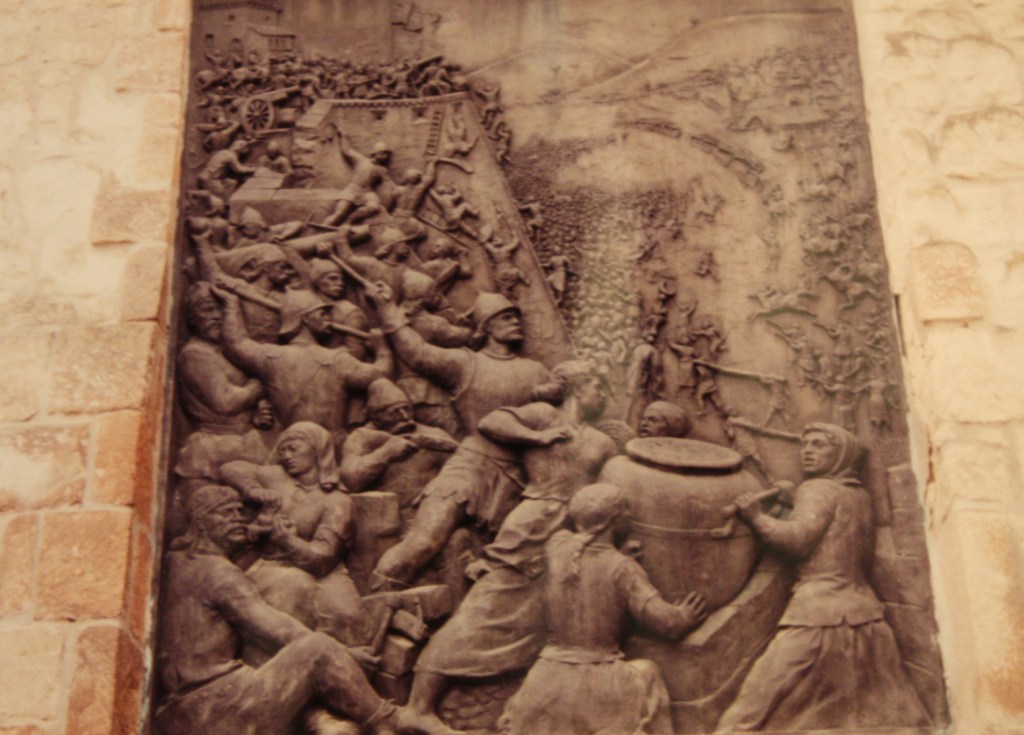
Bas relief of Siege of Eger

Bas relief of Siege of Eger

Eclipse Of The Crescent MoonEclipse Of The Crescent Moon by Géza Gárdonyi

My rating: 4 of 5 stars

This book is the English translation of a volume originally written in Hungarian and titled Egri Csillagok, i.e. “Stars of Eger.”

Historical fiction works best when the event it’s built around requires no fictitious embellishment to fascinate the reader. Eclipse of the Crescent Moon takes place during the 1552 siege of Eger. During this siege, 2,000 Hungarians held off at least 40,000 Turkish invaders for over one month. (In the book the Turks have a two order of magnitude advantage.) The Turks retreated despite having had superior armaments as well as a massive numeric advantage. It’s the perfect underdog story.

Reading a purely historic account would be interesting enough, but Géza Gárdonyi creates value-added by imbuing his characters with depth, particularly his lead Gergely Bornemissza. There wasn’t much known about Bornemissza. He was a minor character in history compared to Eger’s commander, István Dobó. However, his expertise in explosives did play a role in this Hungarian success story.

The book begins when Bornemissza is a young boy. He and a girl named Éva are captured by a Turk. The couple escapes and manages to free others. They later elope to avert Éva’s arranged marriage. They have a child who is later captured by the same Turk who had captured them.

A major subplot is a trip made to Istanbul in the heart of enemy territory to attempt to aid in the escape of Bornemissza’s  adoptive father.

The book is well translated and an engaging read.

View all my reviews

TODAY’S RANT: Viral Video Advertising

I recently saw this posted on Facebook. I, being a doofus, believed I had stumbled upon the black box recording that would show archaeologists the moment it all went sour for the human race– the dawn of the rise of the apes. As soon as our self-aware brethren learn to take our technology and use it against us, we are surely doomed. Being damned dirty, the apes will own humans. [Participle dangle intended.]

Of course, I felt compelled to do a Snopes check because– believe it or not– sometimes people put things on the internet which are fake. I know, I know, hard to believe.

It turns out the video is a piece of viral advertising for the next Planet of the Apes movie. “Lesser” primate use of technology is still about right here:

Viral advertising is the latest craze. One leaks intriguing footage onto YouTube and doesn’t label it or say what it is.  Then you hope a bunch of schmucks fall for it, and they will– because that’s the defining characteristic of we schmucks. It’s tautological.  This kind of video will stick in one’s mind and get more media attention than would a regular trailer.

The problem is that movie-makers have the ability to make really convincing fakes. (That’s what they do.) My well-read reader will certainly have heard of the Orson Welles War of the Worlds incident. People who didn’t hear the beginning of the broadcast, which was formatted like a news bulletin, freaked out about the alien invasion. Some people jumped out windows (why, I have no idea. I don’t think they thought the value of that through.) Some people fled to Canada (assuming, of course, that the aliens wouldn’t be interested in that icy wasteland.)

My problem with all this isn’t that people are duped; it’s the “boy who cried wolf” effect. One day when we’re under attack by aliens, apes, or artificial intelligence, people are going to be like, “Dude, that’s a really convincing looking ray-gun… NOT!”

TODAY’S RANT: Continuity Gaffes

For those unfamiliar, a continuity gaffe is a mistake in a movie in which something that shouldn’t change from one instant to the next does. They result from movies being shot over many days in an order unrelated to how the film unfurls before the viewer. Take an example, say a brawler is wearing a green shirt, they cut away to the other fighter, but when they flash back he’s an orangutan in a bikini. If it’s still not clear what I’m talking about, the YouTube clip below shows a horde of gaffes from the first Star Wars trilogy.

Now, from the title of this post, you probably think that I’m some sort of obsessive-compulsive nerd who catches every little niggling mistake in a movie. To this I say, I wish! I’m a not-the-least-bit-compulsive nerd. I don’t catch any movie continuity gaffes– not a single one. Sure, I can see them when they’re circled and the film is run in slow motion, but otherwise I’m clueless. This has made me wonder if there isn’t something defective with my brain. When they are pointed out they seem pretty glaring.

What really bothers me is not that I never catch a continuity gaffe in a movie, but rather that I catch them in my real life all the time. I’ll distinctly remember setting my keys down on the valet, but after a thorough search I’ll find them in the freezer. I’ll remember having written a paragraph, but when I come back to my laptop I find nothing but the cryptic message, “xzsawrwddd&&ppPPP.” I’ll put down Shakespeare’s Sonnets and when I pick the book back up, it’s a James Patterson novel.

I’ve developed two competing hypotheses to explain these gaffes. First, I’m in the Matrix, and Mr. Smith is corrupting the code. Second, my secretly super-intelligent cat is fucking with me.

BOOK REVIEW: The Road by Cormac McCarthy

The RoadThe Road by Cormac McCarthy

My rating: 5 of 5 stars

Sparse and haunting.  The Road is about a father and son walking cross-country in search of a safe harbor in a post-apocalyptic world. The story pulls one in and leaves a tightness in one’s gut. Every person the duo comes across on the road must be treated as a dire threat, making them each other’s only thread of connection to humanity. One particularly powerful moment is when they get to the ocean and see nothing but ghost ships lolling in the water. To reach the end of the road, the end of one’s world, without a flicker of hope is crushing, but they make a left turn and keep going.

McCarthy uses description in vivid flourishes, but it’s the spartan dialogue that really creates the tone. I was distracted by the lack of quotation marks and dialogue markers at first, but with only two speaking characters McCarthy’s approach works just fine. One soon gets a feel for the unique voice of each, and then the minimalist approach works.

McCarthy cuts away everything that is non-essential. Some of these non-essentials, like names, we so take for granted that their absence helps create a somber tone.

If you don’t like sad stories, this one won’t be for you. I found the ending to be tragic, but some may see it as hopeful.

I haven’t seen the movie, but from the trailer and what I’ve heard, it’s a bit different. Hollywood not willing to take the risk of stripping it bare.

View all my reviews

BOOK REVIEW: Abraham Lincoln Vampire Hunter by Grahame-Smith

Abraham Lincoln: Vampire HunterAbraham Lincoln: Vampire Hunter by Seth Grahame-Smith

My rating: 3 of 5 stars

In this alternative-history / paranormal novel, Abraham Lincoln is re-invented as a man who experiences great tragedy at the hands of vampires and then devotes his life to hunting them- a battle which culminates in the Civil War. In the Civil War of this book, slaves are not just valued as plantation labor but also as vampire food.

Grahame-Smith’s book is written in the mold of Bram Stoker’s, as a series of journal entries, letters, and missives.This helps to give it a feel of authenticity as that seemed to be a common device in the late 19th century.

Lincoln comes into contact with a number of contemporaries, some vampire but most humans knowledgeable about vampires– such as Edgar Allen Poe.

The perspective jumps can be a bit confusion, but all-in-all it is entertaining.

A movie was made about this book, which I haven’t seen.

View all my reviews

Book Review: JOHN DIES AT THE END by David Wong

John Dies at the End (John Dies at the End, #1)John Dies at the End by David Wong

My rating: 5 of 5 stars

If the movie Alien was “Jaws in space,” then John Dies at the End is “Bill and Ted’s Excellent Adventure in the Nether World.” Except that, unlike Bill and Ted’s, Wong’s book is hilarious.

The gist of this book is that two likable anti-heroes ingest a drug, “soy sauce,” that gives them the ability to pass into an alternate universe. They’re inexorably drawn down the rabbit hole (so to speak, there is no actual rabbit hole in this book.) What they find is not what they expected. It’s not what anyone expected, because it’s so mind-boggling ridiculous and richly complex.

The title character, John, oddly enough is not the main character. The author, David Wong, uses a self-named protagonist as narrator and lead. The book unfolds as Wong (the character, not the author) tells a skeptical journalist about the strange goings-on in his small, Midwestern hometown.

We see John mostly through the lens of the narrating Wong. We know that John is a storyteller. Which may sound a lot like “liar,” but that’s not the case. Have you ever known a person who would never deceive you for personal gain, but will never fail to engage in hyperbole to make a story funnier or more interesting? That is John. He has one of my favorite lines of the book:

“We’re talking about a tentacled flying lamp fucker, Dave. What are you prepared to call unlikely?”

Despite the fact that John is a booze-hound and exaggerator, he remains an endearing character. As Wong gets to know Amy, a classmate who lost her hand after they knew each other in school, we get an insightful testimonial about John:

“Let me tell you something about John. The reason I was surprised by your hand was because John never once described you as, ‘the girl with the missing hand.’”

As for Wong’s character, he is hapless but hilarious. When he gets to know Amy, he is shocked to find that she’s not retarded or crazy. They had vaguely known each other from a “Special Needs” school, but it never occurs to him that she might be at least as sane as he.

The book is a pan-genre mélange. While it’s mostly a combination of horror and humor, there are points at which it feels like action/adventure and towards the end it seems largely like sci-fi. Horror and humor are not easily mixed, but this book does it about as well as one can imagine it being done. John Dies at the End is campy, of that there can be no doubt, but Wong writes descriptions of creatures and murderous events in a way that offers grim clarity. As a lover of humor more than horror, I was obviously not put off by this dark comedy.

Throughout the book, one suspects that the whole surreal bag of events is just a bad hallucinogenic trip, and that the “soy sauce” is just LSD on steroids. Happily this is not the case… or is it?

Don’t worry; John dying is not the intriguing twist at the end of this book. There are a couple such twists though.

If the movie that comes out today (January 25, 2013) is not awesome, it’s not Wong’s fault. The trailer shows us the quirky horror, but not the humor of the book. Much of the humor is in the language – i.e. the word choice. Some of that will likely come out in dialogue and narration, but who knows how much.
View all my reviews

TODAY’S RANT: Toy Movies

Uggh!

Uggh!

I’m troubled by the devolution of movie source material. As soon as there were movies, there was a desire to convert books into films. This worked great. While it wasn’t always easy to convey the depth of a 600 page novel in a 100 page screenplay, this gave even the least of us the ability to raise ourselves up to the status of pretentious douche-bag with the mantra –say it with me: “The book is always better than the movie.”

Running low on literary fodder, movie-makers decided to shift to making movies from comic books. This worked even better. You could convey the complexity of a comic in a movie, and you had an existing visual media for continuity. The major challenge was finding actresses with huge boobs who could deliver a spinning back-kick (enter Scarlet Johansson), and figuring out what to do about the crotch bulges (or lack thereof) of male superheroes in Spandex.

Pushing the limits, directors turned to video-games. This gave us such hits as Lara Croft: Tomb Raider and Doom.  Okay, a video game may give us a nice action-packed romp of mayhem and carnage– albeit with dialogue like, “Suck on this!” (accompanying a grenade toss.) One can watch such a movie on basic cable on a Sunday afternoon while eating an entire pizza and still leave all of one’s mental faculties for contemplating such deep questions as whether this is the low point of one’s existence.

Movies based on toys and board games are the low point of Hollywood’s existence. I thought they had learned their lesson from the movie version of Clue in the 80’s, but apparently not. 

To show that I am nothing if not flexible, I will say that I’m willing to change my view if any of the studios are willing to develop  my ideas such as:

Lincoln Logs: Zombie Slayer: A rogue ex-cop, Lincoln Logs, takes a break from drinking himself to death after his family is Zombified to lure zombies into poorly constructed cabins, toppling the cabins, he crushes the Zombies to undeath. Tagline: “Eat Log, Bitches.”

Chutes and Ladders: Into Darkness: Two naughty children find out what happens when one chutes right off the board — an express ride to hell, that’s what. In order to get out they have to learn to count to 100, but the devil is teaching them to count: 1, 7, brick, egg, 14, 6, toad, biscuit… They must warm Satan’s heart, and then develop the upper-body strength to climb a ladder out of hell.  Tagline: “Numbers are Hard, Hell is Hotter.”

Lego Box: The Musical: A plucky red-headed stepchild is devastated when his siblings get all the Lego bricks, but he only gets the plastic tub they came in. However, through hard work and dedication, he becomes the lead percussionist for the Boston Philharmonic Orchestra, leaving his horrid family behind. Working Tagline: “Eat Box, Bitches.”