POEM: Consciousness

it’s a lighthouse in the wilderness

shining a spray of consciousness

over all that is surveyed


experiencing the world through a window

framed by this meat machine,

which is optimized for chasing down prey

over long stretches of African savanna


maybe there is so much more

as so many boldly claim to know

but neither they nor i have the mechanism to know it

— even if we have a masterpiece mechanism for believing it —

so, i’ll not yet extend my footings into the darkness

BOOK REVIEW: Hypnotism for Beginners by B.V. Pattabhi Ram

Hypnotism for Beginners: Easy Techniques to Practice HypnotismHypnotism for Beginners: Easy Techniques to Practice Hypnotism by B.V. Pattabhi Ram
My rating: 4 of 5 stars

Amazon page


Dr. Pattabhi Ram provides a concise and accurate overview of the basics of hypnosis. There are a lot of books on hypnosis in publication, but – unfortunately – it’s a subject for which there is a lot of chaff to shift through to get to the grain. Many of the books that address the subject with scientific accuracy are dense scholarly tomes unsuitable for the average reader. And many of the books that target hypnotic neophytes are filled with erroneous statements which contribute to the perpetuation of myths. This book strikes a nice middle ground for those looking for an introduction to hypnotic trance that isn’t too dense, but yet is rooted in scientific findings on the subject.

The book consists of twelve chapters. The first two chapters examine the development of hypnosis as a subject of scientific inquiry. This isn’t to suggest that there was no application of hypnotic trance earlier, but it fell more into the realms of religion and spirituality. The first chapter considers the history of hypnotic science, focusing on major figures such as Franz Mesmer (as in “mesmerized,”) James Braid (the one who coined the term “hypnosis” and moved the subject away from the ethereal approach of Mesmer,) as well as other early influencers, namely John Elliotson and Jean Martin Charcot. The second chapter investigates the legitimization of hypnosis tied to its recognition by governments.

The third chapter explores the varying levels of hypnotic trance, dividing them into light, medium (hallucinatory), and deep (somnambulistic [sleep-walking].) Here the reader learns what differentiates varying degrees of trance.

Chapters four and five offer brief overviews of neuroses and phobias, respectively. As hypnosis is about tapping into the subconscious mind, these are domains in which the technique is particularly likely to be of assistance.

Chapter six is where skeptical readers will begin to doubt what I have said about the scientific legitimacy of this book. It is entitled, “Hypnotism and Occult,” and for one thing it inquires into the evidence that hypnosis can contribute to extra-sensory perception or other super-normal abilities. However, to be fair, the author doesn’t suggest that there is evidence of such a connection, merely that it’s a claim that has often been made. If there is truly an offense to science, it’s more in the later portion of the chapter, which deals in Freud’s ideas about dreams and their interpretation (which is generally discredited in the scientific community, though it maintains a large following among psychoanalysts.)

Chapter seven deals in another common [and controversial] claim, that hypnosis can be used to improve memory. One thing I would have liked to see a little about in a chapter on memory and hypnosis is discussion of inadvertently planted false memories as has now been well established in the literature. There have been a number of cases in which it seemed hypnosis had turned up a repressed memory, but under investigation it was discovered that the memories were false. (It should be pointed out that it needn’t require a diabolical intent for this to happen. It seems likely many of the therapists who suggested visualization in the hypnotic trance state genuinely believed they were helping, but failed to realize that a visualization can become indistinguishable from a memory under the right conditions.) At any rate, that isn’t addressed in this book. However, to be fair, the book is several years old at this point (I read a 2010 edition that I suspect wasn’t the first edition), and a lot of these findings are relatively new.

Chapters 8 and 9 form the heart of the book, teaching the reader how hypnosis is done. The first of these chapters focuses on the script and technique by which a hypnotist would induce a hypnotic trance in a subject. Chapter 9 is an overview of self-hypnosis. A truism in the field is, “All hypnosis is self-hypnosis,” and so it makes sense that this subject is addressed – especially given the self-help nature of the book.

Chapter 10 explores smoking, and how hypnosis can be used to break that addiction. This is one of the areas in which the usefulness of hypnosis has been most clearly established. The chapter is specifically geared toward smoking addiction, but an astute reader could apply the script to dealing with other addictions. The penultimate chapter explores the use of hypnosis and self-hypnosis as a means to overcome stress. This, too, is a major area in which hypnosis has shown itself to be helpful for a large number of people. The book focuses heavily on mental conditions, suggesting that hypnotism shouldn’t be considered for physical conditions. In this sense, I feel it may take too conservative a stance as it tries to avoid being accused of “hypnotic imperialism” (i.e. the suggestion that hypnosis can be used on anyone for any purpose.) Hypnosis as an analgesic (pain-reducer) is extremely well-established.

The last chapter is a bit different, and it focuses on how to do demonstrations of hypnosis. In India, where this book was published, there are laws regulating such shows in response to a lot of charlatanism. So, some of the chapter deals with legal issues that may or may not apply to you, depending upon where you reside, but it also deals with the general flow of a stage show for demonstration.

The book has black-and-white graphics (photos and drawings), but doesn’t provide much else in the way of ancillary material. Where references are made, they are in text – i.e. there is no bibliography. Footnotes are used rarely. The edition I read does have some typos here and there, but not at a distracting level.

My biggest criticism of the book would be that I couldn’t quite grasp the logic of its organization – particularly through the middle. Chapters 1, 2, and 12 make perfect sense, but the other chapters seem like they might benefit from being rejiggered with the how-to / technique chapters (8 and 9) moved closer to the front and the topics regarding afflictions and their treatments being more tightly grouped. That said, this wasn’t particularly distracting or detrimental while I was reading.

I would recommend this book for someone who is interested in learning the basics of hypnosis.

View all my reviews

2019: A Year Finding Out How Weird the Mind Gets, Pt I [The Mushroom]

For the past five years, since I moved to India, I’ve been studying what my mind is and what it’s capable of. I’ve used tried and true methods, including: yogic dharana (concentration) and dhyana (meditation) techniques, Vipassana meditation,  dream yoga/ lucid dreaming [albeit, with limited success,] and the practice of self-hypnosis.

In 2019, while continuing the trend, I’m going to get into the weeds and see how strange the mind gets. I was originally going to entitle this “My Year of Exploring Varieties of Conscious Experience,” but that sounded punishingly boring. The current title may come off as frivolous, but I hope is more intriguing as well.

The year has begun, and so has my year of exploration. January was the month in which I first experienced psilocybe cubensis — what the kids call “magic mushroom” or “shrooms.” I should point out that — besides alcohol and caffeine — this was my first experience with any mind or mood altering substance. [With the exception of one afternoon thirty years ago when I was prescribed Tylenol with Codeine after having all four wisdom teeth pulled — an event that probably remains the most bizarre mental experience of my life.]

I’d like to be able to say that I’m the type who boldly tries out new things with derring-do, but those who know me know I’m the kind who reads hundreds of pages of research and commentary and then cautiously dips a toe into the waters. Among the extensive pre-experience reading I did was Michael Pollan’s excellent book, How to Change Your Mind and a study finding psilocybin mushrooms to be the safest of the mind and mood altering substances. (Yes, that includes being much safer than alcohol — a finding, the veracity of which, I have not a doubt. Those curious about this topic are encouraged to see Drugs without the Hot Air by David Nutt, which delves into how society’s approach to such substances can be absurd and without merit in logic. Nutt was famously fired from a government position in Britain for openly stating that alcohol and nicotine are both considerably more dangerous /damaging than a number of prohibited substances)

What was my experience like? Strange and fascinating. However, even at the time, I found myself wondering whether I was cursed with knowledge. How much did all that reading and research influence my experience for the good, the bad, or the indifferent? I don’t know, perhaps a lot, but maybe not at all. I’ll give some examples. One of the early and persistent effects was seeing the world overwritten in prismatic geometric forms. The closest I could describe this is to imagine the shapes seen in jaali — the latticed windows seen in Indo-Islamic architecture — but with a repeating “echo” of lines and a kind of rainbow prismatic effect.

Jaali

I suspect this is a neuro-chemical effect of the substance on one’s brain, but I couldn’t help but wonder whether my experience was trained by having read Aldous Huxley’s descriptions of “sacred geometries” during his own experience. (Of course, it also makes me wonder what Indo-Islamic craftsmen and architects might have been taking.)

As I mentioned, I could see where prior knowledge could have both positive and negative influences on the experience. I’ll start with an example of a possible positive effect of prior knowledge. One thing the reader needs to understand is that the physicist’s conception that things at rest will stay at rest and things in motion will stay in motion doesn’t hold in the mental world of psilocybin — everything goes into motion. It could be the breathing letters of a word on the page or the gentle writhing of a house plant, but not much just sits there. As I stared up at the ceiling, the staples that held the cable to the ceiling fan in place became blocky ants on the march, and soon any dot anywhere became an ant on the move. Now, I can imagine how this might stir in some people a “bad trip,” freaking out about the infestation. However, my mind always somehow recognized that the animation of those still objects was in my brain and not in the room. I was trained to think of these experiences as the effect of a serotonin mimic going hog-wild inside my brain, and I never thought that maybe I’d kicked open Huxley’s famed “Doors of Perception” and something real was now on display to me that I couldn’t ordinarily see. [Though I can’t eliminate that possibility.]

However, I also must wonder whether I might have had a grand breakthrough or experience of enlightenment (probably little-e) — as many claim to have had — if my experience wasn’t so grounded. I scribbled about seven and a half pages while I was “tripping,” and I was very curious about whether it would be gibberish or pure illumination. It was neither. About half my sentences broke off about 2/3rds of the way through, but those that I could make out were not wide the mark of my day-to-day philosophy. It reflected the diminished self and euphoria of the experience (which I’ve  also experienced in meditation), but wasn’t otherworldly. I will say, my psilocybin self was a wee bit bolder, realizing that — like a dog chasing its tail — if I ever captured the understanding I seek, the fun would be blanched from life. The closest thing to a revelation was that I needed to embrace my ignorance — a conclusion my sober self had already come to acceptance of in its bolder moments.

What are my recommendations if you plan to partake of a cup of mushroom tea? Make sure your environment is not overstimulating. Make sure there is nothing fear or anxiety inducing in the area (perhaps including knowing the legal status where you are.) Have a calm state of mind. Realize that for about 30 for 45 minutes you will think the tea had no effect upon you and the strangeness will come on gradually. Some people say you should have someone around. I don’t know that I’d say it’s necessary, (unless you have anxiety issues and then you might not want to partake without seeking medical advice)  but if you do make sure it’s not someone who gets on your nerves.

So what is next? February will be the month in which I try out a sensory deprivation float tank. In yoga, one of the legs of practice is pratyahara (withdrawal from the senses.) I’m fascinated to see what effect the body temperature Epsom salt water has — if any — over and above closed-eye meditation in a dim room.

My tentative schedule is:

January  —  Mushroom — check

February — Sensory Deprivation Float Tank

March — 30 days of hour-long meditations

April — Hypnosis (attending an intensive workshop)

May — EEG feedback meditation

June — Tummo / Wim Hof Method / Holotropic Breathwork

July — extensive Yogic dharana  and dhyana practice

August —  resumption of dream yoga / lucid dreaming practices

September — periodic fasting (and, maybe, controlled sleep deprivation)

October — Biofeedback pranayama (breathing exercises)

November — Poetry of the Subconscious Mind

December  — mixed practices, putting it all together

I plan to keep up documentation of my practice, and hope you’ll follow along when I post something. I’m also interested to hear about the experiences of others regarding these and other consciousness related practices. I don’t know how strange it’ll get, but things might get pretty weird.

5 Seated Meditation Postures & How to Choose the One Right for You

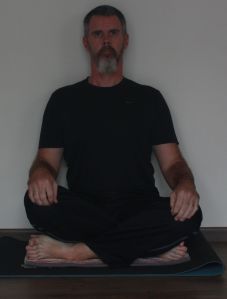
Sukhasana (Easy Pose)

5.) Sukhasana (Easy Pose): One simply folds the legs so that each leg rests on top of the opposite foot. This is a popular crossed legged seated posture. For reasons to be explained, it’s usually not considered a meditative posture.

Pros: As the name suggests, it’s an easy seat for most people to assume. Because the leg is resting on the opposite foot, the knees don’t have to (re: can’t) lay flat on the floor, and so this is pose is more comfortable for practitioners with tight glutes or who otherwise can’t open their hips — for short time periods at least.

Cons: The downside of not putting the knees down, is that the posture is not nearly so stable as the others that will be mentioned. Instead of a big triangle running from one’s sit-bones out to the knees and between each knee, one is resting on a small triangle with the gap between the sit-bones as its base. Furthermore, there will be a pronounced tendency to slump in the back in this pose, and this makes Sukhasana not ideal for sitting more than a few minutes.

Notes: As I mentioned, this isn’t a good meditative posture because it’s unstable and prone to back pain over relatively short periods. I mention it here because many beginners can only manage to do this pose. If that is the case for you, you will probably want to look at using props to achieve a comfortable position (e.g. lifting the hips), if you intend to practice more than five minutes or so.


Swastikasana (Auspicious Pose)

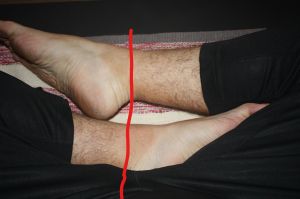
4.) Swastikasana (Auspicious Pose): Note: this pose and the next (Siddhasana – Accomplished Pose) are quite similar, and it’s hard to see the difference in photos, but I’ve added a couple pictures and some text description to try to clarify the difference. Bend the left knee and place the left sole against the inside of the right thigh. One will then bend the right leg and, squeezing the left foot into the space at the crook of the right leg, tuck the right foot into the space between the left thigh and calf muscle. Tucking the feet in is important to making the posture comfortable — particularly the bottom one, which can be compressed if not positioned properly.

The difference between this pose and Siddhasana is simply that the heels aren’t aligned on one’s center-line, but rather the left heel will be to the right side of one’s center-line and the right heel will be to the left. If one’ imagines the line below were straight and on the body’s center-line, one can see how Swastikasana has the heels / ankles offset.
Pros: The posture is much more stable than Sukhasana and, while not quite as wide a the base as Siddhasana, it avoids Siddhasana‘s disruption of circulation caused by the bottom heel being pressed against the perineum / genitals (depending upon gender.) That makes Swastikasana‘s strength its position on the middle ground. It’s stable enough for meditation but doesn’t require as much flexibility in externally rotating the thighs as does Padmasana (Lotus Pose.)

Cons: Some people (including the author) have troubles squeezing the feet into the gaps between thigh and calf — i.e. if one has thick legs, it can be problematic. Both this pose and Siddhasana are contra-indicated for those with sciatica or sacral infection (Sacroiliitis.) Some traditionalists would say that the lack of stimulation to the moola bandha / perineum is a con as well.

Notes: Both this posture and Siddhasana can be practiced with either leg folded first, and many teachers recommend alternating for those students who spend a lot of time in meditative poses, because the postures aren’t symmetrical and muscular asymmetries may develop if one always does it on the same side.


Siddhasana (Accomplished Pose)

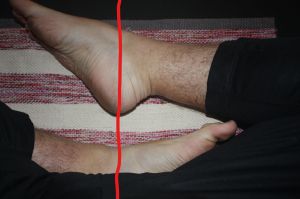
3.) Siddhasana (Accomplished Pose): As mentioned, the gist of this pose is the same as Swastikasana, except that the bottom heel will be aligned on one’s center-line, pressing into the perineum lightly, and the heel of the top foot will be in alignment with the bottom foot. (Note: Males will probably have to do some genital re-positioning to make this position comfortable.)

The picture below shows how the heels are aligned on the body’s center-line.
Pros:  While not without controversy, many teachers propose that having the heel pressing into one’s body has advantages in stimulating the moola bandha – including helping the practitioner be chaste.

Cons: The aforementioned controversy involves potential damage done by long-term disruption of blood flow in the area. It should be pointed out that there’s no reason to think that short term pressing of the heel into the groin — as is done in janu shirshasana (head-to-knee pose) — is problematic. However, meditation may involve much longer disruption in blood flow. So while some opponents of Siddhasana would agree that it helps attain chastity, they might argue that potentially causing impotence is not an ideal way to achieve that control over one’s sexuality — if control is even needed in the first place. 

Note: When practiced by women, this posture is sometimes referred to as Siddha Yoni Asana, which just reflects that contact point with the heel is a bit different owing to differences in anatomy in the region.
 

Ardha Padmasana (Half Lotus Pose)

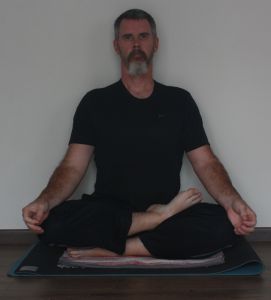
2.) Ardha Padmasana (Half Lotus Pose): The left foot will be folded in so that the left sole rests on the right inner thigh, much as in Swastikasana, and the right foot will be folded up into one’s left hip crease with the left heel as close to the navel as possible. One may need a prop (e.g. block or rolled up towel) under one’s elevated knee — especially for long term sitting. As mentioned with regards the previous two poses, this pose can be practiced on either side, giving one the opportunity to work out the asymmetries.

Pros: Half lotus offers some of Padmasana‘s (Lotus Pose) advantage in terms of stability in the lower back, without having to have quite as much flexibility in external rotation of the thigh. As a person with thick legs, but flexible hips, I find ardha padmasana and padmasana tend to be more comfortable than the preceding poses for me, personally.

Cons: The asymmetry of this pose is considerable, and failure to balance it out will be problematic. Also, if one doesn’t have sufficient hip flexibility, one may end up putting a dangerous torque onto the knee joint.
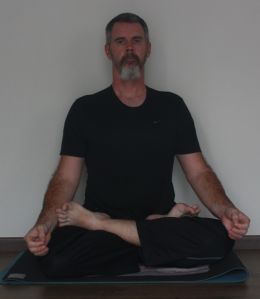
 

Padmasana (Lotus Pose)

1.) Padmasana (Lotus Pose): One will take the left leg and fold it so as to put the left foot into the crease of one’s right hip with the left heel as close to the navel as possible. One will then take the right foot and folding it over the top of the left so that it comes to rest at one’s left hip crease. One may want to (or need to) press both knees inward to get the legs into a stable position.

Pros: This posture is not only very stable; the lower back achieves a tension that allows one to keep one’s back upright for much longer periods of time without the back starting to slump — leading to the back pain inherent in that slump.

Cons: This takes: a.) a fairly high level of hip flexibility; b.) strong knees that will not become damaged by the torque of getting into or maintaining the pose; c.) the ability to live with discomfort, because it will be somewhat uncomfortable at first even if one has flexible hips and strong knees.

Note: For meditations of less than 30 – 40 minutes, I find padmasana to be the most comfortable and stable pose. However — at least with my thick legs — disruption of circulation of both blood and lymph becomes problematic for longer practices, and in longer meditations I tend to use poses with hips elevated and legs loosely crossed.


This is by no means a comprehensive list of seated poses used in meditation. Notably, there is the posture vajrasana (thunderbolt pose), in which one is seated back on one’s heels with the knees pointing in front of one. Since this pose puts the entire body weight onto the lower legs, circulation disruption can be substantial over long periods. Virasana is similar, but one sits down between the feet, which is challenging for the knees. While both of these postures may be hard to hold in their classic form for extended periods of meditation, variations using props — e.g. a bolster — may be the perfect solution for students who have trouble with all of the poses listed above.

BOOK REVIEW: Hidden Depths by Robin Waterfield

Hidden Depths: The Story of HypnosisHidden Depths: The Story of Hypnosis by Robin Waterfield
My rating: 4 of 5 stars

Amazon page

“Hidden Depths” is a history of hypnotism in the Western world from speculative discussion of its use in the ancient world through its employment for self-improvement in the modern era. It’s a bold undertaking. For one thing, hypnotism as we know it today given the insight of modern science is a relatively new phenomenon. Historically, what we call hypnotism has existed variously in the domains of religion, spirituality, pseudo-science, entertainment, and outright fraud. For another thing, the hypnotic trance is a subjective experience and an individual’s susceptibility varies greatly, leaving some scholars to doubt to this day that a hypnotically-induced trance is a real thing. Added to all that, another aspect of confusion is that there are few activities that are so firmly wrapped in misconceptions in the popular mind as hypnosis. The hypnosis of fiction and film is different from the practice as it exists in the real world.

Waterfield takes on the aforementioned difficulties throughout the book. He tends to error on not calling any practice hypnosis unless the descriptions of it in historical documentation are quite explicit on a range of criteria we currently associate with hypnosis. I was ambivalent about this skew. On the one hand, I sometimes wished that Waterfield had more expertise in hypnosis (as a practitioner rather than as a historian) as it might have given him greater insight into hypnotic activities before that word (or its predecessor “mesmerism”) evolved. It seems dubious that all mentions of hypnotic activities are going to be described in a way that makes the state of consciousness readily identifiable to a lay reader, and some reading between the lines might be of benefit. On the other hand, I’ve read books by hypnotists who are what Waterfield (quite properly) calls “hypnotic imperialists” – i.e. individuals for whom any activity that involves suggestion or persuasion is hypnosis. So, it is easy to go to far, and to start calling everything hypnosis. While at times I thought Waterfield suffered from that chronic malady of historians (i.e. thinking that a thing never existed before the first mention of it in the earliest texts they can find), ultimately, I think his approach was sound in that he presented the thoughts of other authors about what activities constituted hypnosis and then offered his reasons for discounting (or not discounting) them. That seems to be a sound line to take.

The first couple chapters discuss this complex question of what hypnosis is and how we can tell it from other states of consciousness (if we can) and they also refer to the earliest mentions of activities that may (or may not) have involved hypnotically-induced trance. It is only when we get to chapter three that we get onto terra firma on the history of hypnosis. That’s when Franz Anton Mesmer enters the picture. Some credit Mesmer with inventing hypnosis. [Note: It wouldn’t come to be called “hypnosis” until a surgeon by the name of James Braid later coined that term. It did become known as “mesmerism,” reflecting Mesmer’s role in development of the technique and / or his fame. Personally, I always cringe when I hear someone in the modern world credited with “inventing” mental and physical techniques that require only a body and conscientiousness, rather than a particular state of technological advancement. It stinks of what a beloved professor of mine used to call the “outhouse fallacy” – the idea that because earlier people had no indoor plumbing that they were complete blithering idiots.] Mesmer was a study in contrasts. He thought himself a man of science and railed against the accusations of false science, but he also wore a cape and engaged in bizarre showmanship that one wouldn’t want to see if one went to one’s doctor’s office for a check-up. While it turned out that the hows and whys of Mesmer’s method are generally considered pseudo-scientific quackery (Waterfield is more diplomatic), it seems clear that the man had a gift and /or a skill for inducing trances.

There are chapters on the early use of hypnosis in both the United States and the United Kingdom, including by both doctors and religious men. There is also a discussion of the early debate about whether hypnosis presented a public safety danger. While the consensus view today is that a hypnotist can get most people to do something they wouldn’t ordinarily do, he or she can’t make them do something they don’t want to do, at the time there was a concern that nefarious hypnotists might use hypnosis to prey on women or even to make an assassin of an unwitting stooge. There is a lot of interesting legal history to be discussed involving individuals who pled non-guilty by way of mind control. The discussion of hypnotism for nefarious purposes is revisited in chapter 12, which deals not only with persuasion by advertisers but also [unsuccessful] government attempts to make Manchurian Candidates (programmed assassins who would kill on command, but have no recollection of it in a state of ordinary waking consciousness.) The idea that a hypnotist could make a subject do anything they wished is a notion that has died hard, but remains alive and well in fiction. I should point out that Waterfield addresses many of the more prominent fictitious applications of hypnosis, and – as an avid reader – I found this to be of literary interest, while as a person interested in human behavior I was intrigued by the influence of fiction on people’s decisions and behavior.

The middle of the book also has a chapter that discusses a widespread notion that hypnosis was key to unlocking super-normal skills of extra-sensory perception (ESP.) While that part of the chapter might not be of much interest to the skeptically minded reader, chapter 8 also addresses the fascinating and well documented phenomena of false memories. The book devotes a chapter (ch. 9) to Freud, another individual who went from being at the top of his field to being widely disregarded by modern psychology.

Chapter 10 elucidates the debate over whether the hypnotically-induced trance is actually an altered state of consciousness, distinct from other states. As I said, there are many psychologists today who believe that it’s just suggestible people in a state of waking consciousness. This chapter lays out the arguments on both sides. While the author argues for the considering hypnotic trance a unique state, to his credit he gives fair hearing to the opposition.

Chapters 11 through 13 consider hypnosis in the modern era as a tool used in medicine, mind-control, and self-improvement. The first and last of these applications are alive and well. Attempts to use hypnosis for mind-control seem to have been written off with the debacle of MK-Ultra. However, that chapter (ch. 12) also deals with hypnosis related to sales and persuasion. However, use of hypnosis as drug-free analgesic as well as for other medical purposes, as well as to quit smoking or stick to diets is alive and well. The final chapter is a short plea to keep interest in genuine hypnosis alive. The book has illustrations, annotations, and a bibliography.

I found this book to be interesting and thought-provoking and would recommend it to anyone wanting to learn more about hypnosis — particularly its history in the Western World.

View all my reviews

Crazy Wisdom Sonnet

one can’t get to that sacred place direct
one must pass through a station called CRAZY
your mind and that wild line don’t intersect
and the path between is dim and hazy
you’ll find there is no you, you can detect
as you flicker in and out, mind-phasing
til on the far side emerges perfect
a mind that fires bright and remains blazing

beware he who values his sanity
above the wisdom of this space-less place
flashing sane is just a passing vanity
but madness brings a timeless kind of grace

It’s venturing through the dark that steals will,
but venturing through the dark steels the will

BOOK REVIEW: How to Change Your Mind by Michael Pollan

How to Change Your Mind: The New Science of PsychedelicsHow to Change Your Mind: The New Science of Psychedelics by Michael Pollan
My rating: 5 of 5 stars

Amazon page


Psychedelics have been coming back into mainstream interest of late. Until recently, this renewed interest mostly occurred quietly through a continuation of scientific study, a promising line of inquiry that was aborted in the late 1960’s. There is growing evidence that these substances may be useful for combating depression, anxiety, and addiction – as well as their other, long-known benefits. (It should be noted that while it seems the writing is on the wall for these substances to become medically legitimate, it remains controversial whether they will be legalized for use by well individuals – though some were legalized in the US for a small religious group that takes them as a sacrament of their faith.) This book by the immensely popular immersion journalist, Michael Pollan, has brought the topic front and center into mass awareness, and may help turn the tide of a sullied public image.

Because these substances remain widely unknown or misunderstood, allow me to present some background — much of which Pollan discusses in varying degrees. Unfortunately, the term “psychedelic” has become so loaded with layers of meaning that it’s not optimal for discussing the topic at hand. Literally, psychedelic means “mind manifesting,” but its common meaning is tied up in notions of 1960’s counter-culture and even with styles of art and music. However, alternative terms are also troublesome. “Psychoactive substances” (i.e. chemicals that change mind states) encompasses a much broader selection of molecules and medicines – though it’s probably the most neutral term used popularly today. “Hallucinogens” is also problematic because a large portion of consumers of these substances don’t have hallucinations – at least not of the full-blown variety people normally associate with that term (i.e. seeing sights that one genuinely believes exist, but don’t.) Pollan opts to largely stick with the loaded term of psychedelic, and thus will I throughout this review.

Psychedelics are chemical substances that change one’s mindset, typically creating euphoria, shutting down “I”- centric parts of the brain such that one feels a “oneness” commonly described in the mystical traditions from around the world, and which, yes, often generate sensory experiences that aren’t reflective of the actual environment (hallucinations.) The downside is found in the fact that the substances produce constructive experiences, which means they amplify what’s in the subject’s mind, and, therefore, can result in “bad trips” in which people hallucinate terrifying products of their own subconscious mind. Pollan focuses heavily on three of the most popular psychedelics: psilocybin (naturally produced in a common species of mushroom), LSD (a chemical synthesized from ergot fungus that grow on rye), and DMT (which is most famously an active ingredient in Ayahuasca, a concoction long brewed by Peruvian Shamans.) Mescaline, which is well known from the writings of Aldous Huxley, is another popular psychedelic, but one which Pollan only mentions in passing.

To wrap up the background portion of the review, a little history. Psychedelics have been used by shamanic traditions around the world since time immemorial. In 1938, Albert Hofmann, a chemist for Sandoz Laboratories, accidentally synthesized LSD. That marked the (re-) introduction of psychedelics to the modern Western world (the ancient Greeks were believed to have mixed something with their wine that sounded like it had psychedelic properties.) Unbeknownst to most, between Hofmann’s invention and the late 1960’s, there was a promising line of research on the use of psychedelics for various conditions as well as in non-medical domains – e.g. relating the psychedelic experience to religious / mystical experience.

Unfortunately, there was a two-pronged turn of events that would end in these substances being made illegal and categorized “Schedule I” (which deems them not only risky / requiring care of use, but also denies they have any legitimate medical use – the latter seems to be proven demonstrably incorrect.) The well-known prong in the death of psychedelics resulted from the substances becoming tied into the 1960’s counter-culture, at first through shoddy scholarship by academics – most famously Timothy Leary – and then through recreational use that typically stripped away the rituals and “protocols” that had allowed shamans and mystics to safely use these substances for millennia. The second prong was government-sanctioned shenanigans in which LSD was used and misused in an attempt to create everything from truth serums to mind-control agents – most famously the MK-Ultra Program, and its sub-projects such as Operation Midnight Climax during which the CIA illegally used prostitutes to “roofie” their customer’s drinks with LSD so that a spy could covertly watch to determine whether the johns got loose-lipped or not. (Note: Pollan writes at length about the former aspect [i.e. Timothy Leary, Ken Kesey, et. al.] though not as much as books like Lattin’s The Harvard Psychedelic Club or Wolfe’s The Electric Kool-Aid Acid Test. However, Pollan only gives passing mention to MK-Ultra.) Psychedelics might have remained out of the popular consciousness and only of interest to the fringe of society that was involved with “hard drugs” had it not been (in addition to renewed scientific interest) for a blooming interest by Silicon Valley engineers and executives who took to “micro-dosing” psychedelics to obtain creativity gains.

Now, I’ll get to the review, proper: As I mentioned, Pollan refers to himself as an “immersion journalist,” which means that he provides a two-in-one book. The first element is what one would expect in a popular science book on psychedelics, i.e. he reports on the scientific findings, the key history and background information, and delivers quotes from people he interviewed. The second element, however, is description of his own psychonautic journey. Pollan consumed psilocybin mushrooms, LSD, ayahuasca (DMT), and also a substance excreted by a toad that lives in Mexico and the Southwestern US. The reader gets both Huxlian “trip reports” (though Pollan remains much more scientific-minded and less mystical than Aldous Huxley) as well as the objective overview of the topic.

The book consists of six chapters as well as front and back matter. The first chapter discusses the psychedelic “renaissance,” i.e. how it came to be that these substances brought back from the dead – i.e. being purely of interest to “druggies” and far-flung shamanic traditions. Chapter 2 deals largely with mushrooms, and specifically psilocybe mushrooms that are the most popular and common type of psychedelic mushroom. Pollan spent time with Paul Stamets, a world-renowned expert on all-things fungi and the man who – literally – wrote the book on psilocybe mushrooms. Chapter 3 focuses heavily on LSD, including its development and rocky history. The fourth chapter is a “travelogue” in which Pollan discusses his own experiences in taking these substances. The penultimate chapter is about the neuroscientific findings. There is much that remains to be known, but yet somethings are well-known. These substances generally mimic the neurotransmitter serotonin (though mescaline, for example, mimics dopamine.) There is also a fascinating discussion of how these substances may temporarily reduce activity in the default mode network, which is prominent in generating one’s sense of self. The final chapter examines the findings of research into the use of psychedelics as a treatment for medical conditions – particularly depression, anxiety (especially death anxiety of terminal patients), and addiction (contrary to a widespread notion, resulting from these substances being lumped in with “hard drugs,” psychedelics not only aren’t addictive, but – in many patients – they counter addictions to more dangerous drugs, such as alcohol – yeah, you read that right.)

The book contains the usual ancillary matter, including: a glossary, bibliography, and notations. As the approach is narrative, graphics are minimal.

I found this book to be highly informative and extremely readable. The use of stories to convey information makes it engaging while it educates. I would highly recommend this book for any readers who are interested in psychedelics as medicine or a mystical experience.

View all my reviews

BOOK REVIEW: Superhuman by Rowan Hooper

Superhuman: Life at the Extremes of Our CapacitySuperhuman: Life at the Extremes of Our Capacity by Rowan Hooper
My rating: 4 of 5 stars

Amazon page


There are mounds of books out on the science of maximum human performance, be they on mind-hacking, sports & exercise science, or some combination thereof as applied to a particular pursuit. Hooper creates his niche by way of a broad and varied selection of topics, including: language learning, singing, running, achieving longevity, and sleeping. For the reader who is interested in the topic of how top performers in a given domain achieve that supernormal performance, it makes for an interesting read. However, it may leave some readers scratching their heads as to who the book is aimed at. It should be noted that several of the topics addressed are of much more broad-ranging appeal than those I mentioned (e.g. focus / attentiveness, bravery / courage, and resilience.)

The book is divided into three parts on “thinking,” “doing,” and “being,” respectively. The four chapters in the first part investigate the heights of intelligence, memory, language, and focus. The chapter on language deals with how some people are masterful polyglots, speaking many languages, as opposed to the harder to investigate question of how someone becomes William Shakespeare. Throughout the book, there is a mix of stories and interview insights from those who are peak performers as well as discussion of what scientific studies have found. The former makes up the lion’s share of the discussion, and the central question with of science is how much of peak performance is genetic and how much is built.

Part II, on doing, has three chapters, exploring the topics of bravery, singing, and running. This is where one really sees the book’s diversity. Books like Amanda Ripley’s “Unthinkable” address the question, among related questions, of why some act heroically, and there are a huge number of books on how to be the best runner or singer one can be, but not a lot of books take on all three questions in one section. The book on singing focuses on opera singers who belt out their tunes largely sans technology – i.e. there’s no Milli-Vanilli-ing L’Orfeo. The chapter on running gives particular scrutiny to endurance running.

Part III investigates why some people live longer, are more resilient, sleep better (or do well with less sleep,) or are happier. Since Buettner’s “National Geographic” article on “blue zones” (i.e. places where a disproportionate percentage of the population live well beyond the average human lifespan,) there’s been a renewal of interest in what science has to say about longevity. As mentioned, the chapter on sleep covers the topic from multiple vantage points. Everyone needs sleep, but some perform best with ten or more hours of sleep while others are extremely productive on four hours a day, and some can cat-nap periodically through the day while others need a single extended and uninterrupted period of sleeps. Wisely, Hooper doesn’t simply take on the question of why some people are happier than others in the book’s last chapter, but rather he asks the more interesting question of why some people who have every reason to be morose (e.g. paralyzed individuals) manage to be ecstatically happy.

The book has a references section, but there isn’t a lot of ancillary matter (i.e. graphics, appendices, etc.) It’s a text-centric book that relies heavily on stories about Formula-1 racers, opera stars, ultra-marathoners, and other extraordinary individuals while investigating the subject matter.

I enjoyed this book. I am intensely interested in optimal human performance across a range of skills and characteristics. So, I guess when people inevitably ask who the book is directed at, it’s directed at me and others with this strange fascination. If you have that interest, it’s for you as well.

View all my reviews

5 Haiku on Consciousness


thoughts form & float,
reflections of a gliding bird
over murky pools.


sleeping deeply,
universe? where art thou?
do you rest too?


within my dreams,
i feel the familiar,
but see the strange.


images gel,
but seeking sense in them
sends them hiding.


next car rolls fore,
i yank the parking brake,
halting false back drift.

BOOK REVIEW: Be As You Are ed. by David Godman

Be As You Are: The Teachings of Sri Ramana MaharshiBe As You Are: The Teachings of Sri Ramana Maharshi by Ramana Maharshi
My rating: 4 of 5 stars

Amazon page


In the early days of yoga, before there was Power Yoga or Yin Yoga — or even Hatha Yoga or Raja Yoga, there were three approaches to yoga. Bhakti yoga was devotional yoga, the yoga of the believers who pursued the path through worship. Karma yoga was the yoga of action: practiced by doing selfless deeds. Jnana yoga, often said to the hardest, was the path of knowledge, and it involved intense study and – in particular – introspective study of the jnani’s own mind. Sri Ramana Maharshi was one of the most well-known Jnana yogis of modern times (he lived from 1879 to 1950.)

This book presents Sri Ramana’s teachings in a question and answer format. The editor, David Godman, begins each chapter with an overview of Ramana’s views on the subject at hand, and he then launches into the Q&A exchange that makes up most of each chapter. The preludes are beneficial not only because they set up the topic, but also because they help separate Ramana’s core beliefs from the way he occasionally explained matters to non-jnani’s or those who weren’t ready to grasp what he believed was the fundamental teaching. (There’s a fair amount of, “Until you realize the self, X is true, but after you achieve self-realization Y will be true.)

Sri Ramana’s central teaching is that the jnani must actively inquire about the nature of the true self (a practice called atma-vichara, or self-inquiry.) As such, the book is organized as a guide to building a practice of self-inquiry.

The book’s 21 chapters are divided among six parts. The first part investigates the self as Sri Ramana refers to it. This isn’t the individual self that one is normally referring to in common speech. Part II is entitled “Inquiry and Surrender” and three out of the four chapters, herein, discuss the process of self-inquiry. Three chapters may sound like a lot, but this practice really is the core of jnana yoga. These chapters not only explain how self-inquiry is done and what it’s supposed to achieve, they also contrast the practice with others that bear a resemblance to atma-vichara, such as reciting “Who am I?” as a mantra, as well as, neti-neti — an exercise in negation in which one considers all the things that aren’t the self (e.g. “I am not my body.” “I am not this thought,” etc.)

Part III is about Gurus and transmission of teachings. It takes on such questions as: is a Guru necessary, and what constitutes a Guru (i.e. must it be a living human? Can it be a book?) The second chapter in this part is about sat-sang, which may be literally translated as “sitting with the guru,” but refers to a kind of transference that flows from being together.

Part IV is on meditation and yoga. Sri Ramana differentiates self-inquiry from meditation, though superficially they seem to be similar activities. He discusses dharana (concentration) and mantras in these chapters as well. One inclusion that may seem unrelated to the general theme is chapter 12, which is about the four-stage model of life called the asramas (student, householder, hermit, ascetic.) The chapter on yoga is about the eight limbs of yoga described by Patanjali, and their relevance to the practice of Jnana yogi. It should be noted that Ramana downplays the importance of these practices to the jnana yogi (a.k.a. Jnani) with the exception of pranayama (breathing exercises.)

Part V discusses samadhi, siddhi (supernormal psychic powers that some yogis believe can be achieved), and other challenges and phenomena that may be experienced during one’s practice of self-inquiry. While superpowers sound cool, Sri Ramana (as well as Patanjali) warned against he pursuit of these abilities as they become distractions from obtaining self-realization.

That last five chapters are grouped under the title of “Theory.” These chapters deal in the big “meaning of life” kind of philosophical questions. Much of these chapters consist of Ramana telling the interviewer to stop over-intellectualizing about obscure philosophical matters and start asking oneself who is asking the question (in other words, get back to self-inquiry and forget about abstract navel-gazing.) At any rate, the questions include: was the universe created, and – if so – how? is reincarnation real? what is the nature of god? is karma real? is free will real? etc. They are fascinating questions, and Ramana offers a few intriguing ideas, but mostly discounts the value of philosophizing.

There are no graphics in this book, but there is a glossary, notes, and a bibliography.

I found this book to be thought-provoking. At times it can be a bit repetitive. The key point that Ramana sought to get across is (in theory, not practice) straightforward. At times it seems like the questioner is badgering the witness because he doesn’t like the answer, such as when Godman wants Sri Ramana to elaborate on the nature of suffering and the need for compassionate acts. Ramana keeps telling Godman to just go back to self-inquiry and all will take care of itself. That said, Sri Ramana offers some fascinating thoughts, and generates beautiful food-for-thought.

I’d recommend this book for anyone who wants to know more about jnana yoga or to get a different take on the philosophy of yoga in general.

View all my reviews