BOOK REVIEW: Siddhartha’s Brain by James Kingsland

Siddhartha's Brain: Unlocking the Ancient Science of EnlightenmentSiddhartha’s Brain: Unlocking the Ancient Science of Enlightenment by James Kingsland
My rating: 5 of 5 stars

Amazon page


Kingsland builds his niche by connecting the dots between the teachings of the Buddha and scientific discoveries about meditation and mindfulness. There are many books that tell the life story of Siddhartha Gautama from various perspectives (e.g. famously the books by Hermann Hesse and Karen Armstrong.) There are also a number of books reporting the science of meditation (e.g. Herbert Benson and Sat Bir Singh Khalsa.) However, it’s not so common for the subjects to be overlapped.

There’s a reason that this middle path hasn’t been more widely studied. While Buddhism is arguably the most science-friendly of the major world religions, there’s always a gulf between spiritual and scientific thinking. The writer has to figure out how to chart a course through rocky waters. Books appealing to spiritual seekers are likely to come across as insubstantial fluff to the scientifically minded reader, and books appealing to skeptics are likely to feel materialistic and cold (and, perhaps, naive) to the spiritualist. The Buddha’s teachings about the need for the practice to be experiential, rather than faith-based, offers a unique opportunity to tread this tightrope. Furthermore, the Dalai Lama’s willingness to facilitate a dialogue between science and Buddhism has been crucial as well. One can easily set aside controversial issues like reincarnation and karmic law as they aren’t essential to the value of mindfulness.

The book consists of twelve chapters. The chapters generally begin with a story or teaching from the life of Buddha, and then go on to investigate the relevant lesson in more detail with particular emphasis on any relevant scientific discoveries that support said teachings.

The story of Buddha begins in a wealthy, high-caste household with young Siddhartha Gautama being kept from seeing the effects of aging, illness, and death. When the young Siddartha, nonetheless, sees these things, it is a powerful introduction to the concepts of impermanence and suffering that will play a central role in his future teachings. Chapter 1 starts this introduction and also offers an overview of the book. Chapter two continues it. In Chapter three, Kingsland describes a little of the known history of meditation, though its origins are lost to time.

Chapter 4 is entitled “The Second Dart” and it discusses the Buddha’s teaching of the same name—the second dart being one’s mental reaction to an event (i.e. the initial dart.) Chapter 5 investigates the question of whether there is a self—and, if so, of what manner. A core idea within Buddhism is that the self is illusory.

Chapter 6 gets to the heart of the matter by explaining the mechanism of mindfulness meditation and what has come to be known as MBCT (Mindfulness Based Cognitive Therapy)—a secular approach to the use of mindfulness to improve well-being. The next chapter tells the story of how a group of fire worshippers came to follow the Buddha after he made clear that everything (their senses, thoughts, and emotions) were aflame with craving, hatred, and delusion, and that springboards into a discussion of how mindfulness is used to reduce craving and addiction.

Chapter 8 tells the story of an attempt to kill the Buddha via an angry, drunk elephant, and the Buddha’s thwarting of the plot by way of calm and compassion. As one might have guessed, the chapter is about moderating emotions, just as the Buddha controlled his fear before the elephant.

Chapter 9 takes a jaunt into evolutionary biology to question how the mismatch between what humans evolved to do and what we do in the modern world causes mental illnesses and how mindfulness can help mitigate the problem. Chapter 10 is about metacognition, or the ability to observe and reflect upon our own mental experience—i.e. thinking about thoughts. Chapter 11 is about cognition and decision-making, and the role that meditation can play in improving our performance in this domain. The last chapter discusses the Buddhist conception of death and enlightenment. It isn’t until this point that there’s a major divergence between the Buddhist and scientific viewpoints. There is a discussion of the Buddha’s teachings emphasizing that belief in ideas from on high is not so important as experience.

Six of the chapters (2, 4, 6, 8, 10, & 11) are concluded with guided meditations to offer the reader an introduction into the basics of mindfulness. These are simple practices that many readers will already be familiar with in some variant or another. (e.g. breath awareness, bodily awareness, and mindful eating.)

There are only a few graphics (e.g. maps and diagrams—mostly of the brain) but there is no need for additional graphics. The book has references annotated.

I found this book interesting and thought-provoking. It uses the stories of Buddha as well as some stories from the present day to make the reading more engaging and approachable. The discussion of scientific research is easy for a neuroscience neophyte to follow.

I’d recommend this book for anyone interested in learning more about the science behind Buddhist practices.

View all my reviews

BOOK REVIEW: The Discourse Summaries by S.N. Goenka

Discourse SummariesDiscourse Summaries by S.N. Goenka
My rating: 4 of 5 stars

Amazon page


I began reading the summaries before I attended the Vipassana meditation 10-day course. While most of one’s days are spent in meditation, each evening they play video-taped discourses by S.N. Goenka, with each running for an hour to an hour-and-a-half. As the title suggests, this book consists of edited transcripts of those talks. As the course is known for being challenging (approximately 10 hours/day in meditation, noble silence [no talking–or even acknowledging–anyone but the teacher and staff], and no distractions [no phones, no books, no journals, no i-Pods, etc.]), reading the discourses was a way to mentally prepare for the course. (Though I’d already read a book call “Equanimous Mind” by an individual who’d completed the course.)

Let me provide background for those unfamiliar with Vipassana meditation. It’s nominally a Theravadan Buddhist practice, but its religiosity is stripped to a minimum and it’s presented in a largely secular manner. That doesn’t mean that a scientifically-minded skeptic such as myself isn’t occasionally left scratching his head and thinking “that’s not right.” However, it’s repeatedly emphasized that one should take what is of value to oneself and leave the rest behind, and so while there are a few notions mentioned during the discourses that aren’t supported by evidence, one needn’t believe anything controversial to benefit from the practice. (e.g. Karma and reincarnation are mentioned, but if one doesn’t believe those are likely realities, it doesn’t change the effectiveness of the meditation.)

Moving on, Theravadan Buddhism is the branch that is most commonly practiced in Southeast Asia. (It’s sometimes called Hinayana, but—as I learned during a discourse—that’s considered a derogatory term by many Theravadans. “Hinayana” means “lesser vehicle” in contrast to Mahayana’s “greater vehicle,” and the implication is that it’s a path by which only a more select group can achieve enlightenment. One can readily see why this would be objectionable to Vipassana practitioners as they emphasize that the practice is available to everybody [one need not even identify as Buddhist] and that the practice is the heart of the path to enlightenment.) Vipassana meditation involves systematically scanning one’s body for sensations and acknowledging them without attaching positive or negative thoughts and labels to them. The idea is to train oneself to not mindlessly react to sensations, nor to mindlessly attach values to them.

There are eleven discourses, corresponding to the days over which one is at meditation center. However, the new information is mostly in the discourses from days one through nine. The last two discourses consist of a review and a discussion of to how to keep one’s practice going—should one choose to do so.

The discourses present two types of information. On one hand, they provide a primer on Buddhist philosophy regarding the path to enlightenment. For example, Goenka explains the Four Noble Truths and the Eight-fold Path. The Four Noble Truths describe human suffering, its causes, and the path to moving beyond this suffering. That path brings one to the Eight-fold Path which describes eight areas in which one must properly align one’s approach in order to eliminate said suffering.

On the other hand, the discourses provide information about the meditational practices and the logic that informs them. During the first few days of the course, one focuses on respiration and related sensations over a progressively smaller area around and on the nose. Then, on the fourth day, one gets into the Vipassana practice as mentioned above (scanning the body for sensation), but one practices several variations of this over the last few days of the course. It seems that one practices these different ways both because one becomes capable of more challenging approaches and because not everybody experiences the same types of sensations, and so some methods work better for some types of sensations than others. To give an example, on day one might scan one arm at a time, but then one shifts to scanning both arms simultaneously.

There are no graphics and the only ancillary matter consists of a list of Pali quotations as well as a Pali term glossary. (Pali is the language in which the Buddhist scriptures were originally written.) However, there was really no need for either graphics or notations.

I found these summaries were worth reading even having gone through the course and heard the discourses at the center. For one thing, there’s a good amount of information packed into the lectures. While it’s not hard to understand, there’s a high density of information content. For another, Goenka was a charming and humorous individual, so it’s not boring to watch the taped discourses even if one has previously read them.

I would definitely recommend reading the Discourse Summaries if one is considering taking the Vipassana course.

View all my reviews

My Vipassana 10-Day Experience: No Solidified Gross Sensations, No Gain

woman-pointing-at-herself6

It’s 4:45 in the morning and I’ve been sitting on my cushion at the Dhamma Setu Vipassana Meditation Center in Chennai, India for a quarter-hour. It’s day one, and I’m observing my breath as it comes in and out through my nostrils—at least for seconds to minutes at a time before I have to coral my mind back from some random tangent. This breath exercise (ānāpāna-sati), I will soon learn, is a preparatory exercise used to reign in the mind enough so that actual Vipassana meditation can be introduced on the middle of the fourth day. In eleven days, I’ll be in the closing session of the course.


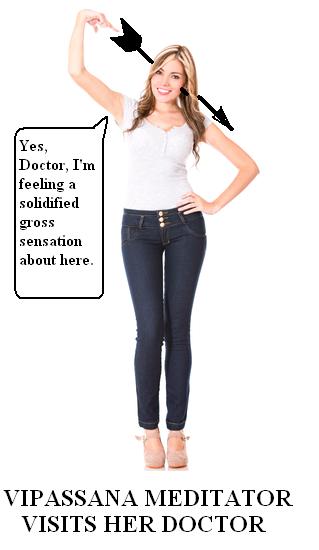
There are several approaches to Vipassana meditation taught throughout the balance of the course, but the gist is the same for all of them. One rotates one’s awareness throughout the body systematically observing sensations. As one does this, one works toward equanimity, a calm and quiet state of mind in which one neither covets pleasurable sensations nor shuns unpleasant sensations. The idea is to train the deepest level of the mind to not habitually lunge one toward pleasure or away from displeasure.  (FYI: displeasure = pain.  At least for a novice, such as myself, there is a fair amount of pain involved in sitting still for such long periods. It’s generally referred to a solidified gross sensation to differentiate it from the uniform and subtle sensations that one may feel in the parts of the body that aren’t in agony. I joke about it here, but there’s good reason to train oneself to not think in terms of pain, and the negative connotation the word evokes.)


At that course’s beginning, I knew a little about Vipassana from research, including reading the book “Equanimous Mind,” one man’s account of his experience in the course. For example, I knew that most people who quit, leave either on day two or day six. At the time, I didn’t know why, but would learn soon enough. It’s nothing about those two days, but rather the days that precede them. Day 1 seems to last forever, and it’s easy enough to discern why it might give students trouble. When one gets through day 1, an optimist says “yeah, I can do this because I’m through the first day” but a pessimist says, “I just barely made it, I can’t do this.” Day 5 is when the strong commitment (adhiţţhāna) is added, which means that one has three one hour sessions during which one is to commit to not changing one’s posture for the whole session. No opening eyes, but—more challengingly—no unfolding /refolding one’s legs.  This commitment to not changing posture steps up the difficulty of the course to another level.


It should be noted that one can opt to sit in a chair. However, that introduces an entirely new challenge—drowsiness. During the long sessions, when I’d get up to walk the lymphatic fluid out of my legs, there were usually two people in a straight-spined meditative position and six to eight who looked to be sound asleep.  (Drowsiness was one reason that I didn’t sit in a chair. I’m prone to get sleepy enough during meditation, especially in a complete absence of caffeine. The other reason was that I’ve not found chairs to be more comfortable for long-sits of meditation. Once your bony parts start pressing into the chair, one begins to wish one was cross-legged on a cushion. One can make the chair more comfortable by placing padding wherever it’s uncomfortable, but eventually one has a virtual La-Z-boy and the drowsiness factor becomes all the more problematic.)


With respect to these strong commitment (adhiţţhāna) sessions, I didn’t make it the full hour without moving on the fifth day–or any day until day 10, in fact. However, I don’t count this as a failure, because I did give it my all. I say that based on the endorphin-induced euphoria, simple hallucinations, and a proprioceptive form of Alice-in-Wonderland Syndrome that I experienced from toughing it out past mere discomfort. I’ll get to what that all means, but for now suffice it to say these happenings were symptomatic of sitting still through the period in which the pain came, grew, and then started to numb out.


In fact, these trippy experiences may, sadly, have been one reason why it never occurred to me to want to leave around day six. While I tried not to get caught up in them, these experiences were fascinating. I could see why day 2 presents a challenge to so many, but day 6 was a hoot, relatively speaking. The second most challenging day for me was day 8, because I’d reached a plateau but I didn’t yet feel myself in the homestretch. But by day 8, who’s going to leave? You’ve gutted it out that long, and are almost done. For those concerned about whether they can make it to the end, I can honestly say that I never seriously considered quitting. It’s not that hard to get through the 10 days, as long as one isn’t too addicted to comfort and communication.  That said, I wouldn’t offer a wholesale recommendation of the course as many do, but rather recommend it on a case-by-case basis. If you’ve done no meditation whatsoever, this is the meditative equivalent of going from couch-sitting to training for an ultra-marathon overnight. If you think you can’t get through nine days of silence–without no phones or books, maybe you can’t, and you should probably reevaluate your life.


I mentioned some of the unusual experiences that I witnessed during the course, and I’ll get into that a bit more. I should preface this by saying that one shouldn’t get caught up in these trippy happenings for reasons I’ll elaborate upon below, but they may happen so it’s worth being ready for them. Here’s a list of the unusual events I experienced:


-Extreme relaxation / lethargy: a little off topic, but between sessions on day 1, I noticed that I couldn’t be bothered to shoo away a fly that kept buzzing around my head with random touch downs. I don’t know how long I walked with the fly buzzing over me before it struck me that this was unusual. This was before Vipassana proper had been introduced, so it didn’t yet seem apropos.


-Olfactory hallucination / vivid scents: on day 2 I witnessed a distinct smell from my elementary school days (i.e. a mix of cleaning solution and milk cartons?) that theoretically could have originated at the Dhamma Setu, but which was quite probably an olfactory hallucination. It was short-lived and I never smelt it again. I did later experience an intense smell of flowers inside the meditation hall. This may well have been an actual scent as there were many blooming flowers there. These vivid scents were also short-lived.


-Endorphin-Induced Euphoria: on days 4 and 5, I experienced this as an almost intoxicated feeling. [Endorphins are the body’s indigenous pain-killers.] As drunks find unfunny things funny, so did I—including the pain in my legs and back. I wondered if anyone would be distracted by my occasional giggle-fits, but I think they were much more subdued than I suspected from my vantage point. Just like I’ve thought I was talking in my sleep in the past, only to be told that it sounded more like faint and indistinct whimpering. On day 6, I experienced a more sophisticated (not drunk-like) form of euphoria that expressed itself as a feeling of “oneness.” I’ve read about feelings of oneness being attributed to a form of transient hypo-frontality—i.e. a shutting down of the parts of the prefrontal cortex (PFC) that track the self / other distinction. There may have been more happening than endorphins (and other neurotransmitters) involved in that happening.


-Lifting sensation: This was the single most awe-inspiring experience that I was party to. For those unfamiliar with seated meditation, one of one’s chief enemies in long meditation sessions is a proclivity to slump. Slumping translates into agonizing back pain and labored breathing. So whenever one catches oneself slumping, one has to straighten one’s back. [If you wonder why a meditator would pretzel up his or her legs in full lotus (padmasana), the alignment of one’s legs helps one maintain a straight spine.] At any rate, on day 6 I experienced the feeling that I was being lifted up straight and it became effortless to maintain a straight back for the rest of that session—as if an outside force were doing the work. This lifting sensation wasn’t like being lifted by a person, but rather like the action of a “tractor beam” from the world of sci-fi. While I have some inkling of the causes of much of what I experienced based on the science of the human body, explanation of this “lift” is harder to come by. I did read an account in Oliver Sacks’ “Hallucinations” by a woman who suffered from migraine-induced hallucinations and Alice-in-Wonderland Syndrome that was a spot-on description of what I experienced as well.


-“Visual” [closed-eye] simple hallucinations: I didn’t experience anything even close to the what people usually think of as a hallucination—that is, there was nothing that could be confused with reality. I wouldn’t have even known to call these images hallucinations if I hadn’t been reading the aforementioned Oliver Sacks’ book. Mine were quite close to what are described as hypnogogic (falling asleep) hallucinations in the Sacks’ book. This makes sense. While I wasn’t drowsy at the time, my brain was probably in a pretty similar state of relaxation. Mostly, these were moving shapes that formed and dissipated in a field of black-fringed purple.  On day 7, there were more complete visuals—mostly of partial faces, usually with mouths wide open. I took this as my subconscious mind’s comment on the noble silence. (On the noble silence: from about 6pm on day 0 [orientation afternoon] until the morning of day 10, one isn’t allowed to talk or in any way interact with / acknowledge anyone except to direct questions to the teacher or staff. Whether one has questions or not, one will speak at least a few words to the teacher every day or two when he / she reviews one’s progress. For some, this may be the single biggest challenge of the course, but I’m a hardcore introvert and could do ten days of silence standing on my head.)


-Tactile Alice-in-Wonderland Syndrome: Alice in Wonderland Syndrome usually refers to a visual form of hallucination in which things appear a great deal taller, smaller, closer, or farther than they actually are. What I experienced was a great deal less whacky and traumatic than that. With eyes closed, I felt a distortion of the size and shape of my arms. Sometimes my arms felt like they were six-foot long from deltoid to fingertips, and sometimes the same points seemed to lie a foot and a half apart. Needless to say, those are both distortions of the actual length of my arms.


-Inexplicable Beatles’ Music: On day 8 my mind bombarded me with music from the Beatles for a little while. In particular I heard “Sgt Pepper’s Lonely Hearts Club Band”, “Lucy in the Sky with Diamonds”, and “All You Need is Love,” or parts thereof, in high fidelity. Now, while this is fine music, it’s not music that I’ve listened to recently nor have I listened to that album a great deal. When I was growing up, there was a copy of “Sgt Pepper’s…” at home, but I’ve only periodically heard these songs on the radio since. The experience was monotonous because only the parts that I knew the words to (i.e. the choruses) replayed on a loop, but the music and voices were crystal clear as if I were listening to the album.  Given the lack of personal relevance, I can only imagine that my subconscious thought this is the kind of music a person meditating would like to hear.


As I said, by about day 8 I’d hit a plateau. The aforementioned odd experiences were petering out, particularly when I did as I was supposed to do and gently returned my mind to the task at hand. Yet, the practice wasn’t getting any easier or smoother. I still had the same dead spots—areas that I could observe for extended periods without even the subtlest of sensations—and I still had growing pain zones in my back and legs—i.e. starting from isolated pains, the pain would become increasingly diffuse and of ill-defined boundaries—but often no less painful.


Now I’ll explain my comment about not allowing oneself to become captivated by the trippy experiences. If one seeks after these experiences, not only is one missing out on the value of the practice, one is actually moving in the wrong direction by coveting an experience while impulsive craving is what one is training oneself away from through Vipassana meditation. Beyond this, seeking out such experiences is likely to be frustrating because they are products of the subconscious mind and physiological processes that are beyond conscious control. They happen when they happen, on your body’s schedule. (Note: Some people think of these as spiritual phenomena. I don’t, but—for those who do—they still won’t happen on your schedule. Ostensibly, they’ll happen on some deity’s—presumably rather tight–schedule. And—divine as they may be—they are still a distraction from the objective of the practice—and that’s not my opinion, but according to the teachers of the tradition, starting with Gautama Buddha and through to S.N. Goenka.)


So when one experiences such phenomena, one should do the same as one always does in meditation, quietly and non-judgementally return one’s mind to the object of awareness—in this case, systematically witnessing the sensations on one’s body. I won’t say that this isn’t a challenge. It is, because your mind is presenting you with something fascinating and new, and you’re asking it to return to a task that has become rather mundane over hours and days of practice. It should be noted, I would broadly categorize the phenomena that I experienced into two slots, one of which is things the brain does to cope with a lack of external stimulation. (The other being, things the body does to cope with unrelenting pain.) So it takes some discipline, but one should remind oneself—as one is frequently reminded during the discourses—that you are there to give the Vipassana approach a fair trial, and as fascinating as these sideshows are they are a distraction from the practice.


That said, these things will happen and their unusual nature may make them points of concern or confusion, and so I’ll discuss them a bit more. I have a theory about the cause of the euphoric experiences, but it requires a little clarification and background. What makes Vipassana challenging for a new practitioner—at least for me— is that in systematically rotating one’s awareness to observe sensations, one has to ignore areas that are screaming with pain while carefully running one’s attention through areas that seem completely devoid of sensation. This requires quieting the mind and especially not feeding the anxiety about one’s pain and discomfort—hence, developing equanimity (steadiness of mind.) Sitting still for an hour at a time, lymphatic fluid piles up in your lower extremities (no pump in the lymphatic system but the one of movement), over time blood circulation may be inhibited, and this lack of circulation has ramifications for the cells not being adequately nourished. So your body notices this fluid build-up (a relatively minor concern, easily rectifiable, and which will take a while to be a serious problem for most people) and sends you some pain sensations to spur you to get up and move about. When you don’t get up and walk, it turns up the discomfort disproportionate to what’s happening with your body. You still ignore it. Eventually, your body starts to think maybe a boulder fell on your legs and you’re in shock (the conscious and unconscious minds don’t talk as much as you might think, and—even if they do—let’s face it, at least the conscious mind is a big, fat liar.) It’s at this point that your body starts to emit some feel-good chemicals. (I refer to “endorphin-induced euphoria,” but it’s more extensive than natural painkillers. In reading up on the subject, I noted references to serotonin and even melatonin (yes, the skin color chemical) in addition to beta-endorphins. I wouldn’t be surprised if there was some dopamine—a reward / feel good chemical—in the mix as well. Hence, the euphoria.


I don’t think it’s necessary to get into the hallucinations and other effects that the mind creates in order to cope with the lack of sensory input. This is a well-studied area, and there’s been a lot written on how the mind hates the dark and the quiet over extended periods. I would recommend the aforementioned book by Oliver Sacks on hallucinations as a case in point.


Saving the most crucial question for last, was it worth it? In his discourses, S.N. Goenka offers three criteria by which one might evaluate whether Vipassana is worth practicing. While all three are sound criteria, I’ll focus on just one of these, which is really the bottom-line, and that’s whether it makes an improvement in one’s life. That is, does one start to be less prone to impulsively react to craving and aversion and become more equanimous of mind?


On this, I’ll have to say that the jury is still out. Many come out of the 10-day course calling it life-changing. I’d say that it was beneficial because I learned a meditative technique that has a sound internal logic (even if one doesn’t believe every aspect of the mechanism by which it is said to work by Buddhists—which I don’t), an established track record of benefit for many, and the feel that it’s benefiting one. However, I’m still evaluating the approach. I’ve been doing Vipassana meditation twice a day with morning and evening affirmations. Let’s face it, 10-days isn’t a long time to overhaul one’s deeply ingrained modes of operation—even sitting in meditation for 10 hours a day. I’m optimistic, and the practice sure doesn’t hurt—except for those solidified gross sensations, they hurt.


Out for Meditation

IMG_2445


I’m doing the Vipassana Meditation 10-day course starting tomorrow. I’ll be out of contact (and thus not posting) until September 11, 2016.

For those unfamiliar with the course: no phones, no books, no notebooks, no interaction with anyone but the staff and teacher, and no exercise.  If it’s not meditation, it’s probably not allowed.

Wish me luck.

BOOK REVIEW: Kokoro Yoga by Mark Divine

Kokoro Yoga: Maximize Your Human Potential and Develop the Spirit of a Warrior--the SEALfit WayKokoro Yoga: Maximize Your Human Potential and Develop the Spirit of a Warrior–the SEALfit Way by Mark Divine
My rating: 4 of 5 stars

Amazon page

Like many yoga practitioners, I’m never sure whether to be dismayed, amused, or pleased by the explosion of new styles of yoga. It’s nothing new. Yoga has been branching out since its early days. But today’s flavors tend toward the frivolous, usually involve shoving yoga together with something else generally likable, and said two things are in some cases largely inconsistent. There’s marijuana yoga, dog yoga, karaoke yoga, and tantrum yoga. I wouldn’t be surprised if there was a Häagen-Dazs Yoga. Hell, if I was a bit less lazy and more unscrupulous I’d have made a mint from my patented SELFIE YOGA (™ -pending), which involves modifying impressive looking poses so that an individual can take their own pics for FaceBook. (You’re welcome; to whomever the driven sleeze-bag is that turns that idea into a thing.)

I, therefore, tend to approach books like Mark Divine’s “Kokoro Yoga” with a measure of skepticism. That said, I found that this book offered a respectable vision of yoga that might even succeed in bringing a new demographic into the fold. Divine is a former Navy SEAL who developed a fitness empire called SEALFIT, a system that combines fitness ideas from the famous Special Operations unit with ideas from civilian sports and exercise science, such as high intensity interval training (HIIT.)

Incidentally, “kokoro” is the Japanese word for heart / mind (heart and mind were inexorably entwined for Japanese in the era in which the term came into being.) Divine mentions that “Warrior Yoga” would have been his first choice, but that was already taken. The author appeals to warriors with this approach to yoga. He does this in several ways. Firstly, and encouragingly, he doesn’t neglect the mind, but rather puts it front and center by emphasizing the need for mental strength and clarity. My biggest problem with the plethora of new yogas is that they usually forget that it’s ultimately about calming the mind, and instead of providing an environment conducive to looking inward, they embrace or create all sorts of distractions (loud pop music, mirrors everywhere, nudity, animals, ice cream, circus clowns, etc.) Divine doesn’t just make a new fitness fad, he argues for the need for all of the eight limbs of yoga—not neglecting yama and niyama—and emphasizes how yoga served as a calming and clarifying tool for him and not just as a means to be more bendy.

Second, he adds components to balance out the dimensions of fitness. If you are a yogi / yogini, and you want a yoga body; yoga is all you need. However, if you are a martial artist, cop, or soldier, you also need strength, speed (then, by definition, power), and cardiovascular endurance, as well as those aspects yoga offers (e.g. breath control, flexibility, core strength, posture, and mental clarity.) Again, I’m often dismayed by attempts to round out yoga with functional strength building and cardiovascular endurance. I understand the desire to combine them into one workout. Besides the fact that some people need a more balanced approach to fitness, not everybody has time to do multiple workouts multiple times a day. Still, one can’t just ram these components together willy-nilly because if one needs to be in a space to observe one’s breath while being still and one is coming out of having done 100 burpees, it’s probably not going to work so well. I haven’t yet done any of the sequences from the book, but it looks like this shouldn’t a problem, at least not for individuals who are moderately fit. I’m less confident about the value of mixing in elements of chi gong and “cardio kickboxing,” which is suggested by the system. It’s certainly not that I’m opposed to either chi gong or functional martial arts training, but there’s a lot of important detail in those activities and this format risks some horrible half-assery. (Yes, sometimes you get chocolate in peanut butter and get a Reese’s cup, but more often you get sausage in the pudding. Two things being great, by no means ensures they will be great together.)

Finally, Divine puts his approach in the language of soldiers, using concepts like “strategy” and “tactics” and eschewing Sanskrit terminology. The book begins with an anecdote about going into a combat zone as a Reserve officer, which describes his use of yoga to help him get his mind in the right place. He also talks extensively about his practice of martial arts.

There are eight chapters and three appendices to the book. They proceed from the aforementioned story through a look at the general approach, looking at the eight limbs of yoga, before getting into the details. The penultimate chapter sums up research on some of the benefits of yoga, and the last chapter offers advice about how to set up one’s sadhana (personal practice) with the Kokoro Yoga approach in mind. The appendices offer information about functional conditioning exercises, combat conditioning, and module building.

Overall, I think this is a useful book that provides some interesting thoughts on yoga. You may or may not find that it’s the approach for you, but it’s worth checking out. The photos are well-done—though some readers may wish there were more related to the functional conditioning exercises (but he’s got other books for that, it seems.)

I’d recommend this book for those interested in how a yoga practice might be integrated with other aspects of fitness without losing track of the core yogic objectives.

View all my reviews

BOOK REVIEW: The Relaxation Response by Herbert Benson

The Relaxation ResponseThe Relaxation Response by Herbert Benson
My rating: 4 of 5 stars

Amazon page


I read the 25th anniversary edition of this seminal work on stress reduction, which was released in 2009. Obviously, that makes this an oldie, but it’s clearly a goodie as well. The new addition has a substantial introduction, providing updated information.

The body’s “fight or flight” response to stressful conditions has long been recognized and it’s virtually a household term. However, despite the equally alliterative name and the fact that Dr. Benson’s original book came out well over 30 years ago, the relaxation response remains a lesser known phenomena. Decades ago, Herbert Benson, a Harvard physician, recognized that patients’ coping ability influenced their health outcomes–specifically with respect to hypertension (a.k.a. high blood pressure.) This led him to investigate how a state of reduced stress could be achieved, and whether this could have a positive impact on health outcomes.

Benson and his co-investigators found that Transcendental Meditation (TM) could trigger the relaxation response, and from that they further uncovered specific aspects of TM that were generalizable in achieving this state (i.e. an object of concentration and a passive / non-judgmental attitude.) From this it followed that activities such as yoga, chi gong, walking, and some types of exercise could achieve the same physiological state as meditation. There was scholarly pressure to establish that the relaxation response was more than a placebo effect. In proving that the relaxation response didn’t hinge on a patient’s beliefs and that it had a predictable effect (and hence it was inconsistent with the placebo effect) Benson also realized that maybe doctors shouldn’t be so dismissive of the placebo effect—people were getting better, after all, and there was some mechanism by which that wellness was achieved that would be worth understanding.

In the first chapter, Benson describes an epidemic of hypertension, the fight or flight response, and its opposite number: the relaxation response. The next chapter delves into the specifics of hypertension and related topics like cholesterol consumption. Chapter 3 makes a connection between stress and the proclivity to develop hypertension. The following chapter lays out various approaches to achieving a more relaxed physiological state, including: biofeedback, yoga, zen, progressive relaxation, and hypnosis. Chapter 5 is about altered states of consciousness, and, specifically, the meditative state. Various age-old methods of achieving a meditative mind are examined. That’s followed by a chapter which lays out the results of relaxation response training in reducing hypertension and drug use. Chapter 7 is an explanation of how to achieve the desired state that generalizes beyond the specific approach of TM. The last chapter is a brief summary.

I found this book to be both interesting and informative. It’s useful both as a practical guide to practice and an explanation of related information.

I’d recommend “The Relaxation Response” for anyone who is interested in learned to de-stress. It’s a classic, and the new edition offers substantial updates.

View all my reviews

An Unusual International Yoga Day Post: or, Dream Yoga and Fear Management

"The Sleep of Reason Produces Monsters" by Francisco Goya

“The Sleep of Reason Produces Monsters” by Francisco Goya

I awoke exuberant that I’d achieved lucidity in my dream and that I’d apparently slain a nasty character (picture Hans Gruber on a bad day)–a task that had seemed impossible before my eureka of “I’m lucid!” Only my exuberance was short-lived when I realized that Hans was also me. Do you have the courage to talk it out with your dream world nemesis instead of reacting from fear?

I was thinking that I should do a post on yoga for International Yoga Day (June 21st), but what to write about? My answer came in the wee hours of the morning when I had a minor breakthrough in lucid dreaming–also known as, dream yoga. I know this seems like a stretch because, despite “yoga” being right there in the name, this practice is much more firmly associated with Tibetan Buddhism than Hatha Yoga. But my last couple yoga posts (which were a while back on my experience with RYT300 teacher’s training and teaching a Yoga Kid’s Camp) were fairly conventional, so I’m due one that’s out there. Furthermore, I promise to try to make clear the relevance of dream yoga to my hatha yoga practice. (If you read the aforementioned posts, you’ll see that the theme of freeing oneself by managing one’s fears and anxieties is a recurring theme across all these posts. And that is the crux of the relevance of lucid dreaming to unifying mind, body, and breath [i.e. yoga.])


What is lucid dreaming? It’s becoming aware that one is in a dream as one is dreaming. One can then exert influence over the course of the dream. Maybe half of you have had this experience at some point in your lives, and so what I’m saying will not seem far-fetched. For those who don’t actively practice lucid dreaming, it’s much more common among the young, so maybe you had such dreams as an adolescent but don’t have them anymore.

For the other half, the whole idea may seem like poppy-cock. I could easily have been such a doubter. Without following a practice, I almost never remember dreams–let alone dreaming lucidly. At best, I get disappearing fragments of dreams that are ephemeral and hazy. I’m one of those people who might claim that he virtually never dreams, except that I read the science, which suggests that each of us dreams every night that we sleep long enough to cycle through REM (rapid eye movement) mode (and commonly 4 or 5 times a night.) We just don’t recollect these dreams. [However, I have had lucid dreams on rare occasions, and so my skepticism on the subject was curbed.]


Why do I practice dream yoga? While it wasn’t part of my formal hatha yoga training, dream yoga isn’t as far removed as one might think. I have been trained in yoga nidra (yoga sleep), which is an exercise that takes place in a hypnagogic state (on the edge between waking and falling asleep.) Commonly, yoga nidra is used as a deep relaxation exercise, but it can also help one to access the subconscious (as is reflected in repeating a sankalpa [a resolution] in the yoga nidra state.) Lucid dreaming is another approach to assessing the subconscious in order to see what’s going on in there and to try to make changes as necessary. Curiosity about the subconscious mind and its–largely unseen–influence on my daily life is what drew me to dream yoga. It’s just another aspect of knowing oneself and trying to expand one’s capacities of mind and body.


How does one practice dream yoga? Hardcore practitioners set alarms to wake themselves up when they think they’ll be in REM sleep. This, as I understand it, helps them reconnect with the dream when they drift back and greatly speeds the process. As I sleep with a wife who would clobber me with a brick if I set alarms for random times in the middle of the night, I’m not among those hardcore. My practice consists of three main aspects. First, I make resolutions to remember my dreams and to dream lucidly as I’m drifting off to sleep. Second, when I’m not making said resolutions, I try to just observe the subconsciously generated imagery that pops up as a witness–rather than letting my conscious mind go into its preferred mode of planning for an uncertain future. [One can tell the difference because the subconscious images don’t make a lick of sense, and–for me–are devoid of any verbal/language element–i.e. it’s all imagery.]  Finally, I keep a journal in which I record any dreams or fragments that I can recall–sometimes with drawings to supplement the text (though my artisticness is lacking, to say the least.) The first and last of these are among the most common recommendations one will hear from experts.

I should point out that there are a number of books on the subject by individuals much more qualified than I. Said books give detailed guidance into how one can begin one’s own practice. One that I recently finished reading and would recommend is Charlie Morley’s “Lucid Dreaming: A Beginner’s Guide to Becoming Conscious in Your Dreams.”  At some point, I’ll post a review of that book. Also, there is “Dreaming: A Very Short Introduction” by J. Allan Hobson, which I have reviewed.


As I wrote up the entry in my dream journal, I made a resolution to stop attacking the “bad guys” in my dreams and to try to understand them. Note: I don’t recommend this approach for dealing with real world axe-wielding maniacs, but I highly recommend giving it a try in one’s dreams.


Sweet dreams.

BOOK REVIEW: Running with the Mind of Meditation by Sakyong Mipham

Running with the Mind of Meditation: Lessons for Training Body and MindRunning with the Mind of Meditation: Lessons for Training Body and Mind by Sakyong Mipham
My rating: 4 of 5 stars

Amazon page

Tibetan Buddhists believe Sakyong Mipham is the reincarnation of a great teacher from late 19th century Tibet. He’s also completed many marathons—nine at the time of this book’s publication. He’s certainly qualified to comment on meditation, running, and the nexus of the two–if there is such a thing. However, it may not be clear that the topics are particularly connected. Readers may have an intuitive sense that they are closely connected, but without sufficient understanding of both elements to draw sound conclusions.

The author, himself, proposes that one should recognize the points of contrast as well as comparisons between the two activities. A couple quotes make this clear:
“People sometimes say, ‘Running is my meditation’… in reality, running is running and meditation is meditation… It would be just as inaccurate to say, ‘Meditation is my exercise.’”
“The body benefits from movement, and the mind benefits from stillness.”
Later in the book, the author suggests that the apparent clarity after running usually has more to do with the “wild horse” of the mind being tired, rather than it being tamed. (Taming the mind being the objective of meditation.) That said, Mipham Rinpoche clearly believes that there are benefits to be had from an interaction between these two activities.

The book is divided into six parts. The first part gives background on basics like base-building, breath, what meditation is, and the challenge of starting to build a regime (either of running, meditation, or both.) The rest of the book is organized by way of a Tibetan Buddhist conception about how new skills are learned. This schema relies on animal symbolism. The first level is that of the tiger, and this is when one works on attentively and conscientiously building one’s technique. The lion level follows the tiger. The lion phase is a joyful one because a base capacity and fundamentals have been built and the initial struggle is in the past. The next phase is represented by the Garuda (a mythical eagle-like creature that features in Hindu as well as Buddhist mythology), and it’s expressed by challenging oneself to more demanding practice. The final phase is the dragon, and it involves moving beyond doing the activity for oneself to doing it for others. There’s a final part, entitled the windhorse, that is based on the notion of an energy that Tibetan Buddhists believe accumulates when one follows the aforementioned 4 phase path. This last part is a description of events that might be seen as the culmination of the author’s running career.

Within the aforementioned six parts, there are 40 chapters—most of which are only a few pages and deal with a specific aspect (or pitfall) of that phase of training.

I found this book interesting. Learning about the four phases (tiger, lion, garuda, and dragon) of skill development was illuminating, and I found myself thinking about how this idea could be more widely applied. It’s a handy conception with broad utility. The author uses stories from his own experience to add credibility as well as light-heartedness to the philosophy lessons being taught. While the book may seem ethereal, much of the discussion is on down-to-earth subjects like dealing with pain and injury. It should be noted that the introductory and tiger parts make up a little more than half the book—suggesting the importance of fundamentals. There’s a lot of valuable information on fear, confidence, and how to view pain.

I’d recommend this book, especially for runners and meditators—but not exclusively so. Many people who are interested in mind / body interaction will be able to draw useful lessons from the book, even if running isn’t your thing.

View all my reviews

BOOK REVIEW: Zen in the Art of Archery by Eugen Herrigel

Zen in the Art of ArcheryZen in the Art of Archery by Eugen Herrigel
My rating: 4 of 5 stars

Amazon page

Herrigel’s book is part autobiography of his experience learning Japanese archery (kyudo) from the distinguished master archer Kenzo Awa (and through archery, Zen,) and it’s part philosophical treatise on how archery can help one achieve a Zen state of mind.

The book is less than one hundred pages and has a Zen feel itself. Exemplary of this, the book’s divisions aren’t labeled or numbered into chapters—i.e. there’s a general trimming away of the extraneous features of a book. That said, there’s a clear organization to the book, and most of it follows the chronology by which the author (and others) progress in developing deep insight into the mind through the practice of archery.

There are nine sections:
The first section helps the reader understand why one might consider Zen and archery in the same thought–something that will by no means be obvious (even to many Zen Buddhists.)

The second section explains why Herrigel took up Zen and decided to use archery as his vehicle to understand it.

Section three describes the early learning process, and focuses heavily on the importance of breath.

Section four takes place after Herrigel has been practicing about a year, and the theme of purposeless action is at the fore. This idea is one of the recurring central ideas in the book.

Section five is Herrigel’s introduction to withdrawing from attachments, and—in particular—letting go of the ego. It’s not the point at which Herrigel masters this difficult practice, but he’s made aware of it.

The next section is one of the longer chapters and in it Master Awa tries to teach Herrigel the importance of letting “it shoot” rather than making the shot. This is clearly a challenging idea.

In the seventh section, Herrigel has been practicing for five years and Master Awa recommends that he take a test to help him move on to the next stage in his practice.

Section eight is a brief elucidation as to why kyudo is still relevant and how its relevance has long been tied to what it teaches about the mind.

The final section shifts gears into the relation between Zen and swordsmanship. There have been many works written on this subject, and Herrigel’s purpose may have been to convince the reader that kyudo isn’t uniquely a vehicle for Zen. One can engage in many activities (arguably any activity) with the mind of Zen, be it flower arranging, tea ceremony, calligraphy, or spearmanship.

I’d recommend this book for those interested in the mind / body connection. It’s short, readable, filled with food for thought, and is a classic on the subject.

View all my reviews

BOOK REVIEW: An Introduction to Zen Training by Omori Sogen

An Introduction to Zen TrainingAn Introduction to Zen Training by Omori Sogen
My rating: 4 of 5 stars

Amazon page

This is a guidebook that explains how to sit for meditation—particularly in the Rinzai style. It describes all the fundamentals one needs to begin Zen sitting including: posture, breathing, where to look, what to do with one’s hands, and even how to get up after a long session. It also provides background information about what to look for in a teacher, what differentiates Rinzai from Soto Zen, and what the objective of practice is (and why it is sought after.) This makes it sound like a dry, technical manual, and to some degree it’s unavoidably so. However, the author does include stories here and there to make the book more engaging and palatable. Overall, though, it’s written as a manual for students.

The book is arranged into 7 chapters, but it’s only the first five of these that are the author’s introduction to Zen meditation. These five chapters are logically arranged to cover the ground from why one should practice to what effects it will have with consideration of the aims, technique, and pitfalls covered in between. The last two chapters are commentaries on (including text from) a couple of the key documents of Zen Buddhism: “A Song of Zen” (Zazen Wazen) and “The Ten Oxherding Pictures.”

There are black and white graphics. First, there are line drawings used to convey information about posture and the physical body in meditation. Second, there are a few photographs of the author, including his dōjō and in the practice of swordsmanship. The author was a skilled swordsman; hence my tagging of this book in “martial arts,” as there may be some interest among martial artists in the author’s take as one who straddled the two worlds of Zen and budō. Finally, there are also copies of the ten ox herding pictures that go with the verse.

I think this book is well-organized and provides a beginner an excellent introduction to the practice of Zen. I didn’t really note any major deficiencies, and will thus recommend it as a good resource for anyone considering taking up a Zen practice or wanting to learn more about doing so. I should point out that the book does also get into the philosophical aspects of Zen, but if one isn’t looking for information about how to practice then there may be books more oriented toward one’s needs. Despite the fact that the book is a translation, it’s clear and readable. As I said, it includes stories—including those about Japanese warriors as well as Zen masters—and that helps to break up the dryness of what is at its core an instructional manual.

View all my reviews