DAILY PHOTO: Egg Coffee, Hanoi

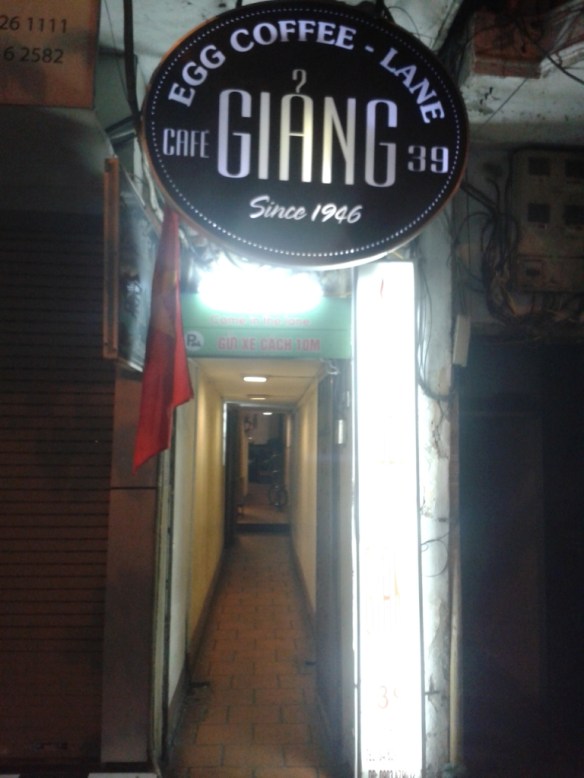
Taken in Hanoi in December of 2015


Egg coffee is a Hanoi staple. It’s made with egg yolk, condensed milk, and sugar so it’s not exactly low-cal, but it tastes delightful. The scuttlebutt is that it was invented when milk was in short supply during the war. The beverage is said to have been invented at Giang Cafe, but I couldn’t say for certain that it’s the same Giang Cafe we were at (shown above.) However, the place did have the feel of a local institution. Imagine people huddled around tiny tables on stools, the floor coated with sunflower seed shells, and nary an empty stool in the multi-floored establishment.

BOOK REVIEW: The World’s Best Street Food by Lonely Planet

The World's Best Street Food: Where to find it and how to make it (General Pictorial)The World’s Best Street Food: Where to find it and how to make it by Lonely Planet
My rating: 4 of 5 stars

Amazon page


This is a combination guide to street food and cookbook. Each of the 100 entries consists of two pages. The first describes the food, how it’s eaten [that’s not always as self-evident to outsiders as one might think], its origins, where one can find a quintessential or famous example of the food, and whether there are any variants on the recipe. The second page is the cookbook entry, which lists the ingredients and describes the process by which they are combined to create the dish in question.

The foods are divided into broad categories of savory and sweet. The savory category is the larger by far, comprising 80 of the dishes—leaving 20 sweets. The dishes represent about 50 different countries of origin. A lot of these countries are well-known street food cultures such as Thailand, Vietnam, India, Mexico, and the US, but there are also a number of locales with which readers may be less familiar– such as Ghana, Malta, and French Polynesia. The dishes include a number of my favorites, such as Vietnamese Banh Mi, US Breakfast Burrito, Indian Masala Dosa, Thai Pad Thai, Hungarian Langos, and Singaporean Hainanese Chicken Rice. However, I also learned of new dishes that I’m eager to try, such as Croatian Cevapcici, Burmese Mohinga, and Chilean Sopaipilla.

WARNING: While I didn’t deduct stars for it, I will warn readers that this isn’t a good book to get as an e-book—at least unless you have a high-end tablet. It was a bit of a pain to read on my Kindle Touch, and the graphics (which I assume are beautiful in the print edition) were largely useless on my device. One could blow up the text easily enough (within limits, at least,) but the pages got grainy if one blew them up too much—and some of the text remained small when expanded.

There are photos. As I mentioned, on my device they were largely useless (grainy black-and-white) but your results may vary.

I found this book to be interesting and informative. While I wish the e-book had been easier to read, it was well-organized and offered a broad selection of dishes from a large number of countries.

I’d recommend this book for street food lovers and foodies.

View all my reviews

DAILY PHOTO: Produce Stalls, Panjim Municipal Market

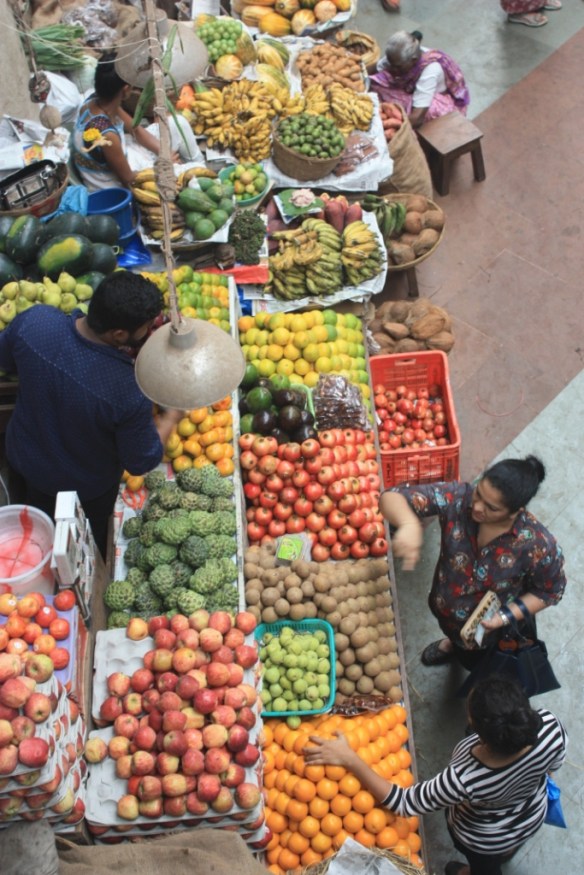
Taken in October of 2016 in Panjim, Goa

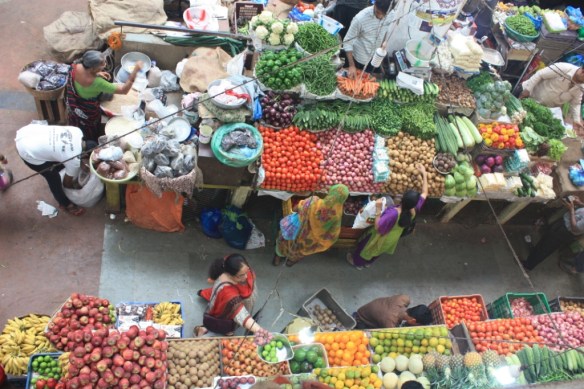
Taken in October of 2016 in Panjim, Goa

img_3072 img_3073

BOOK REVIEW: Nutrition: A Very Short Introduction by David A. Bender

Nutrition: A Very Short IntroductionNutrition: A Very Short Introduction by David Bender
My rating: 4 of 5 stars

Amazon page

Do you want to know what percentage of your diet should be carbohydrates because your personal trainer is telling you it’s zero? Do you know whether you need vitamin B12 supplements? How much energy does your huge human brain use? What the hell is Kwashiorkor? If these types of questions are of interest to you, you might be interested in this book.

There’s nothing particularly fancy or exciting about this book, but it’s still a useful book for a couple of reasons. First, it sticks to the science on the subject, and diet and nutrition is one of the most myth and disinformation riddled subjects around because there are so many people trying to shill their fad diets and because there are so many who desperately want to believe that they can cut pounds and still eat a case of Twinkies every week through some scientific loophole [psst, you can’t.] Here and there throughout this book, there are quick deconstructions of these myths and lies. (i.e. I should point out that some of this dietary “wisdom” will result in weight loss—but it won’t necessarily result in a net health gain. e.g. If you cut out carbs, you’ll lose weight—but your brain will also be starved of the glucose that it needs to conduct its business and will have to engage in slow and costly processes to get it from elsewhere.) Second, the book is short and to the point. If you don’t have a lot of time to devote to reading up on nutrition, this may be the book for you.

The book consists of eight chapters:

Chapter 1: Why eat? (deals with appetite and satiety, and not just the less-than-profound question of why a human body needs energy.)

Chapter 2: Energy Nutrition (gives the basics of food as an energy source—as opposed to food as building blocks.)

Chapter 3: Protein Nutrition (teaches one about food as building blocks.)

Chapter 4: Over-nutrition and Problems of Overweight and Obesity (addresses the causes of being overweight as well as explaining how to counteract those causes. One nice feature of this chapter is it gives a quick and dirty summation of the various types of diets, tells which are supported by science, and explains which have undesirable unintended consequences.)

Chapter 5: Diet and Health (explains many of the ways nutrition influences health. Contrary to popular belief, weight isn’t the only way [or, necessarily, the most critical way] in which dietary problems can adversely affect health. In other words, it’s possible to be stocky or curvy and in good overall health, or, alternatively, one can be svelte and running up on death’s door. This chapter also describes first-world ailments that are sometimes called diseases of affluence.)

Chapter 6: Under-nutrition (Marasmus, cachexia, and kwashiorkor. Don’t know what those words mean? Think they are towns in a sword and sorcery fantasy novel? You’ll know after finishing this chapter.)

Chapter 7: Vitamins and Minerals (Most of the dietary suggestions in the book up to this point are put in terms of macro-nutrients [i.e. carbohydrates, fats, and proteins], but this chapter focuses on micro-nutrients. There’s a reason micro-nutrients are addressed so late in the book, and that’s that most people who are getting sufficient macro-nutrients from actual food [as opposed to the “stuff” sold at McDonald’s or in convenience stores] get all they need of micro-nutrients. But there can be issues with micro-nutrients such as iron, calcium, vitamin D, and Vitamin B12 depending upon one’s unique life situation. In other words, unless your doctor tells you that you need a supplement, you probably don’t.)

Chapter 8: Functional Foods, Super Foods, and Supplements (Probiotics, prebiotics, synbiotics, super foods, and supplements. One area that gets short shrift in this book is the importance of one’s gut bacteria—which has become a huge part of the discussion of late. There is a little mention of it in this chapter, but not much.)

There are few graphics in the book, but there are many tables. I didn’t feel anything was missing in terms of graphics. None of these “Very Short Introduction” guides offers much by way of bibliography, and the “Further Reading” section tends to favor textbooks over popular works. This book is no exception in either regard.

I’d recommend this book for anybody who wants a quick low-down on the science of nutrition. As mentioned, the one area I thought it might have delved into in greater depth was the role of gut microbes. However, overall, I think it was well-organized and provided interesting food for thought (pun recognized, but not intended.)

View all my reviews

POEM: A Dark Note to Jello

jello

Hello, Jello, my wiggly friend

It’s time you meet your fateful end

Perhaps, someday you will come back

But, having been through my digestive tract,

No one will ever love you like I did

[At least, let’s hope–heaven forbid]

DAILY PHOTO: Name That Fruit

Taken in Hanoi in December of 2015

Taken in Hanoi in December of 2015


I know I’ve given you a somewhat blurry photo, but it wouldn’t be the championship edition of NAME THAT FRUIT! otherwise.

DAILY PHOTO: Bombay Vada Pav Stands

Taken in November of 2015 in Mumbai

Taken in November of 2015 in Mumbai


This row of street food stalls is located across the street from Flora Fountain in Mumbai. They don’t all sell Vada Pav, but the most popular one does. (Alternative spellings: wada pav, vada paav, or vada pao)

FYI: Vada Pav is a delicious deep-fried, spiced potato ball served as a sandwich on a fluffy dinner roll style bun. It’s a Maharashtra specialty. There’s a video below if you’d like to see how they’re made or to make your own.


DAILY PHOTO: The Greens and Reds of Khlong Toei Wet Market

Taken on September 20, 2015 at Khlong Toei Market

Taken on September 20, 2015 at Khlong Toei Market


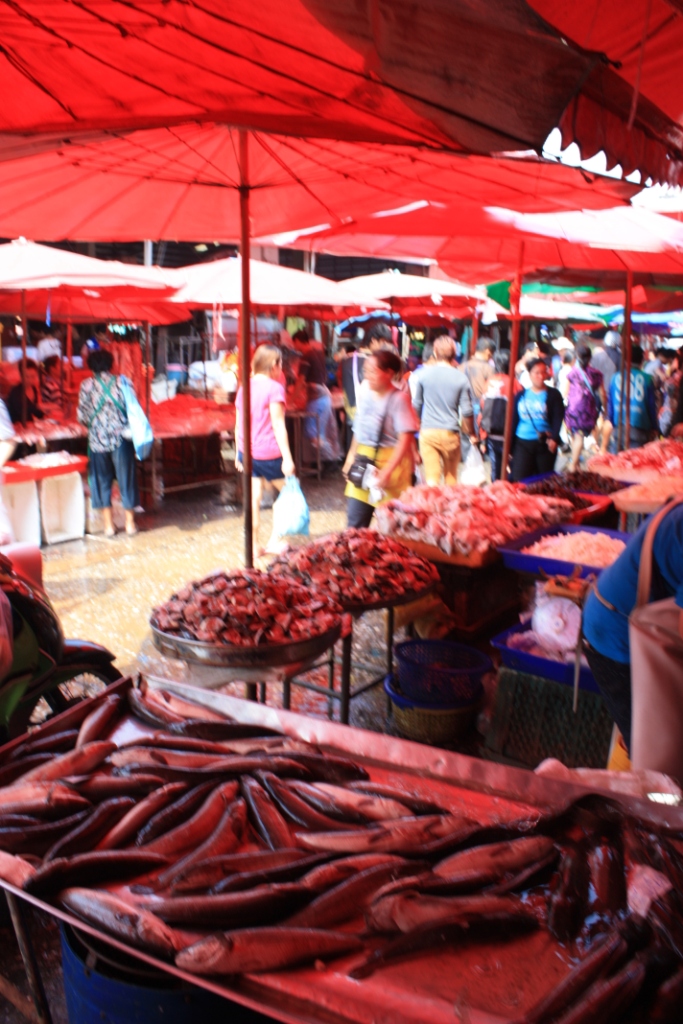
In India there is a color coding system that one sees on all packaged goods and probably a majority of restaurant menus. A green dot in a square means the food is vegetarian (which means neither egg nor meat content in the product) and a red dot means non-veg.

Here in Thailand, at Khlong Toei Wet Market, it’s interesting to see how vendors used red and green awnings. In this case, it’s not so much to signify the product as to enhance its visual appeal. Vendors who specialized in green produce inevitably used green awnings to make their greens look greener. By the same token, meat vendors and fish vendors that specialized in “red fish” (e.g. tuna, as opposed to white fish, say halibut) used red awnings to make the reds redder.  Incidentally, white fish and squid sellers often used a combination of white and blue tubs to create another kind of aesthetic appeal. Fruit vendors are out of luck because they have just too many colors to deal with. (Unless they specialized a single fruit like watermelon–or durian, because if you sell durian you’re out of luck on selling anything you don’t want tainted by the smell of durian.)


IMG_1849

Learning Indian Cooking in Bangalore

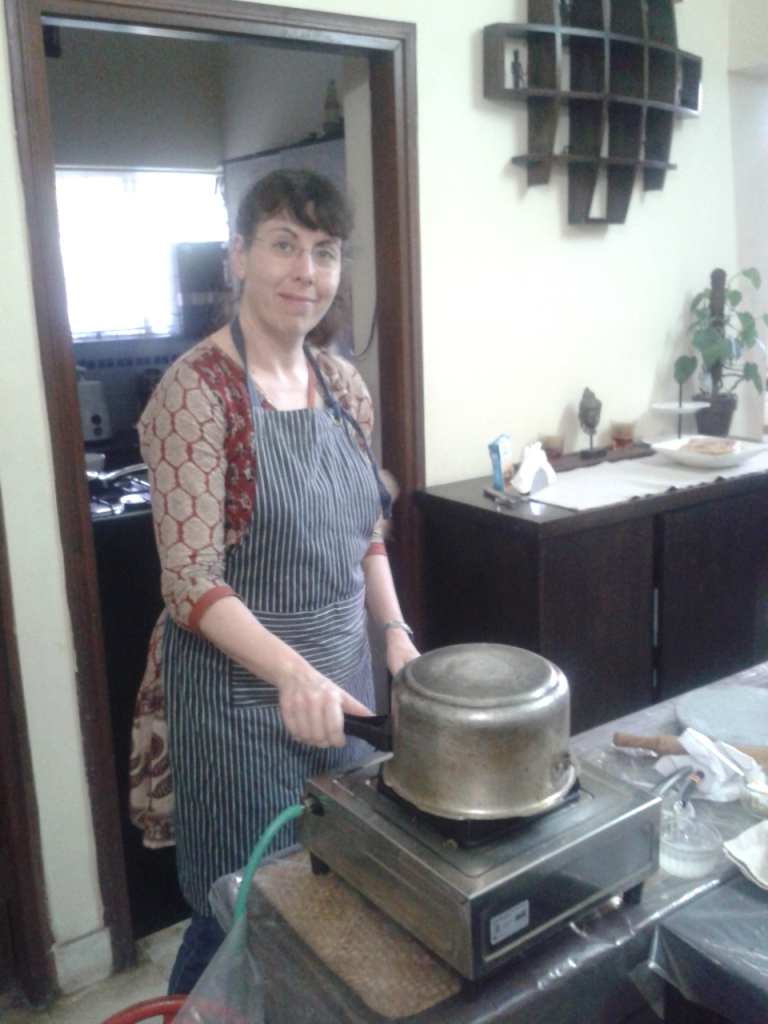
I'm stirring the pot.

I’m stirring the pot.

The thing about Indian food–with its penchant for pureed gravies–is that I find it delectable, but often have no idea what I’m eating or how it got to me looking, tasting, and smelling like it does.


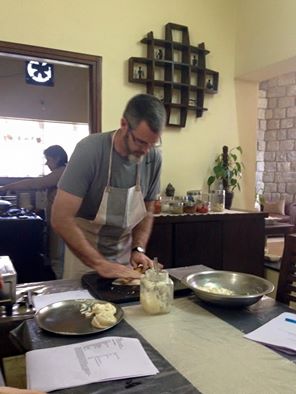
That is until recently. A couple of weeks ago I attended a cooking class at Manju’s Cooking School in RT Nagar in an attempt to rectify (or at least reduce) my ignorance. Manju’s offers a wide variety of classes (Indian and non-Indian, veg and non-Veg, cooking and baking, etc.)


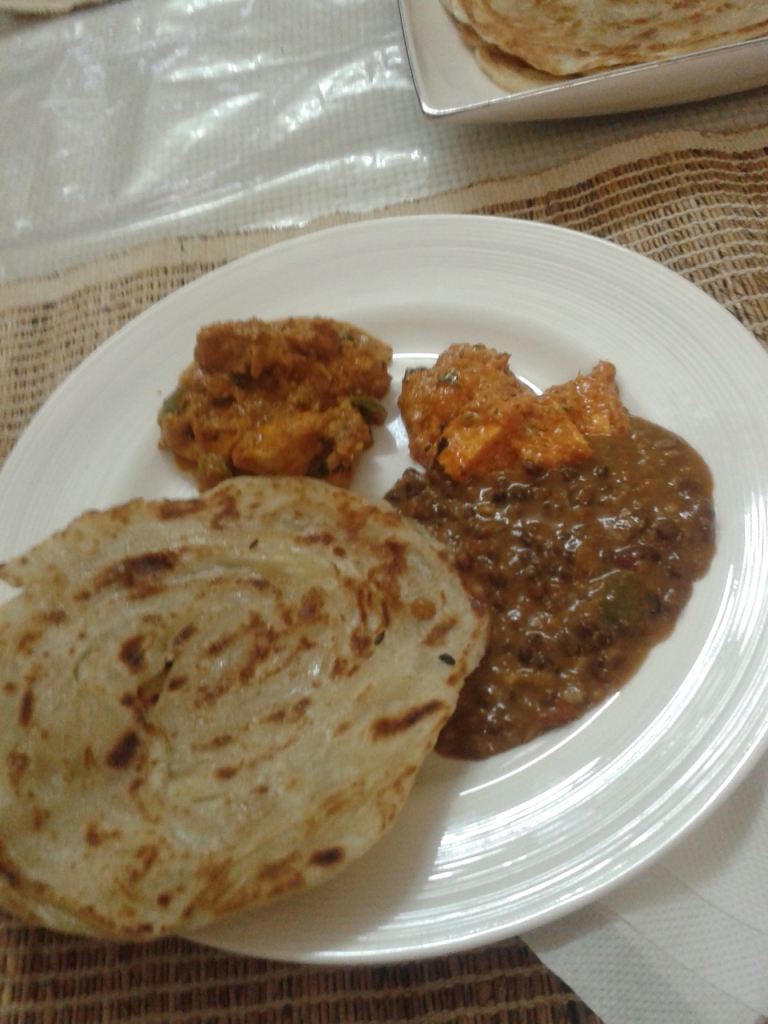
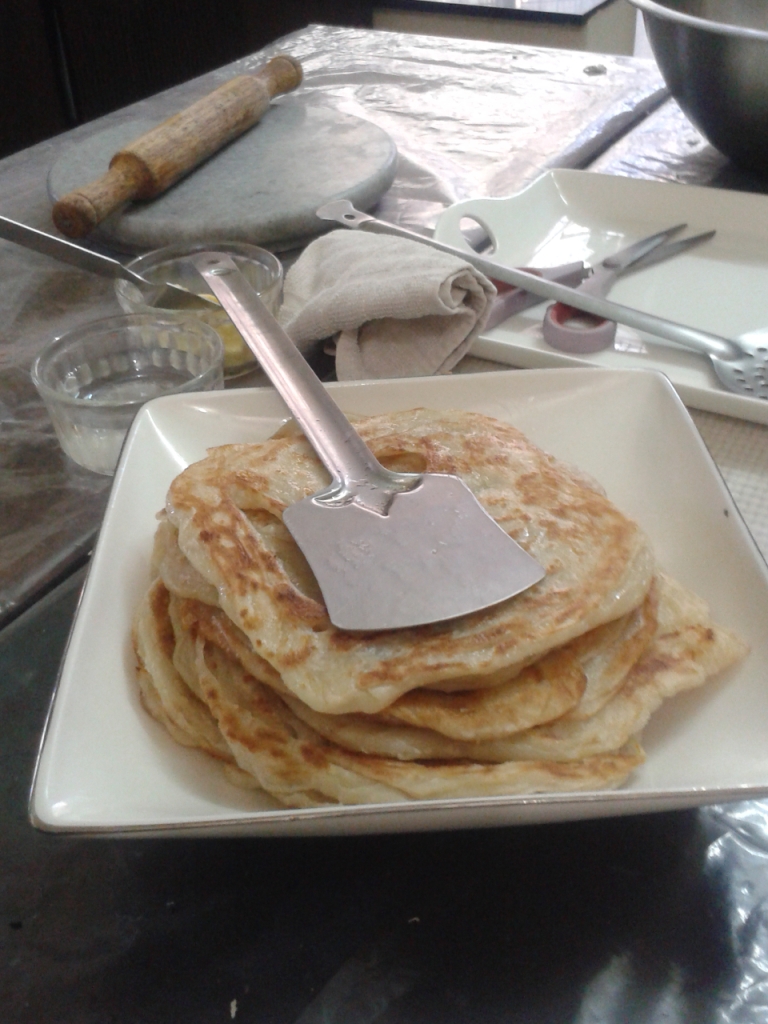
I attended with a group of friends, and we constituted a class unto ourselves. We, therefore, got a quick and dirty introduction to a number of common / typical Indian foods (veg and non-veg, and both North and South Indian.) The menu we prepared consisted of two breads (kulcha and Malabar parota), dal makhani, paneer butter masala, and kadai chicken.


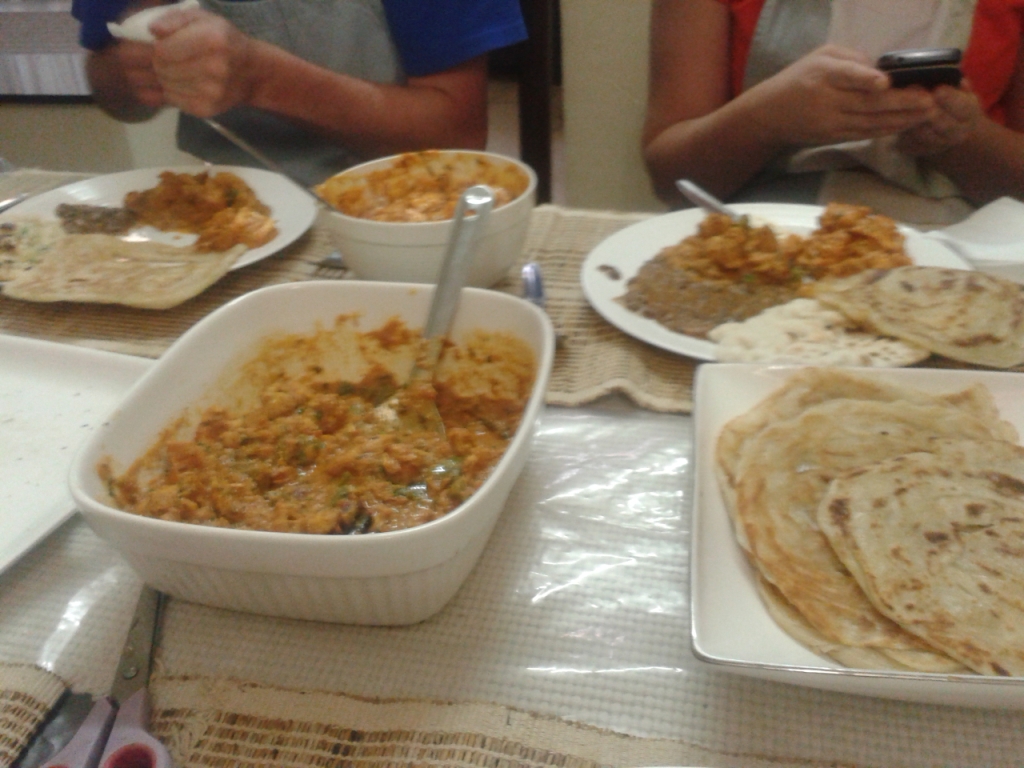
The class took 2.5 or 3 hours, and ended in a banquet of the foods we hand prepared.

20150201_170142 20150201_170013


Some of the fun facts that I learned include:

-“Kadai” in the name of dish just means that it’s wok-cooked.

20150201_154859

-A Kulcha is essentially a naan of a different thickness.

-Dal makhani requires a lot of prep, even if you have access to a pressure cooker.

-There’s a lot of finely chopped onion in these gravies that often goes unnoticed.

-One can cook with the pot upside-down. This is how we cooked Kulcha. In a restaurant it would be cooked in a Tandoor oven, but at home you can cook it stuck to the bottom of a deep pot.

20150201_163717

-Lastly, the key to a the flaky goodness of a Malabar parota is lots of fat… who’d have thought?

20150201_162915

Me&Parota


DAILY PHOTO: Vörösmarty tér Lepény Vendor

Taken in December of 2014 in Budapest

Taken in December of 2014 in Budapest

This is the finished product.

This is the finished product.

Lepény is a Hungarian street-food that some might call a folded over pizza and others might call a flat-bread sandwich. It’s bread (like pizza crust) topped with cheese and various vegetative and / or meaty toppings and cooked on a grill. (I just realized it could also be considered a fancy grilled cheese that starts from a ball of dough and not from pre-made bread.)


Anyway, there aren’t nearly as many lepény vendors as there are for say Kürtöskalács (the cylindrical sweet bread that is so very, very awesome), but the vendor at the Vörösmarty tér Christmas market always had a massive line. (We did discover that part of the long lines had to do with the temperamental nature of the wood-fired grills they used and the long time it took to cook one if they let the fire die down too much.) Still, people stayed in line, and that speaks somewhat to the tastiness of this treat.