DAILY PHOTO: Modern Art For The Sitting

Taken in December of 2013 in Kuala Lumpur.

Taken in December of 2013 in Kuala Lumpur.

In Kuala Lumpur we came across this little wooded area to the side of an office tower. Planted among the trees were these curvy, ornately painted benches.

As I’ve mentioned before, being a weary traveler on occasion, I’m frequently dismayed by artists who take up valuable and precious bench space with their bronze creations. This on the other hand, was a magnificent find, art that one could sit down on and rest one’s feet. As you can see, the benches were quite popular.

DAILY PHOTO: Towering 4-Handed Guardian

Taken November 2, 2013 at Hampi

Taken November 2, 2013 at Hampi.

These guardians of the inner sanctum can be seen here and there throughout Hampi.

I assume they were meant to be guardians and not just four-handed mutant freaks doing yoga stretches to loosen up their leg abductor muscles.

DAILY PHOTO: Colorful Kolam

Taken on October 5, 2013 on 80 Feet Rd in Bangalore

Taken on October 5, 2013 on 80 Feet Rd in Bangalore

Kolam are chalk or (traditionally) rice powder drawings that one finds in front of entryways throughout much of South India. The practice has even carried over to other countries in the South Asia displaying Indian influence such as Thailand and Malaysia. Their drawing is traditionally practiced by Hindu women each day to bring prosperity to the household. Although this one was in front of a business as is also common these days. Some are much smaller and less elaborate than this one. However, some are even more elaborate and perfectly formed. They only last a day, and are traditionally washed away at the end of one day so that a new one can be drawn to start the new day.

Teachable and Unteachable Lessons

[Note: This is posted in my Jissen Budōka blog as well.]

Source: Wikipedia; Status:  Public Domain

Source: Wikipedia; Status: Public Domain

Miyamoto Musashi, who was undefeated in over 60 duels, claimed that he never had a teacher. Some historians refute this claim. Whether one accepts it or not, the statement astonishes.

Musashi wasn’t talking only about martial arts, but about the many areas in which he was accomplished. Not being a painter or a sculptor, I can’t say how important a teacher is in such domains. But it’s easy enough for me to imagine a successful writer who never took a formal class in writing; someone who read profusely and practiced his (or her) craft relentlessly could do it. (Certainly, one can easily imagine successful writers whose formal education was in some area other than writing because there are so many of them–probably at least as many as those whose education was in writing. Examples include: Vonnegut [Chemistry], Crichton [Medicine], Zane Grey [Dentistry], Ursala LeGuin [Anthropology], and J.K. Rowling [French]. That’s not even to start on the many literary legends who dropped out all together– e.g. Dickens, Faulkner, Twain, H.G. Wells, and Jack London.) This isn’t to say that writing teachers don’t make writing better, but just that there is a path to this skill that doesn’t involve being fed lessons.

However, I struggle to imagine a martial artist achieving so much without a teacher. Boiled down to its most workaday definition, a martial art is a collections of lessons about what works in a combative situation. This is what separates the importance of a teacher in martial arts from that of a discipline like writing. In writing, one has the leisure to make one’s mistakes, learn from them, and self-apply course corrections. Musashi was in life or death duels; he couldn’t learn lessons at such a leisurely pace and in such an iterative fashion.

A martial arts teacher has a number of roles, such as preventing inertia (slacking) from taking hold in the training hall. However, the most fundamental purpose is to pass along the collection of lessons so that a student doesn’t have to learn them all by way of personal experience. Most of us aren’t Miyamoto Musashi; we can’t survive the process of learning all our own lessons.

Needless to say, I am a firm believer in the value of a good teacher. I’ve had several over the years, and I received valuable lessons from all of them–all with different, but no less valid, points of emphasis and flavor.

Having said all that proceeds, there’s much that cannot be taught. Such lessons may be described or discussed, but they cannot be learned except through the initiative of the student. I said that most of us can’t survive the process of learning all one’s own lessons, but I’ve increasingly come to believe that one can’t survive learning none of them either. In the beginning, one must be fed the lessons from a teacher in order grow. However, as the decades pass, one increasingly needs the space to learn one’s own lessons. If one lacks said space, one will stagnate and eventually the wheels will roll off one’s training altogether.

So what are the unteachable lessons? Knowledge can be conveyed, but not everything that a martial artist must learn is knowledge. Confidence cannot be taught. A teacher may explain–or even show–how he or she became confident, but that won’t translate one iota into the student being more confident.  This is like a Buddhist monk telling one that “desire is the root of suffering.” One may understand that statement. One may believe the statement. However, one’s suffering won’t decrease because one has the knowledge.  One’s suffering will only decrease if one conscientiously does the hard work of reducing one’s desires.

Another area of unteachable lessons are the lessons that the teacher has never learned. Loyalty is a great virtue, and so there may be a tendency to restrict one’s learning to the lessons of one teacher. However, even if one has an outstanding teacher and are practicing a great lineage, blind spots happen. The only way to learn whether there is anything of value obscured in those blind spots is to throw off one’s blinders and have a look for oneself.

What blinders? An excellent and tricky  question.  It’s like when someone says, “it’s not what you said, but the way you said it.” We all understand that there is some intangible character in language that is commonly understood but not easily seen or defined. In any culture (and a dōjō contains a culture, believe me) there’s always a collection of norms, rules of thumb, ideas, beliefs, mores, credos, etc. that come to be taken so much for granted that they become an invisible filter through which one sees the world. This isn’t an inherently bad thing, and it’s probably necessary to produce sufficient order in a chaotic world in which to learn and grow. Having said that, some of the ideas and beliefs in our cultural filter may be arbitrary, or at least not universal, but yet we don’t necessarily see the potential for error because we are seeing the world through the cultural filter. We take for granted that grass is green, but what if we see it through a yellow filter? Then it’s blue. Right?

DAILY PHOTO: Tai Chi Sculpture

Taken in Montreal in March of 2011

Taken in Montreal in March of 2011

Snake Creeps Down?

DAILY PHOTO: “Look at that Big Ole Building”

Taken in downtown Atlanta in November of 2012

Taken in downtown Atlanta in November of 2012

BOOK REVIEW: The Lone Samurai by Wm. Scott Wilson

The Lone Samurai: The Life of Miyamoto MusashiThe Lone Samurai: The Life of Miyamoto Musashi by William Scott Wilson

My rating: 4 of 5 stars

Amazon page

[Note: this was previously posted in my martial arts blog, Jissen Budōka.]

This is a concise and well-researched biography of one of Japan’s most famous swordsmen. Miyamoto Musashi, however, wasn’t just a swordsman, he was also a writer, a painter, a sculptor, a Zen Buddhist, a poet, a philosopher, and a strategist. In short, he was a renaissance man. While The Lone Samurai focuses heavily on Musashi’s many duels as a traveling warrior, it also describes his artwork as it paints a portrait of a complex and beguiling character.

Musashi holds a curious allure among figures in Japanese history. The Japanese tend to be strictly bound by societal conventions, and being respectful and well-mannered is valued above all else. Musashi flouted convention whenever it served him. He used irreverence for strategic advantage. He was an astute reader of men. He often showed disrespect in order to get into his opponent’s head. This is most famously exemplified in his Ganryu Island duel with Sasaki Kojiro.

Musashi adopted a life of musha shugyo, or warrior errantry, though he could have been much wealthier and more comfortable had he chosen to be. He enjoyed simplicity, and only owned a few possessions. In his travels, he engaged in over 60 duels, and is usually credited with being undefeated [Note: I’ve heard some dispute the outcome of his second duel with Muso Gonnosuke. Wilson calls it a draw, but I’ve heard it called Musashi’s only defeat as well.] He fought as a samurai in battle at Sekigahara as well, but his adulthood was a relatively peaceful time.

One fascinating, but controversial, claim is that Musashi had no teachers–neither in swordsmanship nor in any of the fine arts he practiced. Musashi said this himself, but some historians dispute it. If true, it really takes being an extraordinary person up a notch. It should be noted that Musashi was only 13 when he had his first duel.

There is much about Musashi that is lost to the ages, but this book does a great job of pulling together what is known and weaving it into a portrait of the man.

There is an extensive series of appendices providing background information, notes, a glossary, and even a collection of pop culture (e.g. movie and novel) depictions of Musashi.

It’s well worth the read if you’re interested in strategy, history, or the biographies of incredible people.

View all my reviews

Paintings Through a Writer’s Eyes: 6 of my Favorites

Let me begin by being forthright; I know almost nothing about art. If you’re thinking this post might offer you insight into what makes for a good painting, you’re in the wrong place. A few years back, I did get a couple books on “art for philistines”  (…isms: Understanding Art and 50 Artists You Should Know) Being fascinated by just about everything, I immensely enjoyed both books. However, my objective wasn’t to develop any great expertise, but simply to not be a clod. I wanted to be able to tell Monets from Manets from mayonnaise. And I did learn some nifty lessons, mostly about what art wasn’t. Did you know that Neo-impressionist art is NOT art that makes a new impression on one, as contrasted with paleo-impressionist art that makes one feel their inner-caveman. Secessionism was NOT the art of the Confederate States. Neither sensationalism nor naturalism necessarily involve nudity, darn. One the other hand, Pointillism is exactly what it sounds like, paintings made of little pointills.

As a writer, the story that I see in a painting has a lot to do with its appeal to me. That’s why there aren’t any Jackson Pollack’s or Mark Rothko’s on my list. I’m sure their work is aces in aesthetics, but I don’t get much out of it.

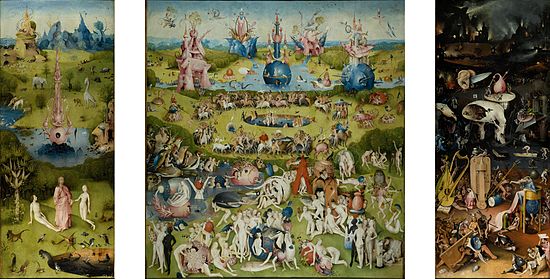
The Garden of Earthly Delights by Hieronymus Bosch, 1510

The Garden of Earthly Delights by Hieronymus Bosch, 1510

I usually don’t care for paintings that are as busy as The Garden of Earthly Delights, but I find it fascinating that an early 16th century artist could produce so much wild surrealism. I didn’t even know they had LSD in the Netherlands back then. Today we have decades of monster movies to help us think up weird and bizarre images, but Bosch had only his imagination.

There are an infinite number of stories packed into this tri-sectional painting. A question being the root of a story, a world in which some people have flowers and berries blossoming from their heinies, makes for a lot of fodder. However, the first thing that strikes the eye is that God is the only one wearing clothing. (Lets avoid a tautology. One could say that the only reason I know that that’s God is that he’s wearing clothing. If he were naked too, the viewer would just assume that he was a perv trying to horn into a menage a trois. I would say the world’s first threesome, but if you look in the middle section, you can see that about everyone is getting their freak on.) So why is God wearing robes?  We can assume that it’s not that he has shame. He’s God, you can be sure he’s sporting the perfect specimen of masculinity (if he cares about such things.)  Is it drafty in heaven? If so, doesn’t his omnipotence extend to the heavenly thermostat, or is it that the Holy Ghost likes to crank the AC? I see tension, and tension is the root of a story. (I realize that I said that a question was the root of a story. Live in the moment.)

The Sea of Ice by Caspar David Friedrich, 1823

The Sea of Ice by Caspar David Friedrich, 1823

Sea of Ice, also called The Wreck of Hope, at first looks like just a landscape. However, if one directs one’s glance to the right hand side, one can see the stern of an old sailing ship. As the alternate title suggests, it’s about a shipwreck. A shipwreck in the sailing age in the Arctic Ocean makes an outstanding setting for a story. Those men are all going to die, but not with the suddenness of drowning. They will freeze to death over the course of hours. If they can start a fire, they may have many hours, but they are not going to be rescued and they cannot walk to home. The tension between wanting to survive and knowing you are just extending your misery is good stuff for story-telling. If this image doesn’t send a shiver down your spine, nothing will.

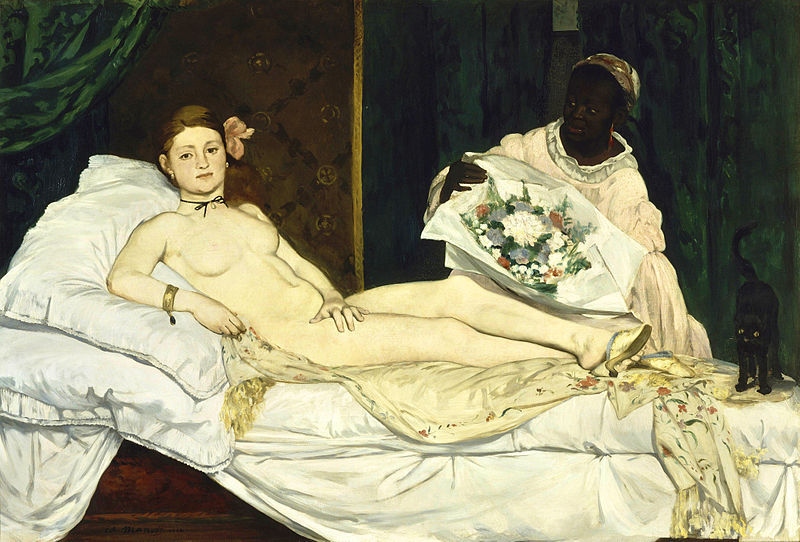
Olympia by Édouard Manet, 1863

Olympia by Édouard Manet, 1863

Olympia was a scandalous painting when Manet first revealed it. Nudity has been around for ever in paintings, right? Certainly, but it’s the context that enraged people. Society was used to characters of classical mythology being nude, e.g. Venus. They were also used to Biblical nudity (see Garden of Earthly Delights above.) However, Olympia made them think of the Parisian prostitutes that they didn’t visit, but somehow knew exactly what they looked like.  There are several stories to be told here. The one that springs to mind is why the servant is about to try to suffocate Olympia with a pillow. Will she, or won’t she, go through with it? If she does, will she prevail? Olympia looks like a fighter. If she doesn’t, will the cat?

Impression: Sunrise by Claude Monet, 1872

Impression: Sunrise by Claude Monet, 1872

In Impression: Sunrise two boats are out on the water, even though the sun has broken over the horizon.  They are rivals. The early bird got the worm, and the other will have to fish with fake lures.
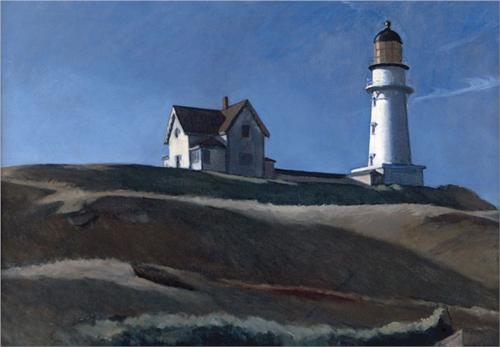
Lighthouse Hill by Edward Hopper, 1927

Lighthouse Hill by Edward Hopper, 1927

Lighthouses make good settings for tragedy. They are remote. Ships depend upon them to avoid the rocky shoals. This lighthouse keeper’s family left because they didn’t like living in the middle of nowhere with a drunk. Now it’s just a man living in a big house alone. He runs out of Jack Daniels, and drives off to town at dusk. Being on the other side of the hill, he can’t see the lighthouse when he briefly glances into his rear-view mirror and wonders, “Did I turn the beacon on?”

The Persistence of Memory by Salvador Dalí, 1931

The Persistence of Memory by Salvador Dalí, 1931

The Persistence of Memory, a.k.a. Melting Time, is a dream state. It makes no sense. Nature is ordered into square edges. Watches are the only evidence of humanity’s existence. There is one creature living, or once living, that looks like the Thalidomide abortion of a three-way mating between a donkey, a Portuguese man of war, and Dalí himself.  The story is about being trapped in a dreamscape where time has become stuck.  Our protagonist must seek the wisdom of the Portuguese man-o-Dalí.