BOOK REVIEW: The Enormous Crocodile by Roald Dahl

The Enormous CrocodileThe Enormous Crocodile by Roald Dahl
My rating: 4 of 5 stars

Amazon page


The story arc of “The Enormous Crocodile” is a familiar one. It’s a variation on a theme seen in “Little Red Riding Hood” and “Three Little Pigs” to name a couple of well-known examples. First, there is a bad guy who wants to eat some helpless and / or unwitting victims. In this case, the enormous crocodile is the gluttonous cad—rather than a wolf–and the helpless victims are the local children. Second, the villain is thwarted at the last possible moment.

While it’s a tale that’s been told many times in many ways, Dahl does a good job adding his own imprint to it. An important element of the story is that the crocodile angers, alienates, and attacks several of the other jungle creatures on his way into town to find a victim or victims. Because of this, these animals conspire to thwart the crocodile’s clever plots, and this ultimately contributes to his downfall. It’s with the crocodile’s clever plots that Dahl most fully engages the imagination. The croc uses various disguises to try to lure children to within snapping distance.

It should be pointed out that the illustrations by Quentin Blake are as crucial as Dahl’s words. The color drawings really bring the book to life, and serve to make feasible the clever plots of the crocodile. (e.g. When the croc scoops up coconuts and fronds and stands on his tail in mimicry of a coconut tree, it’s the illustration that makes this seem believable—not to mention capable of being visualized by a small child.)

If you’re looking for a short young children’s story that can be read in 15 minutes or so, this is a good one.

View all my reviews

BOOK REVIEW: Just So Stories by Rudyard Kipling

Just So StoriesJust So Stories by Rudyard Kipling
My rating: 4 of 5 stars

Amazon page


“Just So Stories” is a collection of 12 children’s stories. The theme that runs through the dozen stories is that they are mostly tall-tale answers for questions that children might have. All but two of them focus on animals and nature, and the two divergent stories deal with the origin of written language. Since it’s such a small collection and the titles tend to synopsize the stories, I’ll include the table of contents below, which may give one greater insight into the nature of the stories.

1.) How the Whale Got his Throat
2.) How the Camel Got his Hump
3.) How the Rhinoceros Got his Skin
4.) How the Leopard Got his Spots
5.) The Elephant’s Child
6.) The Sing-Song of Old Man Kangaroo
7.) The Beginning of the Armadillos
8.) How the First Letter Was Made
9.) How the Alphabet Was Made
10.) The Crab that Played with the Sea
11.) The Cat that Walked by Himself
12.) The Butterfly that Stamped

The edition that I have (i.e. 2006 Scholastic Junior Classics Edition) has a number of black-and-white graphics (block print and line drawn style)—one or two per story. Given the genre, I imagine most editions have some kind of pictures, but your edition’s graphics may vary. A number of the stories include short poetry—usually at the end. The poetry is part of the original Kipling product and so are likely included in all unabridged editions.

I’d recommend this book for those looking for short stories that are relatable to young children.

View all my reviews

BOOK REVIEW: Body Heat by Mark S. Blumberg

Body Heat: Temperature and Life on EarthBody Heat: Temperature and Life on Earth by Mark S. Blumberg
My rating: 4 of 5 stars

Amazon page


I picked up this book for an odd–and potentially disconcerting–reason. I sweat when I work out. I know that everyone sweats while active, but for me it’s preternatural. It’s at a level that has the potential to be a superpower, if I had any control of it. I’ve finished muaythai sessions with the ring floor looking like it’d rained inside—granted Thailand takes humidity to its heights, but still. I was hoping to gain some insight into what this anomaly was all about. After reading the book, I can’t say I have any greater insight on the issue. However, having lived in the tropics for over three years now, I’ve recently begun to notice that my level of sweating seems normal—at least within a range acceptable for our species.

There are nine chapters. The first examines the basics of heat. While the examples are zoological, the substance is largely what one would study in an introductory physics class—sans the math. Chapter 2 dips more into the biology, considering the various ways in which organisms achieve an ideal temperature. The third chapter explores the role that temperature plays in impregnation, gestation, and genetic information transfer.

Chapter 4 explains how various creatures work internally to create a comfortable temperature. It’s related to chapter 2, but the second chapter deals more with external regulation, i.e. animals’ interaction with their environments. Besides explaining the human need to control the brain’s temperature, chapter 4 explores how birds who keep their feet in chilly water manage to keep from getting hypothermia. In the next chapter, Blumberg considers various ways in which animals fight the cold. There’s an extended discussion of Brown Adipose Tissue (BAT)–a fat that is particularly useful in generating heat–that was interesting.

Chapter 6 raises an intriguing question: should one take fever reducer when one develops a fever? Obviously, a fever can become so high that one needs to combat it, but here we’re talking about a fever of a level that won’t cause any long-term harm. Chapter 7 discusses a range of heat related topics including the connection between spiciness and the feeling of heat and the evolution of language related to heat, but the chapter is mostly about the thermal dimension of sex.

Chapter 8 is about how our body regulates fat so that it can be used both as an energy reserve and as insulation, and what can go wrong with the process. The final chapter addresses the thermal dimension of sleep. If you’ve ever woken up soaked in sweat or chilled, it may have occurred to you that our thermal regulation doesn’t work as usual through sleep.

There is a point in the Introduction that reads as though the author is calling Tibetan Buddhists monks charlatans, and that seems both harsh and offensive. However, I’m willing to give him the benefit of the doubt that he used an example in unfortunate juxtaposition to his charlatan comment—which is well taken. He’s referring to monks who wrap themselves in wet sheets in subfreezing conditions. His point is that it’s not a suspension of the laws of physics that the monks don’t end up with hypothermia—true enough. The monks’ point is likely that it’s a tremendous challenge to be able to maintain a tranquil mind under such conditions, which I would argue is true as well.

There are only a few graphics, and they consist of tables, line drawings, and photos. There is an extensive bibliography that is organized by chapter.

The Kindle version of the book that I have has some formatting irregularities. However, they didn’t really detract from the reading experience, and will probably be corrected in newer editions. [But it wasn’t an ARC, so the formatting should have been finalized.]

I found this book to be interesting, and I learned a lot from reading it. It’s an important topic, but for many it won’t be a subject that one thinks of learning about in isolation. If you are interested in finding out more about the many ways in which animals (humans included) are influenced by temperature, I’d recommend you give this book a look.

View all my reviews

DAILY PHOTO: City Elephant

Taken in April of 2016 in Amritsar

Taken in April of 2016 in Amritsar

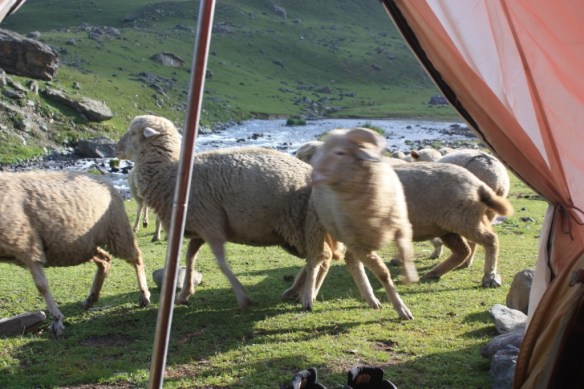
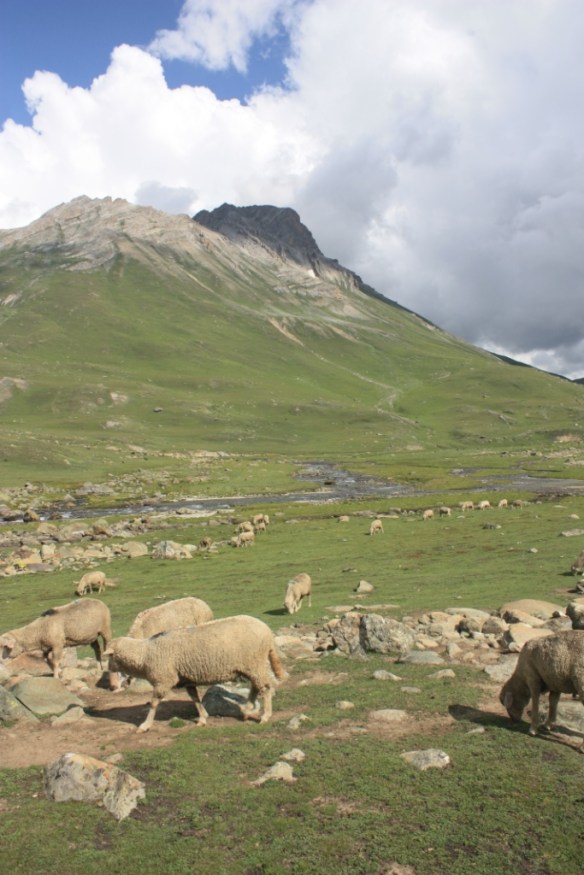
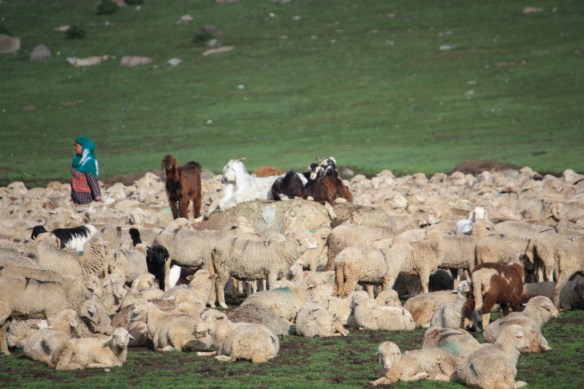
DAILY PHOTO: Campsite Sheep-nanigans

Taken in July of 2016 in Kashmir

Taken in July of 2016 in Kashmir


img_1474 img_1503


On our Great Lakes of Kashmir trek this past summer, one night our campsite was across the creek from a maximum security sheep prison. I kid you not. At all hours of the night, beams of light would cut through our tent as roving guards made their rounds. And there was the occasional shrill whistle when the inmates would get out of line.

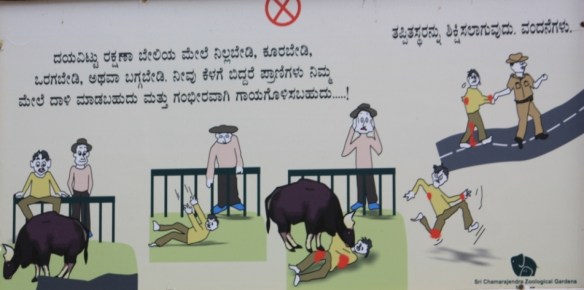
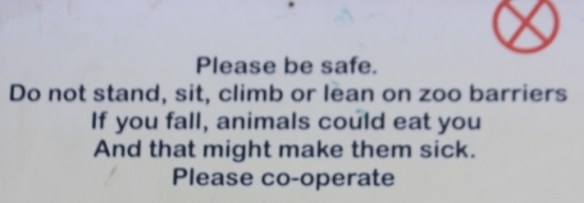
DAILY PHOTO: Best. Zoo. Signage. Ever.

Taken in Mysore in October of 2013

Taken at the  Mysore Zoo in October of 2013

Sri Chamarajendra Zoological Gardens (i.e. the Mysore Zoo) wins the award for the most clever (and most gruesome) signage at a zoo.


img_1431 img_1325 img_1323

BOOK REVIEW: The Stationary Ark by Gerald Durrell

The Stationary ArkThe Stationary Ark by Gerald Durrell
My rating: 4 of 5 stars

Amazon page


If you’re like me, you have mixed feelings about zoos and aquaria. On the one hand, it’s an awe-inspiring experience to see the mighty, ferocious, and odd creatures that don’t make it into one’s backyard (for those who even have yards.) On the other hand, one has to wonder whether the creatures on display are as miserable as one would be in their shoes. (i.e. Figurative shoes. I do know that other animals don’t wear shoes… Except for horses… but I digress.)

In this book, Gerald Durrell examines the question of what makes for a zoo that’s good for the animals as well as for its human visitors. Most of us are sophisticated enough to realize that straight-up anthropomorphization (projecting human thought processes onto animals) isn’t a sound way to get to the bottom of an animal’s experience. Animals seem much more resilient than humans, but they aren’t infinitely tolerant. While one can’t conduct a “zoo resident satisfaction survey,” there are means by which to gain insight into the animal’s state of well-being, including: its health, its appetite, and its sex drive / reproductive success.

Durrell had the experience of opening a zoo, and was himself dismayed by what he saw at many of the zoos he visited. In some cases, they were designed for optimal viewing but didn’t give adequate consideration to the well-being of the animals. However, some zoos genuinely tried to act in the best interest of the animals, but they missed the mark by projecting human thinking onto animals–instead of examining the evidence for what conditions positively (or negatively) impact the animals’ health, appetite, and sex drive.

This short book (less than 150 pages) consists of seven chapters. The first chapter presents the challenges Durrell went through in trying to open a new and different kind of zoo. Chapters 2, 3, 4, and 6, respectively, examine the issues that must be taken into account with regards to enclosures, feeding, mating, and sick animals. Obviously, these chapters don’t cover the entirety of the subject in detail, but rather combine generalities with a few interesting (and often humorous) examples from specific species. Chapter 5 gets into the challenges of keeping records in a zoo that isn’t just about entertainment but is also focused on conservation and education. The last chapter sums up Durrell’s arguments for how Zoos can be of benefit to animal species other than humans.

There are no graphics, notations, or bibliography. It’s not that kind of book, but is rather an extended essay. It does feature both humor and insight in good measure.

I’d recommend this book for those who want to better understand what features of a zoo are good (or bad) for the animals, and how zoos might be restructured to advance their roles in conservation and education.

View all my reviews

POEM: Man’s Best [and Faster] Friend

img_2586

Once there was a dog and a man.
The dog chased and the human ran.
The dog got leaner, the man fitter.
But sometimes got bit, and being bit got bitter.


Chased, one day, a bone in hand.
The man devised a clever plan.
Raising the club, he flung it aside.
The dog caught its meal in mid-stride.


From that day on man carried meat.
To offer dog a tasty treat.
Dog, it seems, had trained its master.
No more racing to get faster.


Thirty thousand years then past.
Pavlov trained at dog at last.
Humans are slow, but can learn.
As the world, in due time, turns.


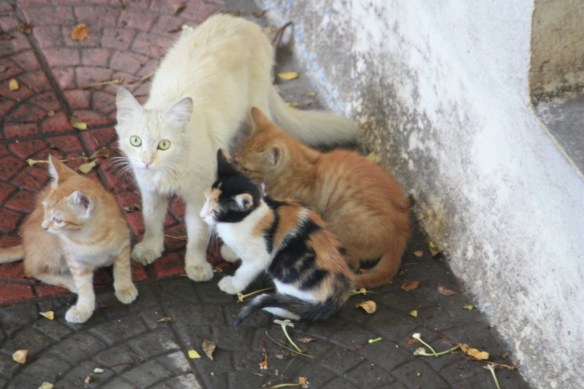
DAILY PHOTO: Neighborhood Cat Family Portrait

Taken on October 25, 2016 in Bangalore.

Taken on October 25, 2016 in Bangalore.

img_3495

img_3488


DAILY PHOTO: Birds of the Mysore Zoo

Taken in October of 2014 at the Mysore Zoo

Taken in October of 2014 at the Mysore Zoo

img_2784 img_2786 img_2795