
a mushroom cap
mango and red, burnished
rises from the forest floor
decomposition painted into a setting sun
what a masterpiece nature makes of rotting gunk


a mushroom cap
mango and red, burnished
rises from the forest floor
decomposition painted into a setting sun
what a masterpiece nature makes of rotting gunk

Taken at Callaway Gardens in the Autumn of 2012

Taken Labor Day Weekend, 2011 at the DragonCon Parade in Atlanta
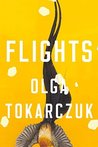 Flights by Olga Tokarczuk
My rating: 5 of 5 stars
This book’s unifying theme is broader than the title would suggest. I would argue that it’s even broader than “travel,” which is a common topic throughout. Given what might seem like a disparate, secondary (but recurring) theme of anatomy, I’d say “movement” is the book’s true theme. (The body, arguably, existing to make us mobile.)
Theme is important in this book, because otherwise it would appear to be a wild pile of written scraps with a few coherent (but only thematically-linked) short stories thrown in. The pieces included range from short paragraphs to long-ish short stories, and include what I would call stories, snippets, essays, observations, and even what could easily enough be called prose poems. Some of the work feels clearly fictional, but other parts feel like memoir bits or essays.
At this point, one might incorrectly believe that I’m trashing the book, given use of words like “disparate” and “scraps.” On the contrary, I enjoyed reading it immensely. The writing is skillful and thought-provoking, and the stories such as the eponymous short story “Flights” and the serially-presented “Kunicki” are evocative and well-crafted. Those stories deal with cases in which there is an urge to abandon the family and live like a vagabond, and that specific dimension of movement (or response to the urge to move) is seen throughout.
That said, those who see the word “novel” in the blurb and believe this is a novel in the usual sense of that literary term may be in for a surprise. I can accept that story is regarded in some circles of literary fiction in the same way that meter and rhyme are thought among some of the poetry elite (i.e. a cheap gimmick used by those ungifted in expressing themselves?) However, I have difficulty thinking of a novel as a written work that discards not only an overarching story, but also dismisses character development. Don’t get me wrong, the stories mentioned (and others) feature both narrative arcs and character development, but not in a cohesive way that undergirds the entire work. I suppose one counterargument is that the unstated narrator (presumed to be the author) is the character that is developed, and into whose mind the reader gains insight. Fair enough. Seems like a stretch, but fair enough.
Long story short: It’s a very readable, artful, and insightful. But I might refer to it in a dozen different ways, and none of them would be “novel — ” except, perhaps, as an adjective. That said, I’m not so concerned about labels as quality, and it’s a quality work.
I would highly recommend the book, particularly for travelers (versus tourists) – you know who you are.

Taken in the summer of 2008 in Beijing
 The Merchant of Venice by William Shakespeare
My rating: 5 of 5 stars
Get Speechify to make any book an Audiobook
This story hinges on the (now proverbial) pound of flesh. Bassanio is a poor gentleman in love with a rich lady, Portia. While Bassanio is upfront with Portia about his poverty — and she could care less — he can’t bring himself to propose to her without a few coins to his name. So, he goes to Antonio, the titular merchant of Venice and a close friend, and asks for a loan. Antonio is free and easy about making loans without requiring interest payments. Antonio says he’d gladly hand over the money to Bassanio, but all his money is tied up in his ships at sea. He, furthermore, tells Bassanio that if anyone will make him loan, the merchant can easily cover it. Antonio has tons of merchandise arriving in the next couple months from all around the world. The loan amount is small compared to what Antonio intends to earn from selling his goods.
The problem is that the only other game in town for loans is a Scrooge-esque lender named Shylock. Shylock is hard enough to deal with as it is, but he has it in for Antonio, in particular. Besides the fact that Antonio frequently offers interest-free loans — cutting into Shylock’s business — Antonio has also kept Shylock from collecting collateral by paying off other people’s loans before said loans went into default. (Maybe that’s why there were no other lenders in all of Venice?) To be fair, Shylock claims that his gripe with Antonio is that the latter is always leveling antisemitic slurs and other insults at the lender. At any rate, Shylock says he’ll make the loan of 3,000 Ducats, but, instead of ship or merchandise, he requires a pound of flesh as bond. Antonio, for reasons of friendship and the fact that he believes he will have a windfall by then, agrees to Shylock’s terms. If he doesn’t repay the 3,000 ducats in three months, Antonio will have a pound of flesh cut from his chest.
[Spoilers follow.] Bassanio takes the cash and goes traveling to make his proposal. First, he is required to play a “Let’s Make a Deal” game in order to earn the opportunity to wed Portia. The game involves three boxes (i.e. caskets): one of gold, one of silver, and one of lead. Inside one of them is a portrait of Portia, but the others are losers. All a prospective suitor has to go by is a brief inscription. By the time Bassanio arrives the reader has seen two Princes’s failed attempts at this courtship game. The inscriptions with the gold and silver boxes flatter Portia and the suitor, respectively. The inscription on the leaden box acknowledges that the marriage will not be all sunshine and roses, and that is the box Bassanio has the wisdom to choose. Unfortunately, shortly after he does so, he learns that a couple of Antonio’s ships wrecked at sea and the others haven’t been heard from, and – by now – the loan is in default.
Bassanio heads out to Venice with triple the Shylock’s money from his generous and wealthy new wife, planning to dispose of the situation. However, Shylock won’t budge on the terms of the bond. A drama plays out in the courtroom. Portia, anticipating the Shylock might not take the lucrative offer, has her butler take a letter to a legal expert and has said servant return with the lawyer’s reply posthaste. Portia and her handmaid disguise themselves as men – a lawyer and legal clerk, respectively – and catch up with the legal proceedings in Venice. After no one (i.e. the Duke, Bassanio, nor Portia-in-disguise as lawyer) is able to reason with the Shylock, Portia-as-lawyer tells him that he may proceed with cutting away the pound of flesh. However, the bond document says nothing about blood. So, if Shylock spills any of Antonio’s blood, he will be guilty of assault (at the least) and murder in the likely event that Antonio dies. Not to mention, going an ounce over a pound would be a breach of contract to be severely countered. This turns the tables, and Antonio and friends end up exploiting the situation to force the Shylock to convert religion as well as dictating the disposition of the lender’s estate (not to mention he’s still out his 3,000 ducats.)
[Spoiler end.] This play has a tense story line, particularly for a comedy, and is a gripping read. However, it’s also one of the most controversial Shakespearean works for its antisemitic and racist comments. On the other hand, there are reasons to believe that Shakespeare might have been engaging in satire. First, I mentioned that Shylock doesn’t cite loss of business as his quarrel with Antonio, but rather that the merchant has repeatedly insulted and slandered him. While we don’t see direct evidence of this behavior, the fact that Antonio rapes Shylock with his religion (by that I mean forcing a conversion using the threat of State force,) makes it ring true. Second, but continuing on this theme, there are a number of points during which the Shylock is sympathetic, most notably the famous “If you prick us, do we not bleed?…” monologue. Third, we learn that Shylock has a delightful daughter named Jessica, leading the reader to the conclusion that perhaps Shylock isn’t a jerk because he’s a Jew, but is a jerk who happens to be a Jew. Finally, the degree to which Antonio and his friends rake Shylock over the coals at the end of the court scene tarnishes Antonio’s virtue and makes Shylock sympathetic once again. The “turn the other cheek” approach of Christianity gives way to Old Testament vengefulness.
Like many of Shakespeare’s plays (notably “The Taming of the Shrew”,) accusations of sexism are also common, but if there were an award for BOSS of this play it would go to Portia, hands down. True, she has to pretend to be a man to get it all done, but those were those the times. The need for disguise also facilitates a prank that she and her handmaid play on their new husbands, regarding their wedding rings. While they are forced to comply with the dictates of the age, the women in this play certainly hold their own as strong characters. Still, I can’t say the degree to which Shakespeare was a satirist versus an anti-Semite / racist / sexist, but it’s a testament to the richness of his stories and the depth of his characters that his works can be interpreted so diversely.
It’s a masterpiece. Read it.
 Dogs of War by Adrian Tchaikovsky
My rating: 5 of 5 stars
What will it mean when there are other entities that (who) are intelligent on a human scale (e.g. master of technology, complex planning, and long-term planning?) This is a question that science fiction has addressed many times and in many ways. Tchaikovsky’s approach is interesting because it doesn’t just ask what if one produced a computer intelligence or if another biological species became (human-style) intelligent, but – instead – it imagines an entity that combines human and animal intelligence with computer capabilities and protocols?
The protagonist, Rex, is a supersized dog-man optimized and super-powered for warfighting. Rex’s general intelligence is about at an elementary school level, but his instincts, programming, and capacity to process and analyze complex and abundant information make him much more competent than that level of intelligence would suggest. The dog-part of Rex has the simple animal instincts that make dogs both loving pets and devastating predators, with both capacities rolled into one (even if one side often remains latent.) His human capacities include a limited ability to reason and – crucially – the ability to communicate via language. The computer part of Rex, besides giving him the ability to process and respond to multiple information streams at once effectively, keeps him in check by creating a hierarchy of command and by giving feedback by way of a crude proto-emotional system (i.e. feelings of being a “good dog” or “bad dog.”)
Rex is the leader of a squad of creatures of various speciation. There is a giant bear named Honey, who serves as the team’s heavy weapons platform. She’s easy to see but packs a wallop in weapons and strength. There is a reptilian member called “Dragon” that genetically shares certain lizard characteristics. Dragon is a sniper. He is stealthy, and exists to take out particularly designated targets. Staying hidden is essential because Dragon doesn’t have the fantastic durability of Rex or Honey. The final team member is Bees, a swarm intelligence of bees. Bees can go anywhere by flight, can disperse or gather as needed, and can sting with various styles of poison. The individual bees of Bees are fragile. However, losing a few here and there has little effect on Bees capacity, but its intelligence does degrade with continued loses, and the ability to act and think as a unit disappears altogether at some level of loss.
The antagonist throughout most of the book is a man named Murray, who is an overzealous military contractor carrying out a brutal war in Central America using teams like Rex’s, but also laying waste to the Geneva and Chemical Weapons Conventions as he sees fit. (The book imagines a world in which the United Nations and global corporations are strong, but national governments are weak – at least relatively.) To cover up his war crimes, Murray kills a technician named Hartnell who is beloved by Rex (though below Murray – his “Master” – in Rex’s hierarchy,) but not before Hartnell can jettison Rex’s command hierarchy. This puts Rex in a rudderless position of having to make his own decisions. While the hierarchy is gone, Rex still has canine instincts and gets signals from his feedback chip. He doesn’t have to follow orders, though it’s still his inclination to do so. Two classes of individuals sit easy with Rex. Friends are individuals that one protects at any cost. Enemies are individuals that one destroys at any cost. Rex has sufficient intelligence to recognize that not everyone fits smoothly into one of these classes, but he doesn’t know how to respond to such individuals.
After Rex and team go “off-leash,” he is adrift in a world he doesn’t quite understand and there are events going on behind the scenes that he can’t fathom. Left entirely to his own devices, Rex might yield to his instinct to try to return to his Master (Murray) and try to get back to life as usual. However, while in command, Rex has gotten used to taking the advice of Honey because he realizes that she is more intelligent than he. (What he doesn’t recognize is that Honey was accidentally over-engineered and is super-intelligent – i.e. smarter than the smartest humans. She is quietly using that intelligence in the background, including finding allies.) While Rex is an autonomous decision maker, he isn’t at ease with this autonomy, and finds himself processing conflicting arguments to make challenging moral decisions throughout the book. Using the combination of his canine instinct to protect friends and fight enemies and his (albeit limited) human capacity to draw conclusions based on information, Rex tends to make satisfying decisions. Though the author does show Rex making cringe-worthy decisions as well. This way the reader feels the stakes, and recognizes that Rex’s mish-mash of instinct, thought, and programming could lead to a poor moral choice at any moment. (If this internal conflict seems complicated, it’s not so much different from the potential wars between the reptilian, mammalian, and human [prefrontal cortex] brains that we see in human beings.)
I enjoyed this book tremendously. I found it hard to put down. It does have intense scenes of violence, but that raises the stakes. Because, the book also asks an interesting question about what “someone” like Rex would be considered and what the legal and moral response to it would be. Is Rex a person, with all the the rights and responsibilities of that condition? Is he an animal that faces the same logic we apply to dogs (i.e. no animal cruelty allowed, but dogs that bite must be put down?) Or is he something else, and what does that mean? Can Rex be decommissioned like a bomb or a tank? What is the legal and moral obligation to an intelligent creature that can be [but isn’t necessarily] a killing machine? Is it right to create an intelligent entity and then install a command hierarchy such that it is a slave to the wishes of others?
If you enjoy science fiction, I believe you’ll find this book intense and entertaining.

Central Presbyterian Church from the State Capitol; Taken in February of 2012 in Atlanta

Atlanta First United Methodist (L) and Basilica of the Sacred Heart of Jesus (R) from SunTrust Plaza
Oh, I can feel the force of your allure.
It tugs my chest, and I am leaning fore.
Have you bent space and time to your contour?
For I fall into you, not down to the floor.
But feet, they fail, anchored in place by nerves,
so I cannot escape toward your force.
Tumbling to a place past knowledge can’t serve,
and time, it fails to flow or rejects course.
Drifting in this dark and humorless void.
Can I salvage this perilous tumble?
Or cruise space like an aimless asteroid
by lack of grace being ever humbled?
As I regain footing and state of mind,
I find that we’ve become somehow entwined.
Taken in December of 2012 at the Atlanta Zoo


