Unknown's avatar

About B Gourley

Bernie Gourley is a writer living in Bangalore, India. His poetry collection, Poems of the Introverted Yogi is now available on Amazon. He teaches yoga, with a specialization in pranayama, and holds a RYT500 certification. For most of his adult life, he practiced martial arts, including: Kobudo, Muay Thai, Kalaripayattu, and Taiji. He is a world traveler, having visited more than 40 countries around the globe.

BOOK REVIEW: The Science of The Big Bang Theory by Mark Brake

The Science of The Big Bang Theory: What America's Favorite Sitcom Can Teach You about Physics, Flags, and the Idiosyncrasies of ScientistsThe Science of The Big Bang Theory: What America’s Favorite Sitcom Can Teach You about Physics, Flags, and the Idiosyncrasies of Scientists by Mark Brake
My rating: 4 of 5 stars

Amazon page


The good news is that this book is full of fascinating tidbits from the history of science, the history of science fiction, and the pop culture phenomena that is the television show, “The Big Bang Theory.” The bad news is that it may not at all be the book that you are expecting if you take the title literally. That it’s not the book it seems like it would be could be a good thing or a bad thing, depending on what your interests and science background are.

Let me explain. Say you are a super-fan of the show with an education in physics and you want to know something like: which Dutch researchers Sheldon thinks Leonard is ripping off and how, or: what the monopoles are that the four male leads go to the North Pole in search of [and why,] you won’t learn anything about those things in this book. You won’t have any more insight about what the scientists on the show – be it Raj Koothrappali to Leslie Winkle — are working on, or what those vaguely referenced scientific terms and discussions mean. You won’t learn about what any of the equations on those dry erase boards mean, and whether it’s gibberish or real science. As I mentioned, this may be a good thing because the topics that are mentioned off-hand on the show are often complex and difficult, e.g. Bose-Einstein Condensates, and most readers would be lost in such discussions. That said, if you are looking for such discussions and clarifications, you absolutely won’t find them in this book.

This book is aimed more at a reader with a high school science education, an interest in science fiction, and who would like to learn some quirky facts about science and science fiction while they are regaled and reminded of fun moments from their favorite episodes of the show. Truth be told, I wouldn’t be at all surprised to learn that this was a collection of essays written long ago, and then the author said something like, “Hey, I have this essay about volcanoes, in episode ___, _____ makes a random comment about volcanoes. I could put some dialogue from that episode at the front of the chapter, sprinkle in a few references to the show in the text of the chapter, and recycle a whole box of columns, putting together a science-pop culture crossover book.”

The 31 chapters are organized into four parts entitled, “Space,” “Time,” “Machine,” and “Monsters,” respectively. That said, organization isn’t the strong-suit of the book. The eight chapters in the “Time” section seem to have more to do with chemistry than time, per se. The “Machine” section does better, but discusses concepts like fire and volcano that are no more connected to that theme than to any of the others. It’s really a disparate collection of essays on various science and science fiction related topics.

I may sound like I’m panning this book, but I enjoyed it, overall. Now, if I’d have shelled out the cover price thinking I was getting the book that the title suggests, I’d be royally cheesed off. So, know what you’re getting and decide accordingly. If you have an interest in the history of science and science fiction, you’ll probably find the book intriguing and worth reading. If you have a high-level understanding of physics and want to learn about the physics they mention in “The Big Bang Theory” television series, you will be sorely disappointed.

View all my reviews

BOOK REVIEW: Book of Words by Abay Kunanbayev

Book of WordsBook of Words by Abay Kunanbayev
My rating: 4 of 5 stars

Amazon page


Book of Words is a collection of 45 short essays by Abay Kunanbayev (1845 – 1904), one of Kazakhstan’s preeminent men of letters. Abay is known both as a poet and philosopher. This book includes more prose philosophy than poetry, though it does contain a few lines in verse.

I picked this book up while traveling in Kazakhstan. It should be noted that much of the book is a rant against the Kazakhs of Abay’s day. The book advocates for individuals to be both more scholarly, more virtuous, and more piously religious, and it skewers Kazakhs as simpletons who only care about the size and state of their livestock herds and the wealth that said herds can bring them. It’s eloquently written, but there’s not much more to it than that. With his Book of Words, Abay is trying to goad the Kazakh’s into being more virtuous and well-read. Judging from both the prominence of his name in Almaty (a huge statue, a major road, and one of the Metro stops named for him) and the success seen in Almaty, many Kazakhs probably took his words to heart.

There was a forward by someone named Nursultan Umbetov who is living, but far less famous (internationally, at least) than Kunanbayev. However, that front matter is the only ancillary matter for the edition I read. It does have explanatory footnotes where necessary to clarify something that wouldn’t make sense to non-Kazakhs.

If you want to gain insight into Kazakh culture, and how it’s changed since the 19th century, this book is worth reading. Much of the book may be viewed as trite truisms rather than earth-shattering wisdom, but it’s concise and well-articulated.

View all my reviews

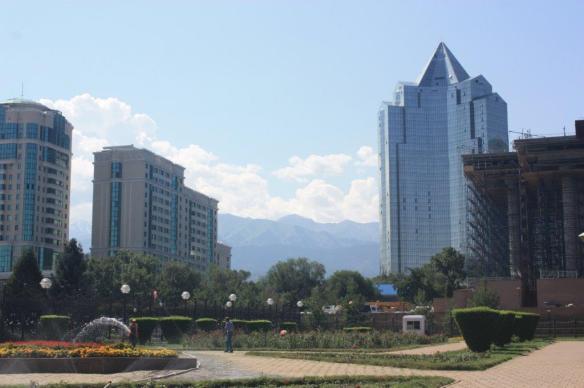
DAILY PHOTO: Mountain Peak Emulating Building in Almaty

Taken in Almaty in August of 2019

My Year of Discovering How Weird the Mind Gets, Pt. VIII [Sleep Deprived]

This month, I skipped two consecutive nights sleep to explore the effect of sleep deprivation on consciousness. Forty-eight hours without sleep may not sound like much. A two-day fast will make you feel hungry, but is hardly a challenge for the body of a healthy individual. Of course, most people could go a few weeks without food as long as they could reduce physical activity.

Sleep may be more closely analogized to water. It’s often said that a person can go a week without water, but some people have succumbed after three or four days. The world record for consecutive time without sleep is 11 days and 25 minutes, set by Randy Gardner in 1964, but most people will experience some severe challenges after a few days, and after even one day it’s not safe to do many fairly rudimentary life tasks (i.e. driving, making important life decisions, doing any work that requires concentration.) [Note: Gardener points out that it was day three when he started to feel nausea and the challenge started to feel daunting.] My choice of two days was largely influenced by the limit of how long I could go without being productive. Into the second day, maintaining the level of concentration necessary to edit or write finished product becomes almost impossible for me and it rapidly gets worse, and I certainly couldn’t safely drive my scooter.

Unfortunately, I’m no stranger to sleep deprivation, though it was mostly in my youth. That makes it sound like I was a party-animal, though I wasn’t (certainly not by the standards of true party-animals.) In truth, in the military I started out working twelve hour night shifts, and I found I could rarely sleep more than four-ish hours per day. Later (still in the military) I worked days at a base in Georgia, but I would frequently (once, sometimes twice, a week) travel from Warner Robins to Atlanta after work for martial arts classes. Often, hanging out with friends after night classes, I would return to base in the wee morning hours and — on a number of occasions — missed a night’s sleep because I didn’t have enough time to get in even a solid two hours before I had to be ready for the 6am shift change. (Note: I’m a groggy napper. While some people swear by naps, I find they tend to make me even more fuzzy-headed — especially if I’m in need of more sleep than I have time to get.) [FYI: My personal record for sleeplessness is a little longer than I did this time — 55 hours-ish. It was also when I was a young man in the military.]

Where sleep is very different (from food or water) is that until recently we didn’t have the foggiest idea why we needed it. Biologists could tell us why we need air, water, and food decades ago, but no one knew why we needed sleep — only that bad stuff happened in pretty soon when we didn’t get sleep. I was under the impression that we still didn’t know (and it’s probably true that we don’t yet have a complete picture.) However, I started reading Matthew Walker’s Why We Sleep, and he suggests that it’s not that we don’t know why we sleep, but rather that it’s not the simple one-to-one cause-and-effect relationship that sleep researchers had hoped to discover as a Holy Grail of sleep causation. Walker says we know a great deal about why we sleep, it’s just that there are a large number of aspects of our body’s operation that hinge on sleep. In other words, it’s a complex many-to-one relationship between causes and sleep. [Another reason I kept a limit on this experience was the book’s discussion of how many adverse impacts sleep disruption can have, and — more importantly — how long-lived the effects of sleep deprivation can be.]

There were a number of ways the sleep deprivation was felt. Of course, the predominant sensation was just an incredible pressure to go to sleep, i.e. heavy eyelids, mental drift, and “head-nodding” micro-sleep. There’s a great deal of discussion about how memory degrades under sleep deprivation, because sleep / dreams seem to be heavily involved in the memory process. I didn’t notice any memory defects [any more than I might normally have.] However, I readily noticed a decline in concentration and focus. After a day without sleep, I found that my ease of proof-reading / editing was significantly reduced even when I did it during those times when I was most awake and didn’t really feel particularly sleepy. A one-hour task would take decidedly more than that, and I recognized that I shouldn’t do any finished work because even if I took twice as long I’d likely still miss mistakes. Toward the end of the second day, I had trouble even following a sitcom story on the television (thought that was at the point in circadian rhythms when I was most desirous of sleep.)

The other mental effect I noticed was a mild altered sensory perception. This was nothing like the psilocybin tea altered perception. The first thing I notice was a little bit of movement in my visual field if I zoned out while staring at at the floor (and zoning out happens much more than it ordinarily would after a good night’s sleep.) Again, this wasn’t vivid like the shrub that sinuously wound in a serpentine fashion when I tried psilocybin tea. Rather it was just a kind of tiny “stretching” of floor surface when I looked down. You’d have to pay attention for it and might rub one’s eye to try to get rid of it. The second thing I noticed was some auditory strangeness. I heard a barking dog in a passing car, and it was as if that one sound was turned up even as the car was getting further away (or perhaps like the other sounds were turned down. All I know is that the barking of the dog took a dominant position in my auditory awareness. I wasn’t anything wild, like the dog talking to me. I suspect that would take another couple days of complete sleep deprivation. And I have no particular anxiety about dogs or barking noises.)

Physically, there were a few other noteworthy effects. First, I found myself getting chilly even with no AC on and even after I turned the fan off. What’s important to note is that I tend to run hot, and in Bangalore if I feel chilly it probably means I have the flu. I’ve known for a long time that thermoregulation is disrupted during sleep. (This is why one may go to bed comfortable and wake up in a sweat puddle, or — for some, I suppose — go to bed comfortable and wake up freezing. It’s not necessarily a change in the room’s temperature, it’s that your body isn’t so much adjusting the difference between room temperature and body temperature anymore.) I found the chill interesting. The fact that I wasn’t sleeping seemed to me should have meant that reduced thermoregulation should be irrelevant. However, after the fact I learned (again in the Walker book) that body temperature changes with one’s bodily rhythms, and that is presumably what I was feeling.

Second, I noticed a very mild rumbly-tummy effect. I didn’t realize how much sleep problems can be tied into eating problems until reading about it, but I have noticed in the past that my stomach gets a sensation that is akin to being hungry if I’m on no sleep — even if I’ve not been without food (at least not more than I normally would be through the night.)

Those were the most noticeable effects. I can see why some people have had similar experiences while severely sleep deprived as during mystical experiences of other cause (e.g. hallucinations from consuming substances, severe fasting, etc.) Still, for me, the long and short of it was that sleep deprivation had (in contrast to the the other practices I’ve done in this series) a clearly negative impact on the performance of body and mind. From difficulty concentrating to a slow time when running, my body was hindered by lack of sleep. Sleep deprivation diminished my mental and physical competence with no offsetting benefit that I could determine (other than assuaging my curiosity.) 

Next month’s post on experiencing altered states of consciousness will be on a mystery topic. [Which may or may not be my way of admitting I’m not sure what I’m going to do yet.] 

DAILY PHOTO: Three Views of Kuntibes Mtn. From Manzhyly Ata

Taken in July of 2019 from Manzhyly Ata

5 Traits Confused for Introversion

There are a number of personality traits or temporary states of mind that may be wrongly attributed to introverts. One reason for this is that introverts aren’t the most expressive of individuals, and in the absence of information people write their own stories — and when writing their own story, they tend to put themselves at the center, even if it’s a story to explain another person’s behavior. So it is that, faced with a lack of verbal or nonverbal feedback, many individuals will assume that the introvert’s behavior has something to do with them. For example, the introvert — lost in thought — who doesn’t acknowledge another person’s entry into the room may be seen assumed to be miffed or irritate, when the truth is that they were just so deeply absorbed in thought that they didn’t notice said person.


5.) Arrogance: If the introvert has a high level of self-confidence in his or her abilities in a particular domain, they may be believed to be arrogant or narcissistic, generally. I, for one, am plenty arrogant in some regards, but that doesn’t mean I’m at all arrogant about what people have assumed me to be arrogant about.

4.) People-hating: Introverts burn energy quickly in interactive, or highly stimulating, situations. That means that they aren’t going to jump on every invitation. An introvert has to manage energy with respect to activities and events where he or she has to interact with others. Choosing to stay home alone rather than go to a given party doesn’t equal hating people.

3.) Shyness: Introverts can be shy, i.e. have anxiety about being in social situations. However, the two don’t necessarily go together.  Shyness, or social anxiety, is also much less stable a condition. In other words, people can overcome social anxiety just like they overcome fear of spiders or heights. However, introversion isn’t conditioned away, generally speaking. One needs to think in terms of managing introversion rather than extinguishing it.

2.) Unintelligence: As Susan Cain discusses in her book “Quiet” this isn’t a global tendency, but it’s common enough in the Western world and America, specifically. In Taoism, it’s famously said that “He who speaks does not know, and he who knows does not speak.” But in the West, if you don’t broadcast your ideas loudly its assumed that you don’t have ideas, and — alternatively — if you are loud enough people may begin to assume you know what you’re talking about. [Which, needless to say, need not be true.]

1.) Hostility / Passive Aggressiveness / Anger: An introvert may be assumed to be giving others the “silent treatment” when — in fact — there’s no “treatment” just a love of silence.

DAILY PHOTO: Graffiti in Almaty

Taken in Almaty in July of 2019.

DC5FDEEE-AD6D-458A-8127-D65D259CD387

POEM: Kyrgyz South Shore

standing on a green mountaintop
with snowcaps to my back
ahead, angular arid lands
crinkled, as marked by wrack

beyond, a lake still and turquoise
waters frigid as clear
not a sound but for bird or breeze
at habitat frontier

where do desert, beach, and meadow
mingle as in this place?
a thousand square miles condensed
into a hundred acre space

DAILY PHOTO: Kolsai-1

Taken in August of 2019 at Kolsai-1 Lake

DAILY PHOTO: Baza Karakol Ski Lift in Summertime

Taken in August of 2019 at Baza Karakol