Unknown's avatar

About B Gourley

Bernie Gourley is a writer living in Bangalore, India. His poetry collection, Poems of the Introverted Yogi is now available on Amazon. He teaches yoga, with a specialization in pranayama, and holds a RYT500 certification. For most of his adult life, he practiced martial arts, including: Kobudo, Muay Thai, Kalaripayattu, and Taiji. He is a world traveler, having visited more than 40 countries around the globe.

DAILY PHOTO: Scenes from Spirit City

Taken in January of 2019 near Vientiane at the Buddha Park (Xieng Khuan)

Xieng Khuan (which translates to “Spirit City”) is what this statue park outside Vientiane, Laos is apparently called by locals. In English, it’s usually listed as “Buddha Park.” I used the former translation because it’s way more intriguing, but if you’re looking to find the place…

It should also be pointed out that some of the artwork is Hindu in origin, rather than Buddhist.

BOOK REVIEW: How to Carry Water by Lucille Clifton

How to Carry Water: Selected Poems of Lucille CliftonHow to Carry Water: Selected Poems of Lucille Clifton by Lucille Clifton
My rating: 5 of 5 stars

Amazon.in page


This is a new collection of selected poems of Lucille Clifton. Clifton fans who’ve already read her “Collected Poems” or her individual collections should be aware that there are ten poems included that have not previously been published. Aracelis Girmay is the editor of the volume and did the selection and arrangement of the poems, and I think she did a fine job with the task.

The poems are largely free verse, and heavily feature confessional and social justice poetry. That said, it is a diverse selection across the poetess’s career, and offers poems that will resonate with anyone. There are poems that examine the world from the perspective of group identity (i.e. as an African American, a woman, or both of the above.) There are also poems that pivot on Clifton’s life experience as an individual – e.g. a cancer survivor who had a mastectomy. Her poetry is bold in its candidness in dealing with issues ranging from civil rights to women’s health.

I found this collection to be powerful and evocative, and would highly recommend it for readers of poetry.

View all my reviews

POEM: Care & Feeding of Your Mr. Hyde

How often should one let one’s Hyde out for a walk?
Just the thought sounds dreadful & unacceptable, right?

But, then again, how many beasts are made more docile by being caged, denied, and disavowed?

It can’t be many.

One never learns the rules of care and feeding for one’s Hyde.

“Just chain the poor thing up in the attic, and hope it doesn’t claw its way through the roof.”

Most people will say, “I don’t have a Hyde.”

They’re the most adorable of all —

like kids who think brown cows make chocolate milk.

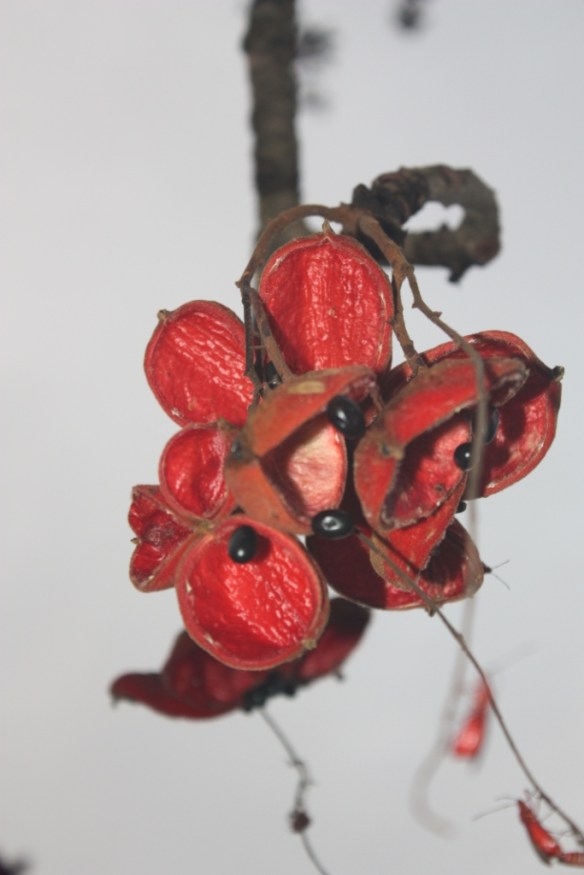
DAILY PHOTO: Seed Pod

Taken in Assam in May of 2017.

POEM: The Engine of Evil

They first noticed creepers crawling
into the dingy depths of caves —
impossibly feeding on that rich darkness.

Something was out of balance.

Something was wrong in the machine —
the one they called it the engine of evil —
and either it was running over the redline,

or its counterpart was faltering.

Either way,

War.
Pestilence.
Famine.
Genocide.

All for lack of a mechanic.

POEM: Dream Envy [A Sestina]

In dreams, I lived in the mountains,
but my home was in a bled swamp.
Did highlanders dream of wet feet?
Or does dream envy flow one-way?
Could my life be one’s serene dream?
Why not? Dreams are built on nonsense.

But there’re fatal forms of nonsense —
like drowning in a vast mountain.
Who knows what will come in a dream?
One might fall off the fetid swamp
because down isn’t always the way —
if nothing pulls up on your feet.

I can’t say for sure I’ve dream feet.
“Now, you’re really talking nonsense!”
Tzu’s butterfly taught me the Way.
Maybe I’m in swampy mountains,
or, perhaps, a mountainous swamp
They’re the same — all places but a dream.

This conversation is a dream —
yet, I feel floor beneath my feet.
Or am I knee deep in the swamp?
Sense is starting to make nonsense.
I can’t be far from the mountains,
though I’m not sure I know the way.

The way? Or the Way? or the WAY!
Who can say, it is just a dream?
Dream mountains are not real mountains —
no more than a real feat is dream feet.
Don’t claim I’m hemorrhaging nonsense
because I’m in my happy swamp.

The swamp that’s known isn’t the true swamp.
The whey that’s unweighed isn’t the Way!
Nonsense that makes sense is nonsense.
That’s true in life, but in a dream?
Am I in bed, or on my feet?
Or falling from a snowy mountain?

All nonsense isn’t found in your dreams.
We slog the swamp and find the Way.
Swampy feet, head in the mountains.

DAILY PHOTO: Trail in a Park

Taken in April of 2011 in DeKalb County, GA

BOOK REVIEW: The Third Policeman by Flann O’Brien

The Third PolicemanThe Third Policeman by Flann O’Brien
My rating: 5 of 5 stars

Amazon.in page


Full-disclosure: I’m a huge fan of stories involving mind-bending, surrealist worlds, of which this is a masterful example. I also find dry, absurdist humor of the Monty Python variety to be hilarious, and this book has loads of it. In short, for me this book was a match made in heaven.

The opening of the story is normal enough. There are two characters who seem to be inseparable friends, but – in fact – they are inseparable because they conspired to murder an old man in order to steal his money. One man, the protagonist, fears that the other man (who knows where the loot was stashed) will make off with the money, leaving our lead high and dry. After the two have left time for the heat to die down, the partner (who knows where the money is) suggests they go to retrieve and split it. Recognizing that the protagonist doesn’t trust him, the partner suggests that the protagonist go into the old man’s abandoned house to extract the lock-box that they left behind.

The protagonist agrees, and once he enters the old man’s house, we know that he has tumbled down some sort of rabbit-hole. The reader doesn’t learn what the cause of this shift into a dreamlike world is until near the end of the story, but it’s quite obvious that this isn’t the real world. “Dreamlike” is an apt descriptor. While this bizarre world clearly builds on the world as he knows it, it also defies the logic of the world as we know it. Furthermore, as when in a dream, the protagonist doesn’t recognize the strange logic of how this world operates, nor does he truly recognize how strange people’s behavior is.

The strangeness begins with the protagonist’s discovery of the man he killed – apparently living – in the house. The conversation gets off to an odd start when the protagonist discovers that the old man will only answer yes / no questions in the negative, and so he’s been giving false information about half the time. Their meandering conversation shifts onto the titular “policemen,” who – while vaguely authority figures – are involved in all manner of inexplicable activities from making garments that indicate the length of a person’s lifespan to taking measurements of unexplained quantities for unexplained purposes (or – perhaps – no purpose.) The protagonist reasons that since these policemen seem to know so much, they will surely be able to tell him where the lock-box is located.

As I said, the book contains a lot of absurdist humor. Some of this derives from the policemen’s obsession with bicycles. When the protagonist arrives, they just assume he is there about a stolen bicycle (or bicycle parts) and – no matter how he tries to convince them otherwise – they continue to answer his inquiries about other matters in terms of bicycles. (There’s also a bit of an unexplained obsession with pancakes, as when a difficult problem is called an “insoluble pancake.”)

As I say, I love this kind of book, and I thought this is a particularly skillful and amusing example of the genre. I’d highly recommend it for readers who like their fiction trippy. Despite huge doses of surrealism, it’s easy to follow what is going on in the story, and to distinguish what is real and what is imaginary.

View all my reviews

DAILY PHOTO: Sunset at MG Beach, Kochi

Taken in Kochi (Cochin) in July of 2017.

BOOK REVIEW: Heathen, Vol. 1 by Natasha Alterici

Heathen, Vol. 1Heathen, Vol. 1 by Natasha Alterici
My rating: 4 of 5 stars

Amazon.in page


The protagonist is a lesbian Norse warrior, Aydis, who is living in exile in the wilderness. After she was discovered making out with a girlfriend, two unappealing fates were offered: marriage (to a man) or death. Her father, recognizing that neither of those options was acceptable to his daughter or himself, pretends to accept the death sentence, but instead of killing Aydis he helps with her escape. The story is set in a period in between the heyday of Norse Mythology and modernity. The story refers back to mythological events (and since many of those characters are immortal it includes a few of them,) but it’s during a time when Christianity is spreading in the region and some of the old ways have been forgotten or dismissed by many.

The four issues contained in this book follow a quest that involves Aydis going to rescue a Valkyrie named Brynhild who was long ago imprisoned on a mountain in a circle of fire for defying Odin. Then – once Brynhild is freed –the quest continues in order to keep the rescue from being reversed and becoming meaninglessness. [Brynhild must be married to a mortal to escape imprisonment, but since that means she must repeatedly see her mortal spouses die only to go back to her prison. Aydis intends to see this reversed.]

I found the writing engaging and action gripping. While I’m no expert on art, I was able to follow the action in the panels and found it stylistically interesting and distinct – though I couldn’t tell you anything about what that style is.

My primary criticism revolves around my own preference for a volume having a self-contained satisfying narrative arc. This volume had plenty of great action and relatable character objectives. Admittedly, this is a tough standard for work that is by its nature serialized. However, at the end of the book one feels the set up for the continuation of the story (the cliffhanger) much more intensely than one feels there was any kind of conclusion and resolution. For readers who are predominantly series readers, this may not be a problem, but as one who reads one book at a time, I need to feel that something was resolved over the course of the story.

I think the book was bold and successful in turning conventions on its head. The primary convention under attack is the distressed damsel – a helpless character who needs a man to come along to rescue her. The book also takes the social issue of persecution based on sexual preference in a scene within Brynhild’s parallel (but intersecting?) quest.

Overall, I found this to be an enjoyable read. If you like the story idea and tend to read in series, then this is a great volume to pick up. If you’re not sure you want to be drawn into another series, you may decide to exercise more caution.

View all my reviews