
Taken in Bannerghatta National Park in November 2013.


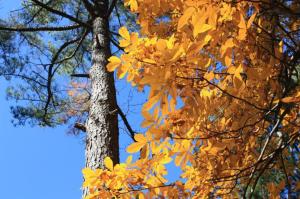
In this land of tropical green,
there is one tree timed to north lands.
Its leaves turn red from deepest green,
and fall as if to season’s plans.
They fall not by mere ones or twos,
but in wild, fluttering masses.
Inside, it gives one the bronzy blues
to starkly feel the year’s passage.
To see sunny-side branches nude,
and know the numbered days still left
for ever-redder multitudes
who suffer time’s — and wind’s — great theft.
No land is so foreign to me
that I can’t see home in a tree.

Taken in the summer of 2011 in Indianapolis.
 It’s mid-month.
But how?
Where are all those days?
Once upon a time,
days were shoved neatly into rows —
like tiles in a perfect pattern…
weren’t they?
Now, the days are tossed rubble:
fragmented,
deformed,
or missing, altogether.
And I wonder whether I was awake through those disjointed days, or whether my mind was kicked into some kind of timeless void?
 100 Things to Do in a Forest by Jennifer Davis
My rating: 4 of 5 stars
I’m a big fan of any book that works to get people to experience nature. The more times I see someone on a cellphone walk into a wall or a pole, the more this is true. [BTW: If you are thinking to yourself, “I’ve never seen a single soul walking into anything while on their phone!” then you are among those who are walking into things. (Or, maybe, you live in a cave.)] At this point, I’m pretty concerned about the continued survival of our species because of the lack of awareness that time in nature cures — one way or another.
This book takes a crack at the problem by coming up with a hundred activities of varying kinds that one can do in nature, the intent being to make it appealing for the segment of the population who have no idea what to do once they get into the woods and / or who may have a bit of angst about the experience. The book shifts philosophy from what has long been the mainstream view defined by the mantra: “take only photos and leave only footprints.” This isn’t to suggest that Davis is condoning wandering around tossing trash about or randomly uprooting plants. On the contrary, she advocates being a good steward of nature, but with the provision that nature can take more individuals plucking flowers or the like (and that if more people were vested in nature through such activities, they would ensure that the large-scale threats were stopped.) I’m not sure how I feel about this philosophical shift, but it does make for intriguing food-for-thought.
The activities are of varied types. I would classify them as campcraft (e.g. knot tying or knife use,) personal development (e.g. meditation and yoga), and crafts projects. One might get the feel this book is geared toward kids, but the author clearly tries to reach a broad demographic. The ideal demographic might be adults with children who are looking at what to do to make a trip to the woods compete with the hot sensory injection of modern urban life. While it’s not a particularly advanced book, I did learn a few new things. Furthermore, I felt that most of the activities suggested were potentially beneficial. There were a couple exceptions. The first is one in which one categorizes things in nature as opposites (which I object to on the basis that humanity does far too much stuffing of things into arbitrary groupings already, and I feel it has negative consequences.) The less psychological and ethereal objection was the candle-lit trail. (Which I primarily object to on the basis that – even placing tealights in glass jars the book suggests – a fire hazard is created by putting jars on loose leaf and needle litter which is spongy, uneven, and often highly flammable. A secondary objection is that carrying enough glass jars to make it work would be ridiculously awkward and risky for a person walking around in the dark in the woods. But 98 or 99 suggestions that remain are still likely to give one something useful to think about.
The book has artwork here and there throughout. Some of this art is ornamental, but other pieces are functional, in support of teaching activities such as knot-tying that are difficult to convey through text.
If you’re looking for a book of activities to perform in nature, this one is worth checking out. The activities are pretty simple, but because they are of several different classes of pursuit, even someone experienced in the woods may learn something new regarding meditation or crafts.
 The Gospel in Dickens: Selections from His Works by Charles Dickens
My rating: 4 of 5 stars
This book captured my attention because (I must confess) I’m delinquent when it comes to the writings of Charles Dickens. I’ve only read “A Christmas Carol” and that is admittedly sad given the profound impact of (and masterful storytelling in) Dickens’ work. The challenge confronting me is that (excepting “A Christmas Carol”) the works of Dickens tend to be huge bookshelf-cracking tomes, and so I’m seeking a strategy by which to approach his publications – given the time investments involved. Because this is a book that largely consists of excerpts from his various works, I figured it might help me devise a plan of how to tackle Dickens (figuratively.) I believe it did help me in that regard.
The book’s theme is how biblical teachings feature in the works of Dickens. While my own reading objectives tend toward the secular, I figured that knowing about the moral conundrums and growth, or lack thereof, of characters would be a good way to understand Dickens’ canon as stories and not only as reflections of religious attitudes. Moral dilemma is, after-all, a central element of storytelling — universally, and not just with regards to religious or mythological contexts. I feel I was correct in this regard, as well. I did learn about which stories were most likely to appeal to me.
I do believe the book was as much about how Dickens (not by himself, by any means, but as part of an artistic and societal movement of the day) influenced the nature of Christianity (both in his time and beyond) as it was about how the Gospel influenced Dickens. I’m not saying this with intent to blaspheme. It’s just that the nature of the problems and how they were approached is very different between the time of ancient Rome and Dickensian London. So, one has a kind of general teaching of being charitable and kind to those less fortunate and it is applied to policy questions that were nonexistent at the time of the Bible or that individuals in the Bible were silent upon.
There are three chapters or section to the book. The first looks at attitudes toward the poor. If one knows anything about the works of Charles Dickens, it’s that they virtually all deal with down-and-out characters having to make their way through worlds controlled by (often uncharitable) wealthy people. This was true of my beloved “A Christmas Carol,” but I know it’s also a major feature in “Oliver Twist,” “Great Expectations,” “Bleak House,” “The Old Curiosity Shop,” and others. This first section takes up about half the book. The second section involves the issue of redemption, and it’s about a quarter of the book. The final section is also about twenty-five percent of the book and it looks at living a good life. Each of these chapters has a series of excerpts. Generally, there is a short paragraph of editorial input before each excerpt to explain any necessary background as well as to provide some insight into why the excerpt is included (i.e. how it relates to the book’s theme.) While most of the excerpts come from Dickens’ major novels, it should be pointed out that there are some that come from other works (i.e. nonfiction and short fiction.)
There are some artistic drawings that are congruous with expectations of a Dickens book. Otherwise, there’s not much in terms of ancillary matter, though there is a Forward. I didn’t feel anything else was particularly needed (though a timeline of publications and / or an appendix with concise plot summaries might have made the book a bit easier to use.)
If you’re interested in learning more about the works of Dickens, I’d recommend this book – particularly (but not necessarily exclusively) if you have interests at the intersection of literature and religion.

The need for new experience burns brightly
gummed into these walls daily and nightly.
I think back to my great escapes
first road-trip blown interstate —
like a loose leaf.
Thrilled like a thief
cutting open his first safe, hoping for something good,
but okay if it’s just a cheap bauble of simple wood.
I crossed into the long-lost land of my youthful mind,
seeking a boon — missed amid youthful buffoonery,
or lodged within the machinery.
But I tripped into so many pits —
Sections of memory had sloughed off and fell away,
leaving a dim and dashed detritus of moments lived.
The present is such a narrow band
between the chasms of past and future,
and I fear I’ll need some mad magic to get me home.


