Taken in July of 2014 in South Karnataka

Taken in July of 2014 in South Karnataka
 Kalari Margam by Ranjan Mullaratt
My rating: 5 of 5 stars
This is one of the few books on the Indian martial art of Kalaripayattu–particularly written in English. [There are English and Kannada editions–Kannada being the language spoken in Karnataka, the state where the book was produced.]Kalaripayattu is believed to be one of the world’s oldest martial arts and many believe it to be an ancestor to many popular Asian martial arts.
This will be a quick review because this is a pictorial book–i.e. like a coffee table book. While there is text throughout, the book primarily seeks to convey the feel of the martial art through photographs. In that regard the book succeeds tremendously. The photos, often full-page format, are vivid, engaging, and bring Kalaripayattu to life. The photographer, Arabind Govind, did an excellent job, as did all of the practitioners who served as demonstrators for the photos.There is pleasing use of natural lighting for both the photos taken in the kalari and outdoors. The acrobatics are awe-inspiring.
The text is well-written and concise. There were a couple tiny typos that didn’t detract from the meaning in any way. (It’s a first edition and a photo book, so I don’t grade hard there.) The text is most extensive and useful toward the front of the book in the discussions of history, philosophy, and mythos of the art. Throughout most of the rest of the book the text consists of sparse paragraphs used to give a little additional information on the weapons and techniques–including the massage style.
The book starts with background, then it delves into the physical exercises that are used to build fitness, then the unarmed fighting approach, followed by the arsenal of weapons employed in the art, and it concludes with a discussion of vital point massage.
I’d recommend this book for students of the martial arts who are interested in Indian martial arts, or who are just interested in martial arts generally.
I will say that the book may be difficult to get one’s hands outside of Bangalore because it is self-published by the Kalaripayattu Training and Research Center. I will, therefore, give their address: Kalari Gurukulam, 102 Maple Meadows, Chikkagubbi, Bangalore, India 562149.
Their website is www.kalarigurukulam.com
 I know what you’re going to say. Why would I want to murder a cereal killer, a taco belle, a holy cow, a pig in a blanket, a deviled egg, or any of the other bearers of bad Halloween punnery? First, you want to kill someone. You don’t have to admit it to me and I’d advise against admitting it to the District Attorney, but at least admit it to yourself. Second, if you kill the person you really want to kill (e.g. your boss, the tax man, your personal trainer, or your hairdresser—sorry, low blow) you’ll be the lead suspect. Therefore, you need to find a way to vent your homicidal rage into productive outlets, and I’d argue that the killing of punsters is community service. You shouldn’t even think of it as murder. It’s more like culling the Halloween herd. Forest fires kill, but the next year the forest is more lush and beautiful than ever before.
Now let’s get down to the real reason to conduct your own Halloween killing spree. Because it’s the perfect time for the perfect crime. Think about it.
So how will you choose your target? First, as indicated, it’s best to pick someone who’s inebriated because no one will realize they’re dead–and not just passed out–until they begin to stink. Don’t worry, finding a drunk won’t be hard. At a given Halloween party there will be four designated drivers for the 150 people in attendance—so 148 people will be completely hammered. [No, my math is not that bad. Two of those designated drivers are cheating bastards. If you kill a pun who’s a cheating designated driver you’ve hit the trifecta—OK, maybe my math is that bad. At any rate, you get bonus points. ]
Next comes the question of determining whether the costume is a pun or not. This can be harder than it seems. Sure there are the easy ones I mentioned above (and others like Kevin “Bacon” [Kevin nametag on a meat vest], “Bat” Man [w/ Louisville Slugger], Down for the Count [Dracula with a blowup doll orally affixed to his crotch region], Spice Girl, Dust Bunny, Formal Apology [tuxedo-clad man with “sorry” written on his tie], etc.) that will be immediately obvious.
However, what if one sees a guy in a Grim Reaper costume with a bag of pot. Perhaps this is just someone who likes to imbibe. However, if the pot is dayglow green, then you may have a “the grass is greener on the other side” who desperately needs killing. The key is that one must pay attention to the details. Sometimes the costume will be poorly done. Imagine a fine “Tom the Cat” costume with three misshaped spheres feebly stapled to the crotch region. This is a “horny as a three-balled tom cat” who must die.
On the other hand, you should avoid reading too much into costumes. Say you see a girl who looks like a stripper. You shouldn’t engage in some Rube Goldberg-esque thought process in which you conclude that she is saying, “All that glitters is not gold–because sometimes it’s a stripper.” Said woman may merely be costumed as a stripper, or might be a stripper who just got off stage and didn’t have time to go out looking for a costume.
When in doubt, if the costume doesn’t seem to make a lick of sense, it’s probably someone’s sense of clever gone awry and you shouldn’t feel bad about friendly fire against a non-pun.
Finally, some general rules of thumb (BTW: feel free to kill anyone dressed in a giant mitten with a page of the tax code taped to the thumb):
I hope this guide to perpetrating a Halloween massacre has been helpful. I think we’d all like to bring the fear back to Halloween like all the Saints who partied down on All Saints’ Day Eve intended. So, whether you’re a first time killer or you’ve been around the block (another potential costume cliché to kill), a few simple steps will keep you out of the hands of the slutty cops—or regular cops.

Taken in November of 2013 at Agra Fort
This photo was taken at Agra Fort, and I believe was in the Jehangiri Mahal.
My rating: 4 of 5 stars
VALIS is the first book in a final—unfinished–trilogy of Philip K. Dick. The other two books of the trilogy were to be The Divine Invasion (finished) and an unfinished book that would have been entitled The Owl in Daylight. Some (notably people who want to sell books at any cost) will claim that The Transmigration of Timothy Archer is the last novel of this trilogy. It’s true that “Transmigration” was Dick’s last complete book and that it shares a domain at the nexus of religion and science fiction with the VALIS trilogy, but it wasn’t intended to be part of the trilogy.
“Trippy” might be the best word to describe VALIS. The narrator is a writer named Phil, who we know from details like the mention of past titles is really the book’s author, Philip K. Dick. The lead character is a man named Horselover Fat. If one is reading carefully, one learns early that Horselover Fat and Phil are one in the same—although we don’t learn until late in the novel that Philip means “fond of horses” in Greek and Dick means “fat” in German. For most of the novel Phil speaks of Horselover Fat as though he was an entirely separate person, and even describes times when the two were said to be in two different places (Horselover goes on a global search for the new messiah, while Phil seemingly stays home.) There’s a point late in the novel in which Phil is “cured,” and his multi-personality delusion disappears.
It’s hard to concisely describe what the book is about because it’s so strange and ranging. One can easily vacillate between thinking it’s brilliant and that it’s gobbledygook. Horselover Fat is in search of a messiah, and he thinks he can simultaneously see the world as it is and as it was in Roman times. He has visions that he comes to believe were laser transmitted into his brain. He is writing a rambling exegesis that features throughout the book in random order as seems “relevant.”
Horselover has friends that are in their own ways both less and more crazy than he—not including Phil who is actually one in the same and, therefore, is equally insane. His big break comes when one of these friends, Kevin, introduces him to a surrealist film that seems completely incomprehensible, but—given their laser beamed “inside knowledge”—they’re able to discern clues in what seems like nonsense. This leads them to rock star and actress, respectively, Eric and Linda Lampton. (While I was under the impression that this was a thinly veiled pseudonym for Eric Clapton, it was apparently a more sophisticated pseudonym for David Bowie.) It turns out that the Lamptons are even crazier than Horselover / Phil, but—nonetheless–they do have the messiah with them in the form of an immaculately conceived two-year old girl named Sophia. I won’t get into what happens next as I don’t want to give away too much.
The ending is not strong, but that’s the nature of writing in trilogies (or multi-book sequences more generally.)
If you are wondering about the title, VALIS is the name of the surrealist film that leads Horselover and his folks to the Lamptons (who were involved with the film along with an electronic musician who is supposedly supposed to represent Brian Eno.) In said fictional film the acronym stands for “Vast Active Living Intelligence System” and it’s an artificial intelligence and / or god.
If you like Philip K. Dick for his clever and clear science fiction story arcs, you may like this work but you probably won’t find it to be Dick at his best. If you like Philip K. Dick for taking you on a walk inside the mind of a drug-addled and bat-shit crazy genius, you’ll find this to be one of his best works.
I found it to be an intriguing read and would recommend it for lovers of the strange.
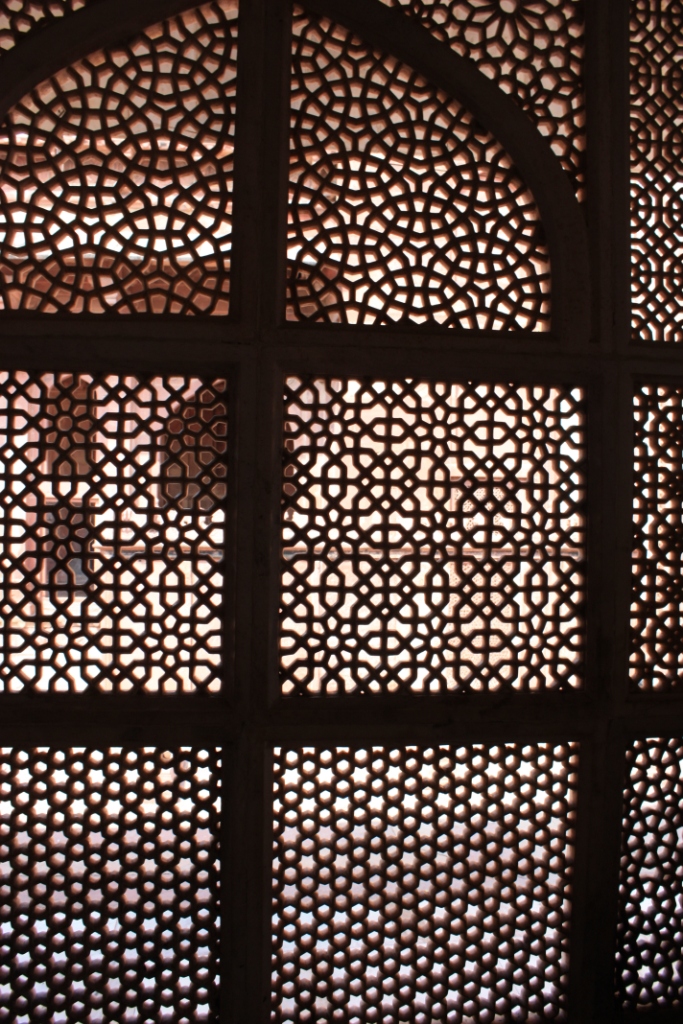
Taken in November of 2013 at Fatehpur Sikri.
This elaborate lattice is carved out of white marble. It’s part of the Tomb of Salim Chishti, a Sufi saint, and is located on the grounds of the Jama Masjid (Mosque) at Fatehpur Sikri.
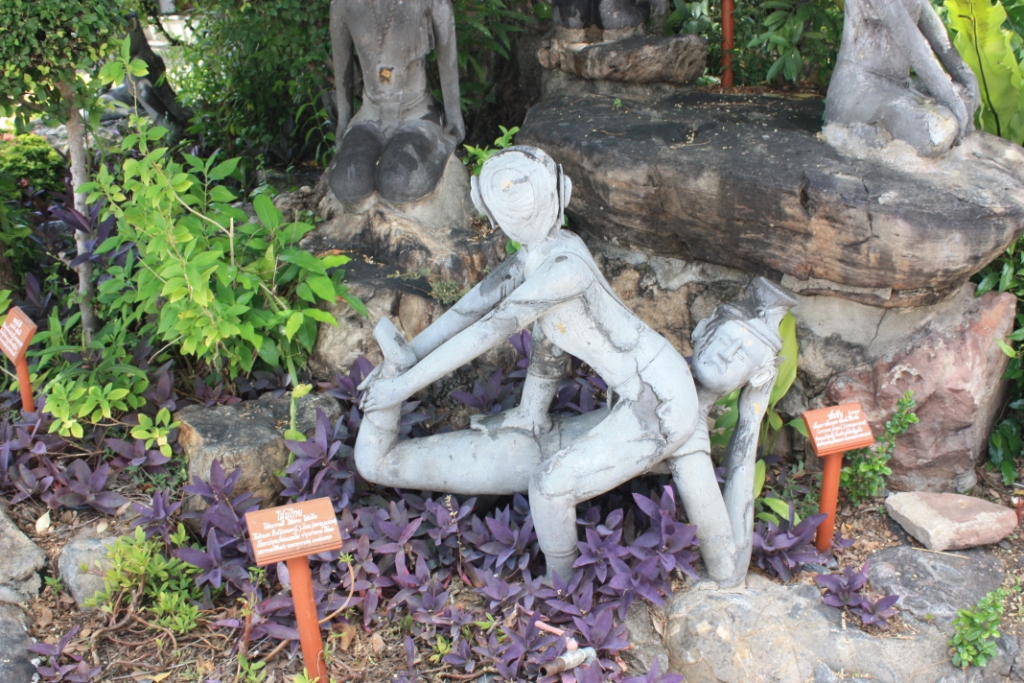
One of the sculptures in the Thai Yoga outcrop at Wat Po.
In September I attended the General Thai Massage and Foot Massage courses at Wat Po. The teacher from whom I first learned Thai Massage (a.k.a. Thai Yoga Bodywork or Nuad Bo Rarn) was trained in Chiang Mai by various teachers, and the style he teaches reflects that northern heritage. I was curious to see how the style of massage varied in the south from the northern approach that I had already learned. Would I be in uncharted waters? Or would the Wat Po course merely be a refresher of what I had already learned? These questions were on my mind as I began the course.
The answer turned out to be somewhere in between. The Wat Po approach wasn’t radically different from what I had already learned, but neither was it a carbon copy. One could clearly see the common origin of these styles. For yoga practitioners, a reasonable comparison would be to imagine you studied Bihar yoga, and then you sat in on an Ashtanga Vinyasa class. Most of the postures would be similar if not the exact same—e.g. a downward dog is a downward dog. However, the sequence is a little different, you may run into a posture or two that you hadn’t seen before, and there will be many little differences in points of emphasis and so on. The same could be said of two martial arts that have a recent common ancestor art. (However, I think martial arts evolve more rapidly than other systems of movement because there is a life and death urgency to adapt to local conditions, and so martial arts can diverge rapidly.)
I won’t get into every little difference in this post. For one thing, the first course I took was a 60 hour (10 day) course, and the Wat Po course was only half as long (5 day / 30 hours.) Therefore, some of the apparent differences might have more to do with the need to conform to time limitations than true stylistic differences. The Wat Po course was designed to impart a sequence that could be done in an hour-and-a-half bodywork session. The first course I took taught some material that was redundant in the belief that one could tailor one’s sequence to the recipient’s needs and / or the masseuse’s preferences.
As an example, at Wat Po we didn’t learn any massage of the chest or abdomen, but I was shown (in fact, I was recipient of) the Wat Po approach to abdominal massage and it was pretty much the same as I’d learned previously. In my earlier learning, the approach to energy lines was to stretch (longitudinally) the limb, then apply palm pressure, then work the line (typically with the thumbs), and then one would repeat the palm pressure and finish with a repeat of the stretch. At Wat Po, they went straight for the energy line (sen) and followed that with the palm pressure work. I have no way of knowing whether this difference was more due to timing or style.
Before getting into the differences, I will talk a little about similarities. The general approach was the same (e.g. the recipient is fully clothed in a light, comfortable garment(s)) and the massage is ideally given on a thin, dense mattress/pad on the floor–rather than on a table. The general principles of sequencing were the same. Namely, one began at the feet and worked in the direction of the head. Also, when working on a limb, one began at the distal end, worked toward the torso, and then back toward to the starting point. Also, energy line work was done before the stretches. There were four positions in both styles: supine, side, seated, and prone, and—unlike many other forms of massage—the supine position was at the fore (i.e. neither style emphasized the prone position and back work over the supine in the way other varieties of massage often do.) Both styles of massage (as probably all massage) began with a brief introduction and questioning designed to make sure the individual didn’t have any contraindicated conditions. Both styles of Thai massage began with a moment of prayer or contemplation—this is similar to some styles and different from others and speaks to the traditional nature of Thai massage.
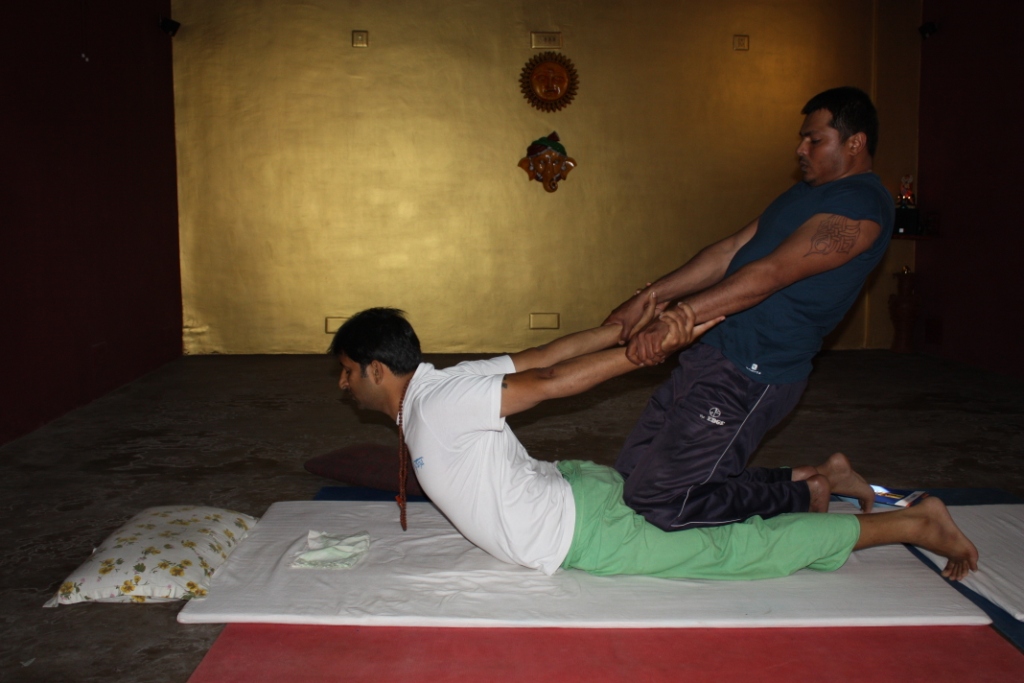
The side and seated sequences were the most similar between the two styles. I learned more in these sequences in the longer (Chiang Mai) course, but what was included in the Wat Po course was largely the same. Where the stretches were of the same type, they tended to be virtually identical. By that I mean to say that both styles had stretches that weren’t taught in the other style, but where that was not the case, the stretches were indistinguishable. For example, the pictured variant on sarpasana / bhujangasana [snake / cobra backbends] was done in the same manner in either style. (I learned more stretches in the first—Chiang Mai–course, because it was longer.) Over all, the energy lines (sen) tended to be identical, but there weren’t always the same number of them, nor were the same ones always emphasized. There were some differences in the feet lines that I’ll get into below.
Now let’s get to the differences. Starting with some small differences, the manner of palm pressure work was different between the two systems. In the Wat Po style, there was always one fixed point that one hand locked in place while the other hand applied palm pressure. I had previously learned to use both hands in a rhythmically alternating series of palm pressure applications.
One little difference that I found interesting involved the technique of closing the little flap over the ears at the end of the face and head massage (both styles close off the ears.) I had been taught to very gently release pressure so as to avoid any kind of popping that might disturb the recipient. However, at Wat Po the instructor taught to vigorously pull the fingers away—resulting in a pop. My guess would be that the idea was to get the recipient’s attention so that one could transition them from the face massage (which notoriously puts people to sleep) to a wakeful state so they could follow instructions for the stretches that followed. (We were taught face massage as part of the seated sequence. Previously, I had learned that this was an option, but that it was easier to do the face massage from supine so you didn’t have to worry about the recipient falling asleep and possibly falling over literally.
A final little difference was how the blood stop was done for the lower extremities. At Wat Po, they did the leg blood stop with both legs straight, whereas I had previously learned this technique with an open groin, i.e. the knee pointed out. (Both ways work about the same, but I think it might be a little less awkward to do it with the groin open as one is not in as close of proximity to the recipient’s privates.) The blood stop for the arm was identical.
The energy lines are one of the most fundamental aspects of Thai massage, and one would expect little variation in them between styles. This proved largely, but not entirely, true. For example, the leg lines were the same (as one might expect because one cannot stray too far from some lines without getting onto bone.) Also the points at the top of the shoulder, around the neck, the base of the skull, and the scapulae were the generally the same–except more or fewer points might be employed from one style to the other.
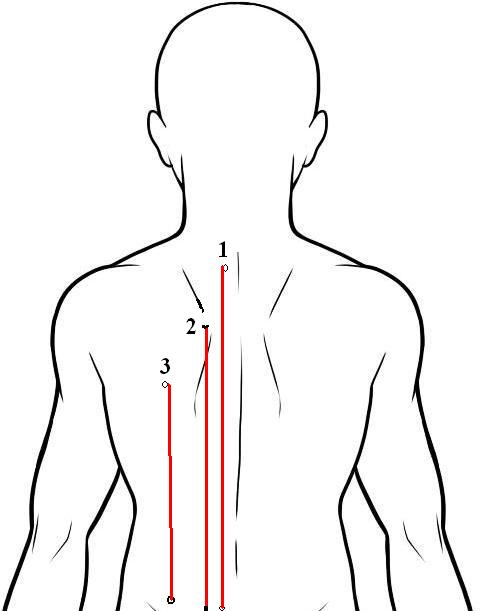
The arm lines were almost the same. The line on the back of the arm was the same, and the line that goes up the middle of the inner arm was the same. However, there was a second inner line that ran in line with the little finger along the lower edge of the arm (presuming the arm is straight out from the shoulder as it is for massaging the inner arm in both styles.) The lines of the back that were used were different. In my (not very accurate) diagram, the lines 1 and 3 were emphasized in the Chiang Mai style, but 1 and 2 were the lines used in the Wat Po system.
The greatest divergence in lines and points was in the area of the feet. The best example of this can be seen in the lines of the sole. In the Chiang Mai style I’d previously learned there were five lines that radiated from a point where the heel transitioned into the arch about midway across the foot and went toward the base of each toe. The Wat Po style had three lines that were more or less parallel in line with the big toe, middle toe, and the little toe. See diagrams.
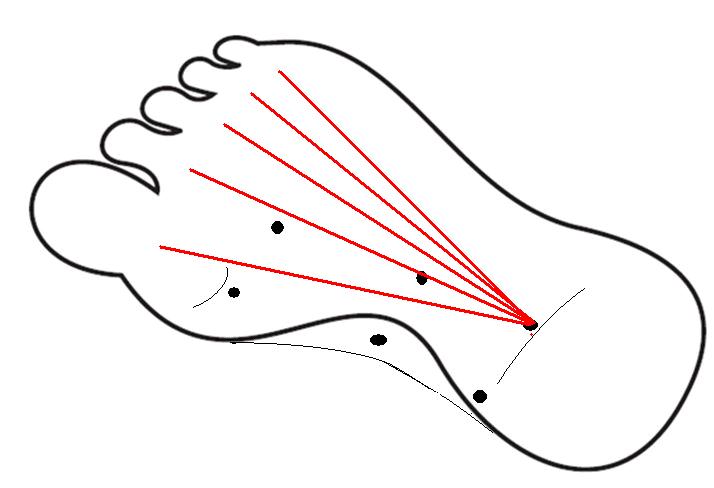
The Chiang Mai 5 lines of the sole.
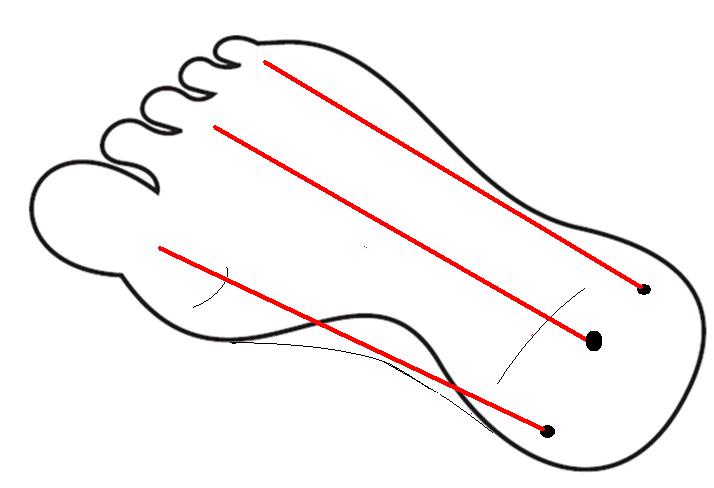
The Wat Po 3 lines of the sole.
In summary, the difference between these two styles wasn’t that great. In many cases the techniques were exactly the same, in most they were marginally different, and only rarely were they completely different. I don’t really have a preference between the two styles. I think which would be a better experience comes entirely down to the skill of the masseuse / masseur.

Taken in March of 2014 in Munnar
It was a damp and dreary day, but colorful nonetheless.
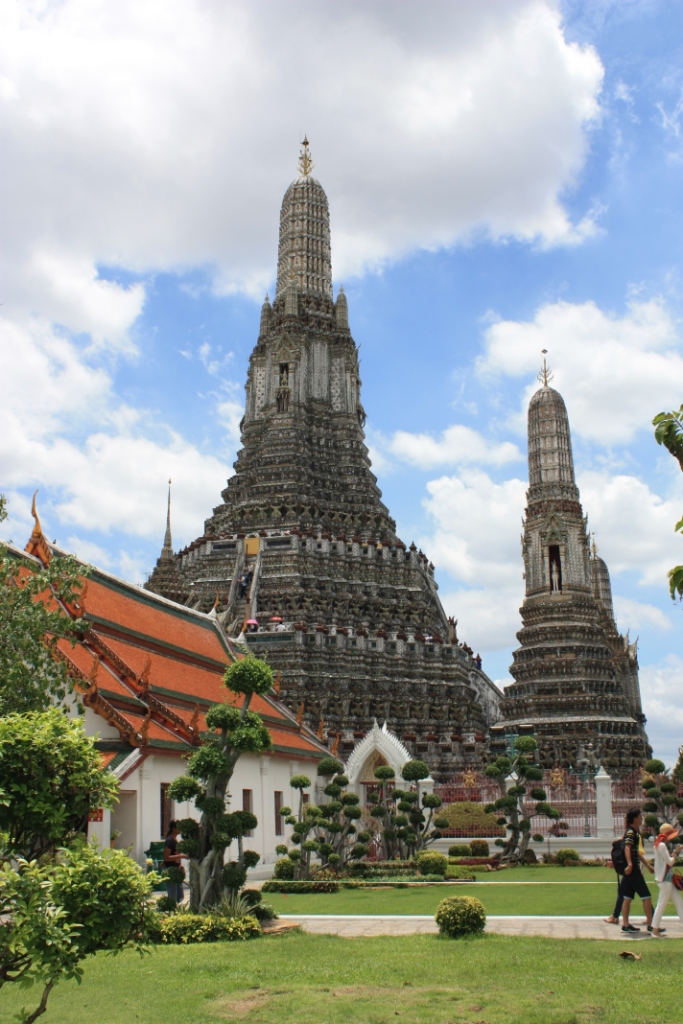
Taken in September of 2014 in Bangkok