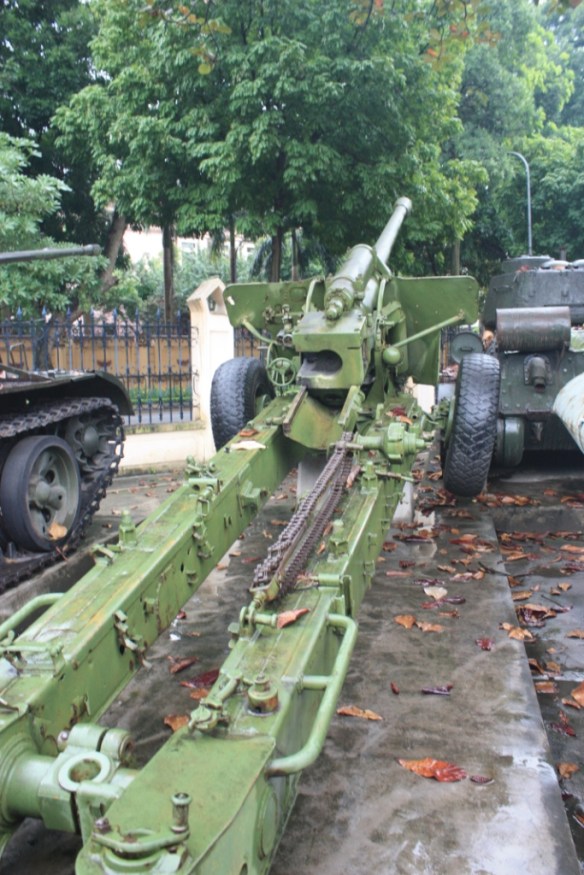
Taken on December 23, 2015 in Hoi An




 The Strange Case of Dr. Jekyll and Mr. Hyde by Robert Louis Stevenson
My rating: 4 of 5 stars
This novella has become more than just another Victorian sci-fi story. The central idea is a kernel that has been revisited in so many popular characters, perhaps most notably Marvel’s “Incredible Hulk.” The titular characters often feature in books, movies, and stories that use the Victorian literary world as their stomping grounds (e.g. “The League of Extraordinary Gentlemen” and “Van Helsing.”)
It’s hard to imagine that anyone doesn’t know the gist of this story. [Spoiler, if you’ve lived under a rock your entire life.] Dr. Jekyll succeeds in splitting off his dark side, and soon comes to regret it. Whereas Mr. Hyde is usually portrayed as gargantuan on film, in the book he’s dwarfish—representing only a part of the whole. It’s telling that it’s impossible to get to reading this book without knowing the twist from a million references to it in pop culture—e.g. the Looney Tunes cartoons.
Still it’s worth reading the original. It starts with a lawyer telling one of his friends a ghastly tale in which a vile, little man—Mr. Hyde–runs into a girl, and then stomps over her body as he makes his exit. The lawyer becomes concerned when he learns that his good friend and client, Doctor Jekyll, is leaving all his worldly possessions to the dastardly Hyde for reasons the lawyer cannot fathom. The book may not be action packed by today’s standards, but it does have good pacing and revelation of information. The descriptions of grotesquery are also gripping. The story is also told in a manner that is very different from how it would likely be told today, and that also makes for interesting reading. Furthermore, it’s short–less than 100 pages over 10 chapters.
I’d recommend this book for anyone who is interested in the classics of science fiction and speculative fiction.
 Learning third level material was when Kalaripayattu became daunting. Until then, it was just exhausting.
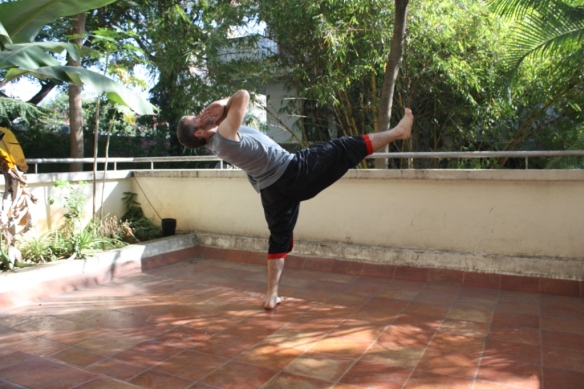
I’d been doing a lap of the kalari consisting of high kicks flowing into Hanumanasana (a scissors split.) Each split is on the opposite side from the last. By yoga standards, my split alignment was off. My hips weren’t perpendicular to my legs, but I’d allowed them to twist open to make the split easier. However, that was probably the least of my errors, and–unlike in yoga practice during which one might take minutes to ease into this intense split–the cadence in kalari was kick – split – struggle to one’s feet. [Okay, the “struggle” shouldn’t have been, but it’s an accurate description of my rendition.]
This wasn’t the hard part, by the way. I’ll get to that. The structure of the class up to that point was logically arranged to facilitate those splits. The practice started with warm ups of rapid repetitive motions that got the muscles and core warm. Then there were a series of kicking exercises that also served as dynamic stretches. Next, there was a vertical version of the splits done in a static form. With the inner edge of one’s bottom foot posted along the base board, the heel of one’s upper foot is slid up a piece of wood lathe worn smooth that has been tied vertically–perpendicularly to the steel burglar bars that one uses to pull oneself into the stretch. (This is an inner city kalari, and not the traditional version dug into the ground.) Then one revisits a high kick, swinging the leg with greater intensity. Only then does one do the lap of splits.
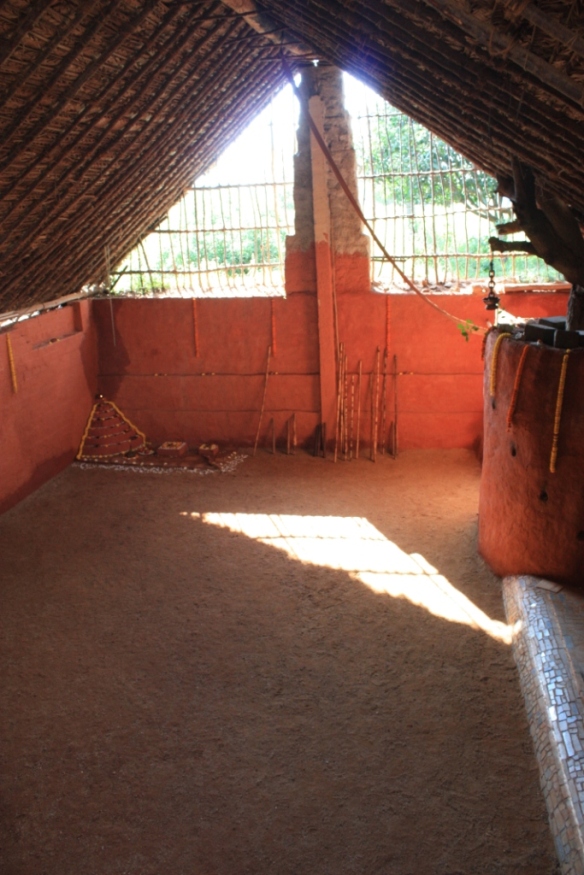
A traditional kalari looks like this. This is the Kalari Gurukulam in Chikkagubbi (parent school to the one at which I train.)
The next piece is where the third level kicked my butt. One’s hamstrings and quads stretched to the max, feeling more like limp noodles than coiled springs, one is now expected to work through a series of leaping maneuvers. There are seven leaping exercises (besides some basic warm-up leaps): a leaping circle kick, a spinning kick that takes one 360-degrees, a split kick in which one leaps up and kicks out laterally in both directions simultaneously, a split kick in which one leaps up spinning 360 degrees [theoretically] and does the same split kick in the middle, a flip kick in which one kicks up and forward and flips one’s body over in mid-air to come down on one’s hands and feet (in a lunged position with palms down next to the feet), and then there are two versions of leaping/spinning kicks that proceed down the length of the kalari.
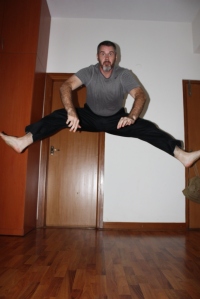 Why does one do these plyometric techniques in the wake of such intense stretching? I suspect that experts in exercise science would tell me this isn’t the best way to improve my leaps. One should do the leaps when one’s muscles are more like rubber bands than al dente linguine. Still, I dutifully comply. Maybe there’s an ancient wisdom at work here. Maybe there’s not. There’s no way to find out without giving it a try. I fall down a number of times that first day, and on all subsequent sessions. As I write this, I’m now learning level five material, but I continue to revisit the leaps every session for two reasons. First, I’m not happy with my abilities. Second, I want to find out whether I can improve my balance of flexibility and power, and whether the kalari approach does the trick. (Note: I’m using the word “power” in the specific sense of work performed per unit time. In other words, it’s not synonymous with strength. It’s a function of both speed and strength.) At any rate, I still fall down.
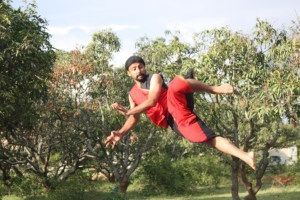 However, looking beyond my own limited capacity to have my cake and eat it too (i.e. retain flexibility as I gain power), I see evidence of the success of this approach. There are a number of advanced people who’ve been using this approach for many years and have a preternatural balance of flexibility and jet propulsion. Said individuals seem to go from deep stretches to phenomenal vertical leaps without difficulty.
If nothing else, I’ve learned a great deal about my muscular composition. While I’m challenged by ballistic movements, my stamina is quite respectable. Type I (slow twitch) musculature seems to be disproportionately common in comparison to type II (fast twitch) in my body. While I’m including more power building training in my workouts, my progress is glacial. If I was smart, I’d take up long-distance running or some other endurance activity. But I tend to find such activities tedious, while I love the martial arts. And so I struggle.

Taken on December 24, 2015 in Da Nang
The Dragon Bridge (Cầu Rồng) straddles the Hàn River in central Vietnam. It was designed by a US firm, Ammann & Whitney, and it opened to traffic in 2013.

Taken on January 1, 2016 on Bai Tu Long Bay


Bai Tu Long Bay is the lesser known–but geographically larger–sibling of Ha Long Bay. It’s name refers to baby dragons, and it derives from the same myth from which Ha Long got its name (i.e. “Descending Dragon.”) Like Ha Long it’s considered a scenic wonder because of the skerries jutting up out of the sea.
We were told that we got a lucky break in getting a clean sunrise during our visit because it’s usually overcast. (Our tour straddled New Years.) It was overcast almost the whole time, but I tend to be skeptical of people selling an experience.
 The Good Psychopath’s Guide to Success: How to Use Your Inner Psychopath to Get the Most Out of Life by Andy McNab
My rating: 4 of 5 stars
The central premise of this book is that psychopaths have a range of traits that help them succeed. These traits include thick skin, focus, fearlessness, charisma, and coolness under high pressure. The “good” in “good psychopath” is used to describe individuals who have psychopathic characteristics while retaining the ability to play by societal rules—at least to the extent necessary to stay in good stead with the law—as well as to recognize the ramifications of their personalities. If you thought you were going to learn how to get away with a tristate prostitute killing spree, you’re looking into the wrong book. The book does discuss what differentiates good from bad psychopaths, but it’s clearly addressing the former.
Unlike Dr. Dutton’s previous book, “The Wisdom of Psychopaths,” this book is a self-help book rather than pop science. It’s designed to help anyone channel their inner psychopath. If you’re already a psychopath, it may help you think about how you can apply your natural tendencies to getting what you want in life. If you’re not a psychopath, it’ll advise you on how to go about facilitating the growth of characteristics that serve psychopaths. McNab serves as the psychopath in-residence, offering stories and his own experience, while Dutton is the scholar trying to lend a more objective understanding of the subject.
The book’s organization is straight forward, there is a prologue plus three chapters that outline the subject and lay out the key concepts, and then chapters 4 through 10 each address one of the seven essential characteristics of the good psychopath. These include proclivities like non-procrastination, being confident, being oneself, taking criticism with ease, being persuasive, living in the moment, and reducing the influence of emotion in decision-making / behavior. These seven chapters are the heart of the book, and they explain how to think about and advance these personality characteristics.
One strength of the book is the use of stories and jokes to convey ideas in a reader-friendly manner. However, some of these stories are clichéd. On the other hand, a number of them come from the career of McNab, and he—as a former SAS member–had a more fascinating career than most. Also, many of tales and anecdotes come from the interaction of this scholar / warrior duo. The chapters also have quizzes that will help the reader evaluate their level of psychopathy, and the e-version of the book is linked to on-line versions of the quizzes.
I can imagine a range of responses to this book from love to hate. There’s one way to love this book (despite its faults), but two ways to hate it. The most obvious way to dislike it, but probably not the most common way, is substantive. One may object to a range of virtues such as coolness under pressure and living in the moment being labeled psychopathic. However, if this was a problem for the reader, one probably wouldn’t purchase (or, being psychopathic, steal) the book. Reading the blurb would tell one what to expect in that regard.
The more likely reason for hating this book is stylistic. The authors wrote it as though they were speaking to the reader, and we know there are good reasons for one’s written style of communication being different from the spoken word. The first such reason is that spoken language can confuse when one is lacking non-verbal information streams. In this case, there are two authors who haven’t merged into one voice, but instead retain their distinct voices. This means that one may have moments of not knowing who’s speaking. Such confused moments usually don’t last long because the authors work hard to create widely different personas. Dutton is the PhD with an erudite / nerdy bent, but who works to come off as the cool professor whose class one might enjoy taking. McNab is the psychopath, and he’s a soldier to the core. Still, even the occasional half sentence in confusion is distracting.
The second reason for writing differently than speaking is that one doesn’t know to whom one is speaking. Not everybody digs f-bombs and bawdy jokes. Those who do will probably find the style neither distracting nor offensive. Many readers won’t have a problem with the language, but will nonetheless find the authors’ attempts to come off as cool to be distracting or irritating. Working to appear cool wears well on 13 year olds, but seems a little pathetic in grown men talking to an audience of other adults.
I found this book interesting and I’d recommend it for people interested in personal development. However, I can’t say that I didn’t find the style of the book grating on occasion.

Taken on December 26, 2015 in Hanoi
Tháp Rùa is the Turtle Tower in the middle of Hoàn Kiếm Lake, which is the “Lake of the Returned Sword” or–more simply–“Sword Lake.” The lake is in the heart of modern-day Hanoi, and is sacred in Vietnamese folklore.
As the story goes, a Turtle god surfaced on this lake to ask a King named Lê Lợi to give up his sword. The sword was called “Heaven’s Will” (i.e. Thuận Thiên) and was said to have been given to the King by a local deity called the Dragon King (i.e. Long Vương.) Apparently, the Vietnamese King took a “the gods giveth, and the gods taketh away stance,” turning the sword over to the Turtle deity.

What it looks like in daylight

Taken on December 25, 2015 at Hue