Unknown's avatar

About B Gourley

Bernie Gourley is a writer living in Bangalore, India. His poetry collection, Poems of the Introverted Yogi is now available on Amazon. He teaches yoga, with a specialization in pranayama, and holds a RYT500 certification. For most of his adult life, he practiced martial arts, including: Kobudo, Muay Thai, Kalaripayattu, and Taiji. He is a world traveler, having visited more than 40 countries around the globe.

5 People You Probably Didn’t Know Did Evil

This post was inspired in large part by a tidbit about whiskey heir James Jameson (#1, below) in a book that I’m reading called “Crossing the Heart of Africa” by Julian Smith. It may have also been influence by having recently seen the surprisingly awesome “Wonder Woman” film, in which a central theme is the notion that good and evil vie for each person’s soul. (Note: I say “surprisingly” only because the DC movie universe has mostly been floating stinkers in recent years.)


I should note that when I started researching, there were an astounding number of candidates for the slots on this list, and so you may have a favorite example that didn’t make the list (please feel free to comment on any prime examples that I missed below.) As for criteria, I tried to avoid including people who just said horrifying things, who acted in an irresponsible or nit-witted manner that didn’t rise to the level of evil, or who were forced to make “lesser of two evil” decisions during time of war or national emergency.


I also didn’t have the time or energy to get into the he-said-she-said of politicians, because in America ideological types accuse people from the other party all manner of evil, constantly. So I didn’t wade into whether George W Bush personally flew the planes into the Trade Center towers via drone-style cockpit override technology, or whether Barack Obama had all nuclear spent fuel jettisoned onto the Arctic Circle to manufacture a climate change crisis. (Note: neither of those is a real thing, please don’t quote.) But, beyond that, I tried to pick candidates that would come as a surprise, and it wouldn’t surprise anyone that a politician did evil. (Frankly, people would be more surprised if they didn’t.)


5.) Chuck Berry: He had secret tapes made of women doing their business in the toilets at his restaurant. I don’t want to be moralistic and get into people’s kinky proclivities with this list, but this breach of trust rises above and beyond.


4.) Alexander Graham Bell was a dick to deaf people. The inventor of the telephone advocated for eugenics, and, specifically, trying to breed the deaf out of existence. Sure, if you invent the phone, the people who can’t use it might not be your favorites, but trying to eliminate them… that’s just cold.


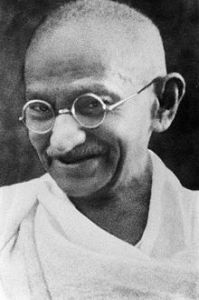
3.) Mohandas K. Gandhi: I said I wouldn’t pick on purely verbal hideous acts, of which Gandhi had a number from suggesting rape victims were responsible to supporting honor killings to racial slurs against Africans (quite a shocker for someone battling British racism so vehemently.) As far as actions, sleeping nude with his under-aged great-granddaughter is pretty vile behavior. It’s said that he was trying to challenge his celibacy, but you don’t need to bring kids into whatever oddities you need to prove to yourself. 


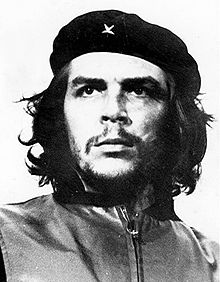
2.) Che Guevara: He had countless people executed without trials or due process. I included him because I assume that not all among the vast number of people who wear his face on their t-shirts are aware of this dimension of his character. Certainly, he was no worse than Lavrentiy Beria (Stalin’s Secret Police Chief), but I’m unaware of any idolization of Beria.


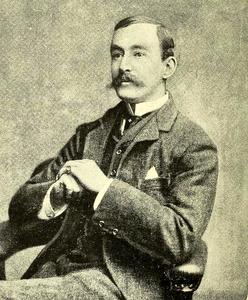
1.) James Jameson: The whiskey magnate bought an 11-year old girl so he could sketch her being victimized by cannibals in Africa. 

DAILY PHOTO: Colorful Buildings of Imphal

Taken in May of 2017 in Imphal, Manipur


POEM: Lady Weeping

An old woman in a sari
weeps at the bus stop.


It’s 6am. Nobody out
but joggers and tired
telemarketers, heading
home from a night of
being Chad from Denver
to be Arjun of Bangalore
once more.


And this woman sitting
solo on a bench–weeping.
Shunning assistance,
her story feels clear.
There’s no space to
grieve in their home.
No instant free of
someone who wants to
fix the unfixable.
So she slips away
from a quiet house
to unburden her grief
at a distance from the
loved ones it might
rain down upon.

DAILY PHOTO: Near Dzuleke Village


Taken in May of 2017 in Dzuleke Village

DAILY PHOTO: Rural Assamese Homestead

Taken in April of 2017 near Nameri National Park

The Thai Yoga Bodywork / Yoga Nexus


[Note: This article was first posted on the IMOSHA website.]


It was October of 2013 and I found my way to the Meditation Hall at the Fireflies Ashram off Kanakapura Road outside Bangalore’s southern sprawl.  That morning, I’d begin learning the sequence of actions of the Chiang Mai style of Thai Yoga Bodywork (TYB.) I would struggle to remember that sequence as I awkwardly groped about trying not to drive my thumb into the bones or nerve junctions of my fellow students. But over the course of those ten days, I progressed to the point that my awkwardness was less apparent, and I could get through the sequence without forgetting much.


I’d arrived in India with a long list of activities to try and skills to learn as part of a plan of self-betterment. That TYB course was the first item on the list to be scratched off. I’d been in the country a little over a month.  The strange thing about that was that TYB was the activity farthest outside my comfort zone. I wasn’t a complete stranger to yoga or meditation when I arrived in India. And while I was new to the martial arts of Kalaripayattu and Muaythai, I’d practiced a Japanese martial art my entire adult life.  So while I wasn’t skilled at those arts, I had a level of transferable confidence to counterbalance my lack of skill. The same couldn’t be said TYB. It was all new. But that’s the magic of moving around the world, everything is outside your comfort zone, so you might as well go big or go home.


Small world.  A couple of years later, I’d be in that same Meditation Hall for the capstone weekend of my 500-hour yoga teacher’s course.  I remember lying in that Meditation Hall, resting after having learned the advanced cleansing practices (shatkarma) of hatha yoga. (By then there was an entirely new level outside my “comfort zone” as I’d purged my entire alimentary canal.) At any rate, the Fireflies Meditation Hall was just a piece of geographic connective tissue that linked my yogic and TYB educations. I’d like to discuss five more substantial links.


5.) Anxiety management:  Let me begin with a theme that I mentioned in my introduction. It’s an aspect of personal development that I’ve spent a lot of time working on recently, and that’s moving outside one’s comfort zone to dispassionately observe one’s anxieties.   Both Yoga and TYB present practitioners with opportunities to observe and tame anxieties in a safe way. In TYB, one’s anxiety might be about injuring the person one is working on, about doing a poor job, or it could even be just about touching strangers. People have various reasons—from various social anxieties to germophobia—for discomfort with physically touching people they don’t know well. (Being an introvert, I have a tinge of this discomfort that would likely be much worse if I hadn’t studied martial arts. But, having studied a grappling-centric martial art for so many years, I’d developed a bit of transferable confidence about being in close physical proximity with people I didn’t necessarily know well.)
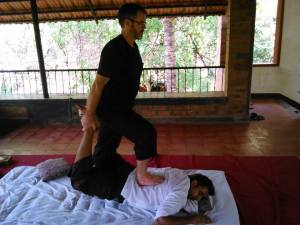
Anxiety about injuring another


In yoga, the sources of anxiety are often gravity related (e.g. inversions and arm balances), but can be quite varied. I mentioned shatkarma as another example. And I’ve found external breath retentions from pranayama to be a potent area in my own personal practice.

 

Anxiety about injuring oneself


At any rate, what both Yoga and TYB do to help one take on one’s anxiety is to insist that one confront it in a mindful way. Just practicing forces one to experience the anxieties, but the crucial second ingredient is that one must keep one’s attention on the action—preventing one’s mind from engaging in the escalatory patterns by which it makes molehills into mountains. While it’s true that there are many other activities that this should be true of, it’s common in many fitness activities to practice distractions. People often blare portable music devices to drown out their body and mind as they exercise and practice other self-betterment activities. Such distractions aren’t an option in [good] TYB or Yoga instruction (Note: I say “good” because one can see a sad wave of distraction yogas out there that bury the sensations of practice in cute animals, alcohol, and—even–frat-house style raves.)


4.) Anatomical intuition: Both TYB and Yoga expand one’s understanding of the human body. A great feature for those who practice both systems is that the two systems are complementary. They present both overlapping and non-overlapping means to insight into the body. Yoga provides insight through all of one’s senses—not just the five we think of, but including proprioception (the sense by which a person is aware of the position of his or her own body parts and their movement) and balance. In other words, yoga allows one to see inside one’s own body as fully as possible. On the other hand, TYB offers the opportunity to learn about the wide range of variance in human bodies—feeling all their varied characteristics, strengths, and weaknesses.

Finding the limits of another


I think a yoga teacher can learn a great deal by practicing TYB. It encourages a greater understanding of the strengths and limitations of others. At the same time, TYB practitioners benefit from yoga’s high degree of intra-bodily awareness because the Thai style involves many assisted stretches that require strength, balance, and awareness.

 

Finding one’s own limits


3.) Appreciating the Slow: Modern life shouts at one to do everything faster. Yoga and TYB are two activities in which there isn’t any payoff for being faster, and, in fact, there are costs. In TYB, the massaged individual will find a fast tempo massage less relaxing. If one has ever been handled by a masseuse or masseur like a baker making bread, one knows exactly what I’m talking about. Hatha Yoga also emphasizes slow movement. Even when one is doing an active style like Ashtanga Vinyasa Yoga, there’s an emphasis on maintaining control of the body throughout, and that requires engaging musculature to counter the forces of gravity and momentum.
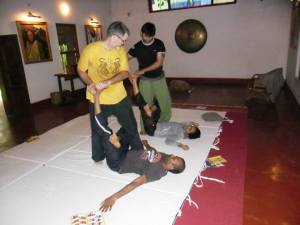
FYI- this is the aforementioned Meditation Hall during that first training


Sometimes slow is the only way to succeed


2.) Core stability and muscular endurance:  Both TYB and Yoga build and require core strength and muscular endurance. Bodywork is a physically demanding job. When one learns TYB, a great deal of attention goes into the minutiae of handling the client so as to minimize the stress and strain on one’s body. Still, there’s no way around the fact that one is manipulating another person’s body  and one has to bear that weight so that the client can be relaxed as one stretches them out or turns them over. Commonly, those people will be larger and heavier than the person delivering the massage.  Even if one isn’t doing TYB all day, one will likely feel it—perhaps all the more because one hasn’t developed that core strength and muscular endurance. Yoga can also help the TYB practitioner to keep supple in a job that can easily make a person sinewy.


On the other hand, yogis and yoginis can learn a thing or two about balance and control of the core from the challenging act of manipulating another person through their stretches.


1.) Attentiveness to Subtle Sensations:  In yoga teacher training, one is often shown Wilder Penfield’s homunculus. Penfield was a doctor who studied the functional organization of the brain, and particularly the sensory and motor cortexes (the parts that process sensations and commands to move body parts.) He was eager to map the motor cortex so that he’d know what portions of damaged or cancerous tissue could be removed without causing paralysis or the like.  At any rate, you’ve probably seen either a flat or 3-D version of the homunculus. It’s notable for its huge lips and hands and comparatively tiny chest and thighs. That’s because the size of a body part on the model doesn’t represent its anatomical size but rather its size in the brain, and our hands have a truly astounding piece of cerebral real estate.


What’s fascinating is that for all this capacity for feeling through our fingers, one has to practice to get the fullest out of that ability. In the beginning, it can be quite different to feel huge knots in the muscle during TYB sessions—even though our ability to differentiate tiny tactile differences is tremendous.  In yoga one isn’t so much engaged in feeling with one’s fingertips as one is with one’s internal sensory suite, but the point remains that we have a great deal of capacity that most people leave unused.


I suspect there are many more points of confluence between TYB and Yoga that haven’t occurred to me. If you’ve got one, feel free to comment below.

DAILY PHOTO: Scenes from Ward’s Lake, Shillong

Taken in April of 2017 at Ward’s Lake in Shillong

BOOK REVIEW: A Study in Scarlet by Sir Arthur Conan Doyle

A Study in Scarlet (Sherlock Holmes, #1)A Study in Scarlet by Arthur Conan Doyle
My rating: 5 of 5 stars

Amazon page

Get Speechify to make any book an audiobook 

This is the first book of the Sherlock Holmes canon, and is also the first Holmes novel (most of Arthur Conan Doyle’s Sherlock Holmes stories are short stories published in collections.) The book was first published in 1887.

There are actually two stories told in the novel. The first part of the novel describes a mysterious murder that happens in London and whose victim displays a gruesome death mask. Later a second murder is discovered. It’s not clear whether the two killings are connected but the two men were associates and so it’s a likely conclusion—though the victims’ manner of death is quite different. Because, it’s the first story, there’s also the meeting of Holmes and Dr. Watson–who becomes Holmes’s roommate and who soon becomes fascinated by the work of the world’s first consulting detective.

Part I is as one would expect of a Holmes’ story in setting and characters, the second part is out of the ordinary but none-the-less fascinating. Part II begins with a man and a little girl being rescued by a caravan of Mormons. The two are the sole survivors of a Donner Party-style ill-fated wagon train through the Rockies. The man and the girl go on to live with the Mormons, if uneasily. Eventually, the girl reaches age. While she falls for a non-Mormon hunter, the polygamous Mormon’s face a situation in which the demand for wives far outstrips supply. This sets up the intrigue of the story. That intrigue is eventually tied up by Holmes at the end of the second part.

It seems like it would be an odd way to tell such a story, in two disparate parts, but both parts of the story are well-told and gripping. Though, I found the adventure in Utah to be particularly edge-of-the-seat. There’s a reason Holmes was such a popular character. Arthur Conan Doyle wove fascinating tales.

I’d recommend this book for all fiction readers—unless you’re a Mormon with anger issues, then you might want to just pass.

View all my reviews

BOOK REVIEW: Steppenwolf by Hermann Hesse

SteppenwolfSteppenwolf by Hermann Hesse
My rating: 5 of 5 stars

Amazon page


Harry Haller lives out-of-step with virtually every aspect of modern society. He finds the prevailing music, art, and entertainment to be trivial and low-brow. He has pacifist tendencies amid strongly nationalist peers. This disjoint between his individual nature and society’s has made him depressed to the point of being suicidal—but he hasn’t been able to bring himself to commit the act, and has instead given himself a deadline.

Enter Hermione (note: her name seems to be rendered “Hermine” in some editions), a woman who is in many ways the exact opposite of Haller. She loves Jazz, enjoys dancing, and doesn’t like to be too serious or analytical about anything. She becomes his Yoda. She teaches him to dance, introduces him to a lover, and exposes him to the delights of frivolity. While the book opens in a way that makes one think it might be an indictment of modern society, what it really shows is how Haller’s unhappiness comes from insisting that society should be fitted to his worldview and proclivities. If he can find a way to get beyond that insistence, he can transcend his unhappiness.

One of the fascinating intrigues of the book is that Hermione early on promises that she will get Haller to do two things: fall in love with her and something else which I’ll leave to the reader but which seems even more unfathomable. This sets up an intense tension that one eagerly follows through the rest of the book. (It’s not so surprising that Haller will fall for Hermione. That seems to happen immediately. Still, you’ll remember that I pointed out that Hermione played cupid and set Haller up with her friend Maria, so it’s fascinating that she intends to make him fall in love with her.)

The organization of the book is a bit unconventional, but it works both in terms of being easy to follow and in providing a multi-dimensional story. (Though if one missed the first part on wouldn’t be at a terrible loss.) The first part is an “Editor’s Preface” as told by the nephew of Harry Haller’s landlady. He comes into possession of Haller’s manuscript and explains what it is that made him go to the trouble of publishing it, despite—as he tells us—he ordinarily would not. It explains how this man’s limited interaction with Haller intrigued him and made him want to tell the story. The second part is labeled “Harry Haller’s Notebooks (for mad people only),” and is from Haller’s perspective. This section shows us a depressed Haller walking the streets and railing against the futility of the world when his attention is captured by a sign for a theater that announces: “Admission not for everybody. For mad people only.” From that point we enter the story itself, which is entitled “On Steppenwolf: A Tract (for mad people only.)”

The novel gets bizarre / surreal at the end as Haller is going through his “Magic Theater” experience. One doesn’t know exactly what is real, what is hallucinogen-induced, and what flows from madness. However, this warped reality works well for a story of transcendence and transformation.

I’d recommend this book for readers generally. It’s short, readable, has intriguing characters, and is thought-provoking. If you like stories that make you think, you’ll enjoy this book.

View all my reviews

BOOK REVIEW: Satantango by László Krasznahorkai

SatantangoSatantango by László Krasznahorkai
My rating: 4 of 5 stars

Amazon page


This was the first novel by László Krasznahorkai, who’s considered perhaps the most important living Hungarian writer (a country with a literary tradition disproportionate to its small population.) “Satantango” was first published in 1985, and it’s been said to remain Krasznahorkai’s best known novel—though winning the 2015 Man Booker Prize may have pointed people toward his more recent works.

If there’s one thing one must know about the Hungarian mindset in order to feel where this novel will take one, it’s the national proclivity for gloominess. You may have heard of the song “Gloomy Sunday” by Rezső Seress, which is often called the “suicide song” because of the number of people who’ve quoted its lyrics in suicide notes, clutched its sheet music as they committed suicide in the Danube, or had it on the phonograph when their bodies were found. If “Gloomy Sunday” is the epitome of melancholy put to song, “Satantango” just might be its literary counterpart—the perfection of gloom in novel form. The book scores highly on emotional evocativeness.

The story is set in a small Hungarian village that is swamped in by perpetual rains. The village has been shrinking as many of the villagers have abandoned it, and the few remaining residents are often known to interact at the village’s only pub—you know how alcohol-fueled scenes can be cheerful or depressing, this is the latter. I won’t get into the details of the story, but suffice it to say that constant tension results from this situation in which everyone knows everyone else and all are more or less trapped together in the confines of the village. Some have wronged others. Some covet that which belongs to others. And everybody’s dirty laundry has been seen flapping in the wind by everyone else. For literary fiction, there’s an intriguing story told using this tense atmosphere.

So, it’s a good story that’s highly emotionally charged. What more could one want? Well, the warning I feel obliged to issue is that this novel’s readability is low. In other words, it’s challenging reading in almost every way that a novel can be challenging to read, except being bad—of course. There are changing points of view and a non-linear story line, but that’s not the worst of it. I read it in an e-format, and it has near zero white space. By that I mean there are no indented paragraphs and pages are just huge, solid blocks of text. I suspect the same is true of hard-copies, but I can’t recall picking one up. The author is stingy with information early in the story, and this leaves one little by way of mnemonic handholds to keep a grip on the story through to the heart of narrative arc. The book is presented and organized to be knocked out in a day or two of intense reading. The problem is, it’s not that type of novel–both because it would be an overdose of gloominess and because it would be mentally tiring to read this style of writing in that way.

I would recommend this book for readers of literary fiction unless: a.) you are prone to depression; or b.) you find it extremely frustrating when a writer / publisher make no efforts to make the reading experience a pleasure. This book is optimized for masochistic readers. If you love a difficult read, this is the book for you.

View all my reviews