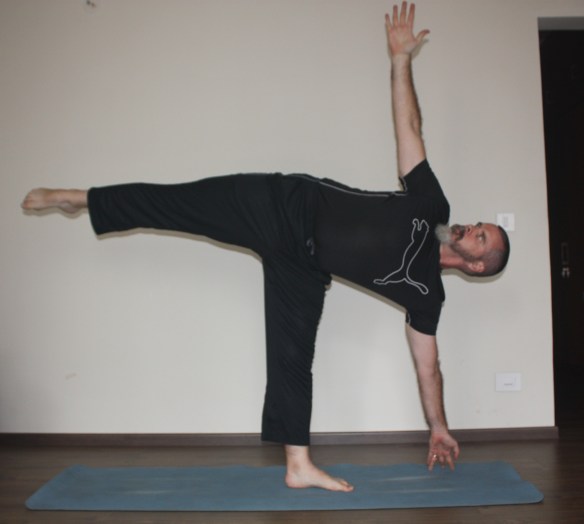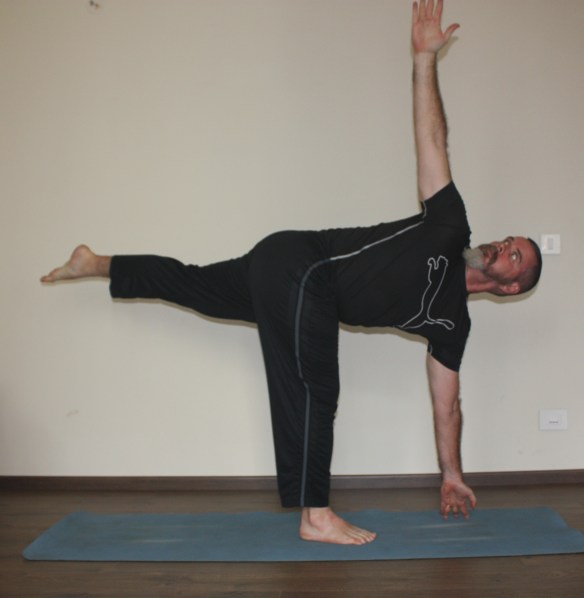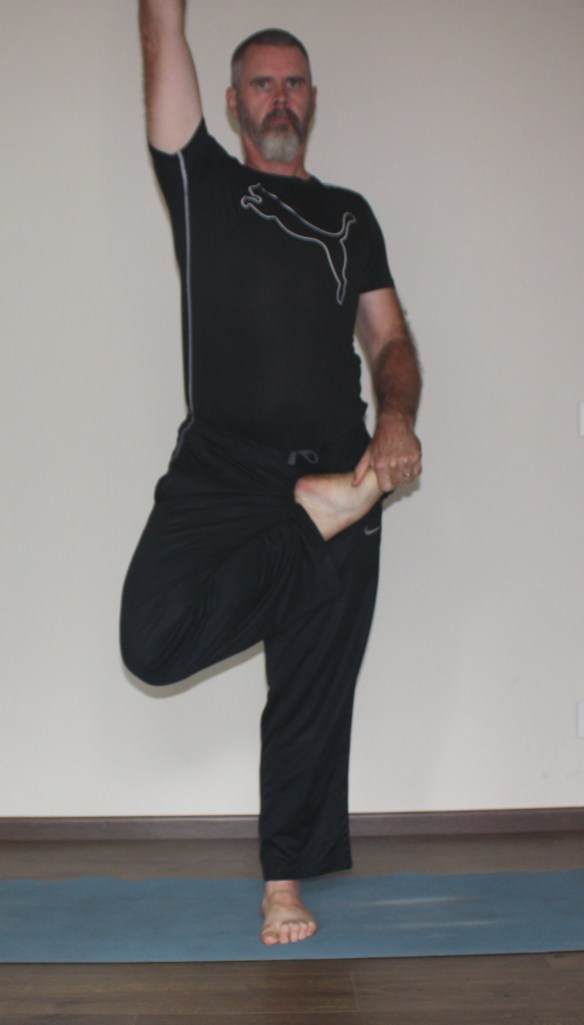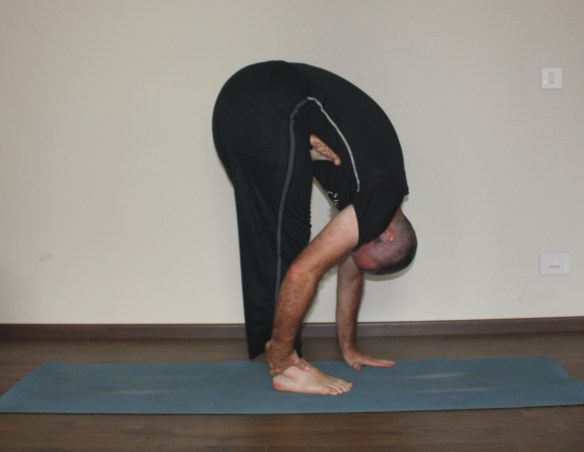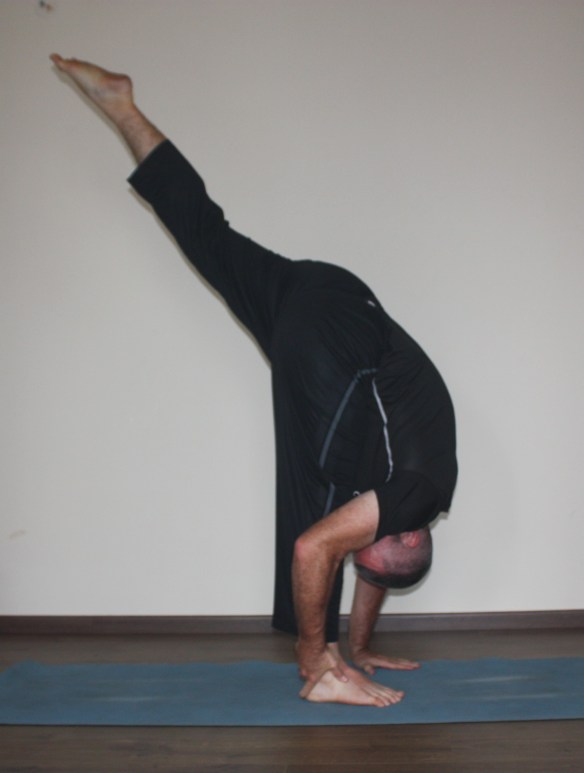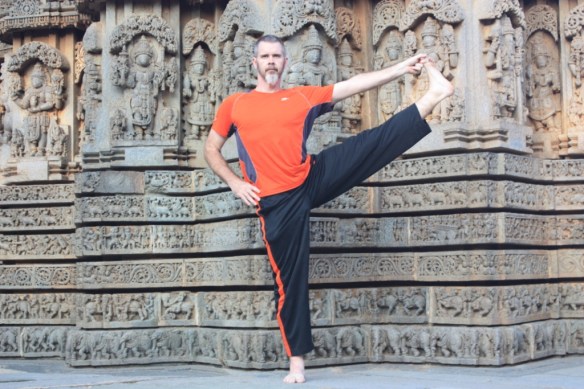
5. Eka Hasta Bhujasana to Astavakrasana
4. Adho Mukha Svanasana to Eka Pada Koundinyasana
3. Bakasana to Salamba Shirshasana II
2. Utthita Ardha Padmasana to Eka Pada Galavasana
1. Parivrtta Utkatasana to Parivrtta Eka Pada Koundinyasana
5. Eka Hasta Bhujasana to Astavakrasana
4. Adho Mukha Svanasana to Eka Pada Koundinyasana
Tantric Yoga: The Royal Path to Raising Kundalini Power by Gavin Frost
My rating: 4 of 5 stars
Whenever I review a book about tantra, I have to start by clarifying which tantra I’m talking about. For tantra is one of those concepts that everybody thinks they know the meaning of, but few agree about what it is exactly. There are at least three broad interpretations of tantra. Among old-school Indian Tantrics, tantra involves the use of practices and rituals to elevate one’s consciousness, and at least some of said practices involve activities that mainstream religions (i.e. Hindu, Buddhism and others) consider vices. Two alternatives can be considered in contrast to that baseline view. The first of these is the mainstream religious view of tantra that keeps the unobjectionable practices and dismisses those practices that the fly in the face of religious prohibitions, saying that they are just misunderstandings or misinterpretations and not to be taken literally.
The second view, and the one relevant to his book, is the modern and mostly Western notion of tantra as being all about sex. This isn’t to suggest that these modern Tantrics are just guided by base desire and are only seeking tips to be better in the bedroom. Most of them see tantra as a road to an altered state of consciousness, but that alpha and the omega of that route is in sexual activity. I’d like to read a book dealing in the first view, but either that is dying out or those kind of tantrics don’t write books. This has left me with books on the alternative perspectives. I’ve already reviewed one on the mainstream religious perspective, and so here is one on the modern / Western sex-centric approach. It should be noted that the authors are aware of the differences in strains and refer to the branch they are offering as “Reconstructed Yoga” or “Neo-Tantric Yoga.”
The book that Frost and Frost deliver is designed to be one-stop shopping for those who would like to join or start a “tantric house.” A tantric house is sort of like an ashram, but smaller and focused on the “Neo-Tantric Yoga” (sexually-oriented) practices. Needless to say, there is a great deal of protocol to consider when living under such conditions. The book is logically organized. It starts with sort of philosophical and conceptual background and progresses to delving into the specific details of various practices. The ten chapters are arranged into three parts that deal, respectively, with basic precepts, preparation, and the details of the practices.
I should point out that it’s not just in the emphasis on sexually-based practices that this book differs from the traditional view of tantra. One of the best examples of this can be seen in the first sentence of a preface entitled “How to Use this Book” which says, “Many believe that teaching requires gurus, but that belief became obsolete centuries ago with the invention of printing. This book will be your personal guru…” In the old-school view of tantra, the importance of an actual teacher is considered paramount both because ritual and practice are so central to the activity and because there is so much opportunity to lose oneself in the weeds.
The book includes a great deal of ancillary matter. There are many black-and-white line drawings and diagrams. There are two appendices. The first appendix delves into the logistics of a tantric house from pet ownership to floor plans to issues to consider in considering applicants (needless to say many of these items wouldn’t be appropriate – or legal – to ask about when considering a prospective roommate or employee.) The other appendix is offered for gay participants because the rituals described throughout the book anticipate heterosexual coupling. There is a short bibliography and some brief assorted front matter as well.
This book is well written and organized for delivering what it’s intended to deliver. While it covers a lot of background information, it’s put together in a “how-to” format. This means that there are a lot of step-by-step instructions that could be useful if you intend to carry out the practices, but aren’t the most pleasant reading if one is trying to get a feel for the subject and / or to compare and contrast it to approaches with which one might be more familiar. There is certainly some intriguing food-for-thought peppered throughout, but it’s a how-to manual through-and-through.
I’d recommend this book for anyone who is interested in getting insights about life in a tantric household – particularly if one is interested in the details of ritual as well as the logistics and practical issues of such living. I’m sure there are more entertaining accounts of living in such a house, but which will not provide as much systematic explanation.
Lilla and I return to Bangalore on New Years Eve from a trip to Hungary by way of Vienna, Austria. It was my first time in Vienna since a similar overnight trip that I believe was over 20 years ago (i.e. my first trip to Budapest in 1994-ish, if memory serves–which it seldom does anymore.) Of course, the parts of the city that attract the eye look the same–the classic Viennese architecture. I’d be lying if I said I had any great recollections from the prior trip except that the weather was cold and drizzly and Vienna’s legendary cafes were much in need. (Fun fact: there’s a Cafe Coffee Day in Vienna. That will mean nothing to my non-Indian friends, but may be interesting to my Indian friends.) This time we had beautiful blue skies and a tolerable dry cold.
January was fairly unremarkable except for several trips to the dentist to get a tooth fixed that shattered upon eating a piece of hard but delicious food. Thankfully, the fracture of previously capped tooth was painless–as long as I didn’t drink beverages of extreme temperatures. And Lilla began her busy season that runs through the first few months of each year.
In the later half of February and through early March, I was in Rangsit, Thailand at the Muay Thai Institute to complete
the third level of their Fundamentals course. Thailand is always fun and friendly, and I finally picked the right time of year for Thai-boxing training. [I’ve done the rainy season, and that’s no fun –when you sweat as intensely as I– because nothing ever dries, including one’s shoes. I’ve also trained during the hottest time of year, and the suckiness of that will be self-explanatory to anyone who knows how hot and humid Thailand can get.] On Sundays, I got to see a few new sites around Bangkok (e.g. the Zoo and the Ananta Samakhom Throne Hall) in addition to watching the fights at the Rangsit Arena, but mostly this trip was training four hours per day, six days a week– leaving little time or energy for touring.
In April, Lilla and I traveled through four states of India’s Northeast (Assam, Meghalaya, Nagaland, and Manipur.) This is a fascinating part of the country because it feels like a different country–except for Assam. It’s very tribal, and if one can imagine what Burma would be like if Christian missionaries converted most of the population instead of Buddhists having done so, that’s what Nagaland feels like. Highlights of the trip included seeing Indian Rhinos from elephant-back and drinking tea with a group of tattoo-faced old men who’d once taken part in internecine killing. (FYI-This was cannibal country once-upon-a-time.)
Our Northeast excursion continued into the early part of May. May was also notable for our participation in the TCS (Tata Consultancy Services) 10K run. This was the first time I’d run such a race and probably the first time Lilla ran 10 consecutive kilometers without stopping in her life. (This was not Lilla’s first race though, she’d participated in a shorter race (a 7k) earlier in the year.)
We also returned to stay at the Golden Mist Coffee Plantation Homestay near Madikeri. This is a quiet estate where they grow coffee, tea, and various spices, and it makes for a relaxing weekend away from the chaos that reigns in Bangalore. Golden Mist was one of the first excursions we made when we came to India, and the food and experience was true to our memory of it.
In June we returned to Zambia, and made short side trips to Botswana and Kenya. (The latter because the Kenyan Airline allows one to stay over at no additional cost.) This time Lilla and I made it to Livingstone to see Victoria Falls. During our previous trip to Lusaka, there wasn’t time, and so we were glad we got an opportunity to go back. (To put it in context, going to Lusaka and not going see Victoria Falls is like going to Flagstaff and not going to see the Grand Canyon.)
The trip to Botswana was to Chobe National Park which sits just across the border / Zambezi River. There is actually a point in the middle of the Zambezi River where four countries’ boundaries touch (Zambia, Zimbabwe, Botswana, and Namibia [which has a little negotiated neck of land that stretches to the Zambezi for water access]) and which I would have passed quite close to when crossing at the Kazungula border checkpoint.
In Kenya, I made a trip to Amboseli National Park. This park is most famous for: a.) its spectacular view of Mt. Kilimanjaro which many argue is better than the view in Tanzania (the country in which the mountain actually resides) At any rate, the volcanic cone was entirely socked in with clouds, and so I didn’t get this benefit the view at all. b.) the Maasai people, famous both as warriors and cattle-herders. and c.) the wildlife–and most especially a huge group of elephants who’re supported by the vegetation of a marsh created by Kilimanjaro glacial runoff. The wildlife more than made up for the lack of view of the mountain. In fact, the experience of viewing wildlife in Africa was mind-blowing–dare I say, life-changing. Being on the savanna in Kenya and reflecting on the origins of our species put the world in perspective.
July and August were fairly quiet, though we had an intense rainy season in Bangalore this year. In our first few years in India, the most intense rains all came after the rainy season should have been over. Not so this year.
In September I resumed teaching yoga. I’d been on a hiatus because our plans had been up in the air. Previously, we were supposed to be returning home to United States sometime in the summer or early fall of this year. At any rate, we found out that we’d be staying here almost until our five-year anniversary in India– beyond which Indian visa law prohibits residency. In other words, we are now scheduled to leave India in the summer of next year–i.e. July-ish of 2018. Where we will go remains anyone’s guess, but the Indian government–taking a line from Semisonic’s “Closing Time” says, “we don’t have to go home, but we can’t stay here.” Anyhow, I co-taught a shatkarma (cleansing practices) workshop for a teacher’s training with Amrutha Bindu Yoga Shala. That was a new experience for me, but mostly I’ve been teaching small classes and private lessons on asana (postural practice), pranayama (breath), and yoganidra (relaxation.)
Also in September, we made our first trip to Gujarat to visit Ahmedabad and some of the nearby historic sites. We saw some awesome temples and step-wells, some of which dated back as far as the eleventh century. Ahmedabad was in festival season splendor, heightened by having recently been chosen as India’s first UNESCO Heritage City.
In November I participated in National Novel Writing Month, and for the first time successfully completed the challenge of drafting a 50,000 word novel (novella) in one calendar month. I’ve started this challenge before, but it never really worked either because of ideas failing me or scheduling, but this year we only had one long weekend trip to Rishikesh and my teaching schedule, and so I was able to keep the required daily writing. This time I had the sense to work on a much less convoluted story than the draft that sits on my hard-drive, mocking me like some hallow-souled demon of the abyss.
Rishikesh was awesome and relaxing. We did some rafting on the Ganges, and saw a number of huge ashrams and temples.
That brings me to December. Lilla and I will be going to the Philippines in the latter half of the month for the holidays, with a day-long layover in Kuala Lumpur, Malaysia on the way back. This will be our first time in the Philippines, but our second time to KL. Besides a couple days in Manila, we’ll be in the Visayas, which is the quiet belt of small islands in the middle of the country–as opposed to Luzon (the big island to the North where Manila is located) or Mindanao (the big island to the South in which Muslim rebels are said to be active.)
As with this year, we should be back in Bangalore in time to ring in 2018.
Hyperkyphosis (a.k.a. Excessive Thoracic Kyphosis, “Dowager’s Hump”, or often just called Kyphosis) is an excessive outward curve of the thoracic (chest) region of the spine. There are many causes and contributors to this problem, but–for the purposes of this post–I’ll be focusing on postural kyphosis. There is a natural curvature in this part of the spine that is healthy. However, as is also true of the lumbar spine, the amount of curvature can become excessive, leading to a number of health conditions.
5.) Hyperkyphosis increases the risk of injurious falls in older people. Having one’s head forward, when combined with a lack of capacity to respond quickly to loss of balance, makes it more likely one will fall and hurt oneself.
Source: Kado, D.M., et. al. 2007. Hyperkyphotic posture and risk of injurious falls in older persons: the Rancho Bernardo Study. J Gerontol A Bio Sci Med Sci. Vol. 62: 652-657.
4.) As far as the muscles of your upper back and neck are concerned, an 11 pound head can weigh 40 to 50 pounds when it’s forward positioned. Hyperkyphosis and forward head position tend to go hand in hand. If you purposely slump your back you’ll see why.
Source: Hansraj, K.K. 2014. Assessment of stresses in the cervical spine caused by posture and position of head. Surg Technol Int. Vol. 25(Nov): 277-279.
3.) There is reason to believe the young are becoming more prone to hyperkyphosis in conjunction with “text neck” from spending lots of time slumped over their phones.
Source: in addition to the Hansraj journal article above, see also: Ward, Victoria.2015. Children ‘becoming hunchbacks’ due to addiction to smart phones. The Telegraph. October 16. Online edition; last accessed Nov. 7, 2017.
2.) Yoga can help reduce hyperkyphosis. A test group who practiced hour-long sessions of yoga three days a week for 24 weeks showed an improvement in the flexicurve angle of kyphosis.
Source: Greendale, G.A., et. al. 2013. Yoga decreases kyphosis in senior women and men with adult onset hyperkyphosis: results of a randomized controlled trial. J Am Geriatr Soc. 57(9): 1569-1579
1.) Older individuals may be at risk for fractures, particularly when doing spine flexing movements, but careful use of spinal extensions (e.g. hands free cobra or superman shalabasana [locust]) can build strength and reduce fracture risk.
Source: Katzman, W.B., et. al. 2010. Age-related hyperkyphosis: its causes, consequences, and management. J Orthop Sports Ther. 40(6): 352-360
A South Indian Treatise On The Kamasastra by Swami Sivapriyananda
My rating: 4 of 5 stars
Amazon page (note: they have a different edition, I can’t comment on its commentary and art.)
This book was originally entitled “Rati Ratna Pradipika.” It’s an unfinished manuscript penned by a member of the Wadiyar (Wodeyar) Kingdom over 350 years ago. The Wadiyars were a south Indian royal family that ruled out of Mysore from 1399 to 1950. Like the “Kamasutra,” which heavily influenced this text, it’s a sex manual. Readers of the “Kamasutra” will not find anything new herein. This book serves more as a window into sexuality, culture, and their overlap for the place and time written. That said, it’s a quick read to appease one’s curiosity. The edition I read was only slightly more than 100 pages and that includes extensive commentary, artworks, and front and back matter.
This treatise consists of seven chapters. Chapter one is largely about astrology and what sex acts are most auspiciously practiced on which days of the month, but it starts with a brief classification of women with regards sexual promise. There’s not much content in this chapter that has any validity outside of the culture and times of its writing, and one wouldn’t want to consider this information to be a relevant guide to one’s behavior in the present day.
Chapter two delves into greater detail in classifying women and men (by body type, demeanor, and genital size / characteristics.) Women are classified as gazelle, mare, and elephant and men as hare, bull, and horse. There’s a brief discussion of which classes are ideally paired. The influence of dosha (i.e. kapha, pitta, vata)–a three-fold classification scheme broadly referenced in yoga and ayurveda—is also described herein.
Chapter three describes “outer play” which—as the name suggests—consists of acts that don’t involve bodily penetration (at least not beyond the so-called “French kiss.”) There are subsections for embracing, kissing, nail marks, and bite marks. The nexus of pain and pleasure is seen in the discussion.
Chapters four and five both concern the practice of “inner love.” The first of these chapters discusses 27 styles of intercourse. The 27 ways of intercourse are functions of genital size, time to orgasm, and level of passion. Chapter five elaborates on the subject that most people think of when they think of Indian sex manuals, and that is the physical positions. As with the “Kamasutra,” these postures range from simple and straight-forward to contortionistic.
Chapter six describes sixteen varieties of oral sex (i.e. eight female to male, and the same number vice versa.) Perhaps reflective of the misogyny of the times, the male to female varieties reflect different physical approaches, whereas female-on-male oral includes varieties such as “post-quarrel.”
Chapter seven is sort of a miscellany chapter that describes approaches to “love blows,” sounds, and a tour of the traits of women of various regions of India. As with the rest of the book, there are some entries that read comedically. (e.g. “While the woman is either sitting on his knee or on a bed the man lovingly punches her with his fist.”… “In response to this cruel violence she will cry like a goose, cuckoo, or duck.” However, the commentary clarifies and reduces confusion over what is presumably an attempt to translate as literally as possible.
The edition that I read (ed. by Swami Sivapriyananda with art by Raghupati Bhatta) was well done. The commentary did a great job of elaborating on confusing elements in the text as well as clarifying points which are incongruous with what we’ve come to know about sex and sexuality through the lens of modern science.
As mentioned, the edition I read had artworks to help clarify the text. These paintings / drawings are exaggerated (not unlike Japanese erotic artwork) and stylistic, but give one the gist of what the author was trying to convey. Most of the pictures are in chapters five and six where they are most helpful, but a few are placed for aesthetic purposes in other chapters. There’s also a brief bibliography in the edition that I read.
I’d recommend this book for anyone who’s interested in the nexus of sex, culture, and yogic / ayurvedic thought.

Silence
Ears ring
Inventing a monotonous tone
to thwart
Silence
on inner eyelids
a dragon dance plays out
in purple & black
a flower scent
too faint for a human nose
swells to a garland market
and becomes
the taste
of
rosewater on the tongue
as the mind wonders,
was it a real
flower
or a
phantosmia?
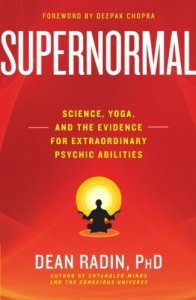
Supernormal: Science, Yoga and the Evidence for Extraordinary Psychic Abilities by Dean Radin
My rating: 4 of 5 stars
With this controversial book, Dean Radin presents the scientific evidence for an array of psychic powers, but he frames the discussion in terms of yogic siddhis. “Siddhi” is a Sanskrit term for an ability that isn’t seen among the general population–at least not reliably so– and for the most part these “accomplishments” correspond to the categories discussed in parapsychology (i.e. telepathy, precognition, psychokinesis, and clairvoyance.) [Note: As mentioned, this is a controversial book. I will attempt to provide as unbiased a review as possible. I am generally skeptical, but don’t believe in poo-pooing the study of subjects because they offend my skeptical sensibilities. Furthermore, I try to keep an open mind because: 1.) there is no scientific consensus about what consciousness is or how it works, 2.) quantum biology is a subject in its infancy and we may yet learn there is more quantum “spookiness” going on in the brain than we think. 3.) for all I know we are in an simulation and then it’s all a matter of programming.]
The yogic emphasis doesn’t change the book much from the pop psych literature review of parapsychology studies it would otherwise be, except to necessitate background information on yoga and siddhis. However, this emphasis may or may not have opened up a huge additional readership. Outside of a fringe, siddhis aren’t much in vogue among yoga practitioners these days. Among modern day yogis and yoginis, there are some who believe in them and some who think they’re throwbacks to an era of superstition, malnutrition, and wishful thinking. However, even among the former, siddhis are generally considered a distraction. The advice of most of the great yogis has been to not get lost in the pursuit of such powers because chasing siddhis can derail one from one’s ultimate objective (e.g. liberation.) Still, if even a small fraction of yoga practitioners take an interest, that’s a fairly large readership.
So what exactly is the controversy? Obviously, there are many divergent demographics with differing views on the topic. For hardcore skeptics, parapsychology is right up there with alien abduction, bigfoot /yeti sightings, and the anatomy of the Loch Ness monster with respect to being a legitimate topic for scientific study. On the other hand, there are believers who are offended by the mere notion of studying such phenomena with science, and who say such investigations are an assault on their beliefs.
But that’s not a very interesting controversy—i.e. there are some people who won’t believe in such abilities no matter what the evidence, and others who will believe in them no matter what science has to say. So let’s chop off the hardcore skeptics and hardcore believers and ask what the controversy is as it pertains to those of us who consider evidence when drawing conclusions.
The root of the controversy can be stated rather quickly and clearly. Here it is: the effect size is small but statistically significant. What does that mean? Say this study asks a subject to determine which of five randomly selected shapes has been chosen using nothing but his / her mind. Using pure guessing, one would expect to be right 20% (i.e. 1/5th) of the time. If a person happened to get 32% right in a given trial, that means nothing because small samples don’t give one a convergence towards a mean value. (i.e. Intuitively, you know that if you flip a coin 10 times and get 7 heads, it doesn’t necessarily mean anything. If you repeat that 10-flip set 10,000 times, and still get 70% heads, then you probably have a trick coin or something else odd is going on.) So the issue is that even when experimenters repeat the experiment over and over again such that the average value should converge on 20%, it doesn’t. It stays at, say, 30% (exact effects vary but it’s on this order.)
At this point the reader might be thinking of all the factors that could result in this effect (i.e. cheating [insider or outsider], subconscious observation of facial expressions, random selection that is biased, etc.) Well, so have the scientists. In any study, one wants to account for alternative explanations to the utmost. Over the years, researchers like Radin have put all manner of protections in place from quantum random number generators to booths with extreme sound-proofing and Faraday cages (prevents radio signals from transiting.) Still they get this small positive effect that can’t be explained by alternative explanations.
There is also the issue of the filing drawer problem, which Radin devotes considerable space to discussing. It’s the idea that when drawing conclusions from many similar studies, one must accept that there may be many unpublished studies that sit in file drawers because they didn’t produced negative results. These filed / unpublished studies could negate the outcome of the body of studies of that nature. While this remains an open criticism, there is mathematics for determining how many negative studies would have to be turned up to make the results insignificant. Radin argues that the numbers calculated strain credulity.
So this “small but statistically significant effect” is generally agreed upon by all, excepting conspiracy theorists. Now we get to the controversy, which is how to explain this effect. Skeptics run the gamut from hot-blooded haters who claim that it’s all just a scam perpetrated by hoaxers with tenure, to more diplomatic challengers who provide thoughtful, plausible, and non-nefarious explanations for what they believe are false results. Said objections include file drawer problems, statistical “crud factor” (an observed effect in which large sample size studies can show a significant correlations between any two random variables—i.e. everything is correlated with everything else to some degree), and outlier effects.
The latter is a particularly revealing controversy. Say your study results in this 30% instead of 20% effect, and there’s one subject in the study who (over many trials) got the shape right 80% of the time. If you’re a skeptic, you call that an outlier and you want to cut it out of the study because it may be causing part, most, or all of the effect you see. Your assumption is that that this outlier could be anything from a data entry error to an outright cheater, but it’s obviously not a gifted psychic. If you’re a believer, not only do you want to keep that result, you want to find that person and study them to find out if the result was a one-time fluke, or if you have some rare, gifted person.
The book is arranged into three parts. The first part offers background on yoga and siddhis. The second part is the heart of the book and it presents an overview of results from studies of precognition, telepathy, psychokinesis (both of animate and inanimate objects), clairvoyance, and the effect of meditation on these abilities (which also shows a small positive effect, i.e. the general population outdoes probability by a little bit and experienced meditators outperform the general population by a little bit.) The last section is just a couple chapters about the future of parapsychology.
I found this book to be interesting and thought-provoking. Radin comes across as a reasonable investigator who is willing to accept that there is a lot of duplicity going on out in the world, but yet when one uses the methods of science one obtains results that would be generally accepted as successful across the social sciences. At times he does go on anti-skeptic rants. On the other hand, one can imagine his frustration in dealing with individuals unwilling to pin down how much higher the bar must be for parapsychology results over results in more mainstream topics. I think Radin’s greatest mistake was in discussing levitation. Besides at a quantum level, the effects of gravity are well-understood and non-negotiable. While our lack of understanding of consciousness leaves wiggle room to at least consider some unusual happenings, levitation seems a non-starter. Fortunately, as it hasn’t been studied, Radin just presents a couple historical anecdotes and moves on (while—to be fair–acknowledging the fundamental risk in relying on anecdotes.)
I’d recommend this book. I can’t say it swayed my belief on the topic, which tends skeptical, but it did inform my confusion. (It should be pointed out that not all these abilities are equally reviled by science. Precognition is the most fundamentally opposed because it seems to violate the fundamental cause and effect nature of the universe at our scale and larger [as opposed to the quantum level were all sorts of weird happenings transpire.]) I do agree with Radin that there shouldn’t be taboos in science in which scientists are afraid to study a subject of interest because the prevailing notion is that it probably doesn’t have merit. If there weren’t scientists with the cojones to study “crazy stuff” we’d no doubt be far behind our current understanding of the world.
5.) Vegetables are vegetables. If the potato is your go-to vegetable, you’ll probably have trouble shedding the pounds. That’s not to say that there is anything inherently wrong with potatoes. But, because of their high glycemic index value (i.e. they’re quickly digested and cause a sharp blood sugar spike), they should be lumped in with bread or rice when considering portions and meal make up. The same is true for sweet corn. Some people consider carrots (and carrot relatives) to be high glycemic, but one has to eat a pretty massive amount to have a problem. Most vegetables have a relatively low glycemic index score and are great foods to fill up on.
4.) Cola is mostly water, how bad could it be? At the right temperature, one can dissolve 2 kilograms (4.4lb.) of sugar in one liter of water. Wrap your head around that.
3.) I worked up a good sweat; now I can eat whatever I want. If you’re in the process of training for an ultramarathon or the Olympics, this might be true, but an hour in yoga class or run in the park doesn’t float you a free pass to kill it at Häagen-Dazs. There’s no getting around the math, the dietary half of the ledger is the 800 pound gorilla (no pun intended) of weight-loss. [That doesn’t mean that there aren’t many, many benefits to exercise, or that it doesn’t contribute to weight loss in more ways than one.] The Mayo Clinic has an excellent table of calories burned for a wide range of exercises and physical activities. You may be demoralized to note that the calories burned in an hour of Power Yoga are completely replenished by a medium size french fry.
2.) I will treat myself with sweets [or pizza.] I’m not suggesting there’s anything wrong with treating oneself, but making food the treat sets a bad precedent. For many, this notion of food as reward or comfort source was introduced in one’s youth, and it can be extremely difficult to dislodge it later in life. One might try music or fun activities as alternative sources of reward.
1.) I shouldn’t have eaten that Snickers on Wednesday. This may seem like a contradiction of the previous item, but being doctrinaire about food creates its own problems. Specifically, sustainability may be a challenge–especially if one has had that “food as treat” story inculcated into one’s psyche. It’s not the once and while caloric splurge that kills most people, it’s creeping portion sizes.
Some people swear by a “cheat day.” Others say that that’s a bad approach because one might feel forced to cheat even when you’re really not feeling a desire for junk food. Some advocate an 80/20 rule, whereby 80% of the time one follows a strict dietary regimen, while the other 20% of the time one takes it more free and easy (though not totally insane.) Personally, I think different approaches work for different people, but I do agree that the dietary Nazi approach isn’t the way to go.
Better Balance: Easy Exercises to Improve Stability and Prevent Falls by Suzanne E. Salamon
My rating: 4 of 5 stars
Balance is one of those qualities that one takes for granted until it fails. Actually, given our bipedal stance, it’s extraordinary that we aren’t falling down all the time. Achieving a stable upright posture takes a lot of complex anatomy and physiology operating flawlessly. I picked up this book because I believe a yoga teacher should be cognizant of the range of capacities for balance that might be seen while teaching. If one teaches students in their 20’s to their 40’s, the need for balance modifications and capacity building might not come up much. It’s when one deals with the very young as well as older students that one sees flawed balance in large measure. [And—let’s face it—the very young can fall down 30 times, pop right back up each time, and be all the stronger for it, and so mature students are the major concern.]
This isn’t the first book in this series of Harvard Medical School Guides that I’ve read and reviewed, and probably won’t be the last. (see: “Your Brain on Yoga,” “Guide to Tai Chi,” and “Low Back Pain.”) I’ve found the series to be beneficial because it presents scientifically sound information, but isn’t afraid to give alternative approaches—such as yoga and tai chi—their due when the studies show that said activities are of benefit. This book is no exception. At several points the authors mention tai chi as being beneficial, and the book includes a yoga balance workout as one of the six that it contains.
The book is organized into 13 sections (i.e. chapters.) The first chapter describes how our vestibular (inner ear), visual, and proprioceptive (the nervous system elements that track where one’s body parts are) systems interact to keep us upright.
Chapter 2 presents an overview of a range of conditions that affect balance. Some of these influence balance specifically and exclusively, but many are conditions that one might not associate with balance problems though they’ve been shown to increase the risk of imbalance. There are sections about which medications have side-effects adversely affecting balance as well as what your doctor may be able to do about balance problems.
Chapter 3 is a “Special Bonus Section” and is of particular importance to mature readers or those who care for said individuals. The topic is preventing falls, and this section describes common causes of falls and offers checklists of considerations for setting up the environments in which those with balance problems will be active.
Chapter 4 introduces various types of activities that improve balance, and chapter 5 is a brief guide to considerations relevant to beginning a balance workout such as whether to consult one’s doctor and what safety precautions should be considered.
In chapter 6, the authors propose how balance workouts can be merged into one’s overall fitness plan. A lot of this chapter is an introduction to exercise—e.g. how much is needed, and what the benefits are. Then there are some tips about how to smoothly merge balance with other exercises.
Chapter 7 presents more specific considerations for beginning balance workouts. Unlike chapter 5, this section provides information about equipment, warm-ups, and how to interpret the instructions for the workouts. The latter is beneficial because the workouts are in a one page per exercise format, and this section negates the need to be needlessly repetitive.
The next six sections (chapters 8 through 13) are various balance workouts that are organized in an easiest to hardest format. The first is a beginner’s workout, which is performed with a chair—used for sitting in some exercises and as a prop in others. The second is a standing balance workout that features simple static balance maneuvers. The level of challenge is similar to that of the first workout, except that one is without a chair prop. The third workout adds in movement to help maintain balance through steps and motion. The next workout is similar but utilizes another prop, a 360 step (a circular step of similar height to the more common Reebok rectangular step, but circular.) The penultimate workout uses a pseudo-balance beam. The author’s mention a product put out by Beamfit, but other manufacturers produce a similar product. It’s a low, dense foam beam that sits on the floor. The last workout utilizes classic Hatha Yoga poses, and features both expected poses like tree pose (vrksasana) and others such as down dog (adho mukha svanasana) that might come as a surprise.
There’s a resources section and glossary at the end. The book presents many graphics, most notably photos of each of the exercises in the six workouts.
I’d recommend this book for anyone who needs an overview of the problems of balance and what can be done about them. It’s short, readable, and user-friendly.