This Harvard Medical School Guide presents the findings of many scientific studies on the benefits of yoga, and it does so in a manner suitable for the layman. The book is written by Dr. Sat Bir Khalsa, a long time practitioner of Kundalini Yoga and a neuroscience researcher at Harvard, and is co-authored by a science writer trained in journalism.
I became aware of Khalsa’s work when reading William Broad’s The Science of Yoga, a book that is complimentary of Dr. Khalsa and his studies—a favor which Khalsa doesn’t return as he rejects Broad’s work as being overly sensationalist. The book does talk about Khalsa’s research, such as a study with young musicians at Tanglewood that examined how the practice of yoga increased their equanimity. That said, this isn’t merely a summation of Dr. Khalsa’s work. It’s what in academia would be called a literature review, but “literature review” implies a far more dismal reading experience than one gets from this book. It does present anecdotes in a way that is useful for a layman’s book, but would not be well-respected in an academic setting. This work isn’t designed for medical colleagues but rather to be of benefit to run-of-the-mill yoga students and teachers.
This is a very short book at only about 50 pages. The book consists of five chapters after an introduction which sets the stage and gives some relevant background on Dr. Khalsa. Chapter one delves into the effect of stress on the body and mind, and how yoga (and meditation more generally) has been shown to help counter the effects of bad stress (not all stress is inherently bad, as is addressed in the chapter.) Chapter two examines the effect of yoga on the body and in countering a number of common ailments. The third chapter considers how yoga might actually help one to be smarter and more creative. Chapter four presents the results of studies of how yoga can counter depression and improve one’s mood. Chapter five is in a different vein, and might well have been included as an appendix. The last chapter gives an overview of the various types of yoga to assist readers new to yoga on what style might best meet their needs and disposition. This is a nice feature for those new to yoga, but also for veteran practitioners who’ve practiced one style and might not be aware of the wide range of styles out there. (A few of the styles mentioned are popular in India, but I don’t think are as well-known in the West.)
For such a thin book, this work covers a wide range of topics including–but not limited to–the effects of yoga on sleep, the immune system, neural plasticity, memory, math skills, and mood. A nice feature of the book is a series of brief exercises that one can practice to help reduce stress or achieve a desired goal. These practices are generally located at the end of chapters. Finally, while this book isn’t written primarily for doctors and other scientists, it’s endnoted so those interested in tracking down the studies the book references can readily do so.
I’m a big fan of applying a scientific approach to the study of ancient methods such as yoga. I would, therefore, recommend this book for yoga teachers and students who are interested how precisely these practices can assist them. It’s extremely short and easily digested. It’s in no way overbearing with medical jargon and is readily understood by anyone with a basic education in biological science.
This book’s author, T.K.V. Desikachar, was the son and student of T. Krishnamacharya. If you’re not a well-read and/or Indian yoga practitioner, there’s a good chance the latter name means nothing to you, and yet your practice has likely been influenced profoundly by him. He was the teacher of B.K.S. Iyengar, Pattabhi Jois, and Indira Devi. Iyengar, who recently passed away, popularized the use of props (blocks, straps, bolsters, etc.) as a means to achieve proper alignment until one’s flexibility was sufficient to achieve perfect alignment without assistance. Jois developed the vigorous and flowing Ashtanga Vinyasa style of yoga, which is the direct ancestor of Power Yoga—a popular style among fitness buffs in the West. Indira Devi was a Westerner actress who took an Indian name and was among the first teachers to introduce yoga to America and to adapt it to American needs. While Desikachar wrote the book, his father’s presence is seen throughout the book in photos and quotations.
After reading the book, it will not come as quite the surprise that T. Krishnamacharya was teacher to several of modern yoga’s most innovative teachers. A central concept of Krishnamacharya’s teaching philosophy was that yoga is a personal path that must be optimized to the individual. That’s what this book tries to do. Its aim is not to teach one yoga for all, but to help individuals tailor yoga to their own needs.
The Heart of Yoga is divided into four parts. The first two parts form the core of the book, and make up the bulk of its length. The first introduces yoga at a basic level and then goes on to impart practical lessons on asana (poses), pranayama (breathing exercises), and bandha (locks.) The second part instructs on the philosophical aspect of yoga, and how an individual can bring these concepts into their life. This includes ideas that are traditionally associated with Yogic philosophy as well as those of Samkhya (Yoga and Samkhya are two of the six orthodox schools of Indian philosophy, and are closely related.)
Part III of Desikachar’s book is his translation of Patanjali’s Yoga Sutras with commentary. Some will appreciate that the sutras are written in Sanskrit, a Romanized phonetical Sanskrit, and in English. In addition to this, Desikachar’s commentary not only elaborates on each sutra individually, but offers insight into how they are grouped and what meaning their organization conveys. For those who have read Yoga Sutras, you’ll know that they consist of 196 lines of instruction, each so laconic as to be cryptic. Commentary is essential, particularly if one is reading the translated sutras and doesn’t have the historical, cultural, or linguistic background to distill the meaning from these mega-concise aphorisms.
Part IV is called the Yoganjalisaram, which is a poem of 32 stanzas each consisting of three to six lines. “Poem” might be a misleading description. Each Sloka (i.e. like a stanza) is a lesson in yoga. It touches on diet, physical technique, philosophy, and religion.
In addition to what I thought were well-written, concise, and informative chapters, there are a number of ancillary features that are beneficial. There’s an appendix that describes some of the prominent historical texts that are commonly referred to throughout the book. Another appendix provides a series of asana sequences that are consistent with the teachings of Part I of the book. There is a glossary of terms that are used throughout the book. Up front there is an interview with T.K.V. Desikachar that deals mostly with his father’s approach to yoga. In addition to the many photos of Krishnamacharya, simple line drawings are put to good use to convey ideas where necessary.
I think what I found so appealing about this book is that the author has a pragmatic, down-to-earth, and open-minded approach to yoga. Some yoga books are way out there in the stratosphere, and their ethereal qualities don’t inspire confidence in me that the author knows of what he/she speaks. Others are doctrinaire about absolutist beliefs and values one “must” hold to be a true yogi or yogini. Desikachar is neither an ideologue nor flighty. He may have benefited from his education as an engineer. His lessons are presented simply and practically, so as to give confidence that he knows of what he speaks.
I’d recommend this book for any practitioners of yoga–be they beginner or advanced. It provides food for thought for bringing yoga into one’s life at a physical and psychological/philosophical level, and in a personal way.
The Bhagavad-Gita is a philosophical poem, the title of which is translated as “Song of the Lord.” It’s often read as a stand-alone work, but it’s included in the sixth book of longest known epic poem, entitled the Mahabharata.
In The Bhagavad-Gita, Krishna teaches the warrior-prince Arjuna about sacred duty (dharma.) The setting is the battlefield at Kurukshetra as a war is about to get underway. Arjuna asks his charioteer, Krishna, to halt the vehicle between the opposing armies. Arjuna is struck with a crisis of conscience. He doesn’t want to fight and kill the men on the opposing side–some of whom are related to him by blood and others of whom are well-respected elders. Arjuna can see no virtue in the war.
Krishna, after briefly mocking what he describes as Arjuna’s newly developed cowardice, goes on to offer his explanation of why it is that Arjuna should fight. The first argument is that nobody really dies because consciousness is reborn. This makes sense if you believe in reincarnation… otherwise, not so much. A concise restatement of this argument is presented in the 11th teaching: “I am time grown old, creating world destruction, set in motion to annihilate worlds; even without you, all these warriors arrayed in hostile ranks will cease to exist. Therefore, arise and win glory! Conquer your foes and fulfill your kingship! They are already killed by me. Be just my instrument, the archer at my side!”
Another of Krishna’s argument is that if Arjuna fails to fulfill his duty he will be thought less of by others. This is an odd argument to make as Krishna makes a more compelling case for ridding oneself of ego, whereas this seems to be saying that one should put what others think of one above doing what one believes is right. That sounds a lot like succumbing to ego rather than eliminating. In the 12th teaching, in fact, Krishna tells us that the best of men are “Neutral to blame or praise…” This suggests that perhaps one shouldn’t be moved by what others will think of one.
At the core of Krishna’s argument is that one cannot escape the Karmic cycle by engaging any acts but those that are selfless. Like the reincarnation argument. One may find this logic compelling or not depending upon whether one believes in Karmic theory. Karma is the idea of cause and effect. If you do good, you’ll receive good effects and if you do bad you’ll experience bad effects. Ultimately, however, the goal is to break free of the Karmic cycle and, in theory, the only way to do that is to engage in acts that are selfless—hence doing your sacred duty. If your driver isn’t God, it’s not entirely clear how you know what your sacred duty is, at least not by way of this work. (Presumably, God talks to kings and princes, and kings and princes tell the unwashed masses what they are supposed to do. If you happened to have already done away with such a system—as most of the planet has—you may have trouble with this logic.) However, if one takes the lesson to be that one should not be consumed with personal gain when one acts, one has an argument of more general appeal.
Another argument is that devotion to God is all important, not a man’s actions in any absolutist sense. From the 9th teaching, “If he is devoted to me, even a violent criminal must be deemed a man of virtue, for his resolve is right.”
It should be noted that Krishna delivers a number of lessons beyond the need to comply with one’s dharma, and, in my opinion, many of these ancillary lessons are more compelling than Krishna’s explanation of why Arjuna must fight.
One such lesson is to concern oneself with the journey and not the destination. Krishna states it as such, “Be intent on action; not the fruits of action…” Furthermore, there are a great many teachings that will be familiar to Buddhists, such as the need for non-attachment and moderation.
The poem contains lessons of Samkhya (e.g. discussion of the three gunas) and Yoga. It describes concepts from the three original forms of yoga (predating yoga as a fitness activity by centuries): those being of action yoga (karma yoga), knowledge yoga (jnana yoga), and devotional yoga (bhakti yoga.) While The Bhagavad-Gita predates the formulation of eight limbs of yoga as described by Patanjali, it does address certain among them in varying detail. Early on, it speaks about pratyahara—withdrawal from the senses—in considerable detail. There are also references to pranayama (breath/energy control exercises) and most of the yama and niyama are listed among the virtues in the latter part of the teachings. Of course, samadhi (liberation / yoga’s 8th limb) is a central concept in this work.
While The Bhagavad-Gita remains widely cited and relied upon for guidance to this day, it’s not without its controversial elements. In the fourth teaching, Krishna explains how he created the caste system. Of course, Krishna might not have intended it to be the stain it became.
The Miller translation that I read has a few nice ancillary features. There is an introduction that offers background and context for those who have little knowledge of Indian history or mythology. There’s also a glossary that goes into detail about terms that are frequently used in the work. It’s not that there are Sanskrit words mixed into to the text. The glossary explains what the English words should be taken to mean in the context of the Hindu worldview.
What is most intriguing, however, is the afterword which is entitled, “Why Did Henry David Thoreau Take the Bhagavad-Gita to Walden Pond?” Of all the thinkers that have cited The Bhagavad-Gita, the use of Thoreau and Emerson as examples raises intriguing questions. The Thoreau of Civil Disobedience and the Emerson of Self-Reliance would seem to be as far from the message of The Bhagavad-Gita as possible. Krishna is telling Arjuna to ignore his conscience, and just do what God tells him to do—be a selfless instrument of destruction. Thoreau and Emerson both preached that one’s conscience should always be one’s ultimate guide. Thoreau went to jail because he refused to pay taxes that would support the war with Mexico. I suspect Krishna would say to Thoreau, “Hey, I’m throwing this war, and you’d damn well better do your part.” However, there are ideas in The Bhagavad-Gita that work with the American Transcendentalist philosophers. The idea of removing self-interest and egotism as a way to eliminate delusion before one makes one’s own decision is a consistent suggestion.
I have mixed feelings about The Bhagavad-Gita. Like many (most?) sources of religious doctrine, I think the central message of The Bhagavad-Gita is just another means by which to keep the masses under the control of an elite—and, specifically, fighting the wars of the royalty. However, I–like Thoreau and Emerson—also see a great deal of insight into how to be a better person in this poem.
I think The Bhagavad-Gita is worth a read, regardless of how you may ultimately feel about its message. It offers a concise summary of key ideas in Indian philosophy and psychology. It will give one a better understanding of the Indian worldview, and may teach you something about how to live in the process.
During my recent trip to Thailand, I attended Thai Yoga (a.k.a. Rusie Dutton, i.e. “ascetic exercises”) classes at the Wat Po Temple. As a yoga practitioner, I took note of the similarities and differences between Thai yoga and the Hatha Yoga of India. It’s no surprise that Thai Yoga would display the influence of India. Indian influence from olden times can be seen throughout Thailand. The roots of Thai Massage (a.k.a. Thai Yoga Bodywork or Nuad Bo Rarn) itself are attributed to Shivago (also, written/pronounced Chivako), a north Indian doctor in the Buddha’s community of followers.
One can plainly see the influence of Hatha yogasana (postures) in these Thai exercises, but the details vary. I’m interested in how movement systems (e.g. martial arts) with a common ancestry diverge over time in response to the unique needs of a different culture. I believe that not only the new system evolves, but there’s also a continuing evolution in the original line. One can, therefore, end up with systems that look little alike over the course of several generations.
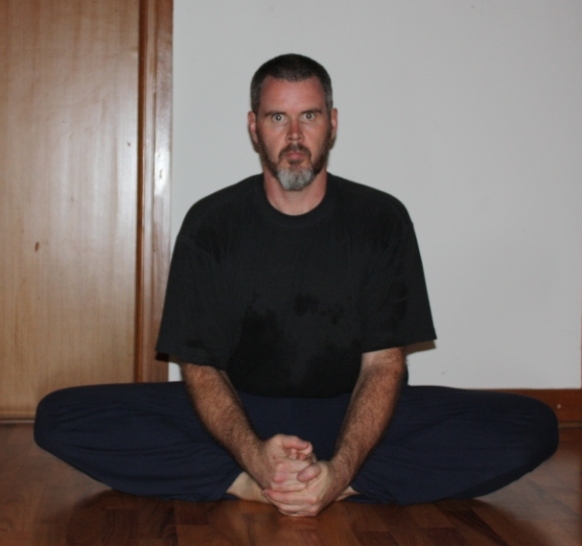
The degree to which the Thai Yoga poses vary from Hatha Yogasana varies. In the Thai Yoga class we did a simple lateral bend with interlocked fingers that was identical to a Sivinanda Yoga pose named tiryaka tadasana.
Lateral Bend (tiryaka tadasana)
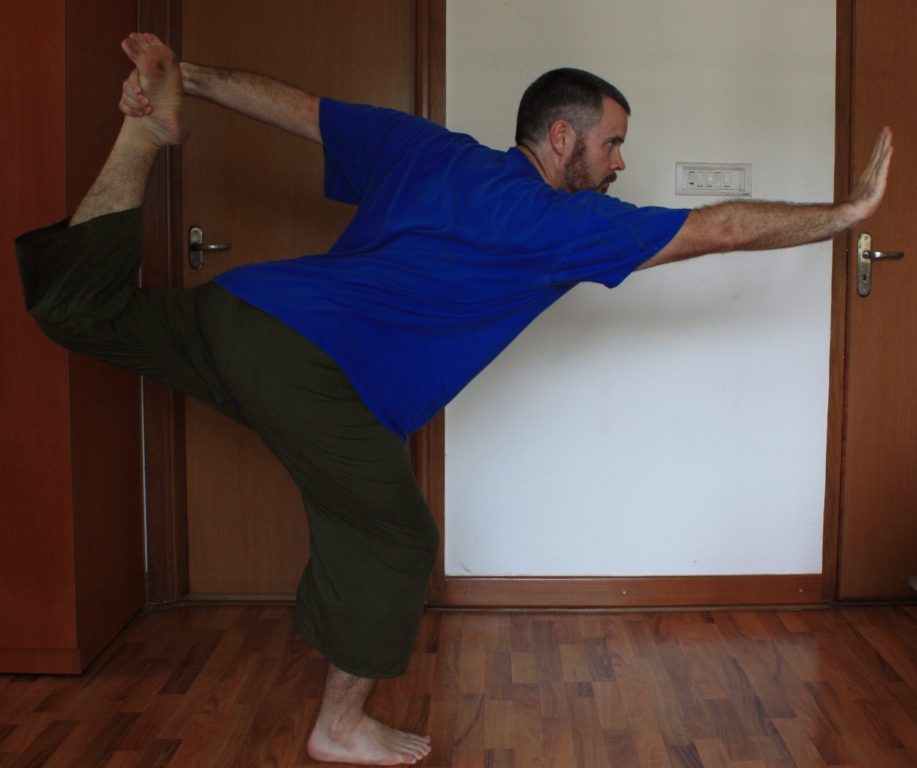
Balancing poses made up much of the Wat Po Thai Yoga sequence. This makes sense as the course was aimed at practitioners of Thai Massage and balance is important in this massage system because there are techniques that involve standing on one foot as one applies pressure with the other fort or in which one must stand to apply stretches. (Obviously, it’s bad for business to step on the recipient in an uncontrolled fashion or to topple onto them.) There were poses that were reminiscent of Natarajasana (Shiva’s Dancer pose), Vrksasana (tree pose), and Utthita Hasta Padangusthasana (hand to big toe pose). Each of these varied in the details. The most prevalent Thai variation was bending the support leg to lower one’s center-of-gravity. In Hatha Yoga, it’s usually taught to keep the support leg as straight as one can manage (this both contributes to the stretch and can prevent loading the tendons.)
NATARAJASANA: There were two variants of this pose practiced at Wat Po. Both folded the torso more forward than one would typically see in Hatha Yoga, as well as bending the support leg more. The first version (palm on front knee) is as such:
Version 1 from Thai Yoga (Palm on Knee)
The second version has the front hand up in a manner similar to the Hatha version, but the torso isn’t kept upright and the support leg is deeply bent.
Thai Version 2 (hand out front)
In contrast, the Hatha version is more upright.
Natarajasana
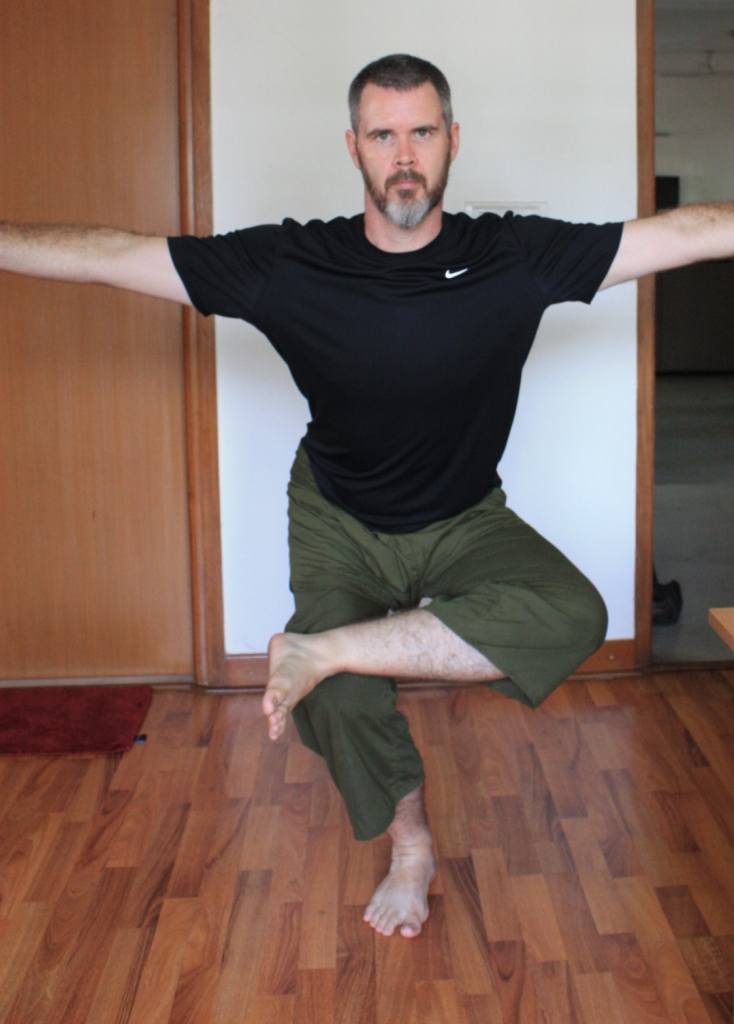
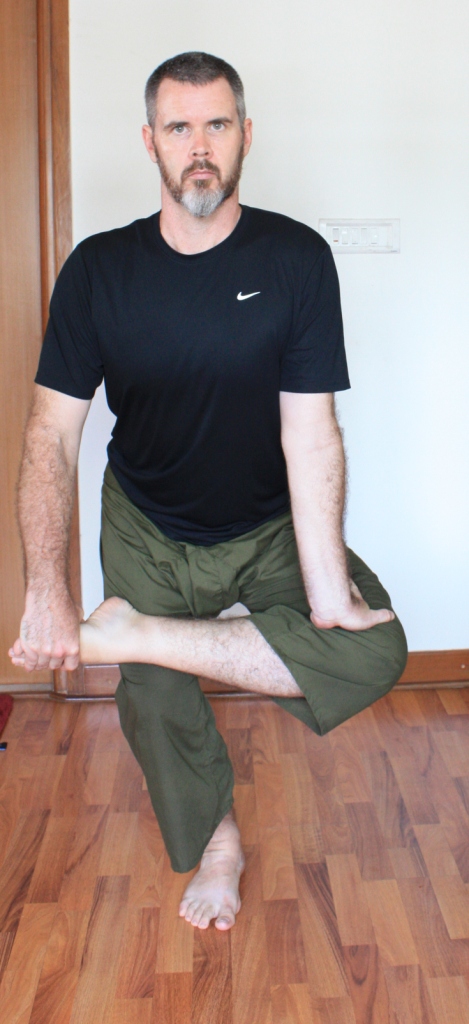
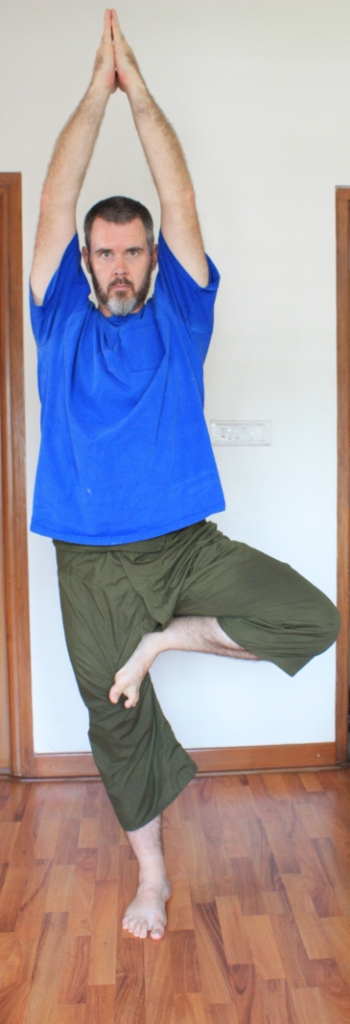
VRKSASANA: There are two variants of tree pose in the Thai Yoga. In both the ankle is kept on top of the thigh and the support leg is bent. Version one is as follows:
Version 1 begins and ends in Pranamasana (hands in prayer pose) but hands are taken out to the side in between
Version 2 includes a wrist stretch with the balance pose. One puts fingers on thigh facing upward and the squat folds the wrist back.
Version 2 with wrist stretch
The Indian version:
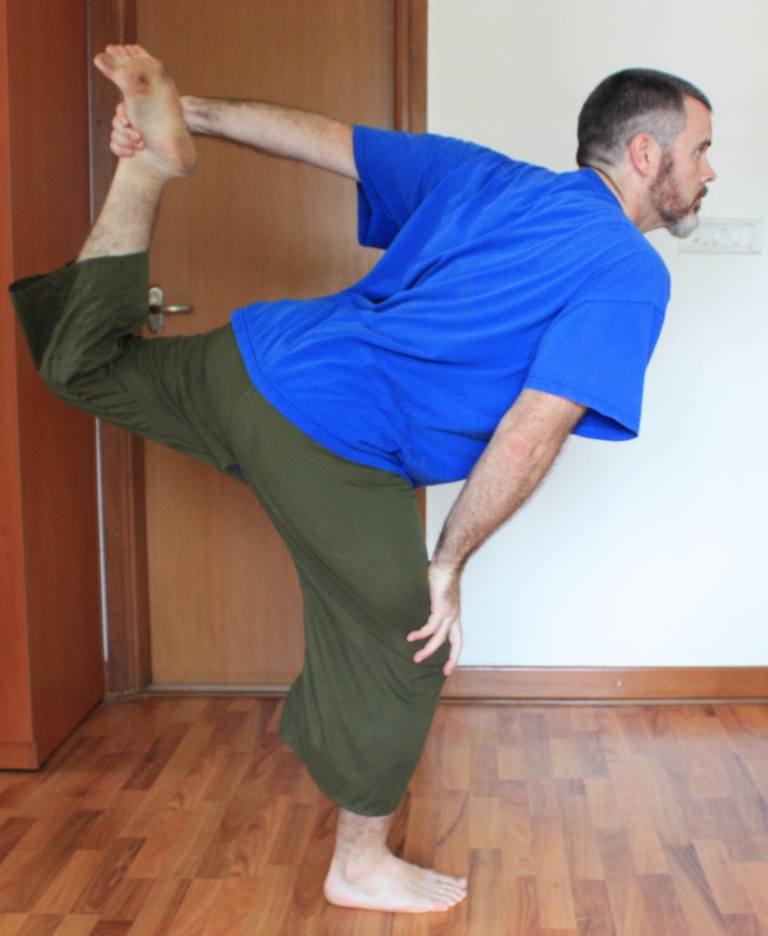
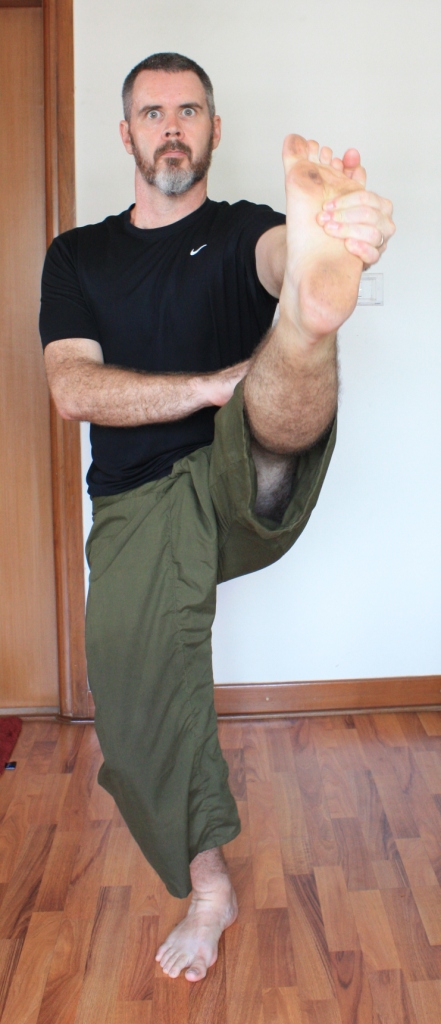
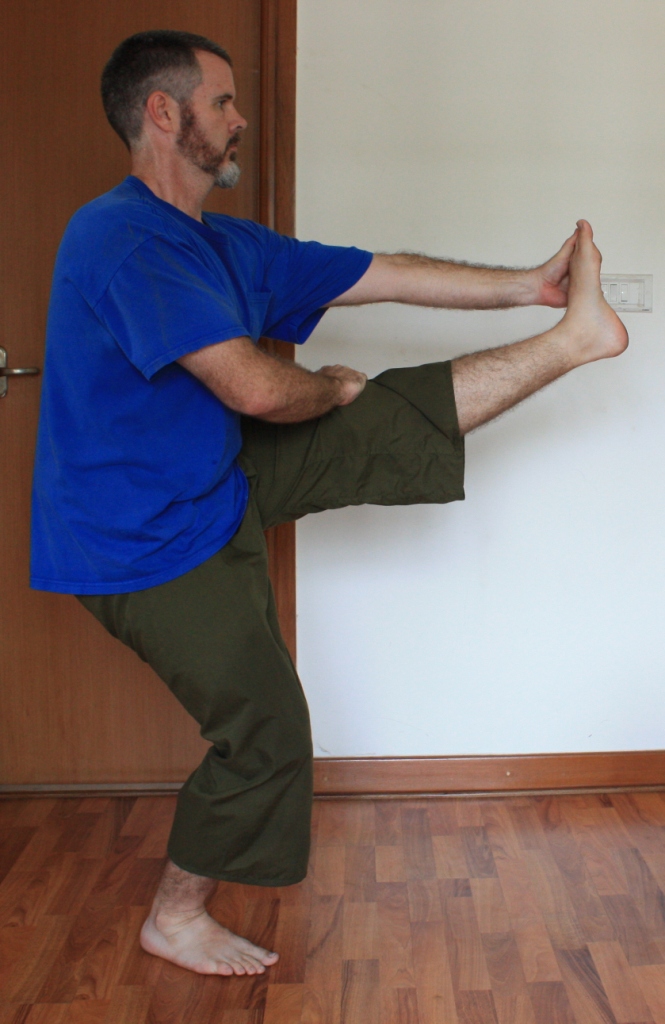
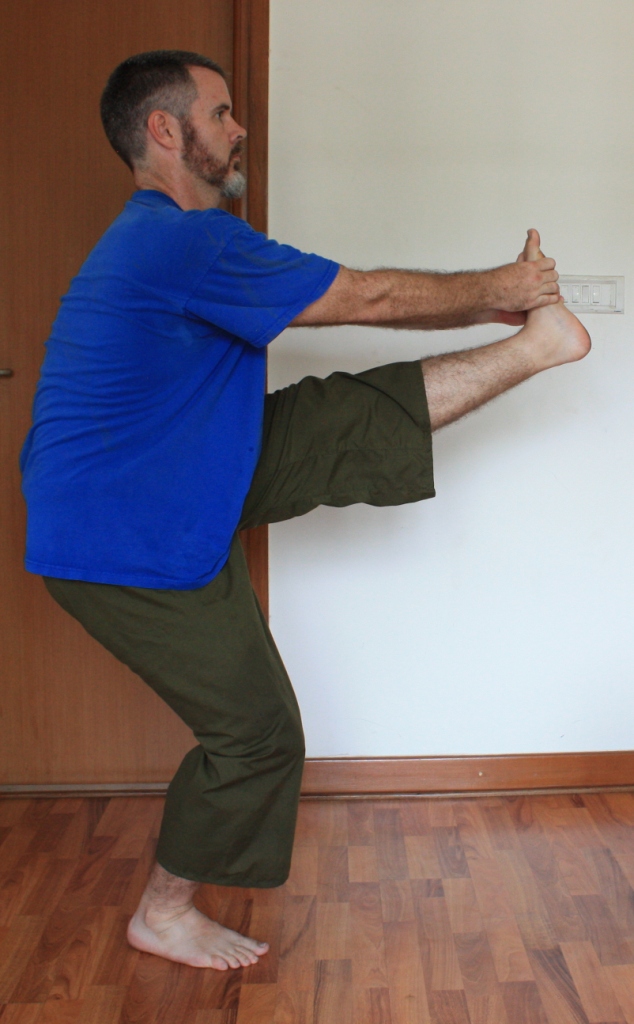
UTTHITA HASTA PADANGUSTHASANA: There are also two variations of this pose. Note the bending of the support knee. Version 1 holds the foot with the same side hand and places the opposite palm on the knee.
Version 1 from front
Version 1 from side
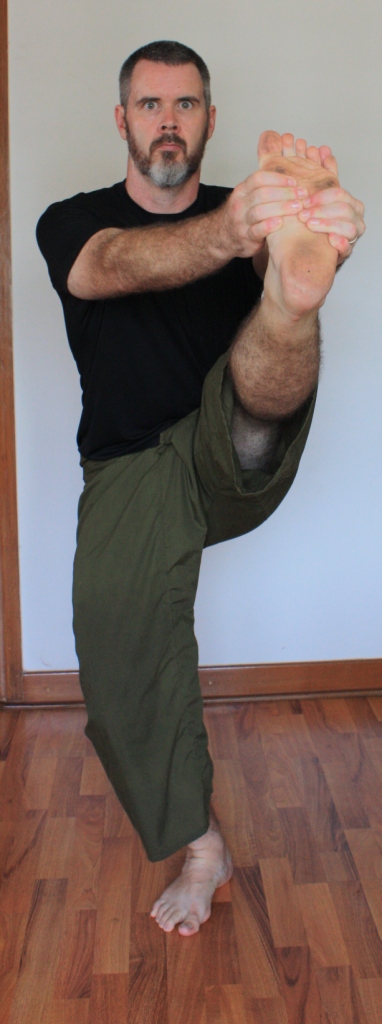
Version two holds the extended foot with both hands.
Version 1 from the front
Version 1 from the side
For comparison, the Hatha Yoga version:
Utthita Hasta Padangusthasana from side
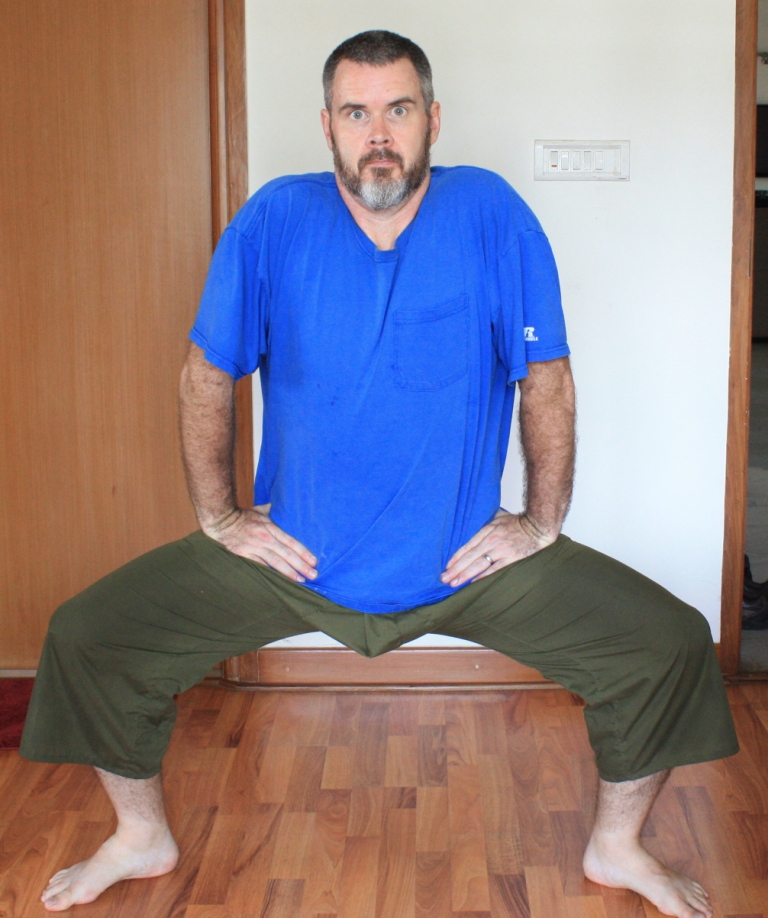
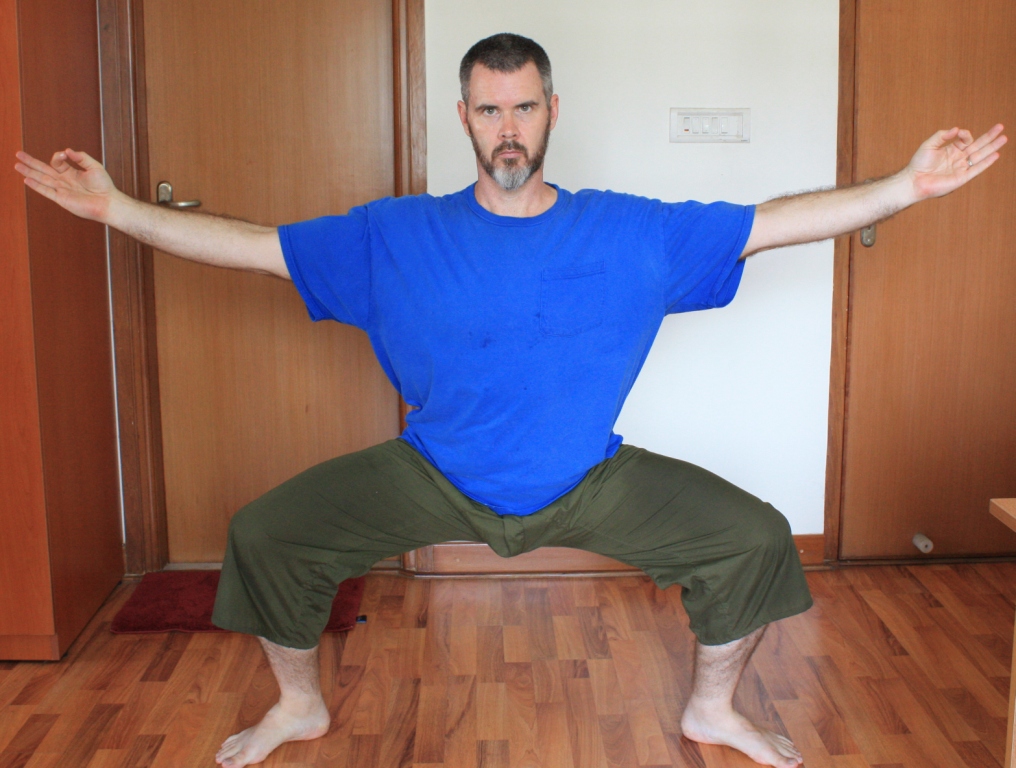
UTKATA KONASANA: There are three variants of a pose that is usually called Goddess pose or Utkata Konasana. The difference here primarily deals with how the hands are positioned, but given the many variants within Hatha Yoga for hand position, this can be seen as a virtually identical pose.
Thai version 1 of Goddess pose
Thai version 2 of Goddess pose
Thai version 3 of Goddess pose
Goddess pose with hands in Chin mudra.
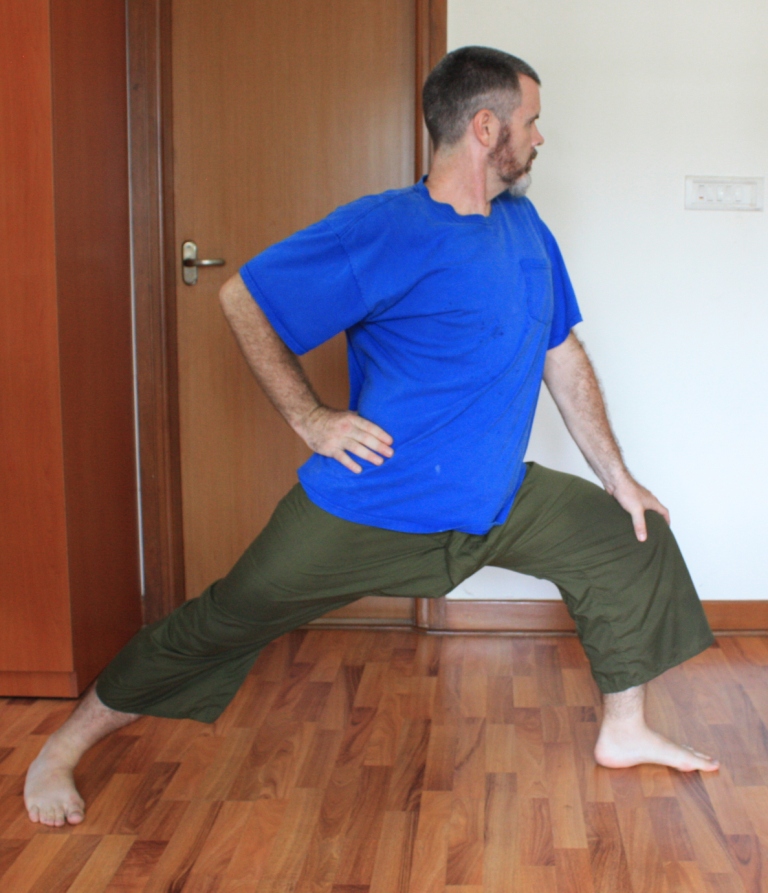
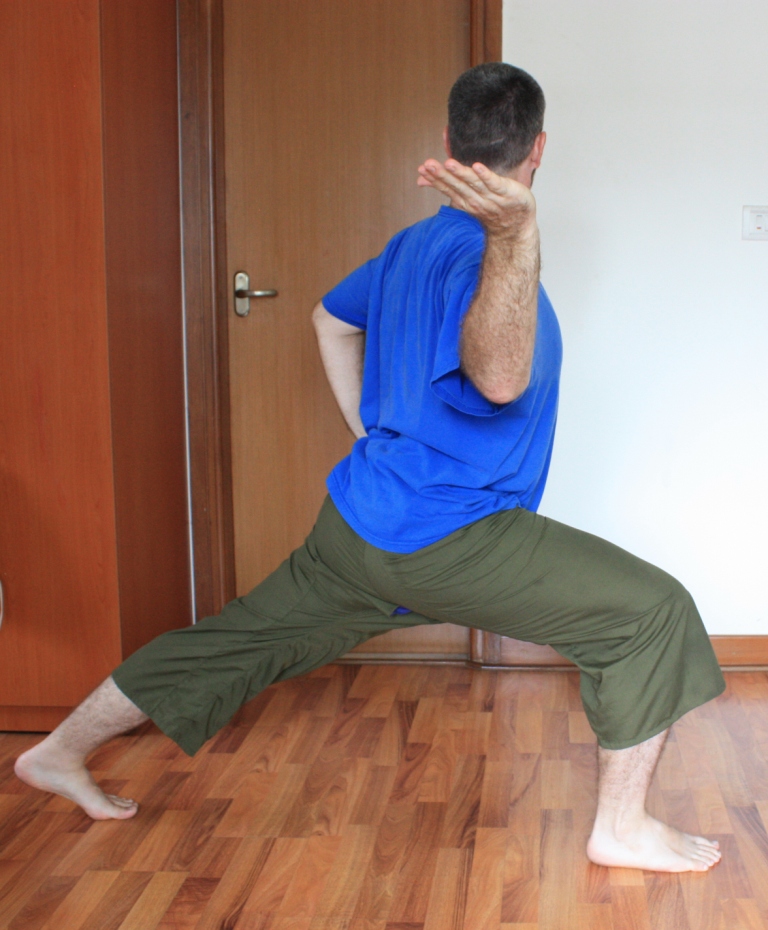
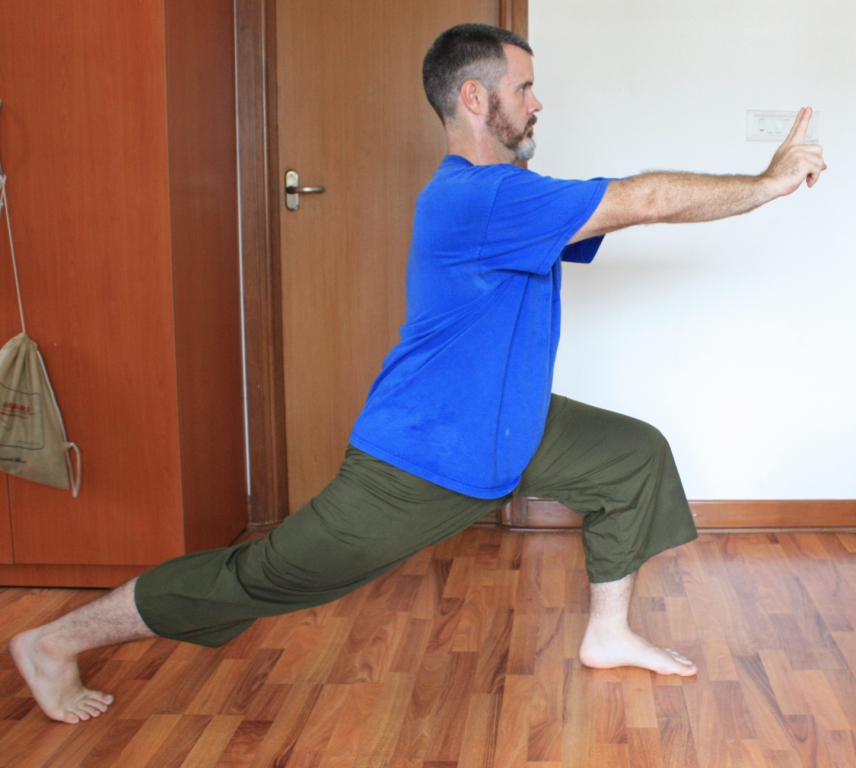
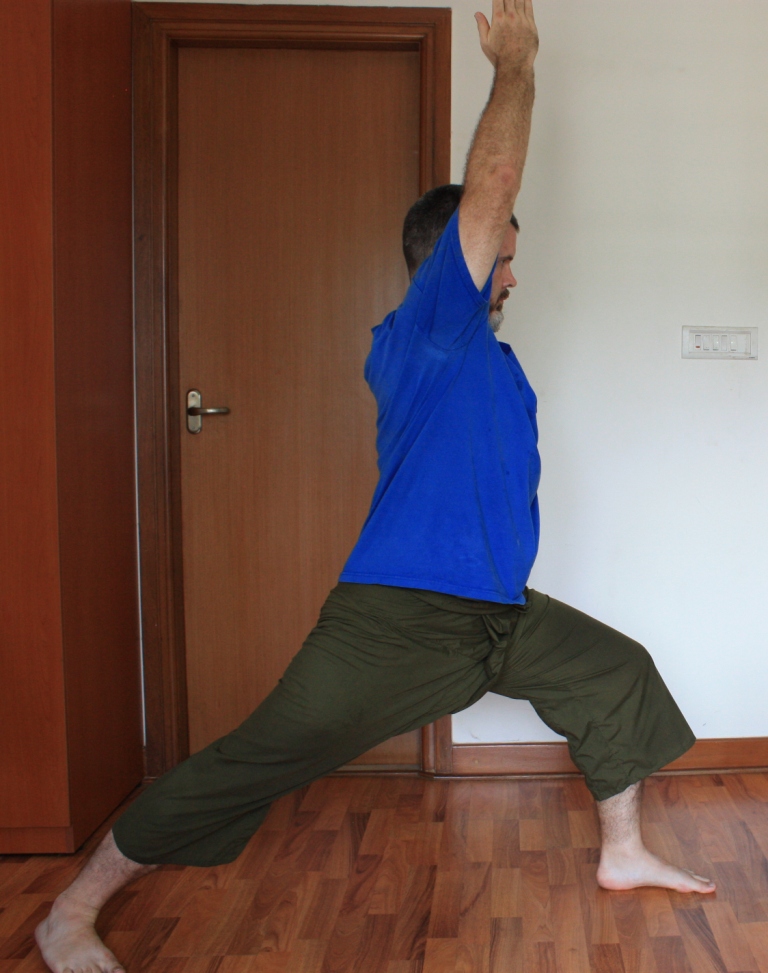
VIRABHADRASANA: There is a series of five lunge poses that are reminiscent of the Virabhadrasana (Warrior). I’ve dropped the first one because it requires a photo taken from a back angle becuas it involves pulling one’s wrist behind one’s back.
It may strike one as hokey that this book has one author, but two names on the byline. But, it’s apropos of an autobiography describing the fundamental transformation of a man.
Part I is the story of Brad Willis, a journalist on the rise. Willis goes from stumbling into a reporter job at one of the smallest markets in the country to being the Asia bureau foreign correspondent for NBC (National Broadcasting Corporation, one of the largest American television networks.) There’s no mention of yoga in this part of the book. It’s the story of a driven journalist covering major world events. Willis made a name for himself reporting from Soviet occupied Afghanistan in the 80’s. He tells harrowing tales of covering the drug war in Latin America, the Desert Storm Gulf War, and human trafficking in Thailand. He was also one of the few American journalists to visit North Korea. There was nowhere he wouldn’t go for the story, and he took serious risks along the way. His highly driven nature is the one point of consistency throughout the book. Willis is not a man to do anything half-assed, be it following a story or pursuing the yogic path.
Then Willis’s world was torn asunder by health problems, and this is the subject of the second part of the autobiography. First, a fall caused a hairline fracture in one his vertebrae that became crippling when Willis refused to take time off from work or to do anything for it. He couldn’t be diverted from his on-the-go foreign correspondent’s pace. Considering the dangerous places Willis traveled, it’s ironic that he initially broke his back on vacation at a Caribbean resort while closing a window during a storm. When the deterioration of his vertebrae made work untenable, he underwent a surgery that failed and left him “permanently disabled.”
Then Willis was diagnosed with a cancer in his throat that spread from his tonsils into lymph nodes. On top of the ailments themselves, Willis’s health rapidly declined because he became dependent on painkillers and other prescribed medications, and—against advisement—he began to drink alcohol in conjunction with these meds. Not only did he become hooked on the medications and alcohol, he became dependent on a back brace, a cane, and a lethargic lifestyle that kept the body from healing itself. Yoga is only briefly mentioned in passing in this part of the autobiography.
The third part is about Willis’s transformation into the yogi Bhava Ram, and his successful battle against cancer. After an intervention that resulted in drug rehab, he was referred to a pain center at Scripps that employed alternative therapies. (As an aside, the book is in part an indictment of a healthcare system in which this Pain Center both helped many people and was completely unsustainable because insurance companies could reject claims on the basis of the treatments being unconventional—but because it was staffed by medical professionals it was too expensive for most people to afford without insurance. Willis points out that there was never a rejection of any claim for any of the expensive medications or surgery that failed to helped him, but the Pain Center that put him on the road to good health went under due to failure to pay.) The Pain Center was the key to his turn around. After progressing with physical therapy, biofeedback, and—most uninsurable of all—Jin Shin Jyutsu, Willis is introduced to Yoga.
The final part charts Willis’s pursuit of yoga both through a series of teachers as well as any books that he can get his hands on. He voraciously reads up on the subject, and begins a sadhana (personal practice) that is marked by all the drive he had earlier given to his journalism career. The practice starts out rough. His muscles have atrophied, his spine curved, and he gained a tremendous amount of weight on a steak, potato, and beer diet mixed with a sedentary lifestyle. However, over the period of a couple of years, well beyond when he had been told he would be dead, he transforms his body and his mind through an intense daily practice and an adjustment of his world view.
I’d recommend this book for anyone. It will definitely be of interest to yoga practitioners—though don’t be surprised that yoga doesn’t come into play until the final quarter of the book. It could also benefit individuals with serious health problems as a way to reconsider how they approach health and treatment. Willis points out that falling into the role of victim was one of the main killers. He inherited a bad situation through an accidental fall and a case of cancer that he believed was attributable to his experience in Iraq (i.e. related to depleted uranium shells.) However, it was only when he stopped gorging on food, alcohol, and self-pity that he made a turnaround.
Even if I wasn’t interested in yoga and alternative approaches to healing, I would’ve found this to be an intensely engaging read. Willis’s journalism career gave him a unique insight into some of the major world events of the 1980s and 90’s. Willis builds lines of tension and sustains them. One wonders what will happen to his marriage to a woman who married one man (a confident and successful foreign correspondent in Hong Kong) and found herself in a marriage with another—first a lethargic addict and then a man who sunk himself hook-line-and-sinker into to the yogic lifestyle. One wonders whether his cancer remission will hold. One wonders whether he can keep clear of the pain meds and stick to the life of a yogi. I haven’t read a book that caught me this much by surprise in some time. I hadn’t heard of this book before I bought it, and didn’t have particularly high expectations (it was on sale on Kindle or I probably never would have picked it up), but I quickly became hooked.
This morning a yoga teacher I’ve studied with posted this article on her Facebook feed. It’s by an Indian yogini who moved to the U.S., and it offers five differences between the practice of yoga in India and in America.
It occurred to me that one additional difference that’s frequently commented upon is that mirrors are ubiquitous in American yoga studios, but a rarity in Indian studios.
There are many possible explanations of this point of divergence. Among the more cynical interpretations is that when yoga spread internationally it was never explained that there are no asana (postures) whose drishti (focal point of gaze) is the reflected “bootilicious”, yoga-panted backside of other students.
The explanation one is likely to hear, however, is that a student needs mirrors to be able to see whether his or her alignment is correct. Sounds logical? Actually, it’s lazy in the same way as saying, “I wanted to know what Lord of the Flies is about, so I rented the movie.” (Read the damn book.)
Yes, looking in the mirror will give one instantaneous feedback, but it won’t help one develop the bodily awareness that’s a huge part of the value of yoga. One should be seeking to enhance one’s proprioception. That’s a fancy way of saying, “know where your parts are.” Proprioception is defined as: “the ability to sense the position, location, orientation, and movement of the body and its parts.” The body has a built-in ability to determine where one’s various parts are in space and whether said parts are straight or crooked. One may not realize this because one may have poor proprioception… because one looks in the mirror instead of closing one’s eyes and listening to what one’s body has to say.
There are about a billion editions of Patanjali’s The Yoga Sutras. The one I got was a free or very cheap on Kindle, and is, therefore, probably not the best edition. I don’t know that the Kindle version I got still exists because it included a supplemental essay by Swami Vivekananda that the version I linked to on Amazon doesn’t. However, the translation is the same, and is by Charles Johnston.
For many old works, the edition might not matter too much, but for Patanjali’s Sutras it matters a great deal. First, there’s the issue of the quality of the translation. Beyond that, however, is the question of the analysis. The Yoga Sutras are extremely brief, consisting of only 196 aphorisms. Owing to the terse brevity of the Sanskrit language, many of these aphorisms are only a few words long. That means that there isn’t a high degree of precision in the language of the Sutras, and, consequently, there’s a great deal of room for misunderstanding and misinterpretation. It’s for good reason, therefore, that most editions are 90% or greater commentary on Patanjali’s words.
The Sutras are typically divided into 4 chapters (this convention apparently came well after Patanjali wrote them.) The first section lays out the objective of yoga. The central notion is the need for Chitta Vrtta Nirodha, which basically means to transcend the fluctuations of the mind. Patanjali’s point is that the problem faced by mankind is that people’s minds are run amok. There is a need for some system to facilitate correction of all this monkey-mindedness. That’s where Chapter 2 comes in.
The second chapter lays down an outline of Ashtanga Yoga, which is the eight-fold path of Raja Yoga (i.e. Royal Yoga). While modern-day people tend to think of yoga only as pretzel-like physical postures, that’s just one of the eight limbs of yoga. The eight limbs are: commandments (yama), rules (niyama), postures (asana), control of breath (pranayama), withdrawal of the senses (pratyahara), concentration (dhanara), meditation (dhyana), and liberation (samadhi.)
It’s interesting to note that the limb that many think of as yoga, i.e. the postures, is one of the most briefly covered. Most famously, Patanjali says in Ch.2, Sutra #46, “Sukham Sthiram Asanam” (i.e. postures should be stable and effortless.) The massive body of asana that developed in Hatha Yoga were initially just a means to give one the ability to sit still for a long periods of time comfortably enough to get one’s mind in order.
The third chapter talks a little bit about the last three of the eight limbs (i.e. concentration, meditation, and liberation.) However, the bulk of this chapter is devoted to the supposed magic powers that yogis claimed to have had as a result of their work on improving their minds. For skeptics and scientifically-minded individuals (e.g. yours truly), this is where the Sutras take a silly turn. The translation in question came out in 1912, and it’s clear that rationalism was already gaining hold and magic was getting to be a harder sell. I suspect that was the reason for the inclusion of Swami Vivekananda’s essay entitled “The Powers of the Mind”—to capitalize on the gravitas of the renowned yogi to convince people that chapter 3 isn’t bunk.
The fourth chapter wraps up the book neatly–discussing karma and the liberation of the karmic cycle achieved through the state of higher consciousness called samadhi.
If one has more than a superficial interest in yoga, it’s pretty much obligatory to read some edition of Patanjali’s The Yoga Sutras. I didn’t find this edition to be devastatingly poor, but there seems to be a consensus among reviewers that it’s not among the best translations / commentaries.
I would recommend that one read some version of these sutras, be it BKS Iyengar’s Light on the Yoga Sutras of Patanjali, Swami Vivekananda’s edition, or Swami Satchidananda’s version. I don’t have any experience with these other editions, though I have read works by BKS Iyengar and Swami Vivekananda, and found works by both to be well-written and clear. Notwithstanding the parts about magical superpowers, the book does provide a lot of food for thought, and in nice bite-sized pieces.
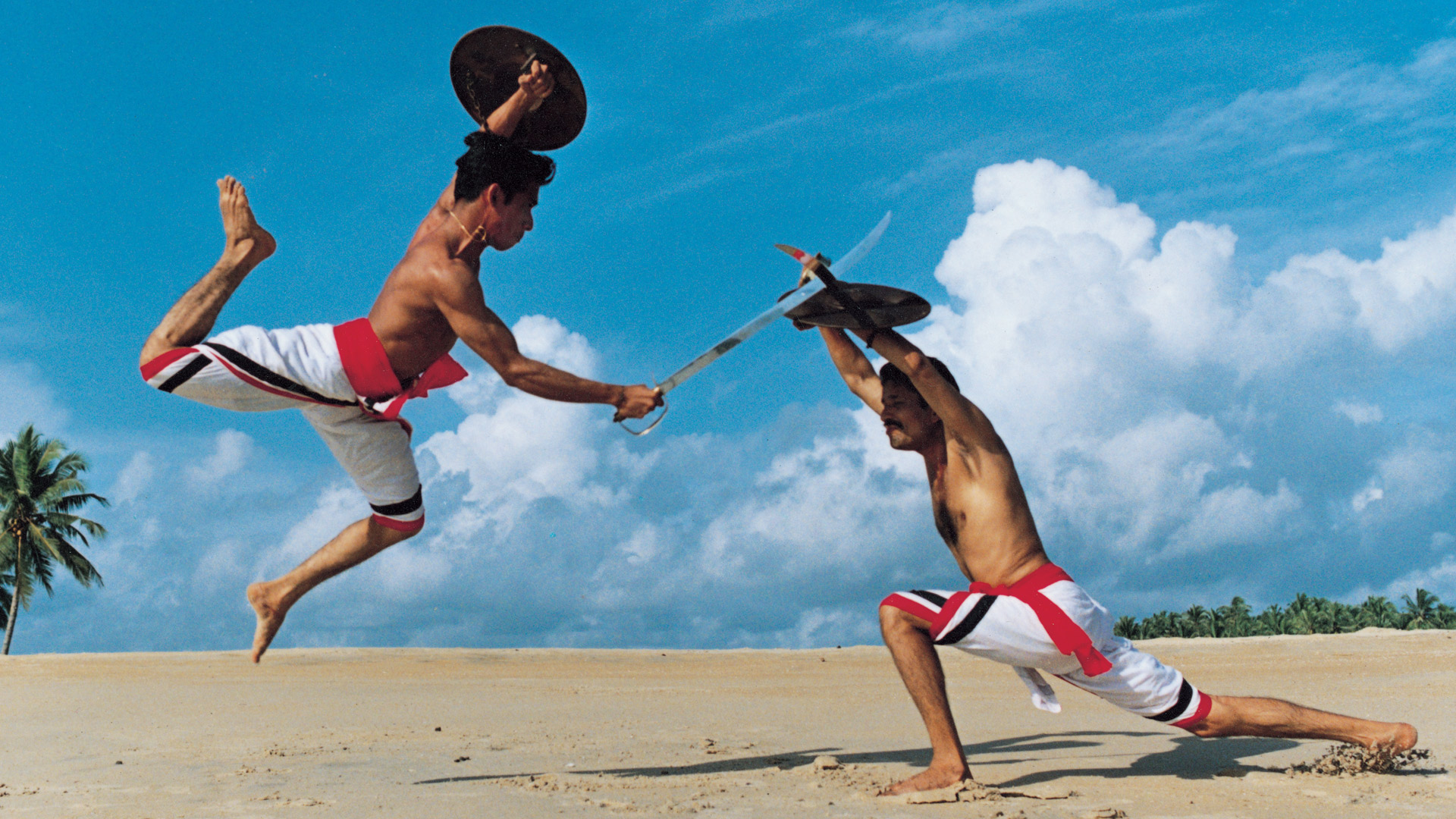
Outside of India, Kalaripayattu isn’t a household name like karate, kung fu, or judō. However, within India, this homegrown martial art is a source of great pride. It’s said to be one of the few indigenous martial arts that survived into modernity (with unbroken transmission, i.e. without a period in which no one was diligently practicing it.) Some consider it to be the mother of Asian martial arts (for reasons I both address and critique in an earlier post.) It’s a mainstay of Bollywood (and non-Bollywood Indian cinema—yes, there is such a thing) and makes frequent appearance in dance performances and plays.
I’ve been attending Kalaripayattu classes for the past 4 or 5 months. While this hardly makes me an expert on the subject, it does give me some insight into the art beyond reading or watching videos. I’m also able to make comparisons to other martial arts–one in which I have an extensive background, and others with which I also have limited experience. I’ve, therefore, put together a collection of answers to questions I’ve been asked as well as others that I can imagine being asked.
Pre-Question Question: “Kalaripayattu” is a long name, can I call it by something shorter?
Answer: Kalaripayattu is often just called “Kalari.” Note: “Kalari” also refers to the place where the martial art is practiced (i.e. not unlike the words “dōjō” or “training hall”.) If someone refers to “the kalari” or “a kalari” they’re probably talking about a physical location, whereas if they say “Kalari”– without an article—they’re likely talking about the martial art.
As an aside, a kalari, historically speaking, has a precise design approach and dimensions. It’s dug into the ground so that from the outside the building can look like it’s for Hobbits, but inside its ceilings are adequate even for the long weapons used in the art. This method presumably began in an attempt to reduce the effect of the south Indian sun. Of course, in modern times, kalari take many forms (e.g. the kalari I attend is on the 3rd or 4th floor of a building.)
Q1: The most common question is, “Kalari? So, what’s that like?” [In this case, the questioner wants to know what classes are like.]
Answer: My stock answer to what classes are like is that if one imagines a class which includes yoga, modern dance, and a hard style of Okinawan Karate, one wouldn’t be far off.
Of course, most people have a tough time imagining such disparate elements in a coherent class, so I’ll describe what a typical class (at least at the beginner level) is like. Each hour-and-a-half class can be divided into five parts. The first is warm-ups, which consist mostly of joint articulations, dynamic yoga poses, and—lastly—leaping drills. Warm-ups may also include those old martial arts mainstays, running laps and side-to-sides (facing one direction and moving to the side without crossing one’s feet.)
The second section is a series of leg exercises, which are mostly kicks done on alternate legs in laps up and down the kalari. These get more challenging as one progresses. The highest level that I currently practice involves going into scissors splits (Hanumanasana) as one does these laps.
The third section is animal poses or movements (depending on one’s level.) One does animal poses in the first level. Now that I’m in the second level, I’m doing animal movements, which involve movement repeated up and down the length of the kalari. I believe there are more challenging versions of the animal movements in the subsequent level(s.) There are eight postures and eight basic movements that are designed to emulate animal behavior.
The fourth section is stretching. This involves a series of yogasana (yoga poses) and core work common to yoga.
The final section involves what in Japanese arts might be called kata (memorized forms–or set sequences of strikes and kicks) and striking drills.
Q2: The second most common question is, “Kalari? So, what’s that like?” This sounds like the exact same question, but in this case the inquisitor is asking what the martial art is like, more generally. [I blame the modern educational system and Twitter for this lack of clarity in language.]
Answer: The answer to the first question gives one a little insight into this question as well, but I’ll expand upon it. First, Kalari is a comprehensive combative system. That mouthful just means that it involves unarmed striking, grappling, and a range of weapons. This should come as no surprise as any martial art that predates sport martial arts is likely to be comprehensive. (In combat, one has to be well-rounded because one can’t plan on a combatant sticking to protocol.) Oddly, we think of “mixed martial arts” as the latest craze, but arts that specialize in either striking or grappling are the new kids on the block.
Second, I have read that the warriors in the area of present-day Kerala (i.e. where Kalari developed) didn’t use armor, and—in a related fact—tended to use weapons that were faster and were employed with greater agility than in other parts of India where armor was more common–as well as, the heavier weapons needed to be lethal against armored opponents .
Third, besides including wide-ranging unarmed and weaponry techniques, Kalari has a massage and medicinal component that has been handed down along with it. Readers familiar with either the Japanese and Chinese forms of acupressure massage (Shiatsu or Tui Na, respectively) and either Kobudō or Kung fu, will not be surprised to learn that the same vital points that are manipulated in massage in one way are exploited in martial arts in another. In Kalari, these points are called marma.
Q3: Who practices Kalari, and for what purpose?
Answer: At the risk of angering some readers, Kalari has little value for either self-defense or for preparing for combative sports (beyond the choreographed competitions that are Kalari-specific.) Because these two objectives are among the most common reasons for learning a martial art, it’s often asked what type of person practices Kalari and what do they hope to get out of it?
It looks to me like practitioners fall into three categories. First, there are those who want to get fit. Kalari succeeds tremendously in this regard. If one practices diligently, one will likely see growth in flexibility, cardio-vascular stamina, agility, and both core and extremity strength. (To be frank, this fitness building is why I said that Kalari has “little value for self-defense” rather than saying that its techniques are “of less value than randomly thrashing about in a fight.” One’s physical capacities rise considerably, and that might serve one even if the motions that are drilled into one’s body have no pragmatic value in fighting a skilled opponent—except in surprising them with one’s flamboyantly acrobatic but excessively expansive and vulnerable motions. I’ll also note that there’s a degree of fearlessness that results from training with metal weapons—even choreographed movement with unsharpened metal weapons—that shouldn’t be ignored as a potent benefit if one were ever to have to fight an advanced Kalari practitioner.)
[For those who haven’t seen Kalari and think I’m being excessively douche about its combat ineffectiveness. Below is a video of a couple of very athletic and skilled Kalari performers, and you can ask yourself–in your heart of hearts–if these moves seem likely to be effective against a focused and experienced opponent who has done a lot of free-form sparring.]
Second, there are dancers and performers who want to impress with the martial moves of Kalari. Hopefully, I can make amends to those who I’ve offended in the preceding paragraphs. While someone employing Kalari techniques would likely be thrashed to within an inch of his or her life if they employed them against someone using Krav Maga, Systema, or even Muay Thai, on stage Kalari moves are far and away more impressive to watch than any of the aforementioned systems. Kalari makes for a great show. The things superheroes do in movies aren’t very realistic either, but we “oooh” and “aahh” when we see them.
Third, there are people like me who are interested in the art in a scholarly sort of way from a historical, cultural and /or movement interest. I want to see what this system has in common with other martial arts, and to think about how it might have evolved. I should point out that I suspect that Kalari was at some point much more pragmatic as a combat system (and correspondingly much less thrilling to watch), and that it evolved to a new purpose over time. This same thing could be said of many arts that evolved into sports or entertainment enterprises (e.g. many forms of Kung fu are also unlikely to gain one success in a fight, but are nonetheless beautiful to watch. Also, I don’t know whether Capoeira evolved away from combat effectiveness or was born that way, but it certainly got there somehow.) One can also learn about movement in a generic way that might be applied in ways that can be useful.
Q4: Is Kalari a unified art or an umbrella term? (To make this clear, consider the word “karate.” If someone says that she studies “karate,” one really knows very little about the art that person studies. However, if one says he studies Isshin-ryūKarate or ShōtōkanKarate, then one might know what that person’s training really looks like.)
Answer: As I understand it, there are two different styles encompassed in Kalari. The northern style is called Tulumanadan, and the southern style is Vadakanadan. By “northern” and “southern” we’re talking about the northern and southern parts of the southwest tip of India, i.e. what is present-day Kerala, but which includes parts of other states–such as Karnataka. I don’t know how much variation is contained in each of those two styles.
Q5: How fit do I have to be to join Kalari training?
Answer: Like any physical activity, you certainly don’t need to be able to do what you see the advanced practitioners doing when you start. There’s a gradual build up from simple movements to ones that are more challenging. There is also, some allowance for one’s (temporary and permanent) physical limitations–because we are all different and have our own unique set of strengths and weaknesses.
Having said that, if someone apparently non-athletic asked if they should sign up, I’d probably suggest they first take a few yoga classes of a challenging nature (e.g. Power yoga, Hatha Vinyasa, or Ashtanga Vinyasa.) The Kalari classes will ask every bit the same of one’s flexibility and core strength, and substantially more of one’s extremity strength and stamina.
1.) Use your words. Don’t demonstrate unnecessarily. I came to teaching yoga in a backward way. It started with me doing my personal practice with my wife a few times a week. We were pretty much just practicing together, though I took the lead based on greater experience and knowledge of yoga. Eventually, a couple of other people began to join these makeshift sessions. I remember looking up and seeing a person doing parivrtta trikonasana (revolved triangle pose) in a dangerous manner. This was my first glimpse into the importance of keeping eyes up if you take on the role of helping someone with their practice.
Having a relatively high level of flexibility and many years of movement training (in the form of martial arts), I generally don’t have that much trouble mimicking postures and following corrective guidance. However, having gotten away from teaching for a little while, I quickly forgot how low the average level of bodily awareness is. Truth be told, I’d probably have been hard-pressed to explain what was so dangerous about that individual’s alignment at the time. I just had an intuitive notion that it wasn’t his skeleton or the correct muscles that were holding him up. I’ve since been working hard to move beyond an intuitive understanding. I’ve been voraciously reading everything about anatomy and body-reading that I can get my hands on–studies above and beyond the requisite anatomy instruction of the course–which itself was substantial.
2.) Demonstrate in a smart (and not narcissistic) manner. Of course, demonstration does have its role when you have individuals who’ve not seen the movement or posture before–and if it’s a difficult posture to explain or likely to result in injury if instructions are misinterpreted. Such demonstration is best done with students watching and before they begin to move into the posture. Having only a small, closed group, whose capabilities are known to me, I’ve learned that it’s better for me to demonstrate in a manner that the participants are capable of doing while maintaining safe and stable alignment.
Of course, if one has a class of students with wide-ranging capabilities–or unknown capabilities–one will want to demonstrate as close to the idealized form as one can, so that the more proficient students can work toward that ideal. However, having struggled to master difficult asana (postures), there can be an incentive to show off one’s capability for the sake of… well showing off. If one demonstrates an idealized form that one’s students are incapable of performing, there’s a risk they’ll do something dangerous in an attempt to emulate that form.
3.) Lazy yogis aren’t without virtue. The primary purpose of practicing asana could be said to build a body with which minimal effort is required to maintain a given posture–be it a meditative seated pose or simply standing. Most people have subtle misalignments in their bodies of which they aren’t even aware. They may have chronic or occasional pain that they aren’t remotely aware is tied to being out of alignment.These misalignments end up costing a person a lot of extra effort and pain over the course of a lifetime. Being conscientious about one’s posture is the first step to fixing these problems, and if one spends all one’s time driven to master the next piece of mega-contortionism or acrobatics without learning to be a little lazy, one is missing the point of yoga.
4.) Props aren’t just for old ladies with bad hips. When I started yoga teacher training, I’d never used a block, strap, or bolster, and chairs only for sitting. Since then, I’ve learned a lot from the asana with props training both in the teacher training course, and by attending and observing such courses of my own volition. I think there’s a widespread notion that props are for those who lack the flexibility to do proper yoga and that such classes are exclusively for those people trying to ease into yoga. What one might not realize is that one ends up holding postures much longer in such a class, that one is usually discouraged from using the prop any more than one has to, and that props don’t always make asana easier.
I’m pretty flexible in most of my musculature, but I found that there were areas in which my alignment could definitely be improved by using a prop now and again.
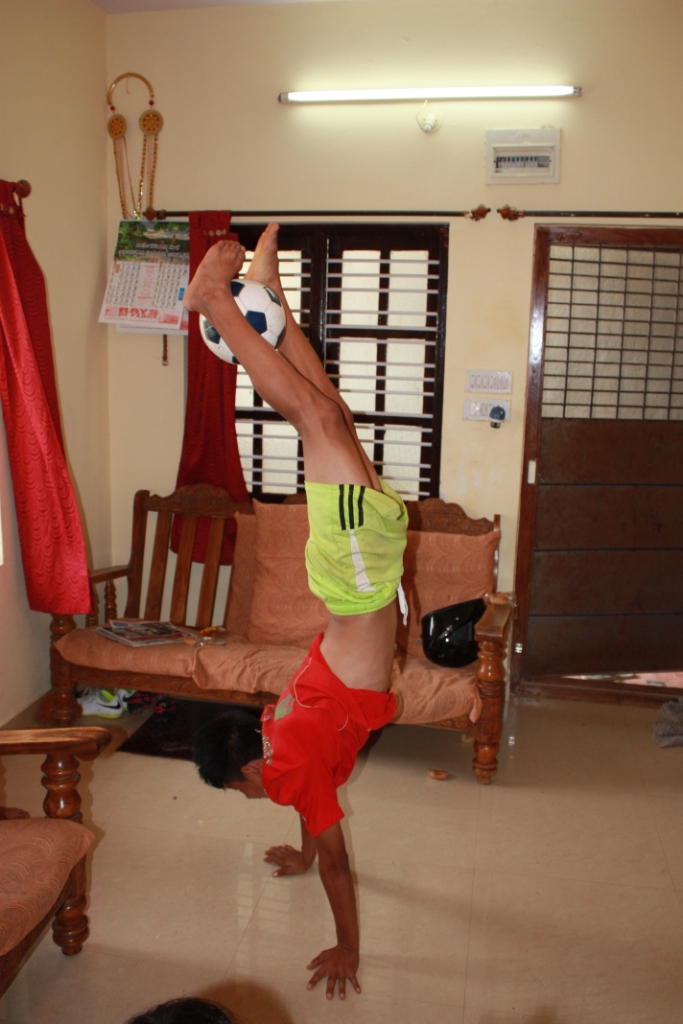
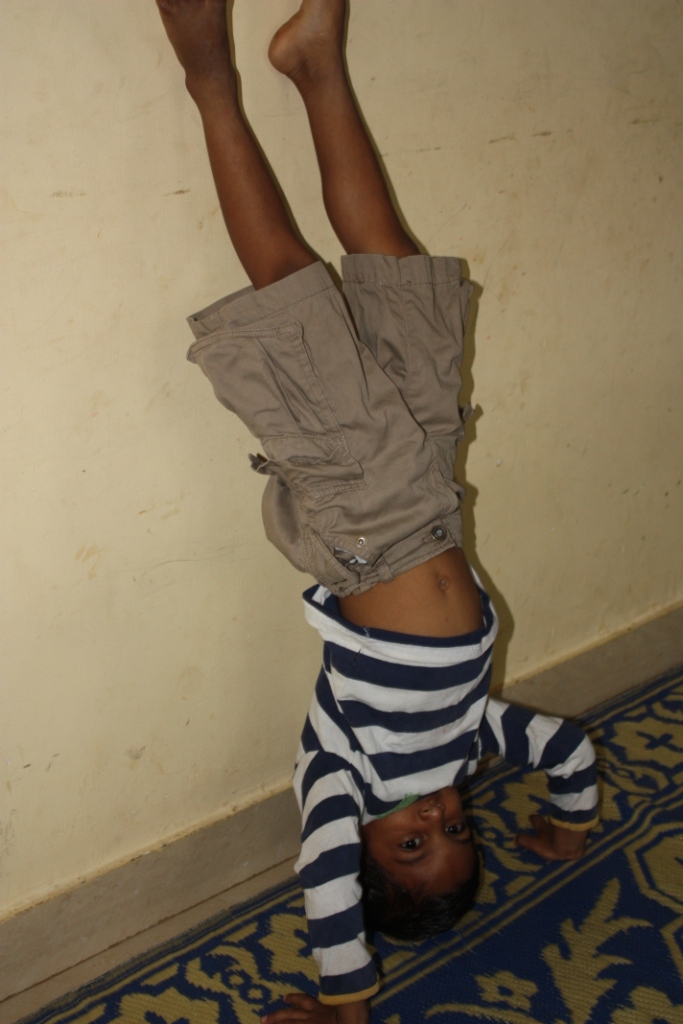
Obviously, this isn’t the aforementioned 4 year old boy, but rather one of the young men who could do a handstand while playing soccer.
5.) Kids are born yogis. Among the course requirements beyond the studio/classroom was charitable teaching for a nonprofit organization. Our group was fortunate to find an orphanage that was interested in having us. However, we were faced with a challenge. Kids weren’t exactly a demographic we were trained to teach–and yoga isn’t an activity one associates with childhood exuberance. We knew we’d have to make it exciting and challenging to keep their interest, but we also didn’t know what their capabilities would be. Furthermore, we had a wide age range with which to contend. Some of the kids went to elementary school and some to college, as well as those grades in between.
It turned out that even the youngest–a boy of four–was ready to take on all that we could throw at him. Before we even began teaching he eagerly showed us his headstand.
6.) Sadhana is most productive when it’s least cerebral. Sadhana is one’s personal practice–away from the studio. We have to report our experience of 50 hours of Sadhana as part of the “beyond the studio” requirement. It took me a while to get into the grove of this. The act of having to think about and record one’s personal practice can definitely be a buzz-kill. There’s a risk of it turning something fun into a bureaucratic chore. Ultimately, I gave up on trying to capture everything. I get the most out of sadhana when I experiment and play with the flow. Sometimes things flow; sometimes they don’t, but there’s a certain degree of playfulness to it. I don’t like either writing down a sequence and practicing it, or writing it down as it comes to me on the mat.
7.) Avoid teacher – student pitfalls. An instructor in any fitness domain is in a challenging position. One needs to push the student to be the best that they can be. Students expect as much. That’s why they come to gyms and studios rather than just working out at home. Being pushy is part of the instructor’s value added. At the same time, one doesn’t want to push a participant into an injury or even let them push themselves into an injury–if you can avoid it.
Here’s a common interaction. A new student comes to class. Testing the water, the teacher tells them to do a task or posture in a more intense way (i.e. lower, faster, deeper, longer, etc.) One of two things can happen. The student either appears to comply or they don’t. If they don’t comply, it could be because they really think they did comply (new students may have horrible body awareness and lack proprioception [it’s a word; look it up.]) It could be because they are scared to try (new students may have very poor understanding of what their bodies are capable of.) Or, it could be because they really can’t (i.e. they may have a skeletal constraint or a past injury, etc.)
If the student doesn’t appear to try, there’s a risk that the teacher will just forget about trying to challenge that person. Call this pitfall #1–giving up. That person may then come to feel ignored or molly-coddled if they do begin to gain bodily awareness and or confidence that they aren’t going to tear in half like wet newspaper. That is, if they haven’t quit by then.
If the student does give a good-faith effort, the teacher is pleased and will continue to try to keep pushing them harder. This works out great for all concerned until eventually the student does begin to run up against their limits. When they do, there’s the risk that the teacher will begin to think they’ve become lazy (Pitfall #2–mistaking the wall for laziness, which reverts to pitfall #1.) If one has a student that doesn’t seemed challenged at first, one can almost believe their potential is limitless, but they will hit walls eventually. It’ll take time for them to get over the walls they can, and some they never will.
8.) People do yoga for many different reasons. Most yoga practitioners are at least vaguely aware why the true believers practice yoga. For the believers, it’s all a road to Samadhi, or liberation from suffering. Of course, there are others who just want to be in better shape and to de-stress, and don’t really believe in Samadhi. Most yogis and yoginis seem to do a good job of tolerating people with other goals, but they don’t necessarily understand each other and their optimal path to where they are going can be quite different.
There are some pretty doctrinaire approaches to yoga out there. Is Power yoga yoga? It has “yoga” right there in the name, but it’s a source of controversy–even though it’s probably among the more yoga-esque of the Western Yoga offshoots. If you’re Bikram Choudhary no one is doing proper yoga unless it’s his patented 26 asana sequence in a room with precise heat and humidity specifications. Some people think you should only practice one sequence until you’ve mastered it, and others believe variety is the spice of life.
I guess the point is to be honest about one’s views on yoga, so that students can make up their own minds about whether one’s objectives align with their own.
9.) Beware of blaming the usual suspects. I have a problem doing certain arm balances. The assumption might be that either a.) I lack the upper body strength, or b.) that I’m afraid of losing balance and falling on my face. Those are the usual problems. I probably wouldn’t be diagnosed with the former based on appearance and performance of other asana (e.g. planks and whatnot), but I might be of the latter. However, countless break-falls done over many years has left me pretty much unafraid of falling from six inches off the floor. The actual culprit? I have one wrist with a poor range of motion (90-degrees of extension on a good day.)
10.) Water in the nose is not nearly as horrible as it would seem. Most people know that there are breathing exercises (pranayama) in Hatha Yoga in addition to the asana. However, some may be unaware that there are a series of cleansing practices (shatkarma or kriya) associated with Hatha Yoga as well. We had to practice some of these, but the only unnerving one we had to learn was jala neti, in which water is poured in one nostril in such a way as to make it come out the other nostril. I imagined it being like the horrible experience of getting a nose-full of sea water while swimming in the ocean. However, I found it entirely harmless. There was no burning, stinging, or feeling waterlogged in the nasal cavity. I will definitely do it again, which is more than can be said for some of the shatkarma practices.
I recently reviewed the book Asana Pranayama Mudra Bandha [APMB] and used this book as a point of comparison, and so further insight into my thoughts on this book can gleaned from that review. This will be fairly short and to the point as the APMB review provided a great deal of detail.
Light on Yoga is the work of world-renowned yogi BKS Iyengar. Iyengar is one of several noted students of T.T. Krishnamacharya, and is celebrated for developing a system using props (belts, blocks, chairs, bolsters, etc.) to achieve correct alignment in yogasanas. You won’t learn about props in this book. Iyengar–at least the Iyengar of the 1960’s–didn’t need props to achieve proper alignment. In fact, he was capable of all manner of what can best be described as contortionism.
This book is a solid reference for Hatha Yoga. It covers all the basic asana (postures), pranayama (breathing), bandha (locks), and a large number of variations and advanced asana. Light on Yoga also has an introduction to the eight limbs of yoga (of which asana and pranayama are but two.) There are also helpful appendices like a glossary, a 300-week course outline, and a list of courses for various ailments. The book doesn’t cover shatkarma (cleansing practices) or mudra (sealing postures) in any depth.
The graphics in this book are beneficial and consist of black and white photos of Iyenger performing the asana with his perfect alignment. There are multiple shots of asana as needed either to demonstrate how to enter / exit the posture or to show the completed posture from multiple angles.
As I suggested in APMB review, my biggest complaint with Light on Yoga is that it doesn’t systematically address contraindications, and we don’t learn what evidence supports various claims of benefits.
I’d recommend this book for Hatha Yoga students and teachers. Its strengths make it a valuable text and its weaknesses can be addressed with other books.

 Your Brain on Yoga by Sat Bir Khalsa















 Tiger Riding for Beginners