

 Crazy Wisdom by Chögyam Trungpa
My rating: 4 of 5 stars
This book collects the lessons of two seminars on crazy wisdom taught by Chögyam Trungpa in 1972. “Crazy Wisdom” is an awakened state of mind that was taught by Padmasambhava – the teacher who introduced Buddhism to Tibet from India. The two seminars consist of six and seven lessons, respectively. These thirteen lessons make up the chapters of the book. Each chapter consists mostly of a text discussion of the topic at hand, but with an interview at the end in which the teacher is asked to clarify points mentioned in the text or that are relevant to the topic under discussion.
The book starts with differentiating two approaches: trying to live up to what one would like to be (i.e. spiritual materialism), and trying to live what one is. While the former is a widespread phenomenon across many religions, it’s dismissed as not all that productive. Along the way, the book discusses how being childlike, ruthless, hopeless, fearless, and in touch with death can all have beneficial effects on the mind. Of course, one has to go about such things in a proscribed manner as it’s emphasized that crazy wisdom and being crazy aren’t identical states (even if they may share similar appearances in some instances.)
Like many books on wisdom, this one offers a mix of profound insight and a sort of double speak used to make profound-sounding but ineffable statements, or logically inconsistent statements, seem true and / or thought-provoking. A philosophizing style is employed rather than narrative style, and so it can read a bit blandly.
There are a few notes and several line-drawn artworks in the Tibetan Buddhist style, but otherwise it’s a straightforward text.
I found this book to be intriguing and to offer interesting food-for-thought. It’s a short book, but may be a bit challenging for a reader without a background in Tibetan Buddhism, or in Buddhism in general. If you’re interested in Vajrayana Buddhism, you should give it a read.
 Modern Buddhism: The Path of Compassion and Wisdom – Volume 1 Sutra by Geshe Kelsang Gyatso
My rating: 4 of 5 stars
This is the first book in a three-volume overview of Buddhism that is available for free (or for the minimum Kindle book price on Amazon.) The book is written by a Tibetan Buddhist scholar-monk, and, therefore, emphasizes the Mahayana approach and specifically that of the Gelug school. (I’m a neophyte, but I don’t think this book goes into so much detail as to be controversial among Tibetan Mahayana Buddhists, but if you are thinking you’ll learn about, say, Zen or Theravadan Vipassana, not so much.) The theme of this volume is an overview of the Limram, which is a sutra describing the path to enlightenment.
The book is divided into four sections. The first offers a broad overview of Buddhism with particular discussion of the Kadam Lamrim (the specific sutra discussed) and Kadampas (which is the name for an individual who pursues practice of the Kadam Lamrim.) The other three sections describe the information needed by an initiate, middling practitioners, and advanced practitioners, respectively.
The section on persons of initial scope (i.e. initiates) emphasizes the need to recognize the limited scope of a human life, to reflect upon one’s imminent death, and to consider the importance of avoiding lower rebirth.
The section on persons of middling scope echoes the four noble truths. They are discussed by way of the four questions: 1.) What one should know? 2.) What one should abandon? 3.) What one should practice? And 4.) What one should attain? In essence, it suggests one understand suffering, the path to is cessation, and that one follow that path.
The largest section, by far, is the portion on individuals of great scope. It is divided into four parts. The first part describes the need to revise one’s approach to love by taking oneself out of the center and practicing loving-compassion for those that one doesn’t know. The second subsection outlines the six perfections (giving, moral discipline, patience, effort, concentration, and wisdom) and the importance of each. The third section is about emptiness and truth. The final section is a brief description of the Lamrim practice.
There are a small number of line drawn illustrations of important figures in the tradition. There are no notations, citations, or ancillary material.
I found this book to offer a concise overview of the subject of Buddhism—specifically from the perspective of the Gelug tradition of Tibetan Buddhism. While there are some historical stories, such as those drawn from the life of Milarepa, the book is not designed to be entertaining reading. It’s a straightforward transmission of knowledge. In that regard it does a fine job, it’s clear and concise.
I’d recommend this book for one who’s interested Tibetan Buddhism, but one should be aware that it’s not a nonsectarian overview of Buddhism as the title might suggest to a reader.
 The Life of Milarepa: A New Translation from the Tibetan by Lobsang P. Lhalungpa
My rating: 5 of 5 stars
Superhero stories can be surprisingly hard to make interesting. The hero’s vast powers make it hard to build obstacles that seriously challenge him. Make no mistake; while this book may be the biography of a Tibetan Buddhist yogi who was born in the eleventh century, it’s a superhero story as well. At various points, the titular character can control the weather, fly, read minds, predict the future, and cover a distance that would take a mere mortal months in just days. Milarepa is basically the entire cast of the X-Men rolled into one monk. [Note: the introduction of 1962 Lobzang Jivaka edition features a series of rants against Westerners that put a bad taste in my mouth early in the reading–basically suggesting the reality of these magic powers should be taken as a given even though the deficient Western mind has trouble wrapping its head around difficult concepts. It made me think I’d probably not like the book, but I’d forgotten it by the time I got around to the end of the book.]
“The Life of Milarepa” is essentially a hero’s journey, which begins with his widowed mother, his sister, and he being taken advantage of by a mean Uncle and Aunt. Milarepa takes up Black Magic to influence the weather so that he can exact revenge. Doing so makes him feel great shame, and puts him on the path of a religious ascetic. After his initial training, he is put through a great series of trials by Marpa, the man who will eventually his guru. Were it not for the encouragement and support from Marpa’s wife, Milarepa would never have made it through the training, and at one point—in fact—he goes away to learn from one of Marpa’s most advanced students because it seems Marpa unwilling to teach him.
Eventually, Milarepa ends up returning to his home and, thereafter, meditating on his own. Here he runs into the aunt and uncle (now separated) who made his family’s life hell after his father died. These elders aren’t the only ones who think Milarepa is a ne’er-do-well. However, most people are too scared of his superpowers to create problems for him, at first. He eventually wanders off and becomes the poorest of ascetics—with not so much as covering for his naked body as he live off nettles.
There are oddities in the book. The Buddhist teachers he studies under both use him as weapon (i.e. his hailstorm magic) as a requirement to taking him on as a student, despite the fact that this will pile onto his Karmic debt (and ostensibly theirs), and it leaves him feeling horrible—as well, it seems, these black magic powers make Marpa hostile to the young man and not take him seriously as a student until the guru receives an omen.
So why does this story turn out to be so satisfying? For one thing, for all his powers, Milarepa is constantly confronting challenges that keep the story tight. (I should again emphasize that this is nominally a work of biography. It just doesn’t read like one because of all the magic and the classic story elements. Few people have such a novel-shaped life. A hagiography is a more apt descriptor but instead of only displaying Milarepa’s good side (boring), this book presumably dances around facts to make a more engrossing product.) While Milarepa could concoct all manner of magic, he mostly doesn’t with the exception of some ESP. After Marpa has taught him, Milarepa deals with people with calm and compassion. (His return home is a little like Alex’s from “A Clockwork Orange” in that people have ill feelings about him because of his past, but at first they are afraid of him. When they discover he can’t defend himself, they start to lay into him.) For another, we can see Milarepa’s growth and we come to respect his intense devotion tremendously as he becomes quite virtuous of the course of the book. While he is a superhero, he’s also an ascetic who denies himself with the utmost of discipline in pursuit of liberation.
I’d highly recommend this book for those who like biographies—especially if you like to learn about Buddhism in the process. In the latter half of the book there are some lessons transmitted through the text as Milarepa interacts with students and other people. Eventually, even his loathsome aunt becomes a student.
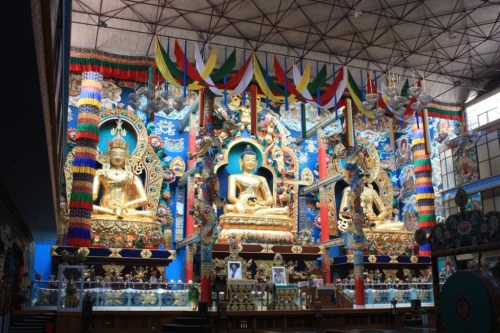
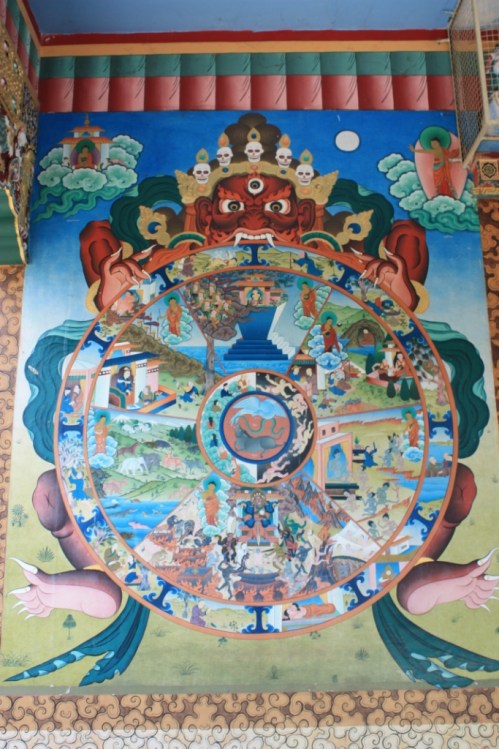
Taken in March of 2014 at Namdroling Monastery in Bylakuppe


Taken on October 30, 2016 at the Buddha Tooth Relic Temple in Singapore
Fudō-Myōō is the name used by Japanese Vajrayana Buddhists for the wrathful deity otherwise known as Acala [the Wisdom King.]
 Sleeping, Dreaming, and Dying: An Exploration of Consciousness by Dalai Lama XIV
My rating: 4 of 5 stars
This book is a product of the 4th Mind & Life Institute Conference that took place over five days in October of 1992 in Dharamsala, India. It reads as a narrated description / transcription of the event. The Mind & Life Institute was established as a dialogue between science and Tibetan Buddhism, and is actively supported by His Holiness the Dalai Lama—who is an important figure in the book, both asking questions of the presenters and offering clarification on Tibetan Buddhist thinking on various points. The exact subject of each conference is different, but the mind is a recurring theme. Which makes sense as Tibetan Buddhist practices of the mind are as advanced as any, and it would be of great benefit to understand them better from a scientific perspective.
As the title suggests, this conference (and the book) deal with three topics: sleeping, dreaming, and dying. This may seem like a case of “one of these things doesn’t belong,” but from the Buddhist perspective on consciousness it’s a sensible enough grouping. One can think of it this way, sleeping and dying are points at which consciousness goes bye-bye. [Although, lucid dreamers retain consciousness in REM sleep, and there are unsubstantiated claims of the ability to maintain consciousness in sleep by extremely advanced practitioners.]
There is some front matter (a forward by the Dalai Lama and an editor’s Introduction) and then eight chapters. The first chapter discusses both the Western and Tibetan perspectives on “the self,” what it is, and whether it is [real or illusory.] This topic seems unrelated to the book’s theme, but it’s a way to develop a common understanding for the rest of the discussion. If participants have different views on what a person is, mentally speaking, and what consciousness is, then it’s easy to talk past each other without even realizing it. The second chapter is an overview of what was known about sleep, principally from the perspective of neuroscience (it should be noted that neuroscience was a fairly fledgling term at that time.) The next three chapters (ch. 3, 4, and 5) are about dreaming. The third chapter is a bit unique. The general approach throughout the book is to give the understanding of science and then to compare and contrast that with Buddhist thinking. However, chapter three’s discussion is led by a proponent of psychoanalysis (i.e. the Freudian approach,) which isn’t so scientific, but is a Western philosophical approach. [Chapter one is also heavily philosophical.]
Chapters four and five delve into the subject of lucid dreaming, which is referred to as dream yoga in the Tibetan Buddhist tradition. For me this was the meat of the subject, and it was the reason that I bought the book. Tibetan practices on lucid dreaming are incomparable, and at this point science’s understanding was beginning to blossoming as well.
The last three chapters are on death, and each offers a different character. The first two emphasize Western views, but in different ways. Chapter six outlines the Christian position on death—a theological rather than scientific understanding. Chapter seven explains the medical community’s view of death. This sounds straight forward, but it’s a much more technical subject than one might imagine. What organ has to stop functioning and for how long before one is actually dead. Besides all the coma patient stories, one may be aware of cases historically in which people were discovered to have been buried alive accidentally due to bad calls by doctors. The last chapter is about near-death experiences. This is an area in which there is a great potential for differing views. While science doesn’t deny that people have all sorts of fascinating experiences such as seeing bright lights at the end of “tunnels” and out-of-body experiences, scientists tend to attribute such events to material causes. [Neuroscientists can now induce out-of-body experiences by zapping a specific part of the brain.]
There are graphics in the form of diagrams and tables in the chapters that are most technical (e.g. chapter two and chapter seven,) but they are used sparingly. There’s an appendix that describes the Mind & Life Institute, as well as a glossary that explains both Tibetan and scientific terms. There are also a few pages of end notes that will help one find related material.
The weakness of this book is clearly its age. The Buddhism probably hasn’t changed much, but the science has changed a lot. Since 1992 there has been a revolution in understanding of the brain due to advances in functional Magnetic Resonance Imaging (fMRI) and other technologies.
However, despite the book’s age, there’s a lot of thought-provoking discussion, which offers plenty of room for both scientists and Buddhists to gain a better understanding of the mind and consciousness. I’d recommend this book for anyone interested in dream yoga / lucid dreaming, or—for that matter—death.



 Tiger Riding for Beginners