
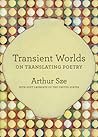
 Transient Worlds: On Translating Poetry by Arthur Sze
My rating: 5 of 5 stars
Publisher Site — Copper Canyon
Release Date: April 14, 2026
Just as people are fond of saying, “the book is always better than the movie,” there is an idea — widely accepted as truism — that goes, “a translation can never be as good as its source poem.” I don’t buy either of those views, but there’s certainly truth to the notion that a poetic translation can never perfectly echo style, tone, sound quality, and meaning at once. Each language is unique, and the more different two languages are the more one has to make decisions about what one will emulate and what one will craft. It’s also true that any translation will represent a drift away from the culture of the original (which is not identical to being worse.) In short, any poetry translation that seeks to be good had better be a work of art unto itself.
The current US Poet Laureate (as of this writing,) Arthur Sze, has written a book to help readers intelligently navigate the troubled waters of poetic translation. Sze certainly has insight, having not only translated Chinese poems himself, but also being Professor Emeritus at the Institute of American Indian Arts, he has multiple cultural lenses with which to view poetry.
This book consists of fifteen chapters exploring poems and poetry excerpts from around the globe — and their translations. The twelve diverse source languages include: Chinese, Navajo, French, Ancient Greek, Hebrew, Danish, and Russian. The original poets include Tao Qian, Guillaume Apollinaire, Homer, Kobayashi Issa, Pablo Neruda, Marina Tsvetaeva, Aime Cesaire, Najwan Darwish, and Mirabai. Many of the chapters include multiple translations, offering the reader a means to see how different translators take to the task. Others offer only a single translation but turn their attention to specific considerations of translation. In one case, there is an interview with the translator. I enjoyed this varied approach to the exploring the topic. It made for a book with zero monotony and many facets.
If you are a poet or a poetry reader who enjoys reading poetry from varied languages or source languages, I’d highly recommend this book.
View all my reviews



 Tiger Riding for Beginners