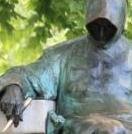
 As I continue to look at variations in consciousness, it occurred to me that poetry writing (or at least pre-writing) often involves an altered state of consciousness. Often, I do an exercise akin to freewriting. Freewriting is an exercise that has been popular for a long time for beating writer’s block. You just write: fast, without judgement, and without concern that you’re taking a reader to any particular place. (It’s somewhat like “brainstorming” in process, but usually solitary and producing sentences or phrases and not bullet-point lists.) The point is to break the grip of self-consciousness and lay waste to the idea that every word has to be pure brilliance to be worthy of your time.
My process begins by quieting my conscious mind, typically with long exhalation breathwork (pranayama.) For those unfamiliar with yogic pranayama or other forms of breathwork, drawing out one’s exhalations (in conjunction with relaxing the body) slows the heart rate and otherwise activates the rest and digest functions of the body. (The curious or dubious can look up “cardiac sinus arrhythmia” or “respiratory sinus arrhythmia,” which is the same thing alternatively labeled by the cause [respiration adjusted] or the effect [heartbeat changes])
After my conscious mind is tranquil, I set pencil to paper and just start writing quickly — without looking back or forward, but just trying to be present with whatever my mind vomits forth. Usually, there is an understandable grammar, but no understandable meaning (at least not beyond the granularity of a phrase.) But building meaning isn’t the point, and I don’t care. Sometimes, I fall into a rhythmic sound quality, but other times I don’t. To give an idea of what the raw feed of this looks like, here’s an example from this morning:
Turn ten, run the nines. I found a fever down the line and could not bend the wall to weep, but heard the conveyor line… beep – beep – beep. Oh, so some fucking wisdom says let live the demons that I dread, but there’s a cold magnolia leaf on the ground and I can hear it skid at the break of dawn, but what sign is that to feel it out. I killed a monk and stole his doubt, but you’ll never blame away the triple frame…
So, it’s a collection of words and phrases that has no discernible meaning collectively. Once and a while, I go through some of these flows of verbiage and underline words, phrases, or ideas that have some spark or merit, and then — if I can — unshuffle and word-cobble until I have a poem.
However, my point in this post isn’t to describe how a poem gets its wings. Instead, it’s to discuss the process by which the consciousness “presents” us with something from out of nowhere. (The conscious mind would claim it “created” it, but I have my doubts. I’ve learned the conscious mind routinely takes credit for many things that are not its doing.)
It’s not like I have an idea (stolen or otherwise) and then I think it through, and then I order those thoughts into an outline. (The usual writing process.) On the contrary, I go to great lengths to make my conscious as quiet as possible as a precursor. I think about the term William James coined, “stream of consciousness” which became a prominent literary device. Is it streaming into consciousness, from consciousness, or through consciousness? Where does it come from?
You might say, “Why worry about where it comes from because it’s a garbage heap?”
But once in a while there are epiphanies and flashes of insight amidst the rubble and dung. Sure, maybe I grant detritus post-hoc gold status, but there’s something there I feel I have yet to understand.
In consciousness, we seem to have awareness of [something] and meta-awareness (i.e. we are aware of what we are aware of [something.]) Sometimes that meta-awareness is a grand and beneficial tool, but sometimes it’s just another word for self-consciousness. Sometimes having a one-track mind is a beautiful thing.
I said that my practice was “akin to freewriting,” and it might seem exactly freewriting, but the main difference is that it’s purposeless. Sure, once and a while I go back through and rag-pick, but mostly I do the practice just to revel in the experience of being completely with whatever words are streaming. The writing and being consciousness of what is surprising me on the page takes enough of my mental faculties that I have none left to be self-conscious.
Who knows where this journey will take me next month? There’s still a lot of territory left in the altered states of consciousness. Fasting, dance, shamanic drumming, tantric sex, psychonautics, etc. Who knows?
Share on Facebook, Twitter, Email, etc.

 The Serious Guide to Joke Writing: How to Say Something Funny about Anything by Sally Holloway



 Tiger Riding for Beginners