Amazon.in Page
It’s the zombie apocalypse in a world brimming with superheroes. Sort of. As is mentioned a couple of times throughout the story, it’s not really zombies as we know them, and there are a few crucial distinctions. But, basically, zombie apocalypse. What matters is that it is a threat that grows to inexorable proportions because it infects efficiently and spreads rapidly, and no one is immune. The threat is increasingly everyone and everywhere. The source is a viral bit of “programming” called the Anti-Life Equation.
This is about as dark as superhero comics get. The heroes that we are used to saving the day experience only victories of a short-lived and pyrrhic nature, while experiencing defeat after defeat. There are no ex machina saviors, at least not that amount to more than a blip in the scheme of things.
I found this story, depressing as it may be, to be intensely suspenseful. Full Disclosure: I also liked the Avengers “Infinity War” movie much more than “Endgame.” It’s not that I necessarily like seeing villains win, but that a story feels more compelling when there is strong and successful opposition and when costs accrue. And credible opposition and true stakes are often missing from superhero comic book stories.
I’d recommend this book for superhero comic book readers.
Amazon.in Page
This volume presents two separate and complete story arcs. The first features the Floronic Man (Jason Woodrue) as the main villain, and it deals heavily in the origins of Swamp Thing and the creature’s struggles to come to grips with who it is and why it experiences the world as it does. The second story makes a shift to a more supernatural threat and shows a Swamp Thing who is more comfortable in its… roots? twigs? foliage? — whatever Swamp Thing has in lieu of skin.
Alan Moore does his usual superb job of creating a clever and satisfying set of tales. Swamp Thing was groundbreaking in its cross-genre mélange of horror, supernatural, eco-fiction, and sci-fi. There is also a certain smartness about the comic. One is led to consider questions of consciousness and humanity’s role in nature through these stories. And solutions are rarely achieved by punching the villain into a stupor. This won’t be for everyone. In some ways, the comic elevates the wise old mentor to the role of hero.
I enjoyed reading this book and would highly recommend it for readers of comic books and graphic novels.
Once upon a midnight dreary, while I pondered, weak and weary,
 Over many a quaint and curious volume of forgotten lore --
 While I nodded, nearly napping, suddenly there came a tapping,
 As of some one gently rapping, rapping at my chamber door.
 "'Tis some visitor," I muttered, "tapping at my chamber door --
  Only this and nothing more."

 Ah, distinctly I remember, it was in the bleak December;
 And each separate dying ember wrought its ghost upon the floor.
 Eagerly I wished the morrow; -- vainly I had sought to borrow
 From my books surcease of sorrow -- sorrow for the lost Lenore --
 For the rare and radiant maiden whom the angels name Lenore --
  Nameless here for evermore.

 And the silken sad uncertain rustling of each purple curtain
 Thrilled me -- filled me with fantastic terrors never felt before;
 So that now, to still the beating of my heart, I stood repeating
 "'Tis some visitor entreating entrance at my chamber door --
 Some late visitor entreating entrance at my chamber door; --
  This it is and nothing more."

 Presently my soul grew stronger; hesitating then no longer,
 "Sir," said I, "or Madam, truly your forgiveness I implore;
 But the fact is I was napping, and so gently you came rapping,
 And so faintly you came tapping, tapping at my chamber door,
 That I scarce was sure I heard you" -- here I opened wide the door; --
  Darkness there and nothing more.

 Deep into that darkness peering, long I stood there wondering, fearing,
 Doubting, dreaming dreams no mortal ever dared to dream before:
 But the silence was unbroken, and the darkness gave no token,
 And the only word there spoken was the whispered word, "Lenore?"
 This I whispered, and an echo murmured back the word, "Lenore!" --
  Merely this and nothing more.

 Back into the chamber turning, all my soul within me burning,
 Soon I heard again a tapping, somewhat louder than before.
 "Surely," said I, "surely that is something at my window lattice;
 Let me see, then, what thereat is, and this mystery explore --
 Let my heart be still a moment, and this mystery explore; --
  'Tis the wind and nothing more."

  Open here I flung the shutter, when, with many a flirt and flutter,
 In there stepped a stately Raven of the saintly days of yore;
 Not the least obeisance made he: not an instant stopped or stayed he;
 But, with mien of lord or lady, perched above my chamber door --
 Perched upon a bust of Pallas just above my chamber door --
  Perched, and sat, and nothing more.

 Then this ebony bird beguiling my sad fancy into smiling,
 By the grave and stern decorum of the countenance it wore,
 "Though thy crest be shorn and shaven, thou," I said, "art sure no craven,
 Ghastly grim and ancient Raven wandering from the Nightly shore --
 Tell me what thy lordly name is on the Night's Plutonian shore!"
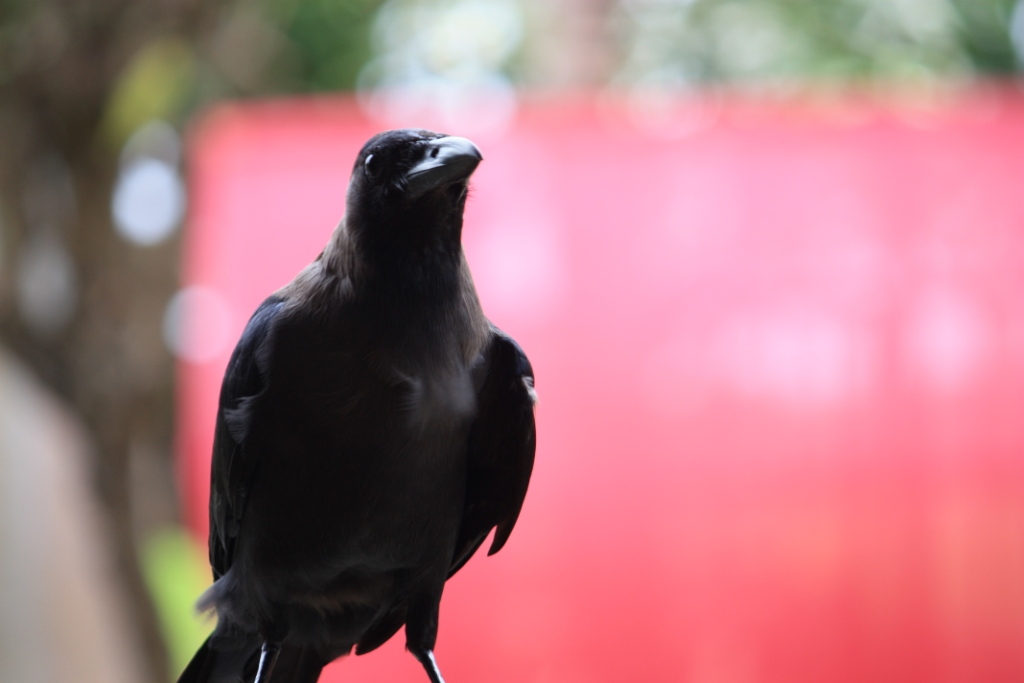
  Quoth the Raven, "Nevermore."

 Much I marvelled this ungainly fowl to hear discourse so plainly,
 Though its answer little meaning -- little relevancy bore;
 For we cannot help agreeing that no living human being
 Ever yet was blessed with seeing bird above his chamber door --
 Bird or beast upon the sculptured bust above his chamber door,
  With such name as "Nevermore."

 But the Raven, sitting lonely on that placid bust, spoke only
 That one word, as if his soul in that one word he did outpour.
 Nothing further then he uttered -- not a feather then he fluttered --
 Till I scarcely more than muttered, "Other friends have flown before --
 On the morrow he will leave me, as my hopes have flown before."
  Then the bird said, "Nevermore."

 Startled at the stillness broken by reply so aptly spoken,
 "Doubtless," said I, "what it utters is its only stock and store,
 Caught from some unhappy master whom unmerciful Disaster
 Followed fast and followed faster till his songs one burden bore --
 Till the dirges of this Hope the melancholy burden bore
  Of 'Never -- nevermore."

 But the Raven still beguiling all my sad soul into smiling,
 Straight I wheeled a cushioned seat in front of bird and bust and door;
 Then, upon the velvet sinking, I betook myself to linking
 Fancy unto fancy, thinking what this ominous bird of yore --
 What this grim, ungainly, ghastly, gaunt, and ominous bird of yore
  Meant in croaking "Nevermore."

 This I sat engaged in guessing, but no syllable expressing
 To the fowl whose fiery eyes now burned into my bosom's core;
 This and more I sat divining, with my head at ease reclining
 On the cushion's velvet lining that the lamp-light gloated o'er,
 But whose velvet violet lining with the lamp-light gloating o'er,
  She shall press, ah, nevermore!

 Then, methought, the air grew denser, perfumed from an unseen censer
 Swung by Seraphim whose foot-falls tinkled on the tufted floor.
 "Wretch," I cried, "thy God hath lent thee -- by these angels he hath sent thee
 Respite -- respite and nepenthe from thy memories of Lenore;
 Quaff, oh quaff this kind nepenthe, and forget this lost Lenore!"
  Quoth the Raven "Nevermore."

 "Prophet!" said I, "thing of evil! -- prophet still, if bird or devil! --
 Whether Tempter sent, or whether tempest tossed thee here ashore,
 Desolate yet all undaunted, on this desert land enchanted --
 On this home by Horror haunted -- tell me truly, I implore --
 Is there -- is there balm in Gilead? -- tell me -- tell me, I implore!"
  Quoth the Raven, "Nevermore."

 "Prophet!" said I, "thing of evil! -- prophet still, if bird or devil!
 By that Heaven that bends above us -- by that God we both adore --
 Tell this soul with sorrow laden if, within the distant Aidenn,
 It shall clasp a sainted maiden whom the angels name Lenore --
 Clasp a rare and radiant maiden whom the angels name Lenore."
 Quoth the Raven, "Nevermore."

 "Be that word our sign of parting, bird or fiend!" I shrieked, upstarting --
 "Get thee back into the tempest and the Night's Plutonian shore!
 Leave no black plume as a token of that lie thy soul hath spoken!
 Leave my loneliness unbroken! -- quit the bust above my door!
 Take thy beak from out my heart, and take thy form from off my door!"
  Quoth the Raven, "Nevermore."

 And the Raven, never flitting, still is sitting, still is sitting
 On the pallid bust of Pallas just above my chamber door;
 And his eyes have all the seeming of a demon's that is dreaming,
 And the lamp-light o'er him streaming throws his shadow on the floor;
 And my soul from out that shadow that lies floating on the floor
  Shall be lifted -- nevermore!
Amazon.in Page
This book is at once a work of eco-fiction, literary fiction, and speculative fiction. The story revolves around a pair of characters whose worldlines become intertwined when the Pacific Trash Vortex is spun out, crashing into the Eastern shore of Taiwan. “Riding” the trash vortex is Atile’i, a member of a remote Pacific Island where second sons (of which he is one) are exiled to the sea to ensure the tiny island’s population doesn’t outstrip its resources. Atile’i is found by Alice, an academic who moved to a rural area of the Eastern shore and who is in an extended period of grieving the loss of her son and [common law] husband. Their union helps them each in the process of finding closure for their respective traumas.
There is a secondary story involving supporting characters, but at its heart, the book is about how an unlikely pair is brought together by environmental factors. That said, the secondary story does offer the reader insight into the indigenous population of Taiwan, a number of tribes whose relation to the island has been overshadowed by both the huge numbers of Chinese immigrants and the various agents of colonization (i.e. Europeans and the Japanese.)
I found this book to be highly readable. It manages to highlight environmental perils without being preachy in a way that detracts from the intensity of the story (and, thus, which reduces the effectiveness as a tool of persuasion.) [This being a line that some other eco-fiction writers have been unable to walk, such that they dissipate the power of story through a need to virtue signal, tribe signal, and finger-point.]
I’d highly recommend this book for readers of literature in translation, eco-fiction, literary fiction, or anyone who likes an interesting story.
Amazon.in Page
Drawing from 70 years of stories, this collection of issues involving the Penguin as Batman’s villain du jour really shows the shifting landscape of comic books over the decades. In the early issues, written with a young audience in mind, the Penguin is a skillful thief, but also kind of goofy, camp, and with not really much menace. By the last issue included, we see the hard edge of psychopathy and the gross deformity of this classic villain.
I was pleasantly surprised with this collection. Often these cobbled together comic collections lack coherent storytelling and feel as cheap and lazy as a sitcom clip show, but this volume shows several satisfying story arcs, and — while there is no overarching arc — it makes for a satisfying read.
I enjoyed reading this collection and seeing, through it, the evolution of comic books.
Amazon.in Page
This volume plays on the spookiness of buffoonery that has made the Joker not only one the most well-known and effective villains of Batman’s rogues’ gallery but in all of comic books. However, while the Joker does play a role in this book, he’s not the villain. Instead, the book employs the popular comic book scenario of having the villain be a version of the hero, a version without moral compunctions or constraints. In this case, the central villain is a demented and mutated version of Batman with Jokeresque qualities, assisted by a Batman who is a bit more malevolent and vengeful, one who goes by the moniker Grim Knight.
How are there multiple versions of Batman? The multiverse, of course. That makes this a sci-fi heavy Batman story. If you like your Batman of the Matt Reeves / Robert Pattinson variety — i.e. in a plausible world, with fully human enemies, and with no freaky supernatural happenings, then this one may not be for you. That said, I don’t think the sci-fi elements detracted from the story, and they did allow for some compelling story elements. Snyder, wisely, avoids a problem that can readily plague sci-fi intense Batman stories, which is reference to (or cameos of) the god-tier DC heroes. (An occurrence that always begs the question, why wouldn’t Superman use his god-like powers to fix this debacle before heading to lunch.)
I enjoyed this story. I especially enjoyed that it wrapped up the narrative arc in a tidy package. It is often the case that comic book volumes end with a speedbump on the way to the next volume. This story felt like the central issue was resolved, while still leaving potential for future stories. I should point out that, with flashbacks and multiple Batmen, it does require one’s full attention while reading, lest one get lost between backstory and the present.
I’d highly recommend this volume for comic book readers.
Amazon.in Page
This is a book about what happens when you hollow out a person of all the complexity of the human condition and idealize them. At the beginning of the story, Dorian Gray is young, attractive, and preternaturally likable in a naïvely innocent kind of way. Almost to the novel’s end, through the magic of a wish made upon a portrait, Gray is still young and beautiful, though that naive innocence cracks under the strain of the impossible bifurcation of man and his soul. The artist, Basil Hallward, and Lord Henry (a man who will become a mutual friend of Gray and Hallward) cannot see Gray as a fully formed human being, but rather see him as an emblem of youth and beauty. But this unnatural ideal cannot hold, and a string of tragic deaths will be left in its wake.
The book is full of clever witticisms, albeit often of a nihilistic nature. These are almost all spoken by Lord Henry, who is the Polonius of the story – but a hipper kind of Polonius than Hamlet‘s. That said, it’s telling that toward the end of the book Gray does some of this epigrammatic philosophizing. (e.g. Such as when Gray tells Hallward, “Each of us has heaven and hell in him…”) One might dismiss this as Gray parroting Lord Henry, but I think that life has defrocked him of his naïveté, and he begins to think in ways that were impossible in his [true] youth.
This is a must-read. It’s interesting, thought-provoking, and well worth the time.
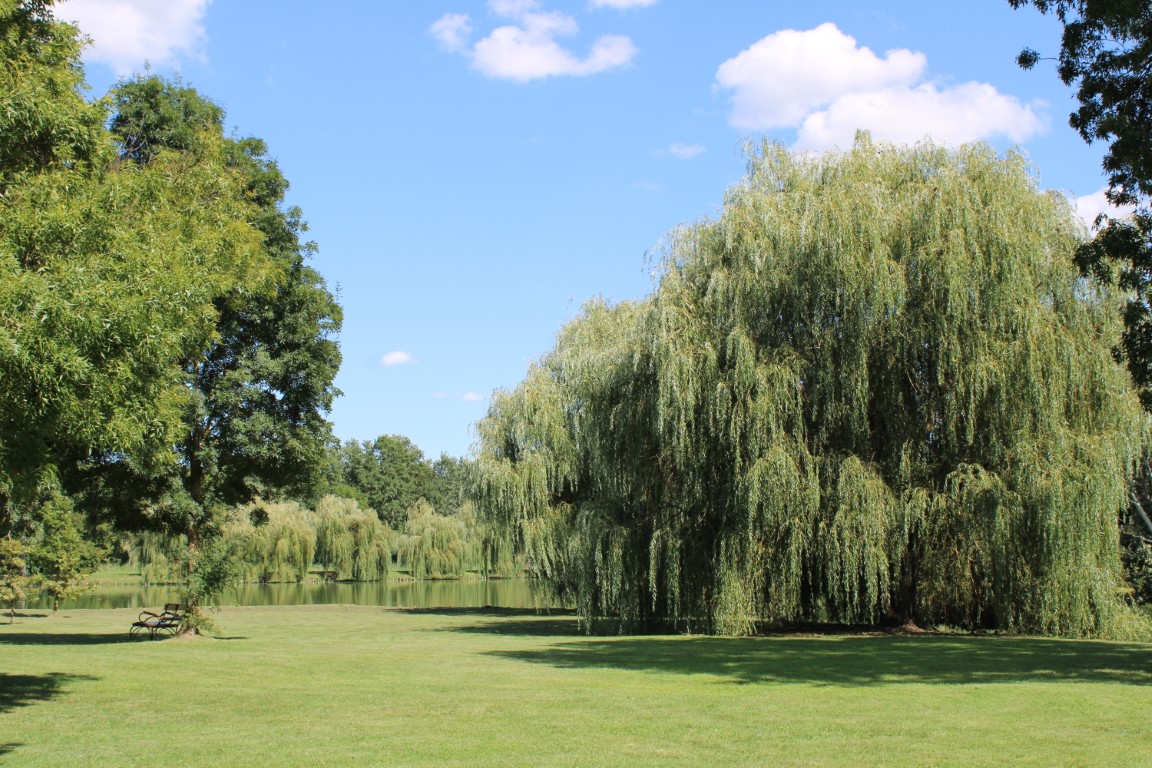
When I see some willows -
 down by water's edge,
  drooping in the moonlight,
 or swaying in the breeze -

I think of Blackwood's tale
 of Danube canoers
  who land upon an isle
  to camp among the willows.

And will the willows that
 I see, mark wicked ground,
  and what will they become
 when darkness makes its stand?

It's such a pretty tree...
 now all but ruined for me,
  and that is story's power
 to sweeten or to sour.
For those interested in reading the referenced story:
Amazon.in Page
In this, the first, eight-issue volume of Sandman, we’re introduced to Morpheus / Dream – the king of dreams & nightmares and one of the seven Endless – when he’s captured by an amateur occultist who was trying to kidnap Death [the (not-so Grim) Reaper and also Dream’s sister.] The story told in “Preludes and Nocturnes” is one of Dream’s captivity, escape, and the subsequent missions to reacquire three magic artifacts that were stolen from him when he was captured (i.e. his bag of sand, helmet, and ruby-like jewel.) That last sentence makes it sound like a far-out fantasy, but it’s really a relatable and human set of stories.
This imaginative and compelling opening volume is at its best with “24 Hours” (as well as “Passengers,” the issue that precedes “24 Hours” and sets up its story.) In “24 Hours,” escaped villain, John Dee, torments the occupants of a smalltown diner by manipulating their reality (a capability he achieved when he came into possession of Dream’s “ruby.”) It’s a story that’s both horrifying and thought-provoking as Dee forces the diners to shed the masks of polite society and get to know the uncensored versions of each other.
Another favorite is the concluding issue, “The Sound of Her Wings,” which is really more of an epilogue, given the story has been brought to a successful and satisfying conclusion with the penultimate issue. “The Sound of Her Wings” introduces us to Death (the kinder, more charismatic, and more articulate Gaiman-version of the Grim Reaper) and shows us interaction between Dream and Death as Dream learns a crucial lesson from his sister.
“Sandman” is an excellent series, and the volume where it all began is no exception. I’d highly recommend it for readers in general.
Amazon.in Page
Over the course of this twelve-chapter story, Batman is pitted against much of his rogues’ gallery, but they’re puppets to a shadowy unknown, a secret villain: Hush. Batman has to do his best detective work, and still faces twist after turn in uncovering this enemy that knows him all too well, who knows all his pressure points. Batman has to battle Killer Croc, Poison Ivy, Harley Quinn, Joker, Scarecrow, and Clayface – and even [due to mind control] Superman and Catwoman, but nothing is as it seems. One might expect that a book this packed with enemies would face problems of pacing and poignancy, but the way the story is crafted (and the villains are effectively subordinated) it’s quite the opposite.
This was one of the smartest comics I’ve read. It’s a mystery that offers foreshadowing, but also false flags. There’s a sub-plot love story between Batman and Catwoman in which the relationship matures, but the question of whether one can ever really trust someone in that world remains ever in the background.
I thought this was one of the best comics I’ve read, and if you’re a Batman fan, it’s definitely a must-read.

 DCeased by Tom Taylor








 Tiger Riding for Beginners