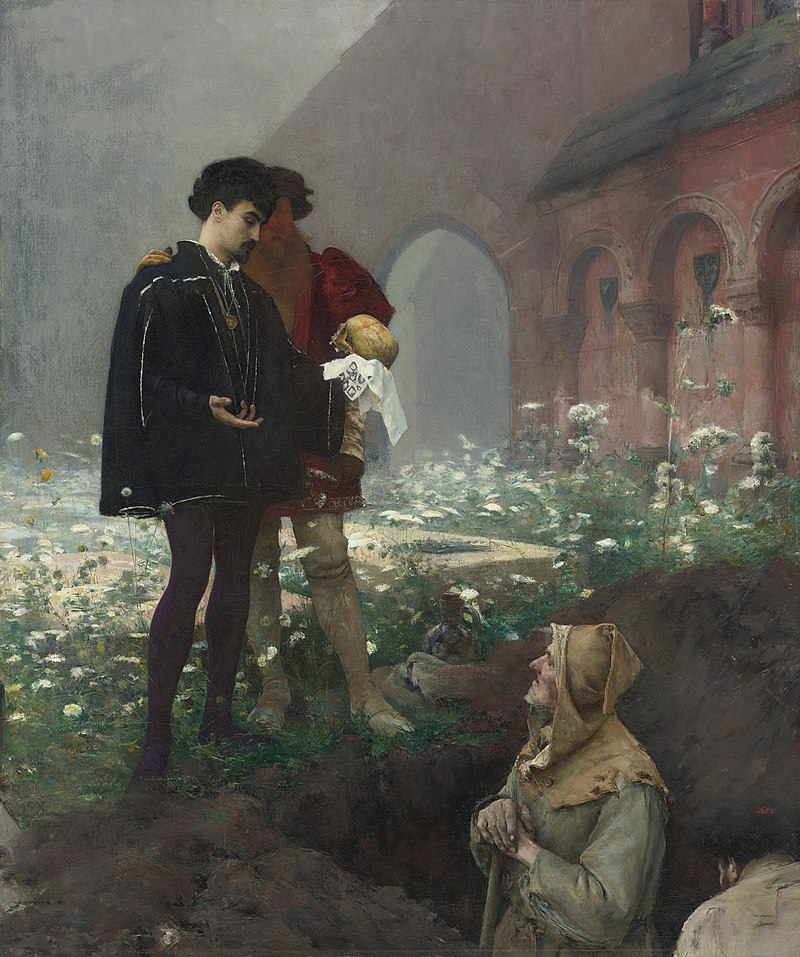
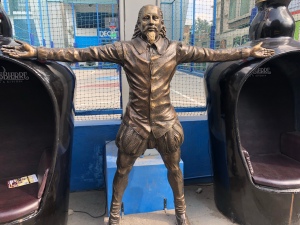
To be, or not to be, that is the question:
Whether 'tis nobler in the mind to suffer
The slings and arrows of outrageous fortune,
Or to take arms against a sea of troubles
And by opposing end them. To die -- to sleep,
No more; and by a sleep to say we end
The heart-ache and the thousand natural shocks
That flesh is heir to: 'tis a consummation
Devoutly to be wish'd. To die, to sleep;
To sleep, perchance to dream -- ay, there's the rub:
For in that sleep of death what dreams may come,
When we have shuffled off this mortal coil,
Must give us pause - there's the respect
That makes calamity of so long life.
For who would bear the whips and scorns of time,
Th' oppressor's wrong, the proud man contumely,
The pangs of dispriz'd love, the law's delay,
The insolence of office, and the spurns
That patient merit of th' unworthy takes,
When he himself might his quietus make
With a bare bodkin? Who would fardels bare,
To grunt and sweat under a weary life,
But that the dread of something after death,
The undiscover'd country, from whose bourn
No traveller returns, puzzles the will,
And makes us rather bear those ills we have
Than fly to others that we know not of?
Thus conscience doth make cowards of us all,
And thus the native hue of resolution
Is sicklied o'er with the pale cast of thought,
And enterprises of great pith and moment
With this regard their currents turn awry
And lose the name of action.
Tag Archives: Shakespearean Tragedy
“Tomorrow and Tomorrow and Tomorrow” [Soliloquy from MACBETH] by William Shakespeare [w/ Audio]
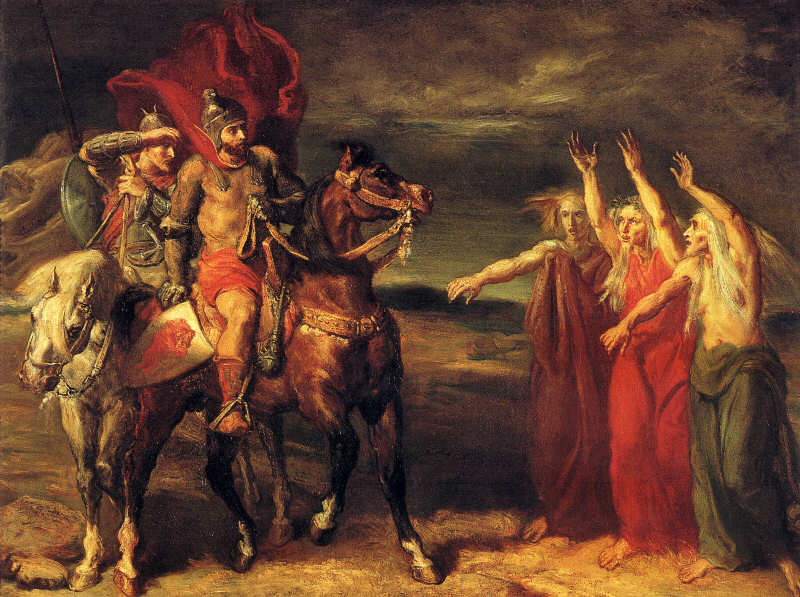
Tomorrow, and tomorrow, and tomorrow,
Creeps in this petty pace from day to day,
To the last syllable of recorded time;
And all our yesterdays have lighted fools
The way to dusty death. Out, out, brief candle!
Life's but a walking shadow, a poor player,
That struts and frets his hour upon the stage,
And then is heard no more. It is a tale
Told by an idiot, full of sound and fury,
Signifying nothing.
Five Wise Lines from Macbeth
“There’s no art to find the mind’s construction in the face.”
Duncan in Act I, Scene 4
“Bloody instructions, which, being taught, return to plague the inventor.”
Macbeth in Act I, Scene 7
“when our actions do not, our fears do make us traitors”
Wife of Macduff in Act IV, Scene 2
“Then the liars and swearers are fools, for there are liars and swearers enough to beat up the honest men and hang them up.”
Son of Macduff in Act IV, Scene 2
“Life ‘s but a walking shadow, a poor player, that struts and frets his hour upon the stage and then is heard no more. It is a tale told by an idiot, full of sound and fury signifying nothing.
Macbeth in Act V, Scene 5
Five Wise Lines from Shakespeare’s Hamlet
We fat all creatures else to fat us and we fat ourselves for maggots… a king may go a progress through the guts of a beggar.”
HamLet to Claudius in Act IV, Sc. 3
One may smile, and smile, and be a villain.
Hamlet to Queen Gertrude in Act I, Sc. 5
I could be bounded in a nutshell and count myself a king of infinite space, were it not that I have bad dreams.
Hamlet to rosencrantz & Guildenstern in Act I, sc. 2
Brevity is the soul of wit.
Polonius to claudius & gertrude in act II, sc. 2
A knavish speech sleeps in a foolish ear.
hamlet to rosencrantz in act IV, Sc. 2
Macbeth Limerick
Shakespeare’s Tragedies, Condensed: Part, The Last

I King Lear too much loved being praised, and too little recognized love. He shunned the daughter he should’ve kept, and held tightly those in need of a shove. II Timon of Athens spent lavishly, but then - in his time of great need - no one would return the favor, so he gave his last coin to watch Athens bleed. III Antony is a love-struck boy, and plots are afoot he can't grasp. He ends in slow suicide by sword, while Cleopatra goes out with an Asp. IV Coriolanus was kind of a jerk, and that's why he was exiled. But he could vanquish all of Rome. Death to the reciprocally reviled!
BOOK REVIEW: Henry IV, Part 2 William Shakespeare
Henry IV, Part 2 by William ShakespeareMy rating: 5 of 5 stars
Amazon.in Page
This continuation of the story of the reign of Henry IV, like the preceding part, is really the story of Prince Hal, the rapscallion who will be transformed into King Henry V. And transformation is the central theme of the play [as it often is in great stories.] In the previous part, we saw that Hal pulled it together to do what needed to be done while the rebellion raged, but here we see a bit of a relapse at the beginning as he returns to Eastcheap to hang out with friends. The Lord Chief Justice has a stern talking to Falstaff to discourage the incorrigible rascal from leading Hal down a destructive path, a talk that fails, causing a defensive Falstaff to take umbrage at the official’s words. However, by the end of the play we see how the weight of the crown forces Hal into what feels like a more permanent changing of ways. To borrow and misapply a Biblical quote: When he became a king, he put the ways of debauchery behind himself.
Prince Hal isn’t the only one who’s changing, Falstaff is also experiencing a transformation, but not so much one of growing up or growing more virtuous, but rather one of getting old. This is seen most vividly when Hal and his past conspirator, Poins, spy on Falstaff and Doll Tearsheet, a tavern girl. Hal breaks the espionage off, realizing there is no adventure to be had in the endeavor.
While Henry IV’s forces (including, prominently, Hal) won the day in the previous play, a peace settlement hasn’t been reached. With Hal out gallivanting and Henry IV having fallen ill, the task of concluding a peace agreement falls to Hal’s brother, Prince John. No-nonsense John receives the rebels’ grievances and says he will see to it that they are all rectified, and then (when their guard has fallen,) he tells them that there is still the matter of the rebellion for which they will have to be put to death. Which they are.
The play climaxes with Henry IV on his deathbed. Hal goes in to visit him, and mistakes the King’s feeble vital signs for death. Overwhelmed not only with grief, but also with an anger at the very crown for subjecting his father to more stress than the old man could bear, Hal takes the crown and walks off in dread contemplation. When the King revives and sees the crown is gone, he questions his men as to where it’s gone, and they say Hal must have it as he was sitting with Henry IV the last any of them knew. Henry IV is outraged that his son should care so much for the crown and so little for father that he’s not willing to wait until the old man’s death to abscond with the crown. When Hal is summoned, Henry IV tells his son as much via more extensive and eloquent comments. When the King completes his rebuke of Hal, Hal responds by saying that it’s not the case at all. Hal refutes that he is eager to be the King, and instead sees the crown as a kind of enemy that he is nonetheless fated to confront. The King is happy with Hal’s articulate explanation, and father and son are on good terms when Henry IV dies – this time for real.
The play reaches resolution when Henry V’s state of mind is revealed. This can be seen vis-à-vis two characters. First, the Lord Chief Justice is afraid Henry V may have an axe to grind about the senior official’s attempts, on behalf of Henry IV, to rein in Hal (including pressuring Falstaff.) Second, Falstaff takes it as a given that his position will be vastly elevated by his old drinking buddy’s rise to King. It turns out that both men are wrong in their assumptions. The newly matured Henry V is gracious to the Lord Chief Justice, and makes a show of turning Falstaff away.
This play is sometimes considered the penultimate of what has been called the Henriad, and so the story bleeds into the next, “Henry V.” It’s definitely a work that should be read by those interested in Shakespeare’s histories.
View all my reviews
BOOK REVIEW: Coriolanus by William Shakespeare
Coriolanus by William Shakespeare
My rating: 5 of 5 stars
Caius Marcius Coriolanus is a brilliant General, and when war is afoot, he’s beloved by his Roman countrymen. However, in times of peace, he’s kind of cantankerous, thinking that people who don’t bleed for their nation should shut their pie-holes and thank their lucky stars for whatever they get in life. This latter fact puts him in conflict with both Rome’s political elite and its commoners. The play opens on this very conflict as rioting citizens are complaining about how the State’s grain silos are full while the rank-and-file are suffering. One gentleman (a friend of Coriolanus,) Menenius, tries to calm the rabble by listening and offering reasoned discussion on the issue. Coriolanus, alternatively, throws fuel on the fire by (and I paraphrase and oversimplify here) telling folks that if they want to get paid, they should join the army.
Soon, Coriolanus is off to war with his arch-enemy, Tullus Aufidius — who is also a great General, but for for the competing state of Volsci. Coriolanus is successful in battle, and uses the merit gained him to successfully be elected Consul. Of course, adversaries tire of being shut down because they aren’t all war heroes, and so conflict escalates. Eventually, the Romans run Coriolanus off, sending him into exile. Except for Coriolanus’s closest friends and his family, all of Rome is pleased to see him go.
But then Coriolanus shows up in Volsci and goes to see Tullus Aufidius. He tells his former enemy that one option would be for the Volscian General to kill his old foe where he stands, but alternatively, if they partnered together, they could easily sack Rome. Aufidius and the Volscians go along with this deal, and soon these great Generals have fought their way up to Rome’s gates. Rome sends three waves of envoys to talk Coriolanus out of burning down Rome. The first two envoys, the Consul Cominius and his old friend Senator Menenius, fail completely. The third wave is Coriolanus’s family and his dear mother, with an eloquent speech, succeeds where the others failed.
And now the Romans are happy, but the Volscians… not so much. In particular, Aufidius is seething because he feels he’s been betrayed. Coriolanus tries to tell the Volscian leaders that, “Look, I got you this far, now you can write a treaty on favorable terms, and Rome is no longer going to look down on you.” But Aufidius still feels that he’s been used and cast aside cheaply. So, he stabs Coriolanus.
This is one of Shakespeare’s last, if not his very last, tragedy. It’s fascinating to consider how his slate of tragedies unfolded. “Titus Andronicus” is generally not regarded as highly as the others because of its savagery – which at the time (and even today) was considered a bit over the top. I will say that I enjoyed the visceral intensity of “Titus Andronicus,” but won’t deny it was a bit bonkers in terms of its brutality. Toward the middle of his career, one has Shakespeare’s best-known and most warmly-regarded tragedies, e.g. “Hamlet,” “Othello,” “Macbeth,” etc. that are not as harsh as “Titus Andronicus” but are tragedies for more than the main character. The last few tragedies are much more personal in nature: (i.e. “Timon of Athens,” “Antony & Cleopatra,” and “Coriolanus.”) Obviously, a lot of people die off stage as Coriolanus works out his revenge plot on the way to Rome, but as far as on-stage / speaking characters, Coriolanus is the sole victim. I don’t know whether this has anything to do with a lesson in “less can be more” or if it’s just how the dice fell in Shakespeare’s writing, but it does make one wonder. (Like many of Shakespeare’s tragedies, this one is based on recorded history, and so that certainly is a factor in the number of deaths. However, it also raises the secondary question of why various projects held interest to the Bard when they did.) I will say these last plays aren’t as gripping the one’s in the middle, but they are never-the-less sound stories.
Like all Shakespeare, this is a must read.
BOOK REVIEW: Antony & Cleopatra by William Shakespeare
Antony and Cleopatra by William Shakespeare
My rating: 5 of 5 stars
This is Shakespeare’s telling of the tragic love story of Mark Antony and Cleopatra. Mark Antony was one-third of a triumvirate (along with Octavius Caesar and Lepidus) ruling Roman territories. Cleopatra is the queen of Egypt. The couple carries out an intense love affair despite the fact that Antony is legally wed to two other women over the course of the play. Early in the play we learn that his first wife, Fulvia, has died and that she was part of a rebellion against Octavius. Hanging out in Egypt, playing kissy-face with Cleopatra, Antony is largely oblivious to events in Rome. Fulvia’s death would be a boon to the love affair, but shortly later [when Antony makes a trip to Rome to deal with Roman affairs, including the campaign against Sextus Pompey,] he ends up marrying Octavia – Octavius’s sister. This marriage is explicitly made to re-cement a growing rift in the triumvirate [and it’s probably also hoped that it might keep Antony from living in Egypt in his own little world.]
While Antony has been accused of being out of touch, he does become irate when Octavius unilaterally decides to renege on a peace treaty with Sextus Pompey. In conjunction with the removal of Lepidus from the triumvirate, being left out of the decision to fight Pompey triggers Antony to take his portion of the Roman lands [the Eastern portion] and jointly rule them with Cleopatra in conjunction with her Egyptian lands. Of course, this brings Antony head-to-head with Octavius. The Battle of Actium, which was fought at sea [though Antony is strongly advised he would be much better off strategically to fight on land,] is a major event in the story. The battle is a disaster for Antony and Cleopatra. The latter prematurely withdraws her fleet, Antony follows, letting his naval forces collapse and the battle is decisively handed to Octavius.
Antony is enraged both by Cleopatra’s apparent betrayal and by self-loathing over his own decision not to fight to the bitter end. Still, his love is so intense that he quickly makes up with Cleopatra even though it appears that he caught her in the act of seriously mulling over Octavius’s offer [delivered via messenger] for a deal whereby she would give up Antony and be spared.
Antony is again enraged when he loses the battle on land, believing he’s been betrayed by Cleopatra once more. Still, he can’t help but be moved when he is told that Cleopatra has died. In fact, she is alive at that point. It turns out that Antony being told that Cleopatra is dead was an ill-considered scheme by Cleopatra to win back Antony’s affections.
This brings us to the most frequently discussed feature of this play, the character of Cleopatra. She is often referred to as Shakespeare’s most well-rounded and intriguing female character. This is saying a lot because Shakespeare has some clever and courageous women among his characters. [True, he also has a number of female characters that serve only as victims, love interests, or some combination thereof.] Probably part of this admiration can be chalked up to the fact that the Egyptian queen is the only female character who has true agency – independent of a father, a husband, a brother, a king, or a fiancé. However, it’s also got to do with the fact that Cleopatra manages to combine the ‘Do you think I’m pretty?’ vanity and petulance of a shallow teenage girl with the ‘Ready my battle fleet!’ authority of a commander. She is both in one package, and people [apparently] find her convincingly so. Mark Antony is also a mish-mash of the loyal and virtuous leader we knew from Julius Caesar but dulled by being smitten and lovelorn. [One event that stands out as showing Antony’s character is when he has the wealth of a traitorous man, Enobarbus, forwarded home to him. It can’t fully be determined whether this is an act of pure virtue or a clever screw-you. If the latter, it worked splendidly as Enobarbus is crippled with regret for shifting sides to join Octavius.]
At any rate, Cleopatra’s plot to endear herself to Antony by making him feel her loss fails utterly. Having been definitively routed by Octavius by sea and by land, and now believing his true love is dead, Antony mortally wounds himself in an attempted suicide. [After failing to get a subordinate to do it for him – one of whom commits suicide himself to be freed of the obligation of killing Antony.] The play ends with Cleopatra’s own dramatic suicide by asp. It should be noted that she kills herself not so much because her poorly conceived plan contributed to Antony’s death, but more because she can’t take the idea of being paraded through the streets of Rome and being subjected to the imagined barbs of Octavia –Antony’s legal wife. [At least there is a great deal of explicit discussion of this fear of humiliation, and not so much of regret.]
This was one of Shakespeare’s last tragedies. For many it is one of his most beloved [though I’d put it more in the middle of the pack.] Still, it’s a great read, and I particularly enjoyed the latter acts.
BOOK REVIEW: Timon of Athens by William Shakespeare
Timon of Athens by William Shakespeare
My rating: 5 of 5 stars
This is a tragic take on a premise similar to that of “The Merchant of Venice.” That is, there is a gentleman who is generous to a fault — and much beloved because of it — who ends up suffering for it. [It’s also a bit like the “Oedipus” trilogy except that, instead of the discovery of unintended incest that sets the lead character walking the wilderness, it’s Timon’s discovery that he isn’t as rich in friendship as he’d thought.] In “Timon of Athens,” the lead character (Timon) is going about business as usual (i.e. being a patron to artists, lending to those in need, and holding banquets) when debt collectors begin to gather at his gate.
At first, Timon is unconcerned. Surely, his friends will help him get through this rough patch, just as he has helped so many of them over the years. However, when he sends his servant out to borrow what he needs to get back in the black, he faces rejection after rejection. Eventually, it hits Timon like a hammer that the only reason he ever got any love was because he was always supporting, feeding, and purchasing the products of Athenians. This realization hastens a sea change in Timon’s attitude. Timon decides to hold one more “banquet” to which he invites those he’s been good to and who’ve not offered the slightest reciprocity. At the banquet, the dishes are uncovered to reveal stones in water. Timon then gives the assembled crowd a piece of his mind. Then, Timon takes off to live in a cave in the woods – shunning contact with humanity.
One intriguing character is Apemantus, who is a Cynic philosopher. [Cynicism was a school of philosophy that was largely ascetic, nature-oriented, and which rejected many of humanity’s norms and values (e.g. valuing comfort and wealth) as anathema to a good life.] Apemantus features in the first part of the story, insulting both Timon and his guests, but also serving as a harbinger of what’s to come when he explains that these sycophants only associate with Timon because of what he does for them. In the second half, Apemantus visits Timon in the latter’s cave and – among other insults – accuses Timon of being a copycat by adopting Apemantus’s way of life.
Living in the woods, Timon stumbles onto a cave of gold. While he could take this money and return to his previous life, that path holds no allure to him. He has no interest in the money. When news of this discovery circulates, people come to the woods to seek Timon’s good favor only to be rebuffed. Alcibiades, a military man who was also wronged by Athens and who now promises to destroy the city, is given gold. Also, Timon gives some money to a couple of prostitutes so that they can go spread venereal disease among the Athenian population. The painter, the poet, and the senators who come to Timon are cursed and sent away. Even Timon’s servant, Flavius, is told to go away, although he is tolerated when it becomes clear that he is – in fact – an honest man who never sought anything more than his just recompense for virtuous service.
It’s generally believed that this play wasn’t a completed work, but rather a work in progress. The pacing at the end does become a bit abrupt, but it’s hard to know for certain. It’s also the case that some points could use fleshing out – notably the discovered gold which gives the latter bit of the play some drama but which also strains credulity. As Shakespeare’s tragedies go, this one is at the other end of the spectrum from “Titus Andronicus” in terms of bloodiness, which is to say it isn’t at all violent. We don’t see Timon’s death but only hear about the discovered grave, and otherwise the soldier who Alcibiades tries to save is the only other fatality of note. There are some critics who don’t even classify this work as a tragedy, but rather as a problem play.
It’s a simple story, but is potent in that it shows such a clear and definite character change. While it’s not one of Shakespeare’s more popular works, it’s definitely worth a read.