POEM: Skipping Stones

I’ve skipped stones —
flat stones with rounded edges,
side slung with a snapping twist of torso,
watching the bounce – bounce – bounce of bounding rock.

Choosing a stone,
rolling it in one’s palm,
feeling its heft;
that’s where the skip is made,
in quiet contemplation of the right rock.

POEM: Cave Days

Stars framed by the dropped rock chasm in the cave roof.

A smoky man and smoky woman sit,

staring up at that rhomboidal field of stars —

a window to the infinite.

They can’t imagine by what means the picture has changed,

when they awake in the middle of the night.

But neither can they grasp how tongues of flame eat wood and glow heat,

and yet they’ve learned to spark fire.

Springtime Haiku

breezy days
cool air weaves its way
through the pines


birds abound,
passing through again,
heading home


the spring thaw
muddy ground squishes
underfoot


dripping leaves,
patter of bulbous rain;
din of spring


color bursts,
fatal assault upon
dreary days

POEM: The Theater of Heaven & Hell

Heaven and hell are filmed

on a lot inside the skull.

Not shot on location,

nor before a live studio audience.

Only one can be shot at a time —

heaven, or hell.

But the sets and props

always lay about

for rapid re-staging.

POEM: One Life at a Time

The man on a metaphorical soapbox said, “Aren’t you concerned about the afterlife?”

I replied, “My hands are full with the duringlife.”

Of course, nobody thinks about the beforelife,

because that requires acknowledging your parents made a bi-backed beast.

[Not you. You’re a single-backed beast in this story.]


BOOK REVIEW: Sonnets by Sri Aurobindo

SonnetsSonnets by Sri Aurobindo
My rating: 5 of 5 stars

Amazon page


This booklet collects together the 88 sonnets written by Sri Aurobindo. Aurobindo was a guru who set up his ashram in Pondicherry because he was on the lam from the Brits, and Pondicherry was under French control at the time. Sri Aurobindo is a karma yogi (yogi of action and good works) who – together with a partner who the community came to call “Mother” – set up Auroville with the intention of making it a utopia.

The eighty-eight sonnets are arranged in two parts. The first seventy-four were written in the 1930s and 40s, and part II consists of 14 sonnets that were written between 1898 and 1909. The sonnets of the first part are more mystical and also more stream of consciousness. The poems of Part I use vivid language, but aren’t always easy to follow – if one is seeking a coherent meaning from each. The sonnets of part II are less sophisticated (and more easily interpreted) and feature a degree of angst that is completely absent in the latter poems (latter chronologically, earlier in the volume.) The sonnets presented are in varying styles. While they are all fourteen lines of pentameter, the rhyme scheme varies.

At the end of the book there are notes on the collection as a whole, as well as short notes on individual poems. There is also a short section in the back that shows a few of the poems under edits so that one can gain a little insight into the poet’s sausage-making process.

I found these poems intriguing to read. As I suggested, they aren’t always easy to interpret but they have a thought-provoking spirituality to them as well as some beautiful use of language. One needn’t necessarily have an interest in Sri Aurobindo to enjoy the poems, although they are overwhelmingly of a mystical / spiritual nature.

View all my reviews

POEM: Red Sun over Tamil Nadu

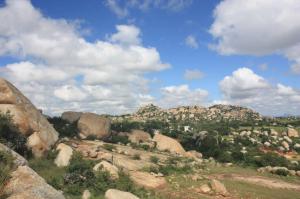
over the boulder fields, and the

stubbled but glassy rice paddies

rises a red ball, the dawning sun

farmers wade, lungi to their knees

bending to plant as the steam rises

day’s just begun, yet needs a breeze

Five Haiku

frost on grass
early morning chill
felt through eyes

wave wall warps,
becoming tubular
surf crashes

mountains turn
to smooth, round boulders,
then to pebbles

lost ruins
a temple overgrown,
recycled

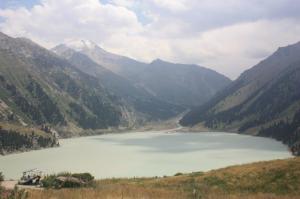
slate gray lake
will be turquoise in time
new eyes, new lake


Taken in August of 2019 at Big Almaty Lake

POEM: Divining Meaning

Imagine standing on the train platform,

listening to the distant approaching train,

and you hear a voice say —

unprovoked —

“Don’t worry, I’m not going to shove you.”

I predict you would take two steps back before you try to divine meaning.

And when that speaker objects, saying,

“Brother, you misheard me. I said I’m NOT going to shove you in front of the train.”

He’ll not have improved his credibility through clarity of negation,

especially if he gently lays a fraternal hand upon your shoulder.

It’s like being told to not think of a white bear.

An inseparable seed of murder is sewn into those words.

POEM: Tokyo Noir

Neon animates a puddle
long after trains have quit.
It seems quiet and abandoned,
excepting those who flit
between afterhours rendezvous
where sake cups go “clink.”
And a bare-chested yakuza
gleams with glistening ink.
An urgent rapping at his door
interrupts the spring sale,
granting coitus interruptus
he ‘s too few fingers to fail.