
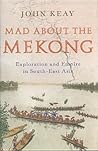
 Mad About The Mekong: Exploration and Empire in South East Asia by John Keay
My rating: 4 of 5 stars
Publisher’s Site
This book is largely, but not exclusively, an accounting of the Mekong Exploration Commission’s two-year (1866-1868) expedition of the Mekong River. The French undertook this expedition in the expectation that the Mekong, like other of the world’s major rivers, would allow ocean-going ships to traverse deep inland — possibly even up into Yunnan, China. The explorers were quickly disabused of this notion, but they relentlessly kept going – despite suffering from disease and the exhaustion of a trip that involved a lot more portaging and other intense physical activities than they’d hoped for.
As I mentioned, Keay doesn’t stick purely to description of the activities of these nineteenth century explorers. Along the way he also brings in fascinating stories from other periods as well as discussion of what the river is like (e.g. its ecology, infrastructure, role in geopolitics, etc.) these days. So, while it would be excessive to call the book a history of the Mekong, it is in some regards — albeit the highlights reel. Some of the diversions were among my favorite parts of the book. Perhaps my favorite was the story of Tony Poe, whose story is said to be the model for Col. Kurtz of Apocalypse Now. I’d long heard that that movie was based on Joseph Conrad’s Heart of Darkness, and it is (the name “Kurtz” is clearly from Conrad’s novella, though Poe’s occupation more closely mirrors the Col. Kurtz character played by Marlon Brando.)
While the book sometimes shines the light more broadly than he Mekong Exploration Commission Expedition, it also narrows its focus much of the way, putting the expedition’s most colorful character, Francis Garnier, front and center. Garnier was not only the most intriguing member of the leadership, he also led the group to what was the end of the line for the expedition, deep in China, when the Captain, Ernest Doudart de Lagree, became incapacitated by disease.
If you’re interested in history, travel, or exploration, I’d recommend this book.
View all my reviews
















 Tiger Riding for Beginners