DAILY PHOTO: Hanuman

Taken November 2, 2013 at Hampi.

Taken November 2, 2013 at Hampi.

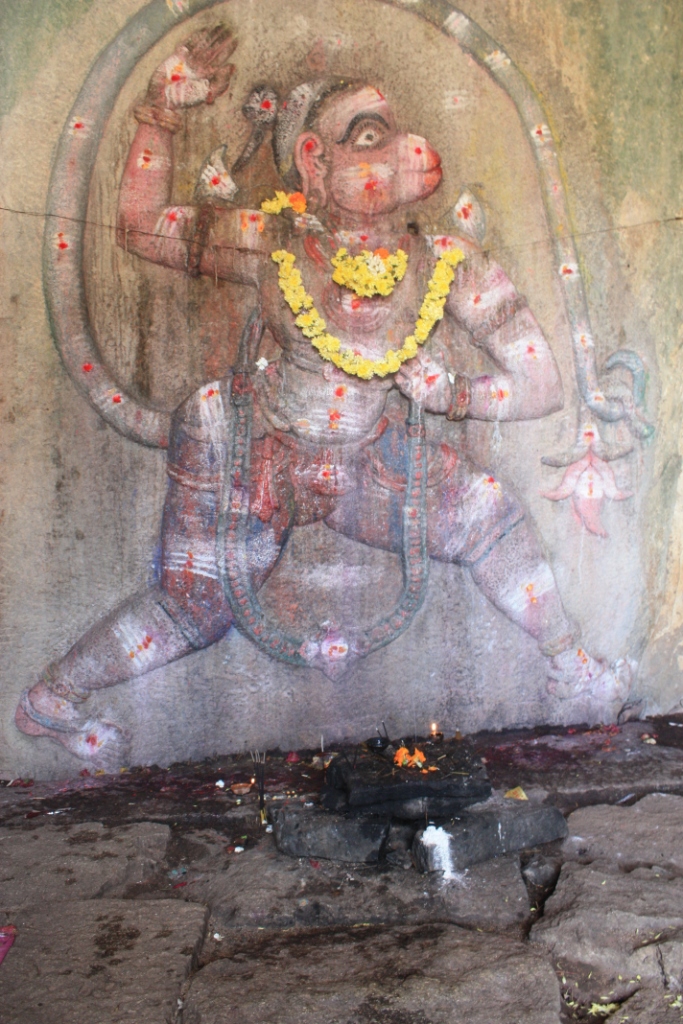
Among the many devotees of this Hindu deity are wrestlers, who admire the monkey-god for his reputed strength. In Rama’s war against Ravana, he was said to have picked up a mountain and carried it a great distance, which is pretty strong.

He’s not whimsical and mischievous like Sun Wukong, the Taoist monkey-king (who also has god-like powers), but some believe that Sun Wukong’s myth was partially influenced by Hanuman’s myth. (Of course, the more irreverent and anti-authoritarian Taoists had a different take than the caste-conscious Hindus. (Whimsicality and mischievousness are considered more virtuous among the former than the latter.)

This Hanuman temple is a small, stone-block affair abutting a giant boulder on the trail from Hampi Bazaar to Achyutaraya temple. As you can see, it still has local devotees.

DAILY PHOTO: Tiny Temple and Wind-blown Trees

Taken November 3, 2013 at Hampi.

Taken November 3, 2013 at Hampi.

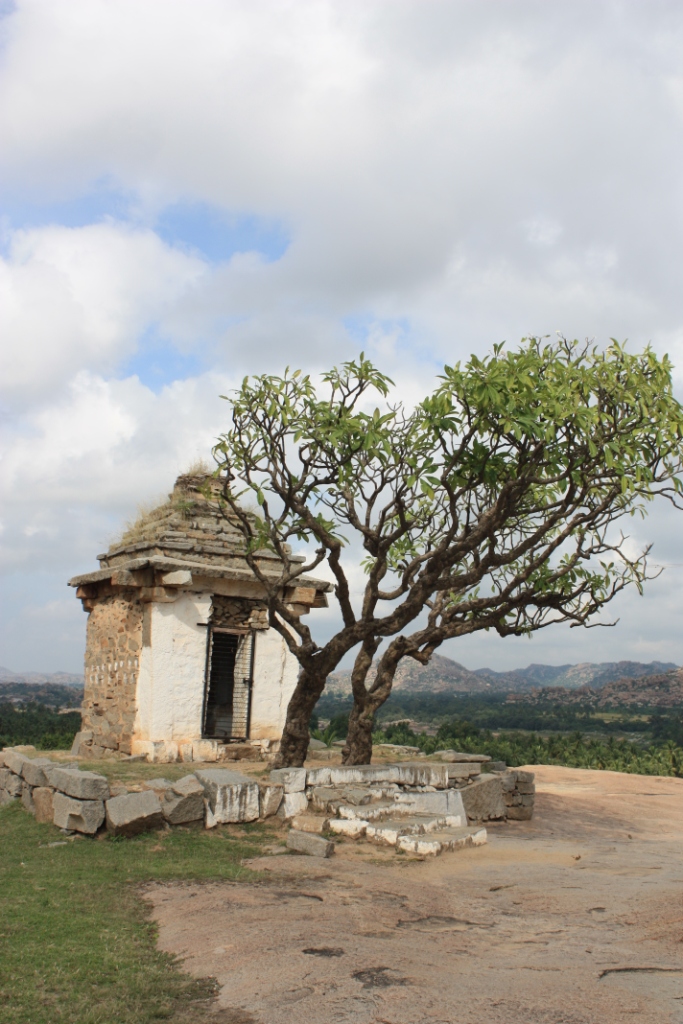
These trees, raising like hands out of fresh, graveyard soil in front of this tiny temple really captured my imagination. It would probably be a better picture in low light, when the creepiness of the scene could really root around in your brain–but I took what I could get.  There were a couple of places around Hampi that I thought would make the perfect setting for horror, and this was one. Another was the banyan tree that had many-colored satchets of rock tied to hang from the tree’s drooping roots.

This picture is taken on top of the hill that overlooks Virupaksha temple, not far from the Ganesh temple.

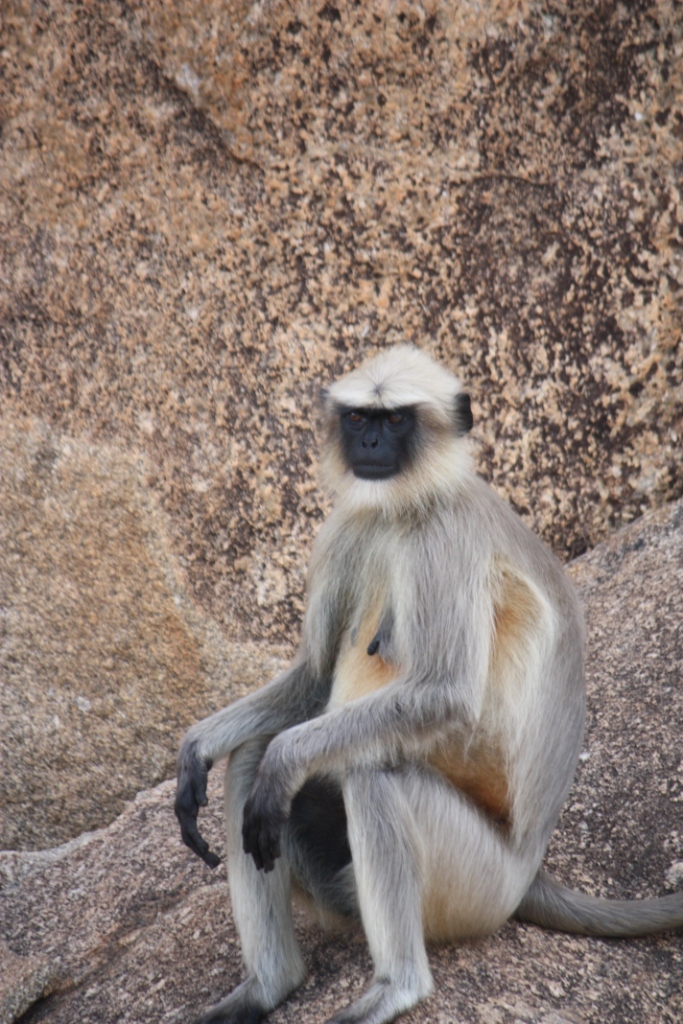
DAILY PHOTO: Gray Langur Watchmonkey

Taken Nov 3, 2013 at Hampi

Taken Nov 3, 2013 at Hampi

Gazing into the distance

he renders his assistance

to the mischievous monkeys–

making him a monkey flunky

A watchman of the langur pranks

yet not a part of their prankish ranks

He screeches warnings now and then

on sight of broom-wielding women

He neither seeks nor needs praise

just the occasional banana raise

He does it not for power or glory

just the occasional funny story

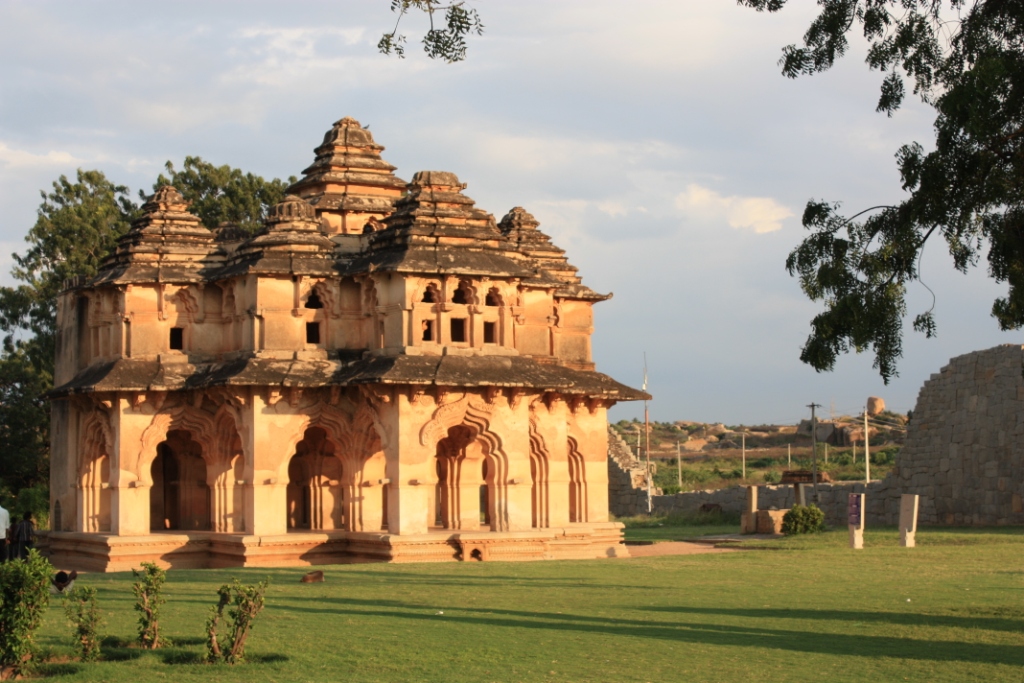
DAILY PHOTO: Lotus Mahal

Taken November 2, 2013 at Hampi

Taken November 2, 2013 at Hampi

The Lotus Mahal is one of the most popular attractions at Hampi. It’s atypical in that it’s built, in part, in the Indo-Islamic style (note: the arches.) (Hampi [Vijayanagar] was the capital of a Hindu kingdom that was defeated by a confederation of Islamic states. ) While this pavilion is often referred to as the “Lotus Temple,” it was believed to be either a rest-house for visiting royalty or the queen’s recreational building–but not a religious building of any sort. 

We got there with good timing. The beige-pink lime mortar seems to glow in the low, afternoon sunlight.  

The Lotus Mahal is located in the Zenana Enclosure with the Elephant Stables. 

DAILY PHOTO: Black Marble Pillars of Hazara Rama Temple

Taken November 2, 2013 at Hampi.

Taken November 2, 2013 at Hampi.

There’s a good chance that Hazara Rama temple isn’t even mentioned in your guidebook. It’s on the loop that includes the Queen’s Bath, the Mahanavami Dibba, the Lotus temple, and the Elephant Stables, but it would be easy to dismiss as lesser ruins if you’re traveling by yourself. This would be a mistake. This small temple has some of the most impressive friezes and carvings at Hampi. This was the King’s own personal temple.

The centerpiece of the temple are four black marble pillars. While black marble can be seen commonly enough at sites in other parts of India (e.g. Agra), it’s a rare building material here. In fact, these pillars were the only use of black marble that I remember seeing at Hampi.  The marble holds the carved images better than the sedimentary stone that is most common at Hampi.

Experts say the most prized sight at Hazara Rama are the friezes of Vishnu as Buddha, which are apparently quite rare.

Out front.

Out front.

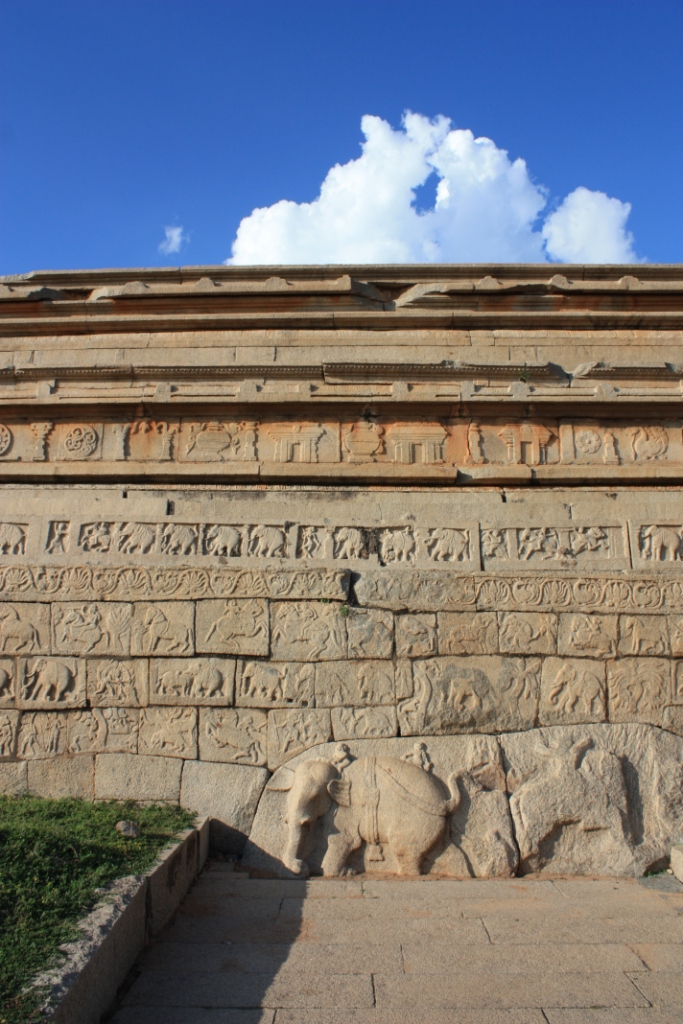
DAILY PHOTO: Mahanavami Dibba

Taken November 3, 2013 at Hampi

Taken November 2, 2013 at Hampi

The Mahanavami Dibba was a monument built to honor Emperor Krishnadevaraya’s win over the state of Kalinga. (I believe he had it built himself. The arrogance of emperors knows no bounds.) At a little over 20 foot tall, it’s the highest structure in the Royal Enclosure, and offers a nice view of the palace ruins as well as  the boulder mountains of the surrounding countryside. The sides of the platform are covered in friezes in which elephants play heavily, but also dancing-girls and hunting scenes.  We had great skies for our visit.

The Royal Center is part of Hampi that one will need to have transportation to get around because it’s quite far from the Hampi Bazaar (where the guest houses are) and the key sites (e.g. Queens Bath, Hazara Rama Temple, the Lotus Mahal, and the Royal Elephant Stables) are spread out over a large area. However, willing auto-rickshaw (tuk-tuk) drivers abound.

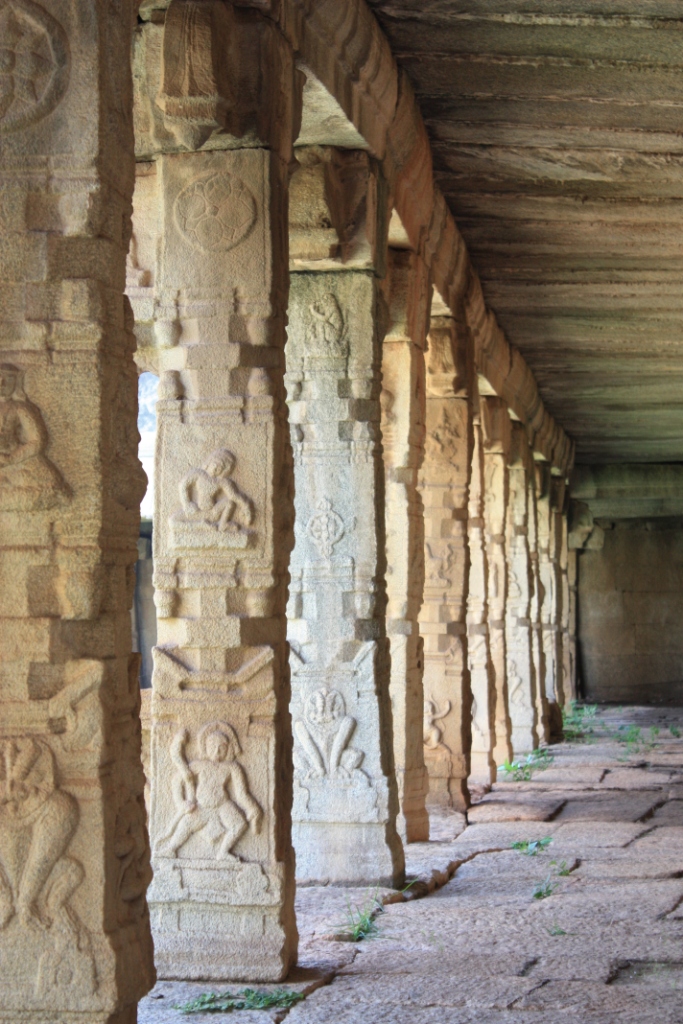
DAILY PHOTO: Columns at Achyutaraya Temple

Taken November 2, 2013 at Hampi

Taken November 2, 2013 at Hampi

I thought the varying colors and designs of these columns made an interesting photo. This is taken at Achyutaraya Temple, which is one of the more extensive standing structures at Hampi, though not necessarily the most well-preserved/restored.

If one is on the Hampi Bazaar, walk away from Virupaksha Temple and toward the police station. Follow the steps that lie past the large bull sculpture, and when one gets to the top of the hill, just past the little Hanuman (the Hindu monkey-god) shrine, follow the fork to the right. One will soon see Achyutaraya temple down below. After visiting Achyutaraya, one can follow the flat land toward the Vittala Temple, which is sort of the crown jewel of Hampi.

DAILY PHOTO: Reservoir Goat

Taken November 2, 2013 at Hampi.

Taken November 2, 2013 at Hampi.

This goat was strutting along in slow motion like he was in the opening scene of Reservoir Dogs.

Have no idea what I’m talking about? See below.

DAILY PHOTO: Climbing Lizard

Taken November 2, 2013 at Hampi.

Taken November 2, 2013 at Hampi.

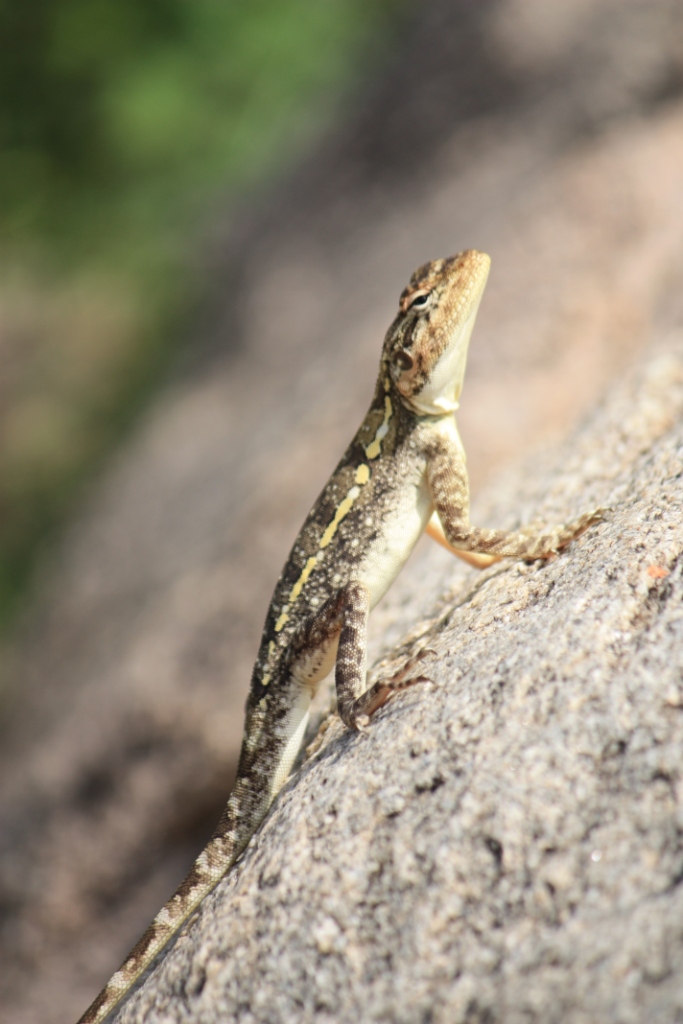
These little lizards were one of the most common animal lifeforms at Hampi.  They blend into the rock quite well despite the broken white or yellow line of dots on their backs, which itself blends into the splotched pattern of the creature.

I believe they are called Psammaphilus Dorsalis, Peninsular Rock Agamas, or South Indian Rock Agamas. [However, I know nothing about lizards and am open to correction by a herpetologist.]

DAILY PHOTO: Precarious Rock

Taken November 3, 2012

Taken November 3, 2012

Part of what makes Hampi so surreal is all of the precariously balanced boulders. This shot is oriented straight up and down, i.e. the camera is not tilted, and so one wonder’s “How is that rock not falling?”