Vinyāsa: A Few Thoughts

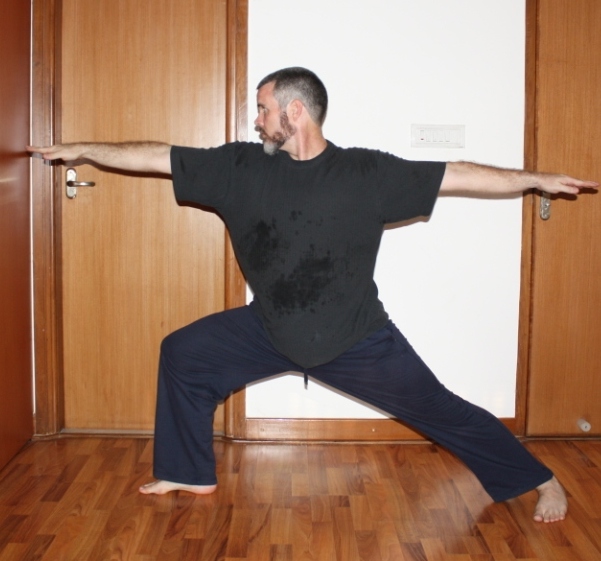
IMG_1254I attended a Vinyāsa Workshop this weekend at a1000Yoga in Bangalore. The workshop was taught by Bharath Shetty, who is the founder of the IndeaYoga Shala in Mysore, and who was a student of–among others–B.K.S. Iyengar.


The word vinyāsa has multiple meanings, but most commonly–and in this case–it refers to a style of yoga in which postures are linked together through transitional movements. (And, importantly, these transitioning movements establish a flow of breathing throughout the practice.)  Vinyāsa practices tend to be vigorous and challenging because one keeps moving when one isn’t holding a posture (i.e. there’s no down time), and the transitions require a lot of lifting oneself up, which necessitates a strong core and reasonably strong arms / shoulders.


Vinyāsa practices can have fixed-sequences (the same asana, or poses, are always done in the same order) or not have a fixed-sequence (the details of the practice will very from one session to the next.) There’s a great argument for the practice of a fixed-sequence. That is, one can get beyond focusing on crude alignment details and put one’s mind on fine details of breath, drishti (focal point), and keeping a slight tension in the perineum. Such facts can slip away when one is struggling to get the sequence and postural details down pat.


However, there’s a great counter-argument against fixed-sequence programs. The counter-argument goes like this, “If you get so bored out of your wits that you quit, you will also never get to the part where you focus on higher level details.” My advice would be “know thyself.” In other words, if you can keep to a fixed-sequence, you should. However, if your practice will peter out without constant fresh challenges, don’t force yourself into a fixed-sequence box. It’s better to take longer to get to a higher level of practice than to quit.


The most famous fixed-sequence vinyāsa style is the Ashtanga Vinyāsa system handed down by Sri K. Pattabhi Jois. (Note: some people call this system Ashtanga Yoga, and others don’t like that name because it implies that this system is heir apparent to Patanjali’s yoga as described in The Yoga Sutras.  [In other words, there’s an argument that that name was already taken.] Furthermore, Jois’s system isn’t really any more of an Ashtanga Yoga [in the Patanjalian sense] than any other Hatha yoga style because it focuses on only a few of the limbs (i.e. asana, pranayama, etc.) at least until one gets to very advanced stages of practice.


The most famous vinyāsa style without a fixed sequence is probably Power Yoga, although many people practice classic Hatha asana in a vinyāsa.  Power Yoga emphasizes core strength building, and was originally developed by Ashtanga vinyāsa practitioners to give one the workout of Ashtanga vinyāsa without its monotony.


This was my first experienced with a fix-sequence vinyāsa program other than Ashtanga Vinyāsa, so I didn’t know what to expect. This was the second workshop I’d attended by Bharath Shetty, so I knew that he was a skilled and knowledgeable teacher. However, I didn’t know what Indea Vinyasa, itself, would be like.


It turned out to be much like Ashtanga Vinyāsa. The general organization is identical. That is, there are two versions of Surya Namaskara, a standing sequence, a floor sequence, and a finishing sequence. Note: I’ve only been taught the first series of each of these systems, and so I can’t say how they vary at more advanced levels.


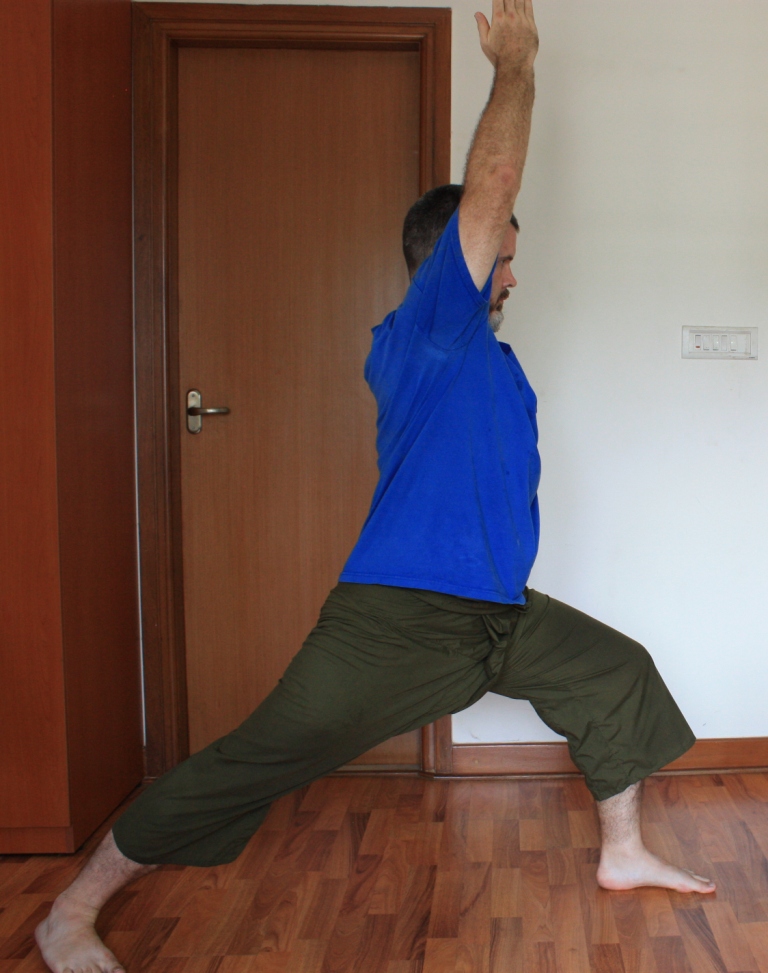
The Surya Namaskaras of Indea Vinyāsa mirror those of Ashtanga Vinyāsa, but they aren’t identical. The Indea Vinyāsa Surya Namaskara-A is slightly more involved, and includes an Utkatasana. The Indea Surya Namaskara-B, like Ashtanga Vinyāsa, features Warrior I, but doesn’t include Utkatasana (chair pose.)


The standing sequences of the two systems are identical. However, the floor sequence is very different. The Ashtanga Vinyāsa preliminary series (as mentioned above, both systems have multiple series) focuses heavily on forward bends, but the Indea Vinyāsa  preliminary series is more balanced between forward and back bends. The finishing sequence is also quite similar between the two styles.  The sarvangasana-halasana-karnapidasana-matsyasana sequence is the core of both finishing sequences.

VinyasaWorkshop

Learning to Leap: Why?

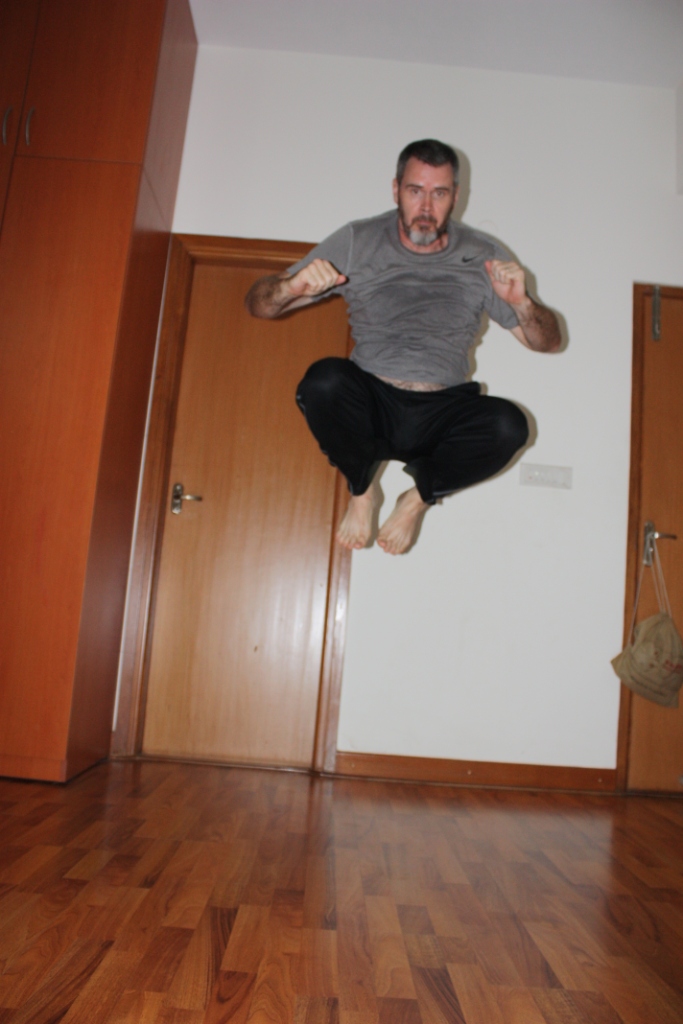
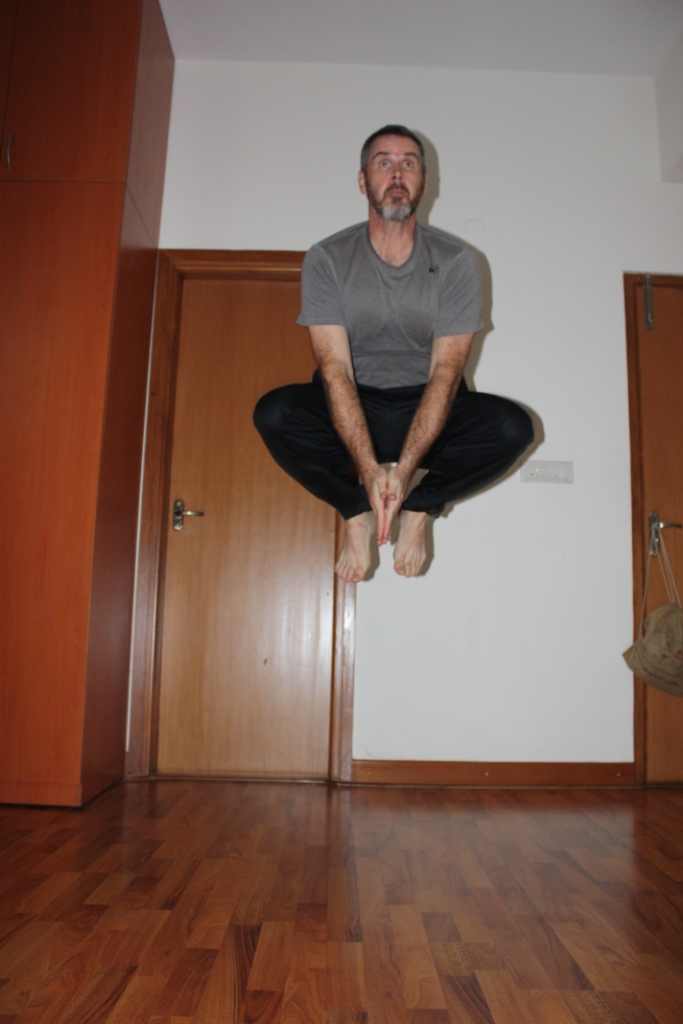
IMG_1631Leaping maneuvers are ever-present in martial arts movies and in some martial arts (e.g. Indian Kalaripayattu and some forms of Kung fu). However, these acrobatic techniques are rarely seen–and are even less often successful–in combative encounters (neither in sport nor in the real world–excepting those sports that highly reward such maneuvers and create rules that make them feasible for entertainment value.)


Why leaping, spinning wildness is popular in movies is easy. We thrill to see extremely demanding action that draws ooohs and ahhhhs. It’s the same reason one wants to watch a parkour runner vault over a car (presuming it’s not one’s car), even when it would be infinitely more practical to walk around it. It’s why we want to see gymnasts tumbling and flipping through the air even though walking across the floor is both easier on the joints and less hazardous.
 

However, the question of why martial arts that aren’t purely for entertainment practice leaping maneuvers. Even a few of the quintessentially pragmatic Japanese martial arts, which follow the motto “eliminate the extraneous” have some leaping techniques. One of the schools I’ve studied, Kotō-ryū Koppōjutsu has a scroll devoted to leaping techniques, despite the fact that it’s otherwise a grounded system–both literally and figuratively. Muay Thai, which also values tried and true winning basics over snazziness, also has leaping knee strikes in its repertoire, though one doesn’t see them a lot in fights. It’s true that the arts that emphasize practicality but have leaping and spinning techniques tend to have a different approach to them. The Kotō-ryū Hichōjutsu (that school’s leaping techniques) emphasize eliminating big wind-ups, and going straight into the leap from a natural posture. This gives one less air, but is much less obvious. It’s particularly useful if you don’t really want air, but you just want to leap as much as you must.  But why leap at all?

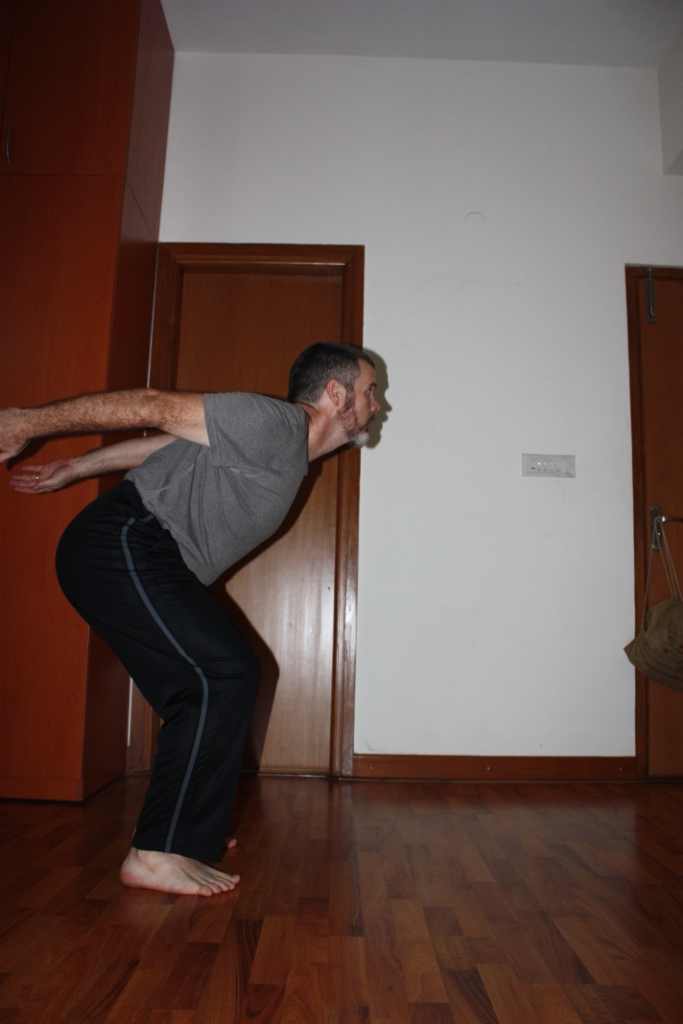
Creating this kind of spring loading of the legs may not fly.

Creating this kind of spring loading of the legs may not fly.

This kind of windup would be anathema to schools.

This kind of windup would be anathema to some schools


There are a number answers to this question. First, while it’s hard to make aerial techniques work, when they work, they can be devastatingly effective. There are few ways to put more power into a strike than to literally put all of one’s body-weight in motion under the force of gravity. There’s understandably something unsatisfying about this explanation. I think it mostly has to do with the dearth of second chances in combative encounters. Few second chances make one want to have the highest likelihood of success on the first go.


Second, while tried-and-true, go-to techniques work because they are hard to defeat and /or they minimize one’s risk of a fight-ending counter, some techniques work because they catch the opponent off-guard. Such techniques work because the opponent can’t believe one is actually trying something so wild on them. However, failing to anticipate the unusual, the opponent hasn’t trained a response into themselves. This answer gets us somewhere in cases where either the situation is dire or one knows something about the opponent.


Third–and I would argue most importantly–these techniques produce explosively powerful legs that are beneficial to a martial artist even when he stays on the ground. In other words, maybe they are more important in the role of capacity building than they are as actual techniques to be emulated.

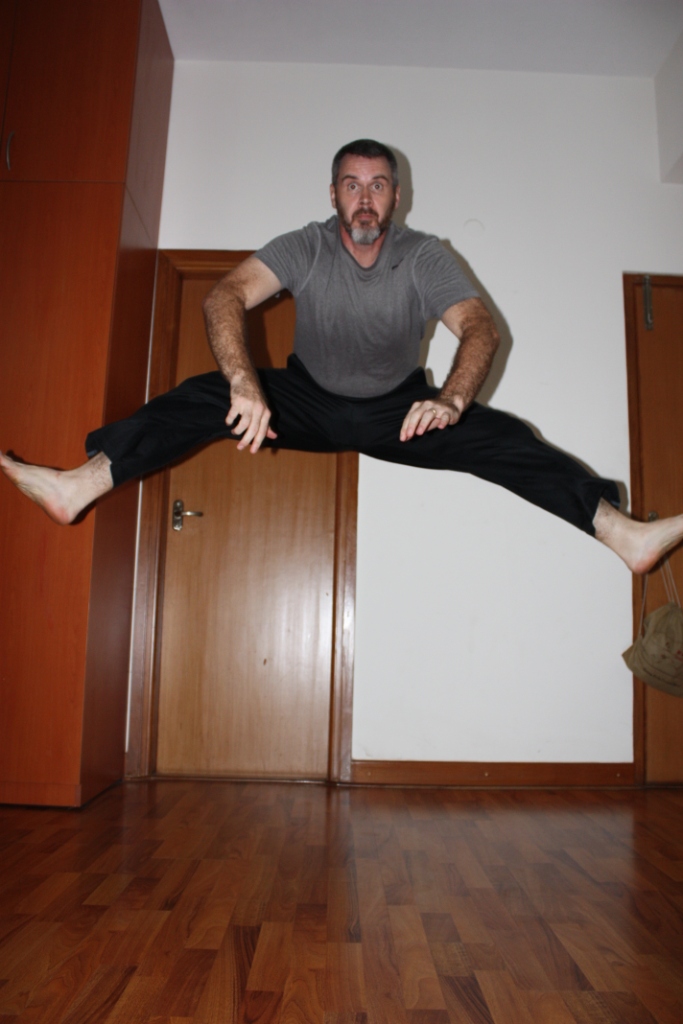
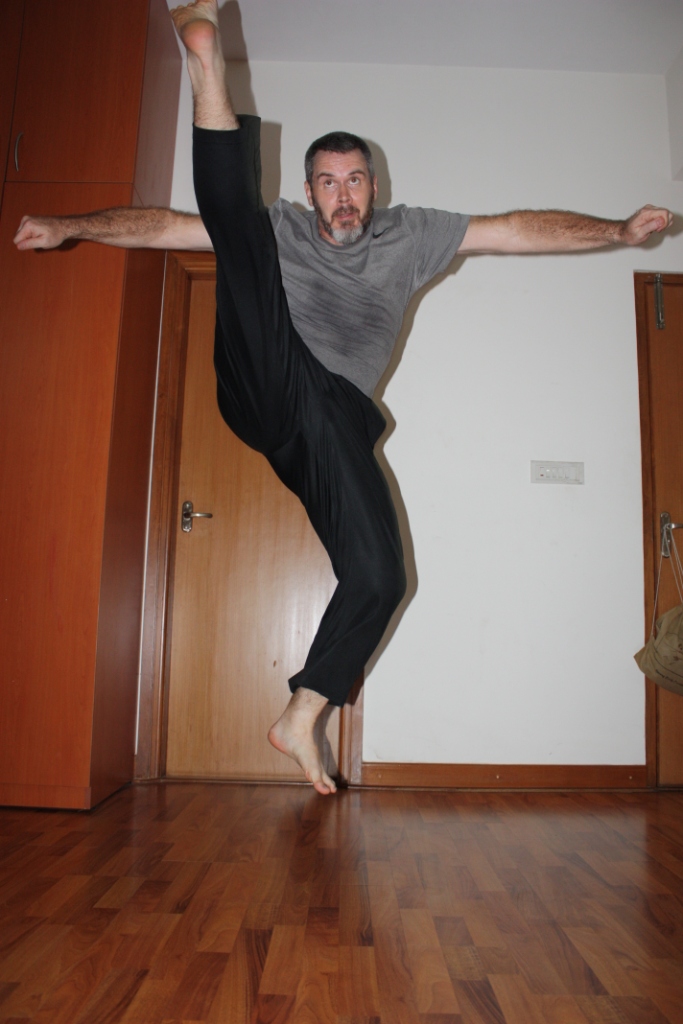
The split kick allows one to kick two opponents at once--as long as they aren't moving and are  perfectly spaced. However, it does require a multidimensional fitness that's beneficial for martial artists. (Which is why I can't do it well.)

The split kick allows one to kick two opponents at once–as long as they aren’t moving and are perfectly spaced. However, it does require a multidimensional fitness that’s beneficial for martial artists. (Which is why I can’t do it well.)


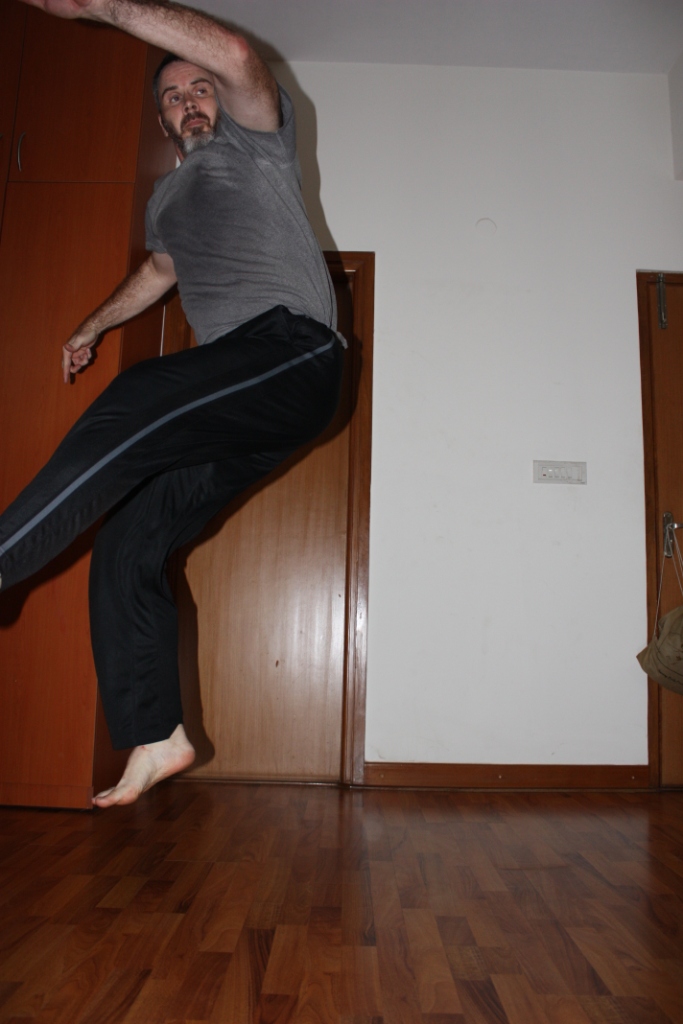
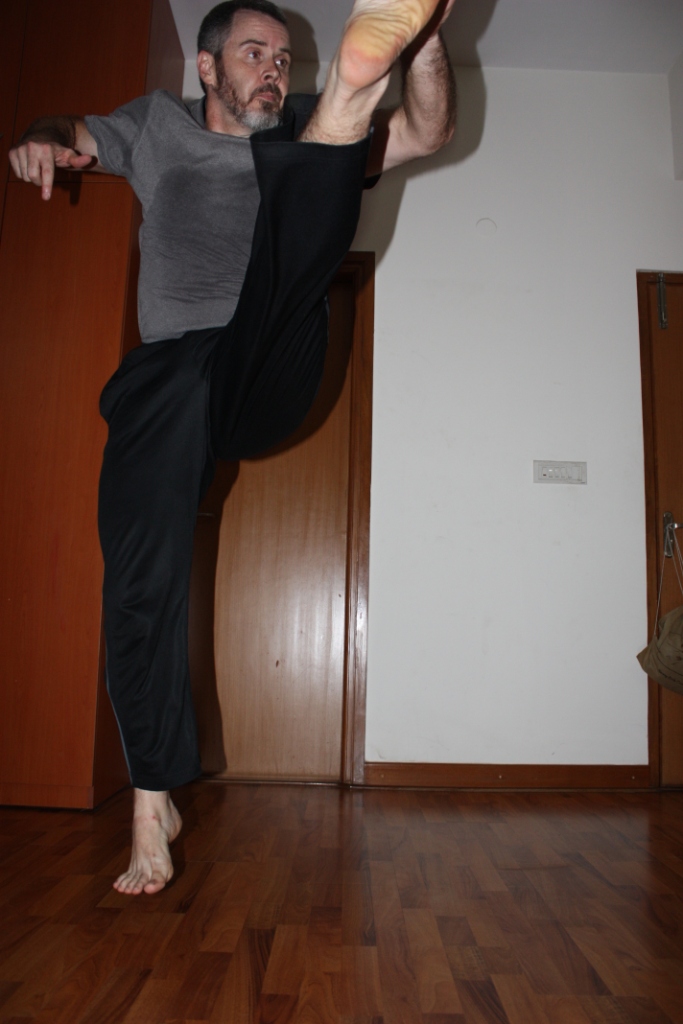
Finally, there’s one more reason that is important but was last because I didn’t even learn this lesson until I was reviewing the photos for this post, and that’s that these techniques require a whole new level of bodily awareness and control. I would generally be considered to have pretty good bodily awareness. I’ve been doing martial arts a long time, have practiced various kinds of yoga and chi gong, and have done my share of other physical training. Still, when I looked at my photos I found that I often had body parts jutting every which way. While one may argue that one doesn’t need that brand of bodily awareness if one is not using that kind of motion, I think that it probably helps with one’s awareness at high-speed in general and that many arts don’t adequately prepare one for keeping one’s body under control when there are those extra forces (e.g. centripetal & centrifugal, and gravity) acting upon it.

In my mind this looked completely different. I didn't have my arms out to the side like I was on a cross and my heel standing leg heel was still up near my buttock.
In my mind this looked completely different. I didn’t have my arms out to the side like I was on a cross and my heel standing leg heel was still up near my buttock.


One aspect of bodily awareness that is particularly important for these maneuvers is control of the eyes. In the arts I’ve studied, there has always been emphasis on the placement of the eyes. However, given all the little details one had to keep in mind, it was a reality easy aspect to half-ass. However, when one is leaping, and particularly if there is a spinning component, wandering eyes translates to crash and burn.

Entering the spin.

Entering the spin.

Mid spin / mid kick

Mid spin / mid kick. I have no idea why my right index finger is pointed down.


I’m not built for leaping. It’s not so much the leaping, but–in the immortal words of Tom Petty–“Coming down is the hardest thing.” I figured that getting to the level of Kalaripayattu training that involves a lot of leaping would be the end of that art for me. As I mentioned, there are some leaping techniques in the martial art I studied, but I was never particularly good at them. When I was young and had the proper body for it, I didn’t have the right mindset, and when I got older I was lacking the physical capacity for them. However, I’ve learned quite a bit about my body through the practice of these techniques, and I’m interested to see what level I can take it to.

IMG_1654


Rewiring the Brain about Pain: All That Isn’t Pleasure Isn’t Pain

IMG_0104

I see people staring at the railing on which they will stretch their hamstrings just like they would look at a side-by-side refrigerator unit that they have to move down a flight of stairs, psyching themselves up for the stretch. Or maybe they are weighing the question of whether they really need to stretch as one might ponder whether it would be better to get an engine overhaul or replace a car altogether. The point is that there seems to be an element of anxiety or dread associated with actions like stretching that aren’t necessarily pleasurable.


I have a theory about why this is the case.

First, people falsely equate discomfort with pain.

Second, the entire point of true pain is to tell one how not to move so as to avoid exacerbating an injury.

Third, this results in a desire to avoid pursuits that cause such physical discomfort.

Fourth, people create a self-fulfilling prophecy in which they tense muscles in the area of the stretch to counteract the aching stretch, but this just increases the discomfort level.


Your body has a clever little device called the myotatic reflex arc (MRA.) That’s when a muscle tenses to avoid injury because the muscle seems to be stretching too fast for comfort. However, that reflex is only relevant to dynamic movement and the fact that it’s a reflex arc means that the signals don’t go through the brain–thus–aren’t consciously controlled. The MRA is different from the tension one holds in a slow and controlled stretch. It’s fun to see people who’ve been encouraged to breath and relax into the stretch realizing that the stretch isn’t as bad as it seems.


Of course, many intense physical activities that cause discomfort may also result in a sufficient endorphin (natural painkillers) inflow and adrenaline / cortisol (stress hormones) outflow to result in net feelings of pleasure. While stretching results in endorphin release, the action of holding the muscle stretched may be too much for our natural painkillers to counteract, particularly when one is breathing easily and thus the body is not under the level of whole-body stress that might encourage the big endorphin dumps desired.


The problem is that one can’t achieve flexibility without pressing against one’s limits any more than one can make strength gains without lifting more or by employing more repetitions. If one just goes to the point at which one is no longer comfortable, you may be able to prevent losing flexibility, but you’re not going to make gains.


Another part of the problem is that people often go into stretching cold, and thus maximize their discomfort. Doing warm-ups and joint articulations before any kind of intense stretching is a good practice. These warm-ups should not test the fullest range of motion, but should move with sufficient quickness to get the muscles and the synovial fluid in the joints warmed up.


The problem with seeing stretching as painful is that it discourages it. Some individuals fail to stretch altogether, and others focus only on the major muscle groups (hamstrings and quads) and miss muscles that adduct, abduct, rotate, and generally stabilize and support the primary agonist or antagonist muscle pairing. The most common injury in the Japanese martial art that I study is a knee injury attributable in part to insufficiently flexible external rotators and abductors and the inability to keep the knee in line with the toes–thus putting too much torque on the joint and too much load on the ligaments.


Wrong: knee is not pointing over toes

Wrong: knee is not pointing over toes


Martial artists, in particular, need to avoid equating discomfort with pain. When discomfort becomes pain, pain becomes agony, and agony become intolerable. There are many factors that can determine the outcome of a combative event, including technical proficiency, physical fitness, and the ability to persevere. The last one may mean the ability to take a licking and keep on ticking as the Timex people used to say.


The good news is that it’s possible to rewire one’s brain to avoid equating the discomfort of stretching with pain.

Step 1: Get a yoga face. In the martial arts, we talk about having a warrior face, which is an expression that conveys one’s intensity and seriousness. For yoga and stretching one should ditch the agony face and replace it with a serene face. My personal recommendation is that you aim to emulate the faces on the Bayon at Angkor.

Yoga face as seen on the Bayon at Angkor

Yoga face as seen on the Bayon at Angkor


Step 2: Keep your mind on your breath, and away from the sensation of the stretch. There’s a reason yoga teachers harp on breath, it will help one reduce one’s overall tension.


Step 3: Stop using the word pain (in your own mind or when speaking out loud) to refer to the feeling of a stretched muscle. You may not be able to replace the word “pain” with something as euphemistic as “stretch bliss,” but try to avoid giving it a name with a negative connotation. It’s simply the sensation of a stretched muscle


Step 4: When you find yourself wearing an agony face and squeezing out the protective muscular tension, ease off the stretch until it’s comfortable. Then ease back into the stretch, keeping the surrounding muscles relaxed and the breath even and deep.  You can visualize expelling the tension with one’s exhalation if that helps.


Step 5: When you experience real pain, have no guilt about heeding it and giving that part of the body time to heal. Of course, this requires an ability to differentiate stretch sensation from true pain.


Now I’ll segue into a discussion of actual pain. When I was having a lot of problems with my lower back–eventually diagnosed as arthritis–I had a bizarro interaction with my healthcare provider. When I first went to the doctor, I faced this unsubtle wall of suspicion because back injuries are a common fraud device for persons addicted to painkillers. That’s because there are many forms of back injury that are hard to witness externally. However, when they x-rayed my back they could see clear indication that something was wrong. Then they were surprised when they tried to foist painkillers on me, and I wasn’t interested.


Here is how I look at painkillers. Imagine the “check-engine” light came on in your car, and you took the vehicle to the mechanic. The mechanic has your car for a brief time and comes back to you with a nominal bill. At first you are thrilled, and then you ask the inevitable question, “So what was the problem?” Your mechanic then says, “Oh, I have no idea, I just disconnected the light. That light won’t be giving you any more trouble.” Needless to say, you are decidedly less thrilled. You wanted the underlying problem fixed.


Don’t get me wrong, I’m not saying that there’s no place for pain-killing medication. If one has pain that is so severe that one cannot rest, one’s body won’t be able to heal itself properly.


However, if you pop painkillers to do away with bodily aches, you should reconsider. Those aches are what being alive feels like, and if they come from exercise or labor they should be welcomed and not be framed in a negative light. If they are an indication of a postural misalignment or some sort of systemic problem, you should look into fixing the underlying problem.


[To be fair to my aforementioned doctor, I think people aren’t conditioned to the notion that they are the key participant in their own healthcare and that fixing problems will often require hard work on their part. So a part of the problem in some places–most notably America–is that healthcare isn’t profitable unless they are pushing surgery or expensive medications. However, another part of the problem is that people just want to go to the doctor and have the expert fix them without requiring the personal effort of fixing postural deficiencies or cutting weight. I can understand why doctors are a bit fed up with suggesting people do the work only to get no response. I saw a statistic recently that only 1 in 8 people threatened with a lethal illness would make a behavioral change recommended by a doctor to reduce the threat of the ailment–e.g. stop smoking, stop drinking, cut weight, etc.]


Thai Yoga & Hatha Yoga: Compare and Contrast

During my recent trip to Thailand, I attended Thai Yoga (a.k.a. Rusie Dutton, i.e. “ascetic exercises”) classes at the Wat Po Temple. As a yoga practitioner, I took note of the similarities and differences between Thai yoga and the Hatha Yoga of India. It’s no surprise that Thai Yoga would display the influence of India. Indian influence from olden times can be seen throughout Thailand. The roots of Thai Massage (a.k.a. Thai Yoga Bodywork or Nuad Bo Rarn) itself are attributed to Shivago (also, written/pronounced Chivako), a north Indian doctor in the Buddha’s community of followers.

One can plainly see the influence of Hatha yogasana (postures)  in these Thai exercises, but the details vary. I’m interested in how movement systems (e.g.  martial arts) with a common ancestry diverge over time in response to the unique needs of a different culture. I believe that not only the new system evolves, but there’s also a continuing evolution in the original line. One can, therefore, end up with systems that look little alike over the course of several generations.

The degree to which the Thai Yoga poses vary from Hatha Yogasana varies. In the Thai Yoga class we did a simple lateral bend with interlocked fingers that was identical to a  Sivinanda Yoga pose named tiryaka tadasana.

Lateral Bend (tiryaka tadasana)

Lateral Bend (tiryaka tadasana)

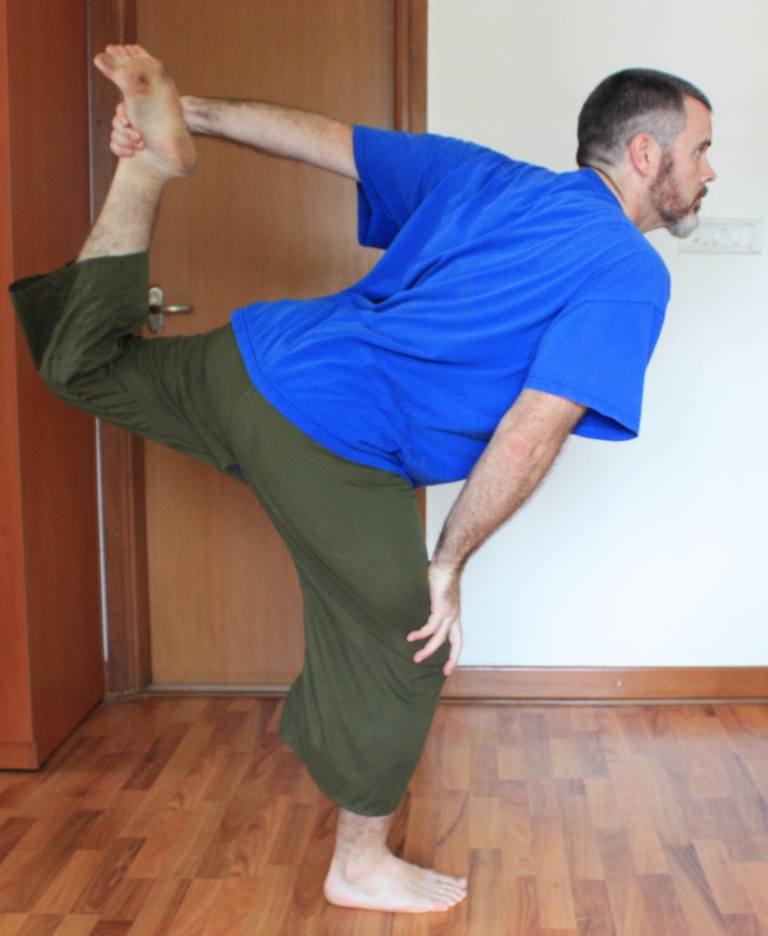
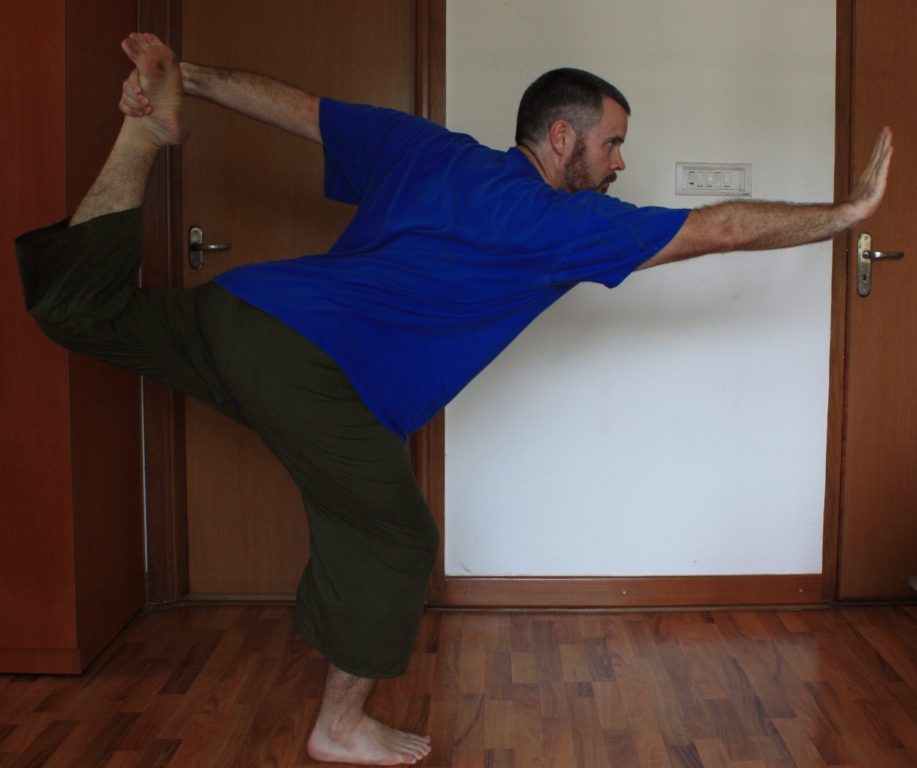
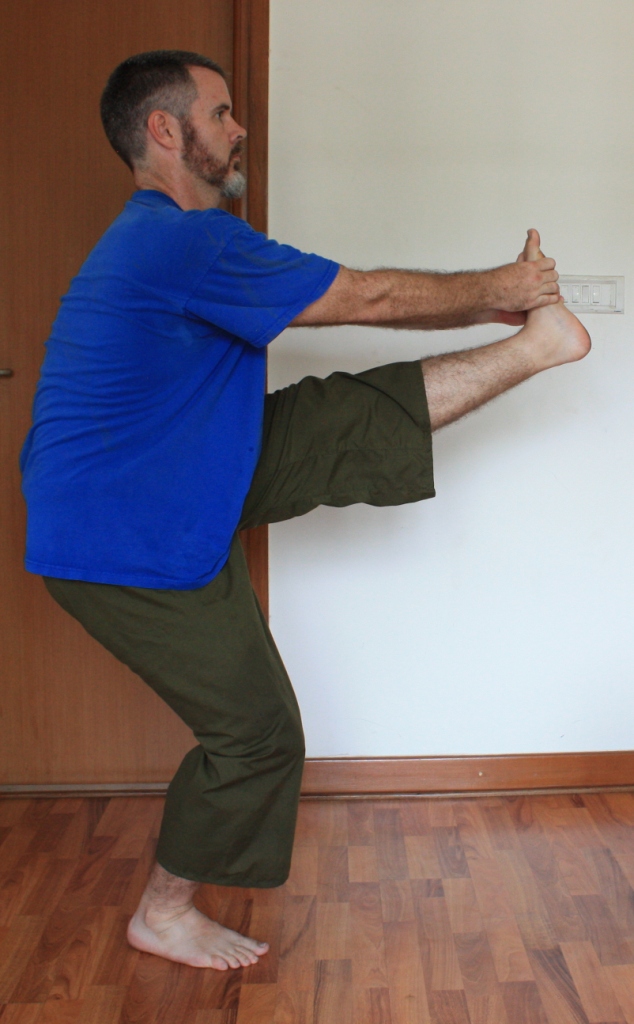
Balancing poses made up much of the Wat Po Thai Yoga sequence. This makes sense as the course was aimed at practitioners of Thai Massage and balance is important in this massage system because there are techniques that involve standing on one foot as one applies pressure with the other fort or in which one must stand to apply stretches. (Obviously, it’s bad for business to step on the recipient in an uncontrolled fashion or to topple onto them.) There were poses that were reminiscent of Natarajasana (Shiva’s Dancer pose), Vrksasana (tree pose), and Utthita Hasta Padangusthasana (hand to big toe pose). Each of these varied in the details. The most prevalent Thai variation was bending the support leg to lower one’s center-of-gravity. In Hatha Yoga, it’s usually taught to keep the support leg as straight as one can manage (this both contributes to the stretch and can prevent loading the tendons.)

NATARAJASANA: There were two variants of this pose practiced at Wat Po. Both folded the torso more forward than one would typically see in Hatha Yoga, as well as bending the support leg more.  The first version (palm on front knee) is as such:

Version 1 from Thai Yoga (Palm on Knee)

Version 1 from Thai Yoga (Palm on Knee)


The second version has the front hand up in a manner similar to the Hatha version, but the torso isn’t kept upright and the support leg is deeply bent.

Thai Version 2 (hand out front)

Thai Version 2 (hand out front)


In contrast, the Hatha version is more upright.

Natarajasana

Natarajasana


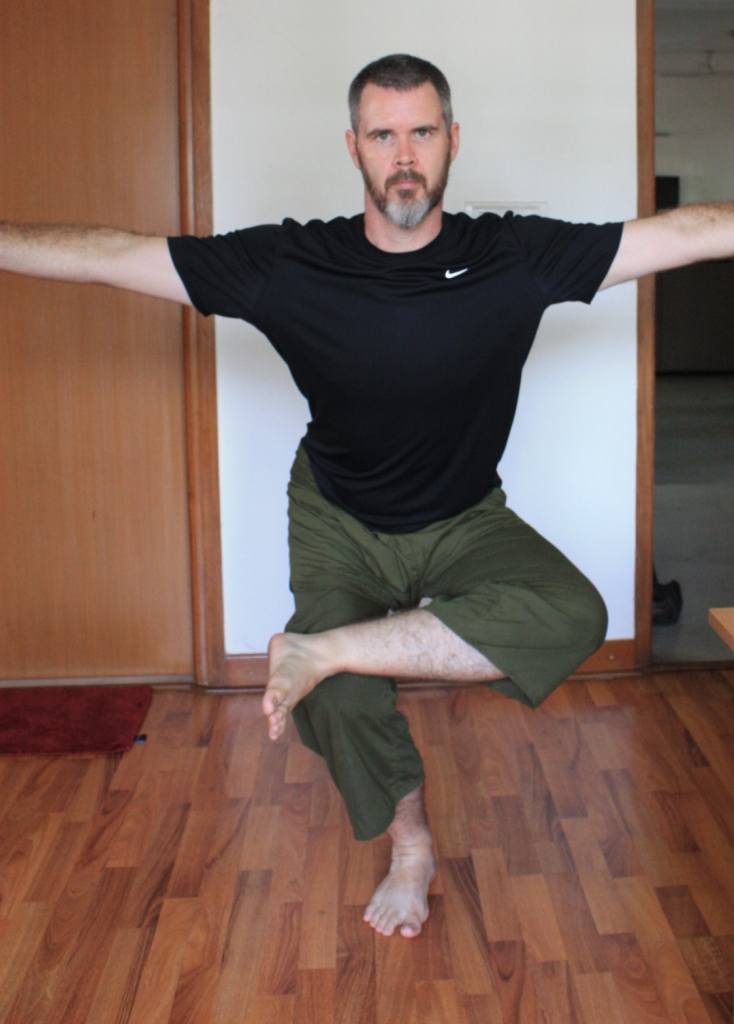
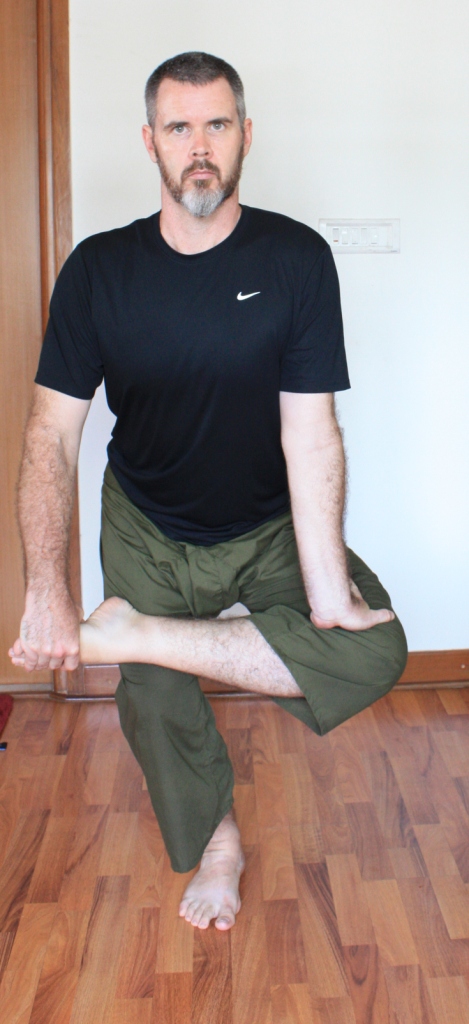
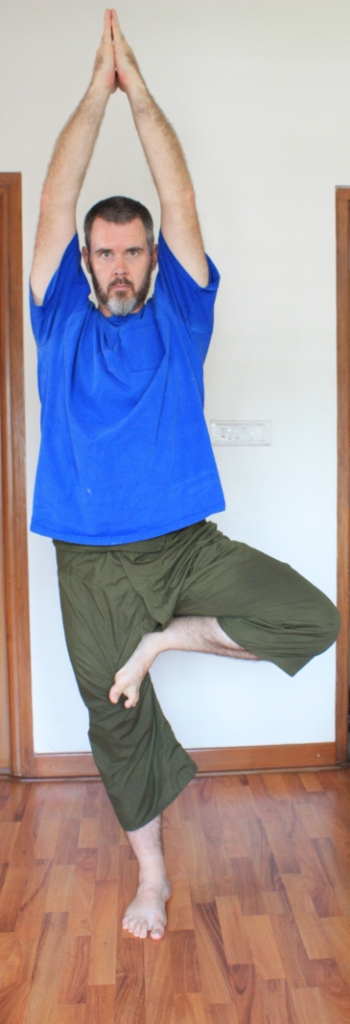
VRKSASANA: There are two variants of tree pose in the Thai Yoga. In both the ankle is kept on top of the thigh and the support leg is bent. Version one is as follows:

Vrksasana1_Thai_Front

Version 1 begins and ends in Pranamasana (hands in prayer pose) With hands out to the side in between.

Version 1 begins and ends in Pranamasana (hands in prayer pose) but hands are taken out to the side in between


Version 2 includes a wrist stretch with the balance pose. One puts fingers on thigh facing upward and the squat folds the wrist back.

Version 2 with wrist stretch.

Version 2 with wrist stretch


The Indian version:

Vrksasana_hatha_front


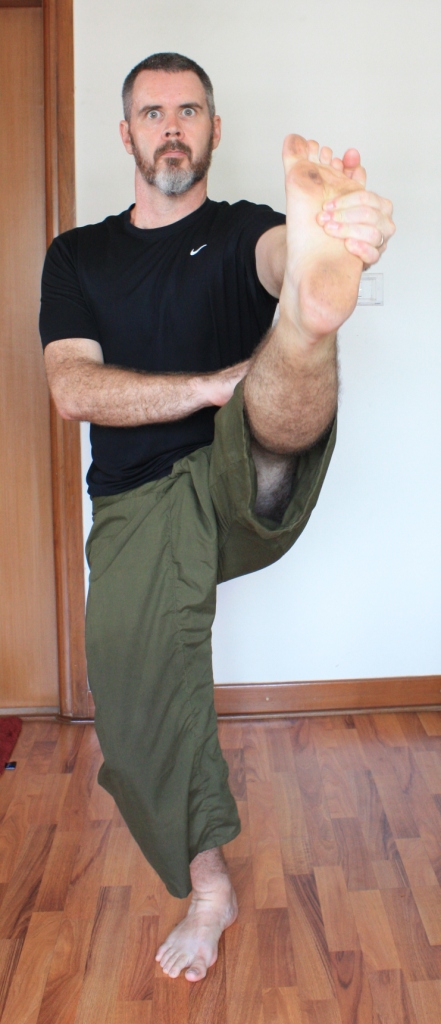
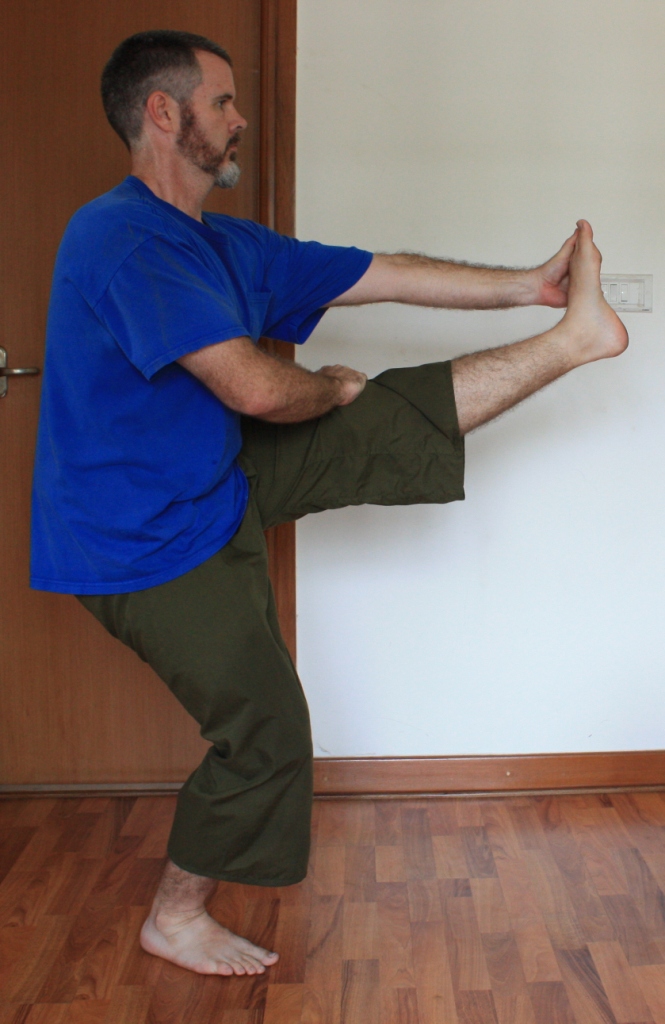
UTTHITA HASTA PADANGUSTHASANA: There are also two variations of this pose. Note the bending of the support knee. Version 1 holds the foot with the same side hand and places the opposite palm on the knee.

Version 1 from front

Version 1 from front

Version 1 from side.

Version 1 from side


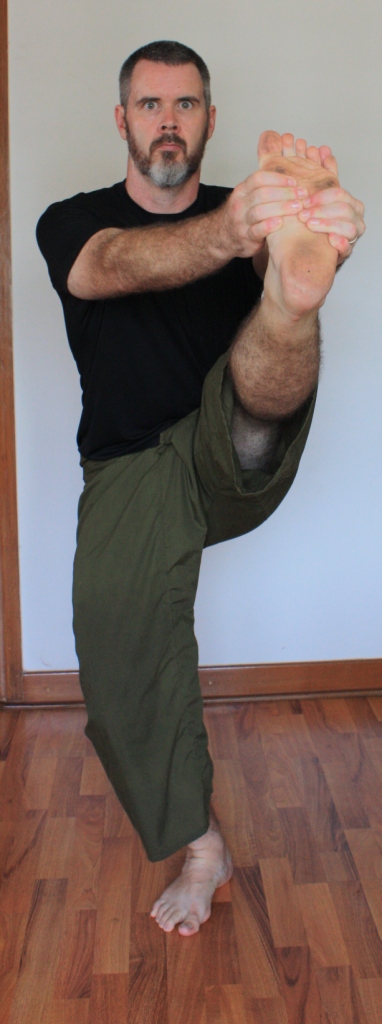
Version two holds the extended foot with both hands.

Version 1 from the front.

Version 1 from the front

Version 1 from the side

Version 1 from the side


For comparison, the Hatha Yoga version:

Utthita Hasta Padangusthasana from side

Utthita Hasta Padangusthasana from side


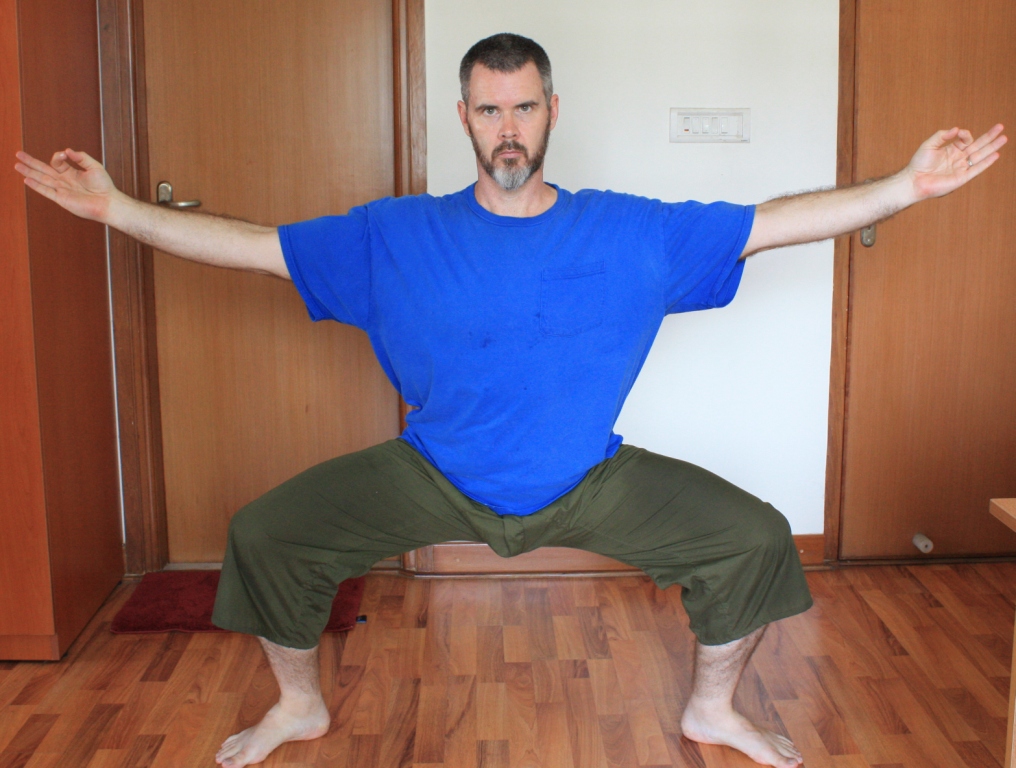
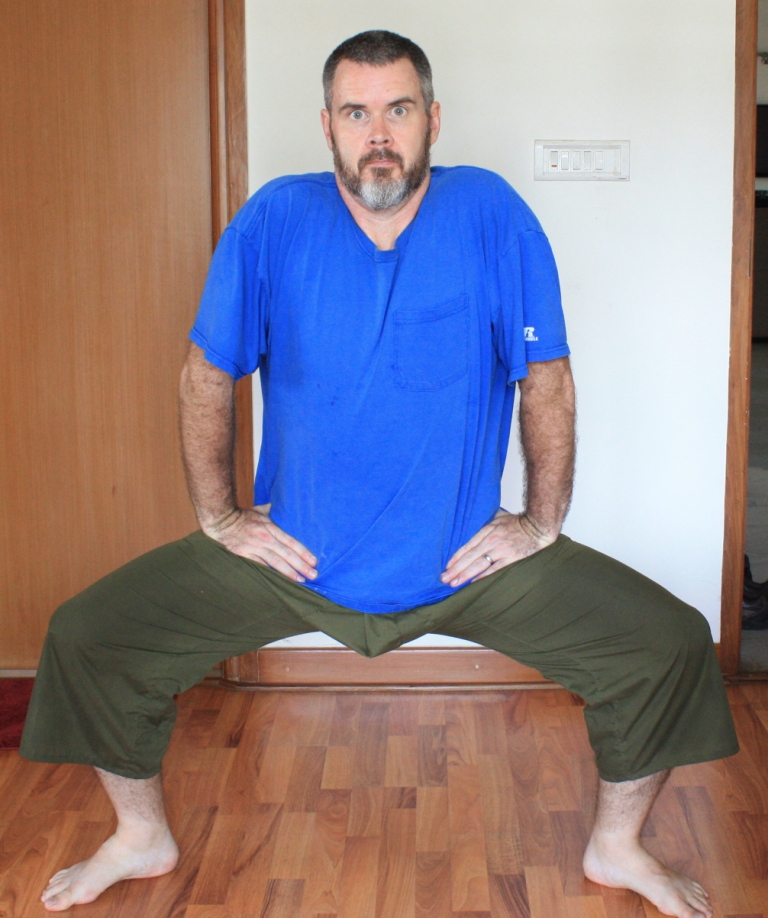
UTKATA KONASANA: There are three variants of a pose that is usually called Goddess pose or Utkata Konasana.  The difference here primarily deals with how the hands are positioned, but given the many variants within Hatha Yoga for hand position, this can be seen as a virtually identical pose.

Thai version 1 of Godess pose.

Thai version 1 of Goddess pose

Thai version 2 of Goddess pose

Thai version 2 of Goddess pose

Thai version 3 of Goddess pose

Thai version 3 of Goddess pose


Goddess pose with hands in Chin mudra.

Goddess pose with hands in Chin mudra.


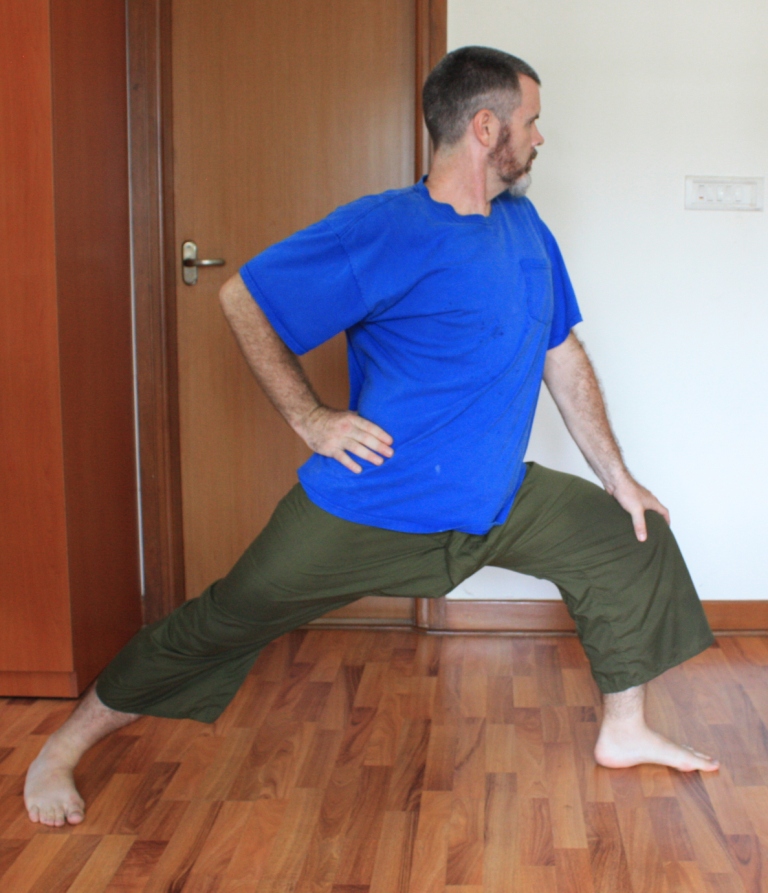
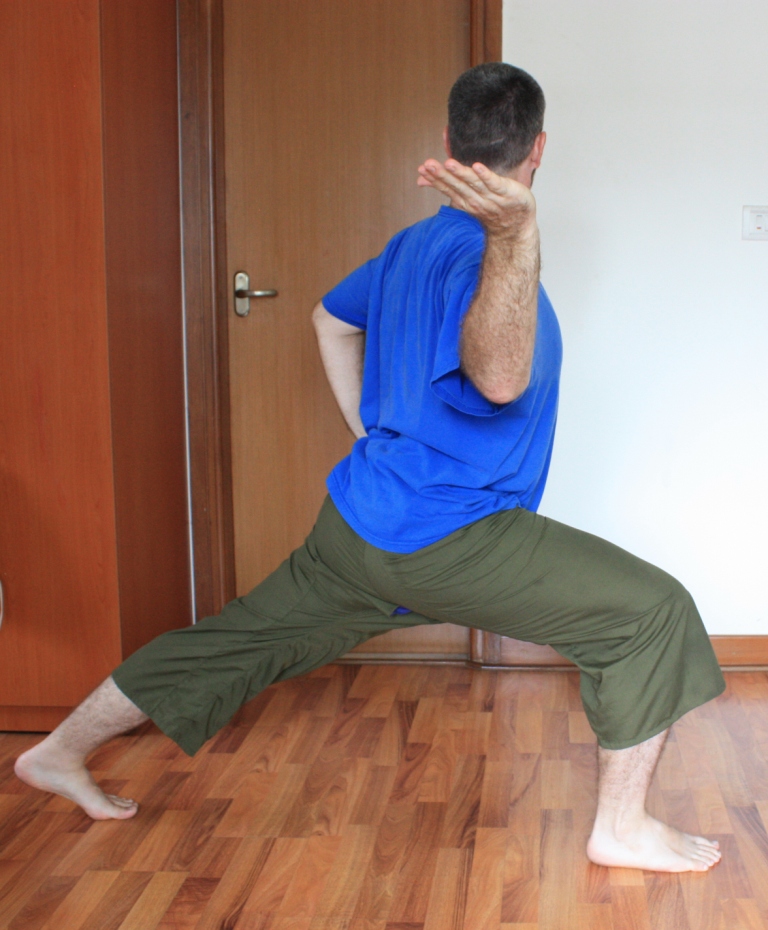
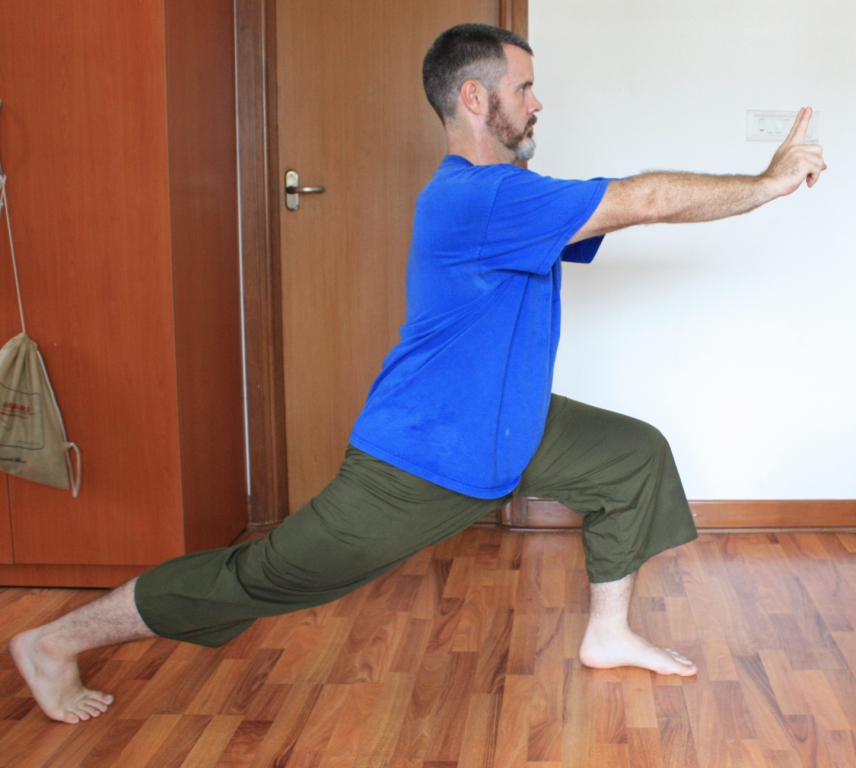
VIRABHADRASANA: There is a series of five lunge poses that are reminiscent of the Virabhadrasana (Warrior). I’ve dropped the first one because it requires a photo taken from a back angle becuas it involves pulling one’s wrist behind one’s back.

Thai Version 2 hand on front knee

Thai Version 2 hand on front knee

Thai version 3 twist

Thai version 3 twist

Thai version 4 looking back

Thai version 4 looking back

Thai version 5 taking aim

Thai version 5 taking aim

Virabhadrasana I

Virabhadrasana I


TODAY’S RANDOM THOUGHT: Yoga, Mirrors, & Proprioception

OLYMPUS DIGITAL CAMERAThis morning a yoga teacher I’ve studied with posted this article on her Facebook feed. It’s by an Indian yogini who moved to the U.S., and it offers five differences between the practice of yoga in India and in America.

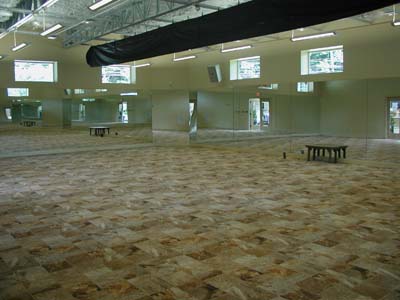
It occurred to me that one additional difference that’s frequently commented upon is that mirrors are ubiquitous in American yoga studios, but a rarity in Indian studios.

There are many possible explanations of this point of divergence. Among the more cynical interpretations is that when yoga spread internationally it was never explained that there are no asana (postures) whose drishti (focal point of gaze) is the reflected “bootilicious”, yoga-panted backside of other students.

The explanation one is likely to hear, however, is that a student needs mirrors to be able to see whether his or her alignment is correct. Sounds logical? Actually, it’s lazy in the same way as saying, “I wanted to know what Lord of the Flies is about, so I rented the movie.” (Read the damn book.)

Yes, looking in the mirror will give one instantaneous feedback, but it won’t help one develop the bodily awareness that’s a huge part of the value of yoga. One should be seeking to enhance one’s proprioception. That’s a fancy way of saying, “know where your parts are.” Proprioception is defined as:  “the ability to sense the position, location, orientation, and movement of the body and its parts.” The body has a built-in ability to determine where one’s various parts are in space and whether said parts are straight or crooked. One may not realize this because one may have poor proprioception… because one looks in the mirror instead of closing one’s eyes and listening to what one’s body has to say.

10 Things I Learned from Yoga Teacher Training

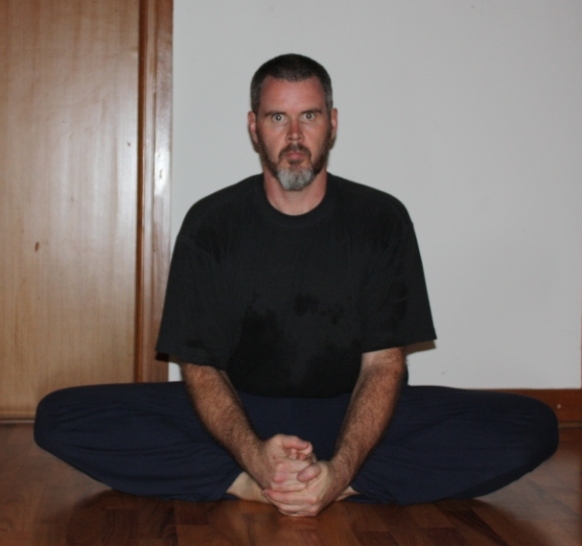
1.) Use your words. Don’t demonstrate unnecessarily. I came to teaching yoga in a backward way. It started with me doing my personal practice with my wife a few times a week. We were pretty much just practicing together, though I took the lead based on greater experience and knowledge of yoga. Eventually, a couple of other people began to join these makeshift sessions. I remember looking up and seeing a person doing parivrtta trikonasana (revolved triangle pose) in a dangerous manner. This was my first glimpse into the importance of keeping eyes up if you take on the role of helping someone with their practice.

Having a relatively high level of flexibility and many years of movement training (in the form of martial arts), I generally don’t have that much trouble mimicking postures and following corrective guidance. However, having gotten away from teaching for a little while, I quickly forgot how low the average level of bodily awareness is. Truth be told, I’d probably have been hard-pressed to explain what was so dangerous about that individual’s alignment at the time. I just had an intuitive notion that it wasn’t his skeleton or the correct muscles that were holding him up. I’ve since been working hard to move beyond an intuitive understanding. I’ve been voraciously reading everything about anatomy and body-reading that I can get my hands on–studies above and beyond the requisite anatomy instruction of the course–which itself was substantial.

IMG_12822.) Demonstrate in a smart (and not narcissistic) manner. Of course, demonstration does have its role when you have individuals who’ve not seen the movement or posture before–and if it’s a difficult posture to explain or likely to result in injury if instructions are misinterpreted. Such demonstration is best done with students watching and before they begin to move into the posture. Having only a small, closed group, whose capabilities are known to me, I’ve learned that it’s better for me to demonstrate in a manner that the participants are capable of doing while maintaining safe and stable alignment.

Of course, if one has a class of students with wide-ranging capabilities–or unknown capabilities–one will want to demonstrate as close to the idealized form as one can, so that the more proficient students can work toward that ideal. However, having struggled to master difficult asana (postures), there can be an incentive to show off one’s capability for the sake of… well showing off. If one demonstrates an idealized form that one’s students are incapable of performing, there’s a risk they’ll do something dangerous in an attempt to emulate that form.

3.) Lazy yogis aren’t without virtue. The primary purpose of practicing asana could be said to build a body with which minimal effort is required to maintain a given posture–be it a meditative seated pose or simply standing. Most people have subtle misalignments in their bodies of which they aren’t even aware. They may have chronic or occasional pain that they aren’t remotely aware is tied to being out of alignment.These misalignments end up costing a person a lot of extra effort and pain over the course of a lifetime. Being conscientious about one’s posture is the first step to fixing these problems, and if one spends all one’s time driven to master the next piece of mega-contortionism or acrobatics without learning to be a little lazy, one is missing the point of yoga.

4.) Props aren’t just for old ladies with bad hips. When I started yoga teacher training, I’d never used a block, strap, or bolster, and chairs only for sitting. Since then, I’ve learned a lot from the asana with props training both in the teacher training course, and by attending and observing such courses of my own volition. I think there’s a widespread notion that props are for those who lack the flexibility to do proper yoga and that such classes are exclusively for those people trying to ease into yoga. What one might not realize is that one ends up holding postures much longer in such a class, that one is usually discouraged from using the prop any more than one has to, and that props don’t always make asana easier.

I’m pretty flexible in most of my musculature, but I found that there were areas in which my alignment could definitely be improved by using a prop now and again.

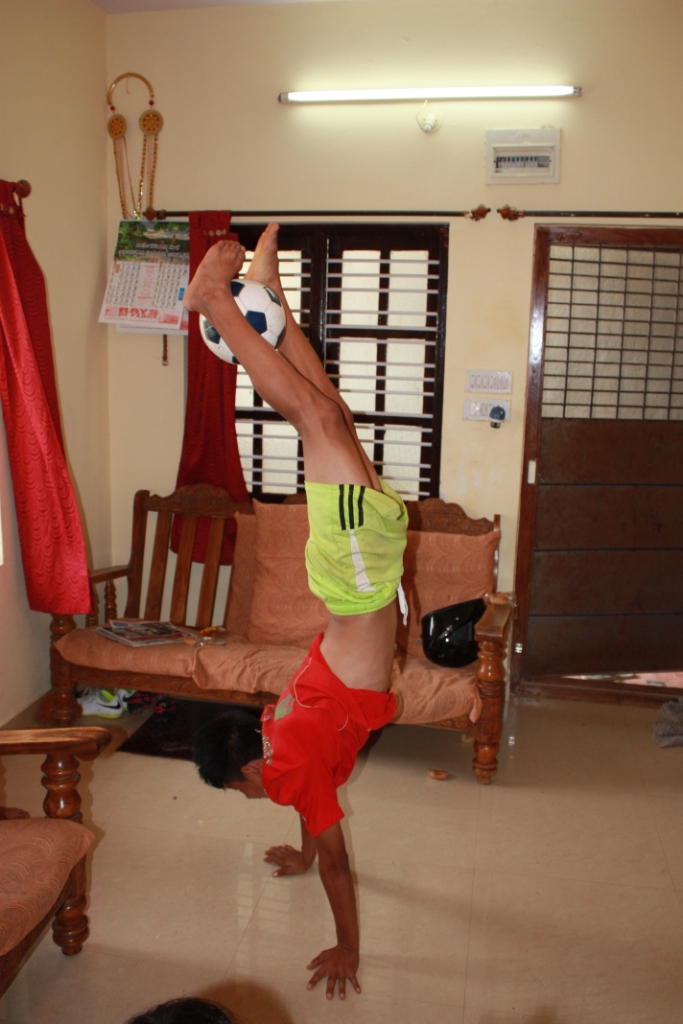
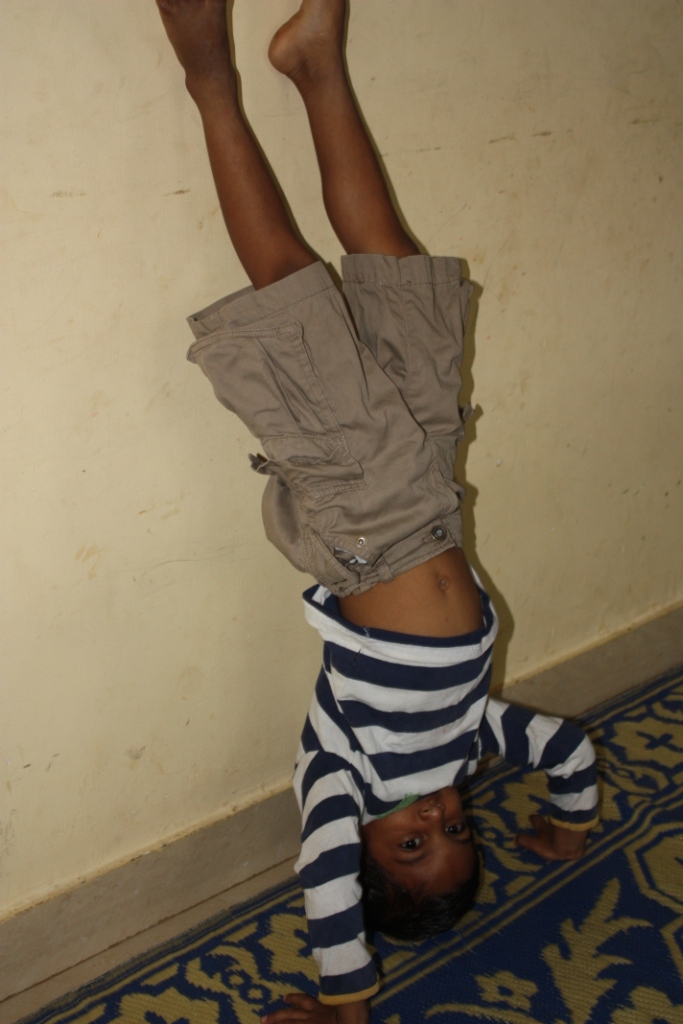
Obviously, this isn't the aforementioned 4 year old boy, but rather one of the young men who could do a handstand while playing soccer.

Obviously, this isn’t the aforementioned 4 year old boy, but rather one of the young men who could do a handstand while playing soccer.

5.) Kids are born yogis. Among the course requirements beyond the studio/classroom was charitable teaching for a nonprofit organization. Our group was fortunate to find an orphanage that was interested in having us. However, we were faced with a challenge. Kids weren’t exactly a demographic we were trained to teach–and yoga isn’t an activity one associates with childhood exuberance. We knew we’d have to make it exciting and challenging to keep their interest, but we also didn’t know what their capabilities would be. Furthermore, we had a wide age range with which to contend. Some of the kids went to elementary school and some to college, as well as those grades in between.

It turned out that even the youngest–a boy of four–was ready to take on all that we could throw at him. Before we even began teaching he eagerly showed us his headstand.

6.) Sadhana is most productive when it’s least cerebral. Sadhana is one’s personal practice–away from the studio. We have to report our experience of 50 hours of Sadhana as part of the “beyond the studio” requirement. It took me a while to get into the grove of this. The act of having to think about and record one’s personal practice can definitely be a buzz-kill. There’s a risk of it turning something fun into a bureaucratic chore. Ultimately, I gave up on trying to capture everything. I get the most out of sadhana when I experiment and play with the flow. Sometimes things flow; sometimes they don’t, but there’s a certain degree of playfulness to it. I don’t like either writing down a sequence and practicing it, or writing it down as it comes to me on the mat.

7.) Avoid teacher – student pitfalls. An instructor in any fitness domain is in a challenging position. One needs to push the student to be the best that they can be. Students expect as much. That’s why they come to gyms and studios rather than just working out at home. Being pushy is part of the instructor’s value added. At the same time, one doesn’t want to push a participant into an injury or even let them push themselves into an injury–if you can avoid it.

Here’s a common interaction. A new student comes to class. Testing the water, the teacher tells them to do a task or posture in a more intense way (i.e. lower, faster, deeper, longer, etc.) One of two things can happen. The student either appears to comply or they don’t. If they don’t comply, it could be because they really think they did comply (new students may have horrible body awareness and lack proprioception [it’s a word; look it up.]) It could be because they are scared to try (new students may have very poor understanding of what their bodies are capable of.) Or, it could be because they really can’t (i.e. they may have a skeletal constraint or a past injury, etc.)

If the student doesn’t appear to try, there’s a risk that the teacher will just forget about trying to challenge that person. Call this pitfall #1–giving up. That person may then come to feel ignored or molly-coddled if they do begin to gain bodily awareness and or confidence that they aren’t going to tear in half like wet newspaper. That is, if they haven’t quit by then.

If the student does give a good-faith effort, the teacher is pleased and will continue to try to keep pushing them harder. This works out great for all concerned until eventually the student does begin to run up against their limits. When they do, there’s the risk that the teacher will begin to think they’ve become lazy (Pitfall #2–mistaking the wall for laziness, which reverts to pitfall #1.) If one has a student that doesn’t seemed challenged at first, one can almost believe their potential is limitless, but they will hit walls eventually. It’ll take time for them to get over the walls they can, and some they never will.

IMG_15498.) People do yoga for many different reasons. Most yoga practitioners are at least vaguely aware why the true believers practice yoga. For the believers, it’s all a road to Samadhi, or liberation from suffering. Of course, there are others who just want to be in better shape and to de-stress, and don’t really believe in Samadhi. Most yogis and yoginis seem to do a good job of tolerating people with other goals, but they don’t necessarily understand each other and their optimal path to where they are going can be quite different.

There are some pretty doctrinaire approaches to yoga out there. Is Power yoga yoga? It has “yoga” right there in the name, but it’s a source of controversy–even though it’s probably among the more yoga-esque of the Western Yoga offshoots. If you’re Bikram Choudhary no one is doing proper yoga unless it’s his patented 26 asana sequence in a room with precise heat and humidity specifications. Some people think you should only practice one sequence until you’ve mastered it, and others believe variety is the spice of life.

I guess the point is to be honest about one’s views on yoga, so that students can make up their own minds about whether one’s objectives align with their own.

9.) Beware of blaming the usual suspects. I have a problem doing certain arm balances. The assumption might be that either a.) I lack the upper body strength, or b.) that I’m afraid of losing balance and falling on my face. Those are the usual problems. I probably wouldn’t be diagnosed with the former based on appearance and performance of other asana (e.g. planks and whatnot), but I might be of the latter. However, countless break-falls done over many years has left me pretty much unafraid of falling from six inches off the floor. The actual culprit? I have one wrist with a poor range of motion (90-degrees of extension on a good day.)

10.) Water in the nose is not nearly as horrible as it would seem. Most people know that there are breathing exercises (pranayama) in Hatha Yoga in addition to the asana. However, some may be unaware that there are a series of cleansing practices (shatkarma or kriya) associated with Hatha Yoga as well. We had to practice some of these, but the only unnerving one we had to learn was jala neti, in which water is poured in one nostril in such a way as to make it come out the other nostril. I imagined it being like the horrible experience of getting a nose-full of sea water while swimming in the ocean. However, I found it entirely harmless. There was no burning, stinging, or feeling waterlogged in the nasal cavity. I will definitely do it again, which is more than can be said for some of the shatkarma practices.

Tradition v. Modernity in Fitness and Movement Arts


TheScienceofYoga_BroadOne of my favorite professors (and I had a lot of them) was in the Religious Studies department of Indiana University in Indianapolis (IUPUI.) Among the lessons he taught us were the various forms of fallacious reasoning applicable to the discipline. He did so in a way that was both erudite and folksy, often in a humorous way.


While I don’t remember the formal names he gave these concepts or their technical definitions, I do remember the more colorful variations. One was the “firstist-is-bestist” fallacy in which it’s assumed that the old ways are inherently superior because bad ideas die out, and young ideas are at least as likely to be crap as not. This is sometimes called “appeal to tradition.” Over a sufficiently long time horizon this assumption may prove true (i.e. the time horizon beyond which Keynes warned we’d all be dead), but we know that wrong ideas can live on for centuries.


Another was the “outhouse” fallacy, which says that because pre-modern man didn’t have indoor plumbing they must have been complete idiots, and we should assume newer is better. This is sometimes called the “appeal to modernity.”  While there is some advantage to having access to the compiled knowledge of history, this doesn’t keep people from coming up with idiotic ideas regularly.


What made me think about these conflicting fallacies is that I’ve been reading a lot about the science of yoga–and other systems of movement–lately. Specifically, I was reading The Science of Yoga by William Broad. During the 20th century, yoga went from not giving a whit about science to trying to show that it wasn’t at all at odds with science–if not that it was grounded in science. (Note: this statement could be applied to many of the old ways—e.g. religions—which sought to prove themselves consistent with scientific evidence out of fear that–in the age of rationality–to be inconsistent with scientific observation would be death to old beliefs.) While the hucksters and con men seeking to bilk people out of money through shows of yoga “magic” have lost power (though some still exist and prey on the gullible regularly), this isn’t to say that science has yet won the day entirely.


Chapter two of Broad’s book discusses the findings of the scientific community on whether yoga has any merit as aerobic exercise. (The consensus is that it doesn’t.) Now, one would think that the whole yoga community would be pleased that academia has for the most part shown that yoga has a range of positive benefits that make it a worthwhile endeavor when practiced safely and conscientiously, but some have been unwilling to accept that yoga isn’t excellent cardio on top of all its unambiguous benefits. The established consensus is being ignored and a single seriously flawed study (small sample size, no control group, and—while peer-reviewed—the author was the journal editor) is cited, that one—of course—suggests that yoga meets all one’s cardio needs.


It’s easy to follow the incentives. For example, if one runs a yoga studio one would like to be able to say that yoga is a panacea for all of a person’s health needs. People are busy and lazy, and if someone else can sell them a silver bullet then they’ll lose business.  If one gives the matter thought, it becomes hard to imagine an exercise panacea. Consider a list of health goals that includes reduced stress, improved balance, greater flexibility, more strength, and enhanced cardiovascular capacity. One should see that some of these goals are at odds with each other. The first three goals—at which yoga excels–require holding a static position for a time while engaging in deep and controlled breathing. The fourth goal, strength enhancement, (which yoga achieves only in a limited way) requires repeated alternation of stressing and relaxing a muscle. And cardio, the fifth goal,–for which yoga is less than helpful–requires rapid and sustained motion so as to cause the heart to be stressed.


Of course, individuals have tried to rectify yoga’s cardio deficit by creating yoga styles that add speed and repetition. If one does five sun salutations per minute for 45 minutes, then—congratulations–you are now getting cardio and strength building. Unfortunately, you are now losing out on the first three goals of stress reduction, balance enhancement, and flexibility improvement. Those three things requiring holding poses while engaging in relaxed and controlled breathing. So the question is whether one is happy having sacrificed the benefits yoga does better than everything else in a desire to have yoga gain benefits that other exercise systems probably still do better.


The old systems of movement and exercise, be it yoga or chi kung, have shown themselves to have merit. However, the mechanisms by which that merit is achieved (or the nature of the merit) are often not what the system’s mythology suggests. There’s no need to fear science, but one should be ready to embrace what is shown true and set aside what is shown to be false.


On the other hand, this modern idea that we can have our cake and eat it too by throwing together disparate systems, which often have conflicting goals and modes of operation, needs to be reevaluated. All of these fads have been created where someone crams together tai chi and yoga or yoga and jazz dance or Zen meditation and parkour and they think they have the ultimate system based on a more complete picture of modernity, and what they’ve got is a muddle.


What we need is the tested merit of tradition without its voodoo, and the compiled knowledge of modernity without its hubris.


DAILY PHOTO: A Walk in the Park

Taken in the summer of 2008 in a small park in Beijing's Central Business District

Taken in the summer of 2008 in a small park in Beijing’s Central Business District

Beijing has workout equipment all over the place–mostly in parks, but sometimes just by the side of the road. One sees the same sorts of things in Bangkok, and even Phnom Penh has exercise equipment on the river front strip of park.

BOOK REVIEW: Secrets of Self-Healing by Dr. Ni

Secrets of Self-Healing: Harness Nature's Power to Heal Common Ailments, Boost Your Vitality,and Achieve Optimum WellnessSecrets of Self-Healing: Harness Nature’s Power to Heal Common Ailments, Boost Your Vitality,and Achieve Optimum Wellness by Maoshing Ni
My rating: 4 of 5 stars

The Secrets of Self-Healing title is a little bit of a misnomer. This book is not so much a collection of secrets as an overview of Traditional Chinese Medicine (TCM.) This is probably not so much an attempt to defraud as it is a sound marketing strategy. In America one can sell something as a “secret” even if it’s been done for 3000 years in the open– if it’s from China.

The book is divided into two parts. The first (between 1/3rd to 1/2 of the book)includes an overview of such topics as yin/yang, the five elements, nutrition, herbs, supplements, exercise [qi gong], and acupressure meridians. It also includes information about how to diagnose problems from external cues (i.e. examining the face, tongue, and hands in particular.)

The second part is an ailment-specific reference section. For 65 of the most common ailments, the book gives six-part advice on diet, home remedies, dietary supplements, herbal remedies, exercise, and acupressure.

It mixes some modern medical science in along the way, where it is useful.

I found this book to be approachable and informative.

View all my reviews