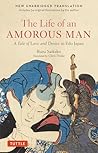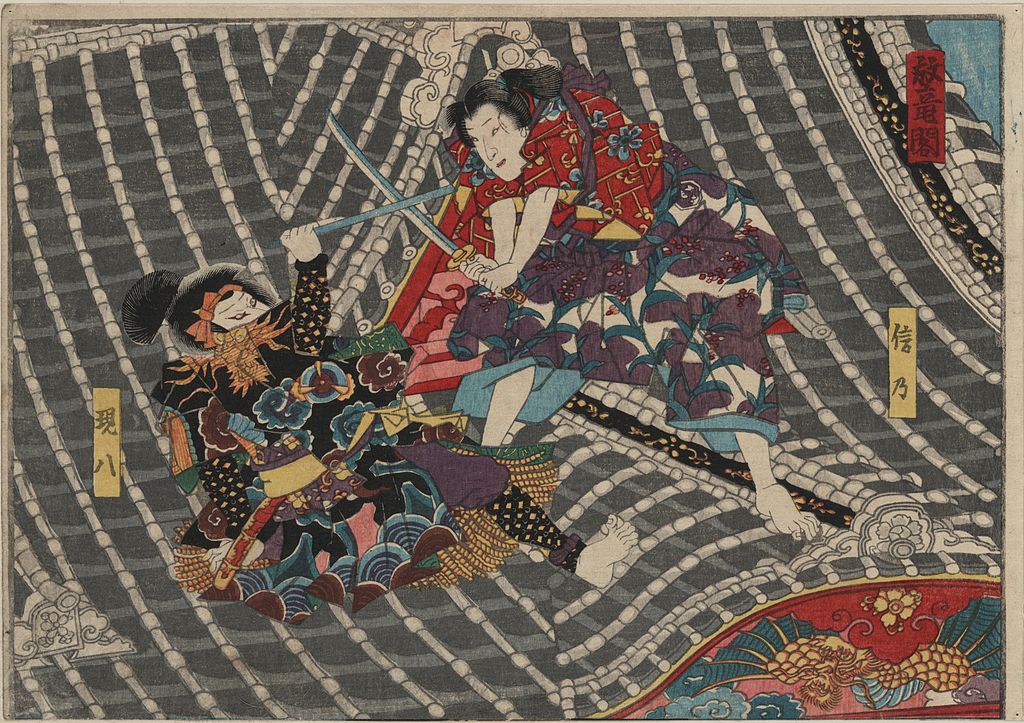
BOOK: “The Life of an Amorous Man” by Ihara Saikaku [Trans. by Chris Drake]

The Life of an Amorous Man: A Novel of Love and Desire in Old JapanThe Life of an Amorous Man: A Novel of Love and Desire in Old Japan by Ihara Saikaku
My rating: 5 of 5 stars

Publisher Site – Tuttle

On sale October 14, 2025

Original Title: 好色一代男

As the title suggests, this novel is presented as the biography of a man who is — shall we say — a horndog. Actually, it would be more correct to say that it is the story of the man’s sex life, as it begins with his sexual awakening as a boy of seven and tells stories of his relationships and dalliances throughout his life until he reaches the age of sixty and is no longer physically capable of the act. Of course, the novel does describe non-amorous life events such as the protagonist’s (i.e. Yonosuke’s) brief time as a monk and as (what in modern terms would be called) a “trust-fund kid.” Yonosuke is from a wealthy merchant family, though his inability to keep his mind on task sees him disowned for many years. So, he leads lives both rich and poor, but never without lust in his heart.

Given that the book focuses on Yonosuke’s interactions with geisha and varied sex workers, one might expect that it is a work of erotica (or even pornography.) It is neither. There is no graphic description of sexual activities and often those events are glossed over altogether. This book will be of much more interest to those interested in what life in Edo Period Japan was like, and particularly how sex work operated as a regulated industry with licit and illicit domains, than to anyone wishing to read erotica for sensual or prurient purposes.

The book has a series of illustrations (one per chapter) that were drawn by the author and appeared in the original (1682) edition. There are also poems (tanka and haiku) sprinkled in here and there, many of which were invocative in their own right.

If you are interested in historical Japan and / or its “floating world,” you’ll find this book to be an interesting read. It’s highly readable and entertaining.

View all my reviews

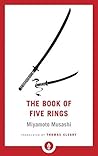
BOOKS: “The Book of Five Rings” by Miyamoto Musashi [trans. by Thomas Cleary] [w/ Yagyu Munenori’s “Book of Family Traditions”]

The Book of Five Rings: A Classic Text on the Japanese Way of the Sword (Shambhala Pocket Library)The Book of Five Rings: A Classic Text on the Japanese Way of the Sword by Miyamoto Musashi
My rating: 5 of 5 stars

Publisher Site – Shambhala Publications

This edition, i.e. The Shambhala Pocket Library edition, contains two guides to strategy, tactics, and philosophy of combat by famous early Edo Period swordsmen. The titular work is Miyamoto Musashi’s The Book of Five Rings, but the volume also contains Yagyu Munenori’s The Book of Family Traditions. The naming of the book is meant to capitalize on the continuing popularity of Musashi, who remains well-known to this day not only because of his own works and legend, but because of an afterlife in pop culture that ranges from Eiji Yoshikawa’s novel to a recent Netflix animated series. That said, one shouldn’t conclude Yagyu Munenori was some sort of slouch. He was, in fact, a martial arts teacher to the Shogun’s son, and he founded a branch of his family’s martial arts school that continues to this day.

It is interesting to see these two guides back-to-back, being by authors whose lifespans largely overlapped, though – in other ways – their lives were quite different. While there is some conceptual overlap in these guides, the two definitely show two very different minds at work, Musashi the pragmatic eccentric and Yagyu the Zen philosopher of noble standing.

Miyamoto Musashi is probably the most famous swordsman in Japan’s history. Oddly enough, he’s not known for his experience in battle (he lived at the tail end of the Warring States period and was only in a couple battles), but – rather – for his 62 duels. The Book of Five Rings and other works he left behind are certainly important factors in his continuing fame. Musashi was a bit of a renaissance man: painter, poet, and sculptor in addition to a swordsman. He also left behind a school of swordsmanship, Niten Ichi-ryū.

The Book of Five Rings is divided into five parts: earth scroll, water scroll, fire scroll, wind scroll, and void scroll.

The earth scroll provides an overview of martial science and an introduction to Musashi’s school, which is noted for its simultaneous use of both the large and short sword. A section is devoted the rhythm of martial arts, a crucial topic. It also includes what might be considered Musashi’s 9-point budō kun (a list of warrior precepts.)It’s worth mentioning a couple of these:
#7 Become aware of what is not obvious.
#9 Do not do anything useless.

The Water scroll describes Musashi’s approach to swordsmanship. It covers a range of elements of a martial art including footwork, the focus of one’s eyes, physical posture, mental posture, techniques, and approaches to cutting and thrusting.

The Fire scroll deals with the strategic or interactive aspects of the battle.

The Wind scroll explores other martial arts. Musashi discusses martial arts that use an unusually long sword, an atypically short sword, that focus on powerful strikes, and those that focus on many rapid strikes. He contrasts other martial arts with his own on subjects such as their focus with the eyes and their footwork.

The void scroll deals with, well, emptiness. It’s actually a short wrap-up.

Yagyu’s guide is much more philosophical and mind-centric. It’s not that Musashi doesn’t deal with such topics, but he also devotes considerable space to more practical nuts and bolts of swordsmanship and strategy. It’s also true that Yagyu gets into technical considerations such as control of distancing (if in a bit more poetic way than Musashi.) One can get a feel for the nature of Yagyu’s Book of Family Traditions [on the Art of War] by seeing how it is organized into three parts: “The Killing Sword,” “The Life-Giving Sword,” and “No Sword.” The latter two indicating the author’s belief in the importance of not equating warrior and killer (nor winning with killing) as well as not fixating on the sword.

These two men had great insight into strategy and the tactics of swordsmanship, their guides are worth being read and reread. And the two authors do offer two intriguingly different approaches to a similar subject.

View all my reviews

The Jujutsu Murders, Plus Some Brain Science

Jujutsu

Imagine you’re a detective in Edo Period Japan (1603-1868), and you’re told to investigate a case in which three highly-trained practitioners of one of the most well-respected jujutsu schools have been stabbed to death. Each of the three bodies has only one mark on it–the lethal stab wound. The wound is on the right side of the abdomen in all three cases. There are no signs of a prolonged struggle, despite the fact that each of the three had many years of training and none of the men was an easy victim. The stabbings happened independently, and there were no witnesses to any of the killings. So, who or what killed these three experts in jujutsu?


Nobody knows who killed them, but a rigid approach to training contributed to what killed them. As you may have guessed, the killer took advantage of knowledge of the school’s techniques, i.e. their “go-to” defense / counter-attack for a given attack. It’s believed that the attacker held his scabbard overhead in his right hand, and his weapon point forward in a subdued manner in his left. All three of the defenders must have instinctively responded to the feigned downward attack as the killer stabbed upward from below with the unseen blade.


It’s a true story. I read this account first in Jeffrey Mann’s When Buddhists Attack. That book offers insight into the question of what drew some of the world’s deadliest warriors (specifically, Japan’s samurai) to one of the world’s most pacifistic religions (i.e. Buddhism–specifically Zen Buddhism.)  Mann cites Trevor Leggett’s Zen and the Ways as the source of the story, and Leggett’s account is slightly more detailed.


This story intrigues because it turns the usual cautionary tale on its head. Normally, the moral of the story would be: “drill, drill, drill…”


Allow me to drop some brain science. First, there’s no time for the conscious mind to react to a surprise attack. The conscious mind may later believe it was instrumental, but that’s because it put together what happened after the fact and was ignorant of the subconscious actors involved. (If you’re interested in the science of the conscious mind’s stealing credit ex post facto [like a thieving co-worker], I refer you to David Eagleman’s Incognito.)  Second, our evolutionary hardwired response to surprise is extremely swift, but lacks the sophistication to deal with something as challenging as a premeditated attack by a scheming human. Our “fight or flight” mechanism (more properly, the “freeze, flight, fight, or fright” mechanism) can be outsmarted because it was designed to help us survive encounters with predatory animals who were themselves operating at an instinctual level. (If you’re interested in the science of how our fearful reactions sometimes lead us astray when we have to deal with more complex modern-day threats, I refer you to Jeff Wise’s Extreme Fear. Incidentally, if you’re like, “Dude, I don’t have time to read all these books about science and the martial arts, I just need one book on science as it pertains to martial arts,” I just so happen to be writing said book… but you’ll have to wait for it.)


So where do the two points of the preceding paragraph leave one?  They leave one with the traditional advice to train responses to a range of attacks into one’s body through intense repetition. Drill defenses and attacks over and over again until the action is habitual. This is what most martial artists spend most of their training effort doing. A martial art gives one a set of pre-established attacks or defenses, and it facilitates drilling them into one’s nervous system.


Of course, the astute reader will point out that the three jujutsu practitioners who were killed had done just what was suggested in the preceding paragraph, and not only didn’t it help them but–arguably–it got them killed. I should first point out that the story of the three murder victims shouldn’t be taken as a warning against drilling the fundamentals. As far as their training went, it served them well.  However, there’s a benefit to going beyond the kata approach to martial arts. One would like to be able to achieve a state of mind that once would have been called Zen mind, but–in keeping with our theme of modern science–we’ll call transient hypo-frontality, or just “the flow.” This state of mind is associated with heightened creativity at the speed of instinct. (If you’re interested in the science of how extreme athletes have used the flow to make great breakthroughs in their sports, I’d highly recommend Steven Kotler’s The Rise of Superman.) Practicing kata won’t help you in this domain, but I believe randori (free-form or sparring practice) can–if the approach is right.