BOOKS: “John Brown” by W.E.B. Du Bois

John BrownJohn Brown by W.E.B. Du Bois
My rating: 5 of 5 stars

Available free online at Project Gutenberg

“John Brown’s Raid on Harpers Ferry” is one of those historic events like the “Teapot Dome Scandal” that American kids have to memorize a rote fact about to regurgitate on an American History test a couple times during their scholastic lives, never to be thought of much again, forever a familiar name lacking all depth of understanding. (At least that’s how it was in my day.) Unlike the Teapot Dome Scandal, which I suspect is not learned about in detail because it was somewhat complex and boring, I think the minimalist coverage of John Brown might reflect a bit of national embarrassment. For Brown’s tale is not complicated, and it’s certainly not boring. Brown thought slavery was an abomination, and he devoted his life to freeing slaves by whatever means he could, which culminated in a raid on an arsenal at Harper’s Ferry, West Virgina, at the convergence of the Potomac and Shenandoah Rivers, a raid intended to liberate weapons to the cause of arming freed slaves and other abolitionist fighters.

It’s a shame that more is not learned about John Brown because he was such a fascinating and principled individual, and in a sense his story isn’t just an embarrassing tale of a sparse few virtuous people against a mainstream that was — at best — indifferent to slavery. But there is a potential for pride in the fact that Brown and those who fought with him were able to see slavery for what it was and to stand strong against that mainstream, to make the fight of the oppressed their fight and — in the case of Brown and others — to pay the ultimate price in the conduct of that fight.

W.E.B. Du Bois’ biography of John Brown came out in 1909 and may not be written in the novel-esque style that a writer today would write it, but it is well-written and readable. Du Bois’ book is a full biography of Brown, if focused on his abolitionist aspect. Du Bois tells a little of Brown’s backstory and of his work life and then explores his experiences fighting in Kansas. However, this book does really shine in its account of the Harpers Ferry Raid and its aftermath.

Readers interested in American History or the biographies of virtuous individuals are urged to read this account of the life of John Brown.

View all my reviews

“Shiloh: A Requiem” by Herman Melville [w/ Audio]

Skimming lightly, wheeling still,
The swallows fly low
Over the field in clouded days,
The forest-field of Shiloh--
Over the field where April rain
Solaced the parched ones stretched in pain
Through the pause of night
That followed the Sunday fight
Around the church of Shiloh--
The church so lone, the log-built one,
That echoed to many a parting groan
And natural prayer
Of dying foemen mingled there--
Foemen at morn, but friends at eve--
Fame or country least their care:
(What like a bullet can undeceive!)
But now they lie low,
While over them the swallows skim,
And all is hushed in Shiloh.

O Captain! My Captain by Walt Whitman [w/ Audio]

O Captain! my Captain! our fearful trip is done,
 The ship has weather'd every rack, the prize we sought is won,
 The port is near, the bells I hear, the people all exulting,
 While follow eyes the steady keel, the vessel grim and daring;
       But O heart! heart! heart!
          O the bleeding drops of red!
             Where on the deck my Captain lies,
                Fallen cold and dead.

O Captain! my Captain! rise up and hear the bells;
 Rise up -- for you the flag is flung -- for you the bugle trills,
 For you bouquets and ribbon'd wreaths -- for you the shores a-crowding,
 For you they call, the swaying mass, their eager faces turning;
       Here, Captain! dear father!
          This arm beneath your head!
              It is some dream that one the deck
                 You've fallen cold and dead.

My Captain does not answer, his lips are pale and still,
 My father does not feel my arm, he has no pulse nor will;
 The ship is anchor'd safe and sound, its voyage closed and done,
 From fearful trip the victor ship comes in with object won;
       Exult, O shores! and sing, O bells!
          But I, with mournful tread,
             Walk the deck my Captain lies, 
                 Fallen cold and dead. 

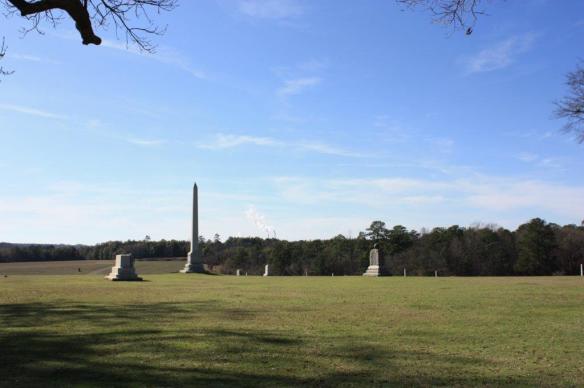
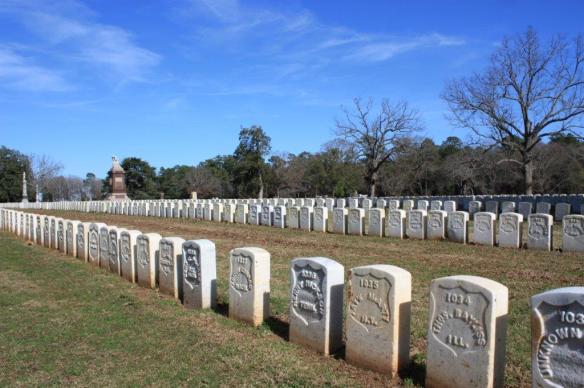
DAILY PHOTO: Memorials under Autumn Skies, Andersonville

Taken in December of 2011 at Andersonville National Historic Site / Andersonville National Cemetery

BOOK REVIEW: Iron Man: Civil War by Brian Michael Bendis et. al.

Civil War: Iron ManCivil War: Iron Man by Brian Michael Bendis
My rating: 4 of 5 stars

Amazon page

With the “Captain America: Civil War” movie set to come out this year, one would have to be living under a rock to be unfamiliar with the basic premise of the Civil War story line. (Not that the movie will—or even can—follow the comic books exactly. But the gist is the same.” The government passes a Registration Act that would require superheroes to be registered, regulated, and trained. This splits the Marvel universe of heroes into two battling factions. (In the movies, it’s just the Avengers, but the comics include members of the Fantastic Four, X-men, etc.) One side, led by Tony Stark—a.k.a. Iron Man, supports the Registration Act. The other side, led by Steve Rogers—a.k.a. Captain America, staunchly opposes the new law. The four issues collected here offer insight into the mind of Tony Stark.

The four issues in this collection are: “Civil War: The Confession #1,” “Iron Man #13,” “Iron Man #14,” and “Iron Man / Captain America: Casualties of War #1.” Putting the issues in this order contributes to the somber tone of the storyline, as the chronological end of the events is put up front in the form of Stark’s confession. The start is a little like the very beginning of “Saving Private Ryan” (before the battle scene begins.) As with “Saving Private Ryan,” this opening does little to detract from the story and in fact builds immediate intrigue.

This isn’t the most action packed collection, but it is an emotional story line. Tony Stark is serious, somber, and sober (in both senses of the word.) This isn’t the cocky, witty playboy philanthropist one associates with Iron Man. It’s a man whose convictions are forcing him to fight his friends and comrades in arms. The irony of the situation is that Stark is certain the Registration Act is necessary because of people like him. In other words, if everybody was like his friend-turned-enemy Steve Rogers (i.e. a pinnacle of virtue) then the Act would be unnecessary.

There is some awkward expositional dialogue / monologuing in this book—a common problem among serial comic books. However, overall the story is engaging. If you want battle scenes, you may be disappointed, but this book makes one sympathize with Stark—even if you’ve previously thought him an arrogant douche.

View all my reviews