A Third Roti: A Story with an Elephantine Moral

IMG_0047I went to a talk at the Rangoli Metro Arts Center last night entitled, Foresters’ Elephants. The talk was hosted by a group called “Friends of Elephants,” and the panel of speakers were all Conservation Officers in South India who were responsible for public lands home to Elephants.

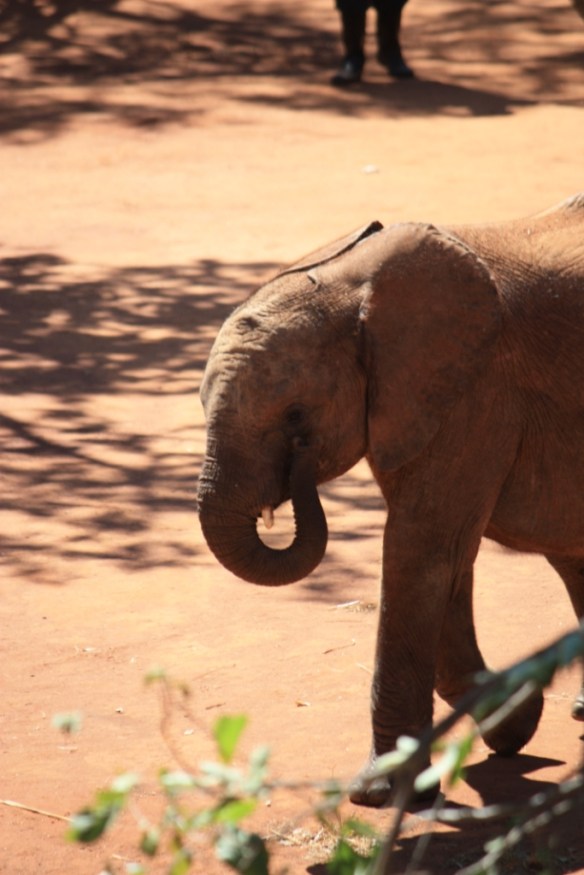
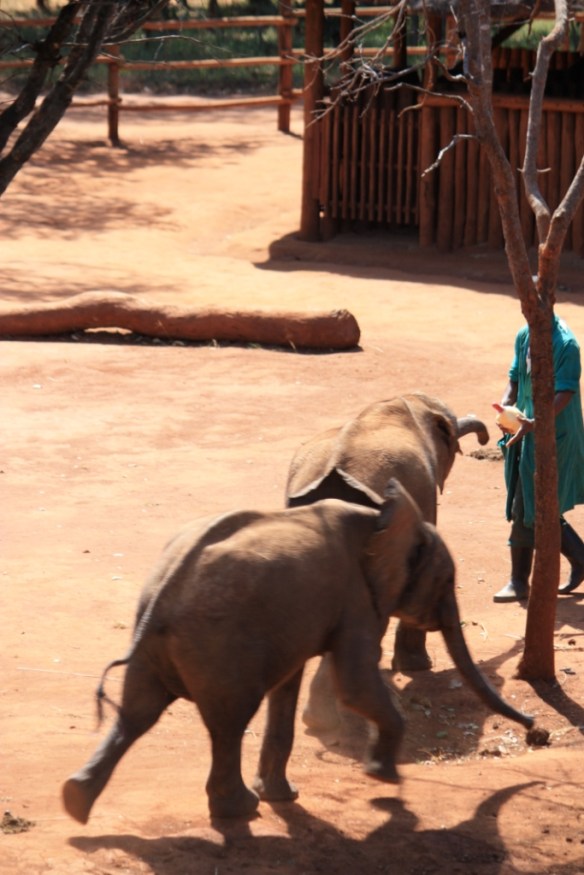
The discussion offered some intriguing insight into state and local politics in India. But the best explanation of the night came from the Chief Conservator of Forests for Kodagu in a story that could be titled “A Third Roti.”

The Conservator explained that, as a junior forest officer, he’d been assigned to a remote station. His housing took the form of an old decrepit colonial era building. This house had a vermin infestation, and the hungry rodents would get bold as he and his wife slept and would nibble at their fingers and toes. Of course, this made for sleepless nights. To solve this disconcerting problem, the Conservator took to getting a third roti with his meals. [For my India-inexperienced readers, a roti is a circular flat bread that’s a common element of meals in many parts of India.] Putting the third roti out for the rodents negated the rat’s need to engage in the mutually terrifying act of nibbling on the forest officer or his wife.

I don’t know if the story is true, and–if it is–whether it’s truly the Conservator’s story. It doesn’t matter. What’s important is that it’s a great use of story to make a point. The point in this case is that a solution often needs to take into account the fundamental needs of the “adversary.” In other words, regulation and punishment can’t always provide the solution–especially when basic needs are not being met. One could try to scare the rodents away or one could set traps (potentially at risk to oneself), but if the rats are driven  by hunger they might find the risk worth taking. The problem that he was addressing was the need for wood for fires, fence posts, and other needs. This caused people to enter public forests, putting themselves at risk of running into wild elephants.

The idea of trying to find a third roti for problems really resonated as an approach to creative solutions.

DAILY PHOTO: Beige and Brown Butterfly

Taken on April 26, 2015 at Patttaduru

Taken on April 26, 2015 at Pattadur

IMG_1995 IMG_1996A small moth or butterfly with false eyes. Taken in southwest Karnataka.

DAILY PHOTO: Quality Family Time, Monkey Style

Taken on March 28, 2015 at Dodda Alada Mara (Big  Banyan Bangalore)

Taken on March 28, 2015 at Dodda Alada Mara (Big Banyan Bangalore)

IMG_3409

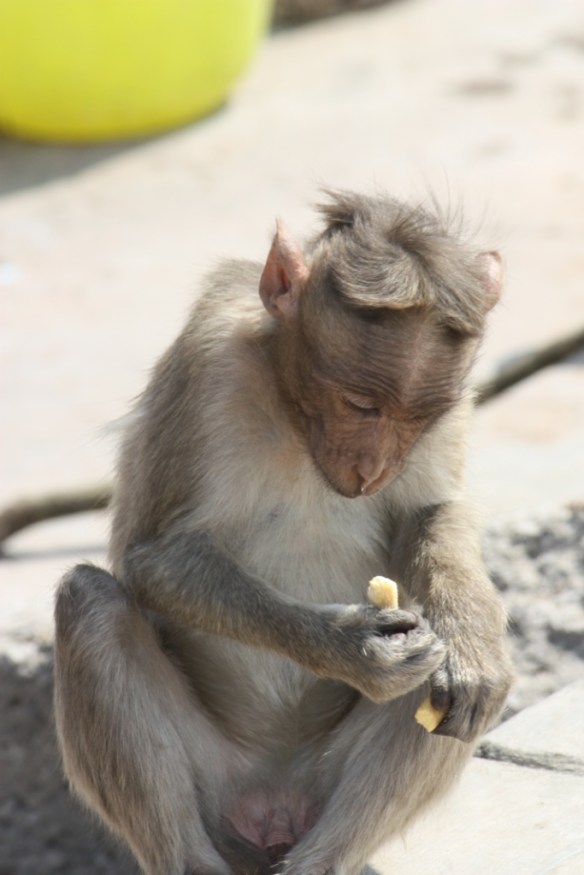
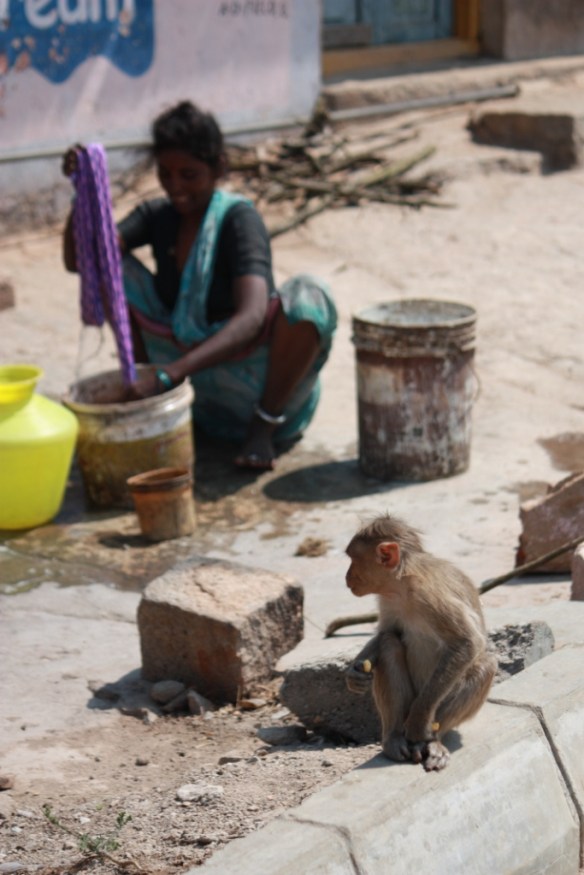
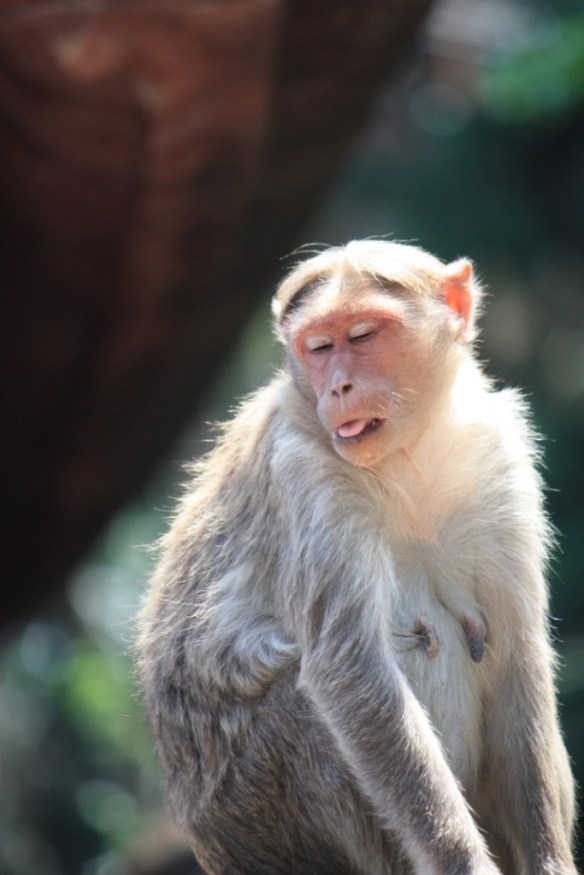
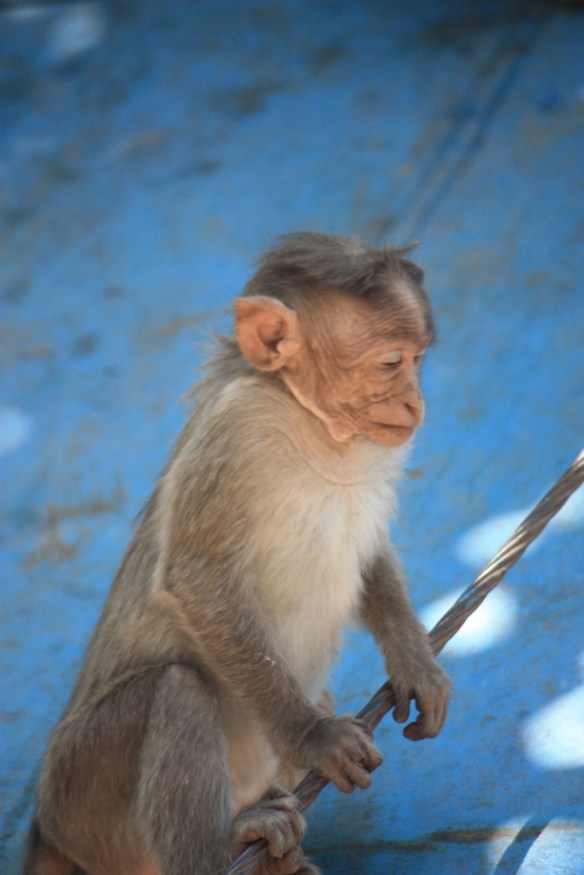
Bangalore’s Big Banyan (Dodda Alada Mara) hosts a number of macaque families, such as this one.

DAILY PHOTO: Life on the Rocks

Taken in January of 2014 at Naiharn on Phuket

Taken in January of 2014 at Naiharn on Phuket

IMG_1646 IMG_1674 IMG_1689

DAILY PHOTO: A Herd of Seahorses at Tortugranja

Taken in July of 2009 in Isla Mujeres at Tortugranja

Taken in July of 2009 on Isla Mujeres at Tortugranja

Tortugranja is a turtle sanctuary on Isla Mujeres (Island of Women) in Mexico. Seahorses are not actual horses.

DAILY PHOTO: Sitting Llama: Yes, “Sitting” not “Spitting”

Taken in July 2010 in the Peruvian Andes

Taken in July 2010 in the Peruvian Andes

DAILY PHOTO: Hampi Scorpion

Taken in November of 2013 at Hampi

Taken in November of 2013 at Hampi

This dead scorpion was sitting on some stonework at the Achyutaraya Temple.

DAILY PHOTO: Macaque Portrait

Taken in the July of 2014 near Chamarajanagar.

Taken in the July of 2014 near Chamarajanagar.

Seeking Expert Answers About A Possible Bengaluru Ratzilla

This fake rat is kind of large, but if you asked me   how it differed from real Indian rats, I'd have to say the bling. Indian rats aren't ostentatious, and rarely wear jewelry.

This fake rat is kind of big, but if you asked me how it differed from real Indian rats, I’d have to say the bling. Real Bengaluru rats aren’t ostentatious, and rarely wear jewelry.

Occasionally, I will see a rat–usually the carcass thereof–that makes me exclaim… Duh-uh-AAAaaammmmm! They often look like beavers, sans the distinctive paddle-tail, but with a whip-like, hairless rat tail in its place.


These sightings have raised some intriguing questions:


The first question is for any biologists or geneticists who–quite improbably–might read this post. Is it possible for the offspring of an English Bulldog and a Norwegian Rat to survive? If so, I’m pretty sure that I’ve seen one. If I find out where it lives, will they name it after me? Can I pay them not to?


The second question is for statisticians–particularly bio-statisticians. Let’s say that 95 percent of rats successfully live their lives underground, in walls, and out of sight. Let’s further say that I’ve seen a rat that was 1.5 feet long and 0.75 feet wide. Is it possible to calculate how large the biggest statistically likely rat would be. I’m thinking, lurking somewhere in the sewers, there is a three-foot long and foot-and-a-half wide ratzilla–probably chomping on a cigar and belching occasionally.


The third question is for an ecologist.  I know that cats and other predators will attack–often successfully–prey that are larger than they are. However, given the freakish disparity in sizes that we are seeing, will the existing ecological order be overturned, and to what effect? Bangalorean cats are about the same size as American cats, but Bangalorean rats are about the size of American pigs–not the cute little pot-bellied variety but rather the kind that take a blue ribbon at a 4H County Fair. I know humans were once primarily prey, and only quite recently became dominant predators. This worries me because I know that humanity’s prey-like predilection to be scared of everything, combined with its unprecedented predatory weapon set, has fucked up the world but good. I can only image what a rat would do with a hydrogen bomb.


The fourth question for a rat neurologist. Are rats really that much smarter than turtles? I know the Teenage Mutant Ninja Turtles follow their Rat Sensei unquestioningly. I googled it. Rats live about 1 year and turtles can live to be about 40. So Splinter must have learned much faster in addition to being much smarter.


OK, the last one was not a serious question (but it’s a serious plot-hole for TMNT), but I do have one last question for the general public.


Which do you find more disturbing: a.) when you see a single mammoth rat? or b.) when you see an elaborate Vietcong-style series of tunnel openings and you know there is a billion rat army wriggling all over each other just centimeters below your feet?


Please don’t think I’m anti-rat. I know that, while we fear the plague-infested rats, it was really the fleas that gave us the Black Plague. I also know there are places like Karni Mata Temple in Rajasthan where rats are treated deferentially. There are an estimate 20,000 rats living on the temple grounds.

Source: Wikipedia entry on Karni Mata Temple in Rajasthan.

Source: Wikipedia entry on Karni Mata Temple in Rajasthan.

I guess this raises one more question for a rat nutritionist. How come these rats, which are fed and cared for, don’t get huge like the one’s lurking in the back alleys of Bengaluru.


DAILY PHOTO: Tiger Amid Bamboo

Taken in Fall of 2013 at Bannerghatta.

Taken in Fall of 2013 at Bannerghatta.