BOOK REVIEW: Inside the Lion’s Den by Ken Shamrock

Inside the Lion's Den: The Life and Submission Fighting System of Ken ShamrockInside the Lion’s Den: The Life and Submission Fighting System of Ken Shamrock by Ken Shamrock

My rating: 4 of 5 stars

Amazon page

Inside the Lion’s Den is two (thin) books in one. The first, and longer, part is an autobiography of MMA fighter Ken Shamrock, and the latter part is a guide to his approach to submission fighting.

The first fifteen chapters form the biographical portion of the book. As is common in the modern biography, it doesn’t follow a chronological format. It begins at the height of Shamrock’s UFC career in the mid-1990s and introduces Shamrock and the Lion’s Den (his dōjō in California.) The book does, however, go back in chapter 3 and pick up with Shamrock’s childhood, beginning in 1969 in Savannah, Georgia. Shamrock had a suitably turbulent childhood to merit inclusion in the book. He lived with an abusive father and then a step-father unprepared for such a handful as Shamrock, before he ended up at the ranch of Bob Shamrock who would eventually become his adoptive parent and an important member of his entourage. Ken Shamrock had a raucous and—as is constantly repeated—rage-filled youth.

As might be expected of the biography of a fighter, one trained to psych himself up and psyche opponents out, the book can read a bit narcissistic in spots. Having said that, a fair amount of space in the biographical portion is devoted to topics beyond Shamrock’s fight career. There’s some space devoted to the development of UFC, but even more devoted to Shamrock’s fighters. There’s a chapter that follows a day of tryouts to get a slot as a Lion’s Den fighter. It’s entitled “500 Squats,” reflecting the fact that individuals must first do an insane number of squats as the first round of elimination during the tryouts. Later they’ll have to engage in sparring/rolling with legs burned out as an indicator of how the individual can gut it out. The book offers insight into how an individual goes about breaking into a career in Mixed Martial Arts.

An important theme of the biographical portion of the book is how Shamrock becomes less rage-prone and grows into an adult. This is both the result of the practice of martial arts and his familial relationships–most notably his spousal relationship. This is the human interest part of the story that centers around the man’s most prominent UFC accomplishments.

Perhaps the most important question one can ask about an autobiographical account is whether it’s accurate or not. There’s obviously an incentive to paint oneself in a more favorable light than an objective account might. There’s a professional co-writer of this book, Richard Hanner. One might expect that a professional journalist co-author would lend credulity to the work as that individual has a professional interest–based on reputation–in making sure the details are accurate. Whether Hanner’s presence lends credibility is hard for me to judge (he’s not a national name), but the work does read authentically. Shamrock, unlike politicians, admits many mistakes over the course of his life, and lets the reader know what his takeaway lessons were. Of course, as a public personality, there’s a lot that he couldn’t be duplicitous about if he wanted to, e.g. his fight record and details in the ring.

The last nine chapters are Shamrock’s guide to his submission fighting method. He covers a lot of ground from nutrition to advice for the day of a professional fight. Martial artists will not find a lot of groundbreaking information in this section, but rather will have to dig for nuggets of wisdom in the details. The submission techniques will be well-known to practitioners of judō, jujutsu, and submission fighting. The “crucifix” was the only technique I hadn’t seen before, and for all I know that one may be well-known to Greco-Roman / Pankration wrestlers. The photographs in this section are helpful in communicating Shamrock’s message, but are relatively sparse and small-format compared to the typical martial arts manual.

I enjoyed this book. Shamrock came across as an intriguing multi-dimensional character, and the manual offers a good overview and some important tips on subjects including nutrition, fitness, striking, grappling, and submissions.

View all my reviews

BOOK REVIEW: The Rise of Superman by Steven Kotler

The Rise of Superman: Decoding the Science of Ultimate Human PerformanceThe Rise of Superman: Decoding the Science of Ultimate Human Performance by Steven Kotler

My rating: 5 of 5 stars

Amazon page

This is NOT a book about the comic book hero. It’s a book about a mental state called “the flow” and how adventure and extreme athletes have used it to make tremendous strides in their sports. The characteristics of the flow include extreme focus, time dilation / time distortion, a vanishing sense of self, extremely high performance, fearlessness, and a falling away of everything non-essential to the task at hand.

Kotler is by no means the first author to write about the flow. The term was inaugurated by a book entitled Flow first published in 1990 by a University of Chicago Psychology professor named Mihaly Csikszentmihalyi. Csikszentmihalyi coined the term in the process of conducting a study on happiness. He found that happy people tended to engage in activities in which they could immerse themselves and find the zone. Contrary to the early part of Kotler’s book–in which it sounds like adventure athletes cornered the market on flow–Csikszentmihalyi says that said activity could be work or hobby and that the flow is to be found in poetry writing, yoga, martial arts, copy writing, or potentially any activity in which the skill level and challenge are both high.

(To be fair, Kotler does get around to recognizing that extreme athletes neither invented nor exclusively exploit the flow. However, his—well-taken—point is that such athletes are unusually good at finding, and dropping deep into, the flow in part because risk-taking behavior is an important trigger. And for free climbers [rock climbers without ropes], mega-ramp skateboarders, and bodysuit skydivers sometimes there are only two possible states of existence—the flow and being scraped off a rock.) It should be noted that some of the elements of flow sound a lot like the states that have been described by various mystical religious traditions for centuries, e.g. the dissolution of a feeling of separation between self and the rest of the universe. Warning: religious readers may find it disconcerting to read that there are scientific explanations for states that were once attributed to communion with god or the like.

While I’ve given Kotler’s book high rating, I haven’t yet given one reason to read it—and I do recommend people read it. First, while Csikszentmihalyi is the “father” of flow research, his methods were decidedly low tech–i.e. surveys and interviews—but Kotler reports on more recent studies involving neuroanatomy, neuroelectricity, and neurochemistry. Second, while Kotler delves into the science of the flow, he does so in a manner that is approachable to non-scientists. Finally, all of the narrative accounts of extreme athletes interspersed with the more technical commentary make for a very readable book, even if one is not particularly knowledgeable of—or interested in—such sports. I gave this book a high rating both for its food-for-thought value, and because of its high readability.

I will admit that I was not so enamored of the book when I first began it, and other readers may find the same irritation. For one thing, Kotler’s adoration of extreme athletes comes off sounding like diminishment of mainstream athletes and others involved in “flowy” activities. A prime example of this is seen in Chapter 1. Kotler gives us an endearing description of how gymnast Kerri Strug won the gold in the 1996 Olympics by sticking a landing on a shattered ankle. However, he then comes off a bit douchey when he suggests that Strug’s achievement pales in comparison to Danny Way’s skateboard jumps at the Great Wall of China.

For another thing, in his zealousness to prove that extreme sports practitioners are full-awesome while mainstream athletes are “meh,” Kotler makes some comparisons that seem apples and oranges to a neophyte such as me. If they are fair comparisons, he certainly doesn’t explain why they should be considered so. The best example of this is when he states that Olympic divers took decades to achieve increases in rotation that extreme skiers and skateboarders surpassed in much less time. This seems unreasonable for two reasons. First, divers have a very standard distance in which to achieve their acrobatics. In other words, they don’t get to build a “mega-platform” that’s 50% taller like Danny Way creates “mega-ramps” that were bigger than ever before. Of course, if you can increase the distance between yourself and the ground you can increase your spins, rotations, or whatever much more quickly (yes, your danger goes up vastly, I’m not diminishing that.) Second, the divers gained zero advantage from technological improvements, but the same cannot be said for skiers and skateboarders. In other words, if you go from skis made of oak to ones made of carbon nanotubes (that are 50 times stronger and 1/100th of the weight) of course you’re going to make gains faster.

Perhaps, I’m overstating Kotler’s disdain for mainstream athletics, but that’s what happens when one uses a national hero as a set up to show how much more awesome a relatively unknown skateboarder is (among skateboarders Way is extremely well-known but he’s not a household name as the Olympian was–at least for a short time in the late 90’s.) I suspect that Kotler was just trying to convince a general audience that the athletes he’s speaking about aren’t pot-smoking knuckleheads who are as likely to be seen on America’s Funniest Home Videos crushing their nads on a handrail as setting a new world record. These men and women are serious people engaged in serious activities, and they give it their all. They do deserve more respect for that than they are probably given by broad sectors of the populace. Perhaps, the importance of what these folks are achieving does need to be conveyed because the demographic that reads books and the one that follows extreme sports probably has wide wings of non-overlapping area. (I’m not saying skateboarders are illiterate or bookworms don’t skate–just that the Venn diagram has substantial areas of mutual exclusivity.)

As I indicated above, in each chapter we get both some insight into the nature of the flow and its triggers and stories of adventure / extreme athletes that serve as examples of what’s being discussed. In chapter 2 we learn what the flow looks like in terms of brain waves (i.e. high theta/low alpha, or between meditation and a relaxed / resting state of wakefulness.) In chapter 3, we learn about the neuroanatomy of the flow in terms of what areas of the brain it lights up, and what areas shut down–which is more important to flow states. In chapter 4, we learn about the neurochemistry of the flow and that a cocktail of dopamine, norepinephrine, endorphins, anandamide, and serotonin makes up the chemistry of flow, but, critically, not so much with the adrenaline. The subsequent chapters deal with triggers of the flow, and what conditions best set up achievement of this state of mind.

Chapter 9 stands out as an important, but quite different, portion of the book. It deals with the downside (or dark side) of the flow. This has a lot to do with the fact that the aforementioned internal substances (and the flow state in general) are quite addictive. While it’s unfair to say, and unlikely, that the extreme athletes Kotler writes about (i.e. the ones at the top of their games) are drug addicts as some might assume of skate boarders, snow boarders, and the like, it may not be unreasonable to say that they have a kind of monkey on their backs—albeit a perfectly legal one rooted in their own neurochemistry.

As I’ve said, I recommend this book for anyone who is interested in this state of mind. One needn’t be interested in extreme sports to get a lot out of the book.

View all my reviews

Yoga for Martial Artists

Long before I ever took a yoga class, I was doing a kind of yoga. It may have even had its roots in India, but it also might have blossomed independently. In the Japanese martial art I study, we called it junan taiso, and many of the poses would be recognizable to a yogi. While it didn’t include the complex and balance-challenging poses seen in yoga, stretches like the butterfly (Poorna Titali Asana), straddle stretch (Upavistha Konasana), and the back stretch (Pashchimottanasana) were virtually identical. As with yoga, the manner of breathing was as important as the nature of the stretch.

Butterfly Stretch (Poorna Titali Asana)

Butterfly Stretch (Poorna Titali Asana)

Back Stretch (Paschimottanasana)

Back Stretch (Paschimottanasana)

Straddle Stretch (Upavisthakonasana)

Straddle Stretch (Upavisthakonasana)

Flexibility is key in the martial arts, and not just the ones with high-flying kicks. Even grapplers and practitioners of the less fancy striking systems gain from increased flexibility, but it isn’t only increases in range of motion that yoga offers.

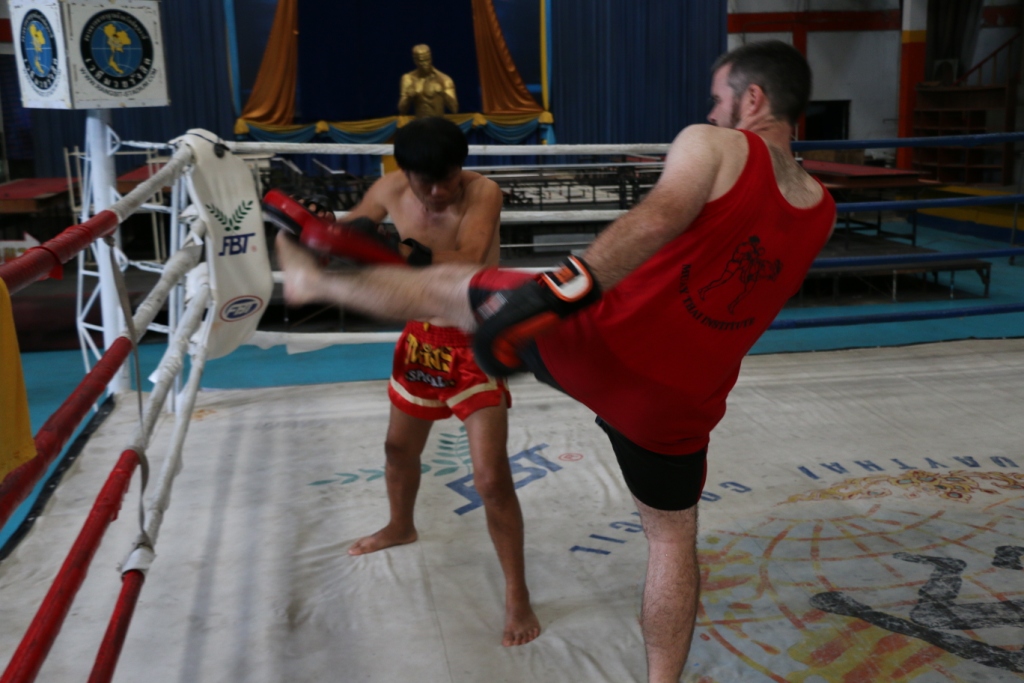
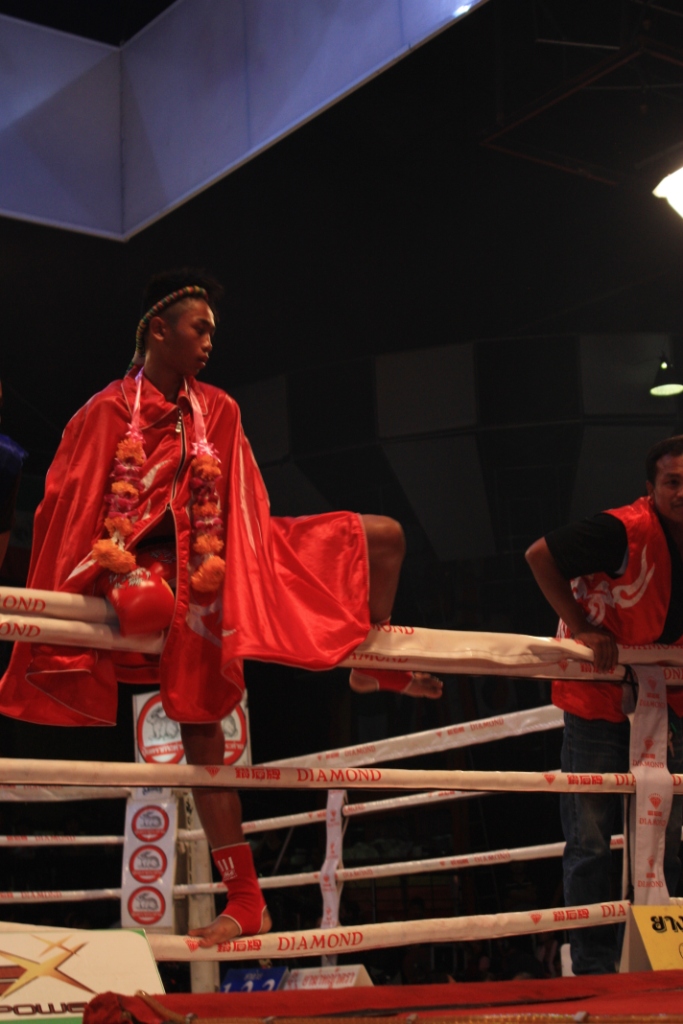
Let’s consider a modest front kick to a target no higher than the solar plexus. One might be inclined to say, “I don’t need yoga to help with that, I do that kick all the time, and have no problem reaching my target.” Do an experiment. Take a full 30 seconds to do the kick, from the time the foot leaves the floor to the time it extends out, and then hold it for 15 seconds, or so. If you succeeded in this without any problem, you may be good to go.

Front kick, slow-motion style.

Front kick, slow-motion style.

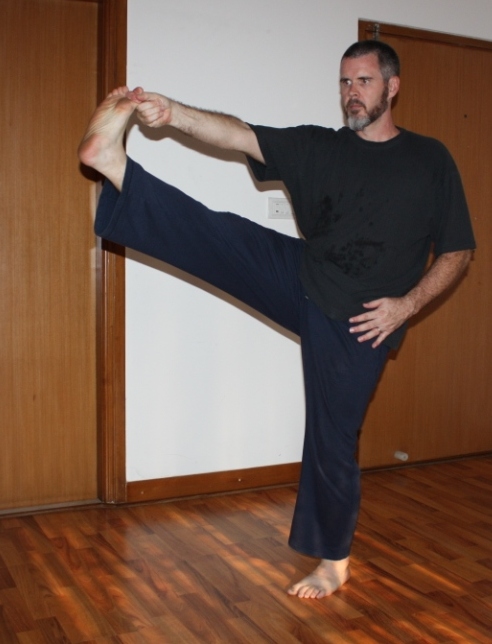
However, there are three problems that might plague one, and yoga is tailor-made to fix two of them. First, you may not have adequate range of motion. You may have thought you did because you can kick at speed and reach the target. But, you say, “Why would I need to kick in slow motion?” You wouldn’t, but this exercise shows you that you are having to use inertia to kick through the resistance of your own muscles. Unless you’re a hardcore bodybuilder that resistance might not seem too daunting, but you are essentially having the brakes applied–albeit softly–to your kick and that’s costing you speed and power.  Yoga can help you develop that range of motion. Consider the pose below, which requires the same type of flexibility.

Hand to Big Toe (Utthita Hasta Padangusthasana)

Hand to Big Toe (Utthita Hasta Padangusthasana)

Maybe you can raise your leg, but keeping it cantilevered in place is too much for you. This means you don’t have the strength to support your own leg. Either your leg is  heavy, your strength is lacking, or both. Building this kind of strength isn’t necessarily yoga’s forte. There are styles and approaches that may help you build that strength, but there are other things you can do that may be more efficient for that purpose–not the least of which is doing a whole bunch of kicks one after the other without a break until your leg is burning, and then doing some more.

You may have had the strength and flexibility, but found it hard to stay on balance. The naysayer says, “Yeah, but that imbalance would never be noticeable at speed. That is (as with the lack of flexibility) one can hide weaknesses with speed. While there maybe some truth in this, a lack of balance will cost you in subtle ways, and yoga can help. There are a number of postures that enhance one’s balance, balance on one’s foot, one’s head, or one’s hands (the latter could be useful for the ground grapplers.)

Warrior III (Virabhadrasana III)

Warrior III (Virabhadrasana III)

Headstand (Shirshasana)

Headstand (Shirshasana)

The Crane (Bakasana)

The Crane (Bakasana)

Tree (Vrksasana)

Tree (Vrksasana)

There are a couple of other areas in which yoga can help one’s performance as a martial artist. One is expansion of bodily awareness of issues of alignment and posture. These might not seem so crucial, but if you are in the martial arts for the long-haul, then having the awareness to make small adjustments can be the difference between chronic ailments or a lack thereof. It can be difficult to discover a misalignment in the quasi-combative environment of martial arts training. It’s easier to notice these issues in the slow and controlled practice of yoga.

Postures like Warrior II and the Side Angle Pose and show you where you are holding tension that you might not otherwise be aware of.

Warrior II (Virabhadrasana II)

Warrior II (Virabhadrasana II)

Side Angle Pose (Utthita Parsvakonasana)

Side Angle Pose (Utthita Parsvakonasana)

It must also be remembered that asana (postures) are only a part of yoga. Another aspect that can be extremely helpful for martial arts is pranayama, or the discipline of breathing.  There’s no substitute for cardio, but that doesn’t mean that one can’t benefit greatly from learning more about how to breath, and the science of breath. This is an area in which yoga excels. The great yogis made extensive study of breath and the effects that are achieved by various types of breathing, and these exercises can expand and strengthen the diaphragm and the muscles of the rib-cage. One tends to see the coup de grace strike and think, “There’s your problem.” However, often it’s fatigue that’s the underlying culprit. Better breathing can reduce fatigue.

Of course, meditation is another critical skill for calming the mind and learning to live in the present. Many martial artists already practice some form of meditation, but this is another option.

There is one more benefit and that is building greater confidence in your ability to exercise control over your body. There are many challenging postures in yoga. I don’t advocate all asana that have been taught historically because there can be such a thing as too much flexibility for a martial artist and some poses exercise joints in ways that were not meant to operate. There needs to be a proper balance of strength and flexibility, a proper tension within /between the skeletal and muscular systems. However, there are many poses that just take a bit of time and effort to develop the skill without putting too much wear on the body.

8-Twists Pose (Astavakrasana)

8-Twists Pose (Astavakrasana)

BOOK REVIEW: Higher Judo by Moshe Feldenkrais

Higher Judo: GroundworkHigher Judo: Groundwork by Moshe Feldenkrais

My rating: 4 of 5 stars

Amazon page

If you’re at all familiar with Dr. Moshe Feldenkrais, most likely it’s for the system of bodily awareness and efficient movement that bears his name (i.e. the Feldenkrais Method.) You may be completely unaware that Feldenkrais was a first-rate judōka who trained under judō’s founder Jigoro Kano, and that his experience with judō played a major role in his understanding of the principles of natural and efficient movement. (It should be noted that Feldenkrais was neither a medical doctor nor a doctor in a medical / biological field, but was a physicist by training.)

Higher Judō was originally published in 1952, and was out of print for many years until a new addition was brought out in 2010 (with three new forwards and some additional back matter.) It’s not hard to imagine why the book made a comeback after such a hiatus–and 26 years after the death of Dr. Feldenkrais. The book explains the ground fighting techniques of judō, which are the basis of Brazilian Jujutsu (BJJ), and BJJ is a dominant form of ground and submission work within Mixed Martial Arts (MMA.) Given the immense popularity of MMA, and the desire of fighters to hone their technique to the utmost, it’s a good time to bring this half-century old book back to the fore.

The book consists of twelve chapters. The first half of these chapters deals with preliminaries such as principles of movement, philosophy, and basic movement exercises. The second half gets into the tactics of ground work. The arrangement for the latter chapters is largely by position of the competitors relative to each other (e.g. the mount, 12 o’clock, side control, in the guard, etc.)

The first half has few graphics, but the last half is packed with line drawings that are based on photographs (ostensibly it was cheaper or easier to reproduced the line drawings back in the day.) The line drawings offer sufficient detail so that one can see what is being done (to the degree one would be able to see it in a photo or even in person—i.e. some of the techniques are subtle and the written description becomes essential.)

The book is a good overview of the basics of ground work with a few unusual and rare techniques thrown in. Feldenkrais points out that some techniques are more important than others, and that one should drill a few of the most critical ones rather than focusing a lot of time on the more eccentric techniques. As I’ve written many times before, I don’t believe that one can learn a martial art from a book. However, if you’ve been taught these types of techniques, you’re sure to find this book an interesting reference with some ideas for approaching ground work training.

Some of the characteristics of the book could be taken as positive or negative, and I’ll leave it to the reader to decide. First, Feldenkrais avoids using names for techniques. He uses neither the common Japanese names for the techniques (e.g. there’s no reference to juji gatame, tomoe nage, or hadaka jime) nor the common English names. He goes by figure number attached to the aforementioned line drawings. Second, he has thoroughly cross-referenced the book such that you might be on the page containing figures 228 and 229, and he’ll make reference to figure 52. So the book involves a lot of turning back (I wrote in the page numbers where off-page figures were referenced so I wouldn’t have to find what page the figure was on each time.) Third, Feldenkrais is a scholar by training and is not averse getting a bit wordy and verging on abstruse. Of course, the flip-side of this is that he provides a great deal of precision in his language. That being said, I found this book readable and much less ponderous than one of his Feldenkrais Method books that I read.

I’d recommend this book for anyone interesting in gaining a better understanding of ground fighting. In the early sections of the book he provides excellent food for thought about the judō approach to movement, and in the latter half he catalogs the basics in a thorough and logical fashion.

View all my reviews

BOOK REVIEW: The Warrior’s Path James Sidney (ed.)

The Warrior's Path: Wisdom from Contemporary Martial Arts MastersThe Warrior’s Path: Wisdom from Contemporary Martial Arts Masters by James Sidney

My rating: 5 of 5 stars

Amazon page

My upfront apology: Having drafted this review, I noticed that the book comes off sounding like a bunch of old folks being curmudgeonly about the current generation. As I read this book, that wasn’t the feeling I got. Therefore, it may be a matter of the points that resonated with me, and be more reflective of myself than the martial arts sensei (teachers) who have chapters in the book. [That being said, young readers be forewarned that your generation does get blasted upon not only in this review, but by the sensei in question.]

Fifteen prominent martial arts teachers offer their insights in this book. The group is in many ways homogenous. All fifteen teachers are practitioners of Japanese gendai budō (the modern-day martial arts that developed after the Meiji Restoration [1868]; as contrasted with kobudō or koryū bujutsu, i.e. old school martial arts). All of these martial artists were born in the 1910’s and 20’s and began their study of martial arts in first half of the 20th century.

These teachers are a bridge between the founders of these arts and the arts as we know them today. In a few cases, they are also bridges between kobudō and modern martial arts. For example, Hiroshi Tada was a student of Morihei Ueshiba, the founder of aikido. While we think of O-sensei (Ueshiba) as a gendai budō practitioner because he founded a modern school, he was brought up on kobudō. Furthermore, students of Gichin Funakoshi (the Shotokan karate founder), Jigorō Kanō (the Kodokan judō founder), Hironori Ōtsuka (the Wadō-ryū karate founder), and Dōshin Sō (the founder of Shōrinji Kempō) are represented.

This book is particularly important in that several of the teachers in it have passed away since the book was published. Time is receding for this generation’s thoughts to be saved for posterity. A cursory google search revealed that at least four of these teachers have passed away: Hidetaka Nishiyama (2008), Tatsuo Suzuki (2011), Keiko Fukuda (2013), and Ron Nobuto Omoto (2013.) However, some were more well-known internationally than others, so there may be a few others that passed on without attracting the attention of English-language websites. However, the youngest of them is 84 (the oldest believed living is 97), and so it’s safe to say there may not be many more chances to hear these people’s wisdom.

I’ve pointed out the homogeneity of this group, but there’s also a diversity about them. Practitioners of karate, judō, aikidō, shōrinji kempō, kendō, kyūdō, and Atarashii Naginata are represented. Despite the notoriously male-dominated nature of Japanese martial arts, at least there are two women’s voices in the mix. While all of the artists are of Japanese ancestry, they’re not all Japanese by citizenry. There are two Americans and two Canadians among the bunch, and one individual who was born in China. There are also individuals who were born in Japan but moved abroad to places like France and Brazil to spread their art.

There are a few themes common across multiple of the commentaries. It might be tempting to dismiss some of these points as the “back-in-my-day” sentimentality of the aged, but their experiences are sometimes too similar to lack veracity.

First, several of the teachers said there was much less doggedness in recent generations than in their era. People come into the dōjō (a martial arts school), dabble a little, and–if they’re not constantly entertained by new and fancy techniques–they quit. As a result, there are many practitioners who possess a vast repertoire of technique, but they aren’t skilled in any of it—and even more who get nowhere. The theme was that there is no fast-track to success in budō, one has to work at it day in and day out. It should be noted that all of these individuals were born before 1930, and yet were still teaching / training in 2003 when the book was published.
Second, this generation devoted considerable effort to developing the mind as well as the body. With the availability of better nutrition, training equipment, and sport science, young martial artists may be physically fitter than ever on average (I’m talking about competitors not those using martial arts as a fat camp), but they are also mentally weaker than ever—with limited attention spans and emotional control. Present-day martial arts students often give little credence to the value of training the mind or carrying a martial arts mindset outside the dōjō. Several of the teachers in this book mentioned practicing Zen or some other form of mental exercise, and some emphasized the importance of carrying the clarity and intention of the dōjō about everyday life.

The problem with this is that the martial arts become a young man’s game, and there becomes a lack of experience. A student does a martial art for a few years and then abandons it because his or her physical athleticism isn’t going to increase. This decreasing physical capacity translates into becoming a weaker martial artist. The only way to grow in the long-run is to become mentally stronger, more self-confident, and having better emotional control.

The problem is that this mental strength and confidence often becomes confused with arrogance or cockiness. But as Nobuyuki Kamogawa (kyūdō) points out, the problem with arrogance is that one can’t see one’s weaknesses—and, thus, can’t grow. While Japanese arts may seem overly-formal (and there can be truth to that), it shouldn’t be forgotten that part of what this formality does is (potentially) build mental discipline and humility.

I think Toshiro Daigo best summed up the problem of not living the art. He said, “But to young Japanese people, judō becomes judō when you put on your judō costume. So without the costume, judō doesn’t exist.”

Third, judō, karate, and kendō teachers bemoaned a shift away from the pursuit of victory by decisive technique (e.g. the the ippon.) Over time, there has been an increased reliance on building up a win by minor points. In judō this may mean trips instead of throws; in kendō it means going for the forearm rather than the head. In other words, competitors have become more risk-averse and less bold. Concern about this is two-fold. For one thing, there’s a worry about the dilution of these arts, but there’s also concern about the sport becoming less interesting to watch and thus losing its following.

Related to the previous two criticisms is a concern about training to build champions, while forgetting to forge good students. This was emphasized not only by some of the sport-oriented art teachers, but also by Hiroshi Tada. Tada, as an aikidō practitioner, is in the unique position being the only one of the teachers to practice a non-sport martial arts system.

Fourth, several sensei suggested the importance of learning for oneself. One of the teachers, Rod Nobuto Omoto, was an uchi deshi (live-in student), and he—as in the old days—spent a lot of time doing chores while getting little to no training. The point is not so much to criticize the younger generation, but to inform them that they must take the reins of their martial arts practice. This may come to a surprise because the educational experiences they are most used to is having information handed to them in as learnable a form as possible.

Fifth, there was a general disdain for the idea of thinking of one’s art as being inherently superior to all others. Masao Takahashi (judō) and Mitsusuke Harada (karate) both made this point. Harada proposed that abject faith in the superiority of one’s art encourages the development of martial artists who cannot defend themselves. If you think your system is inherently best, you may begin to rely on that illusion of superiority rather than on the advancement of your own skill.

Sixth, the importance of mutual benefit was emphasized throughout. Of course, for the judo practitioners, the idea of jita kyoei (self-perfection, mutual benefit) is one of the two Kodokan budōkun (martial arts maxims.) [The other being seiryoku zenyo, or maximum efficiency.] Shigeru Uchiyama said that the belief in Shōrinji Kempō (whose practitioners are also Kongo Zen pupils) is that of “…living half of your life for yourself and half for others.”

A couple of other points that caught my attention were brought up by individual teachers.
Keiko Fukuda expressed concern about women being trained in the same manner as men, and, thus, using too much strength. The 9th dan was concerned about injuries resulting from this over-reliance on strength. This is an interesting point which I hadn’t given much thought. No doubt it’s a controversial point as well. It’s hard for me to comment about whether Fukuda is just old-fashioned and a product of her time and culture (which is, I’m afraid, highly misogynistic) or whether her point is valid. However, I’d be willing to give her the benefit of the doubt as she was an extremely impressive woman.

Lest one think that these are all just traditionalists trying to keep the traditions alive, consider a quote by Yoshimitsu Takeyasu that speaks otherwise. “Not all traditions are good but we have to identify the ones that should be kept.” Rod Nobuto Omoto said simply, “Tradition is not important.” However, I think Omoto’s point is more nuanced than it seems (and perhaps more Taoist) in that what he seems to be saying is that if you make the tradition important it becomes about the tradition and not the what lies beneath the tradition (e.g. values, etc.)

Omoto also offered a great deal of thought-provoking insight into death. It was clearly a topic that he’d reflected on not only as someone coming to the end of his life, but also as one who practices budō.

I think this is an important book for martial artists of all stripes. However, I think that even non-martial artists might learn a thing or two from the insights of these old masters.

View all my reviews

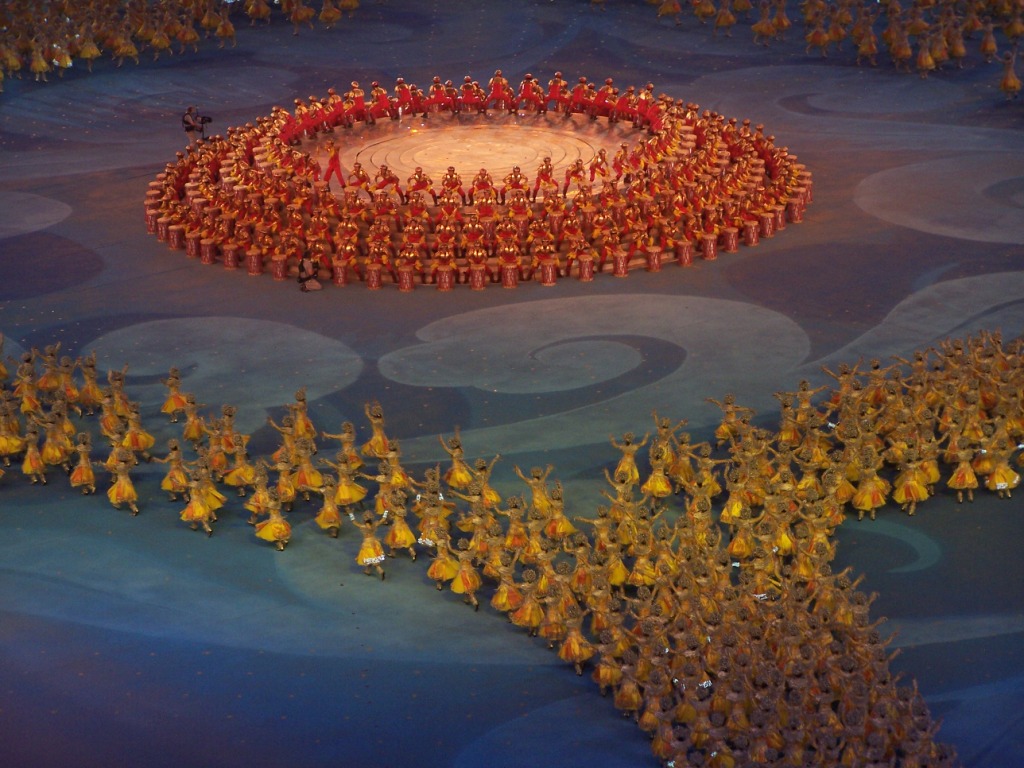
DAILY PHOTO: Closing Ceremony of the Beijing Olympics

Taken by my wife.

Taken by my wife.