BOOK REVIEW: Faster, Higher, Stronger by Mark McClusky

Faster, Higher, Stronger: How Sports Science Is Creating a New Generation of Superathletes—and What We Can Learn from ThemFaster, Higher, Stronger: How Sports Science Is Creating a New Generation of Superathletes—and What We Can Learn from Them by Mark McClusky

My rating: 4 of 5 stars

Amazon page

McClusky’s book tells us how advances in sports science and technology are producing a new class of elite athlete. More usefully, it discusses which practices of high-level athletes can reasonably be emulated by amateurs. One may think that what’s good for the goose is good for the gander. In this case, not so much. If shaving a hundredth of a second off your time isn’t going to affect your life’s course, there are many activities of elite athletes that simply aren’t worth the cost (in whatever terms.) For example, the loss of friendships due to rampant flatulence resulting from consuming large quantities of baking soda isn’t worth it if you just want a little bit stronger Sunday cycling ride. (Baking soda [sodium bicarbonate] counteracts blood and muscle acidification during exercise and makes it possible to keep moving strongly when fatigued would normally degrade performance. Incidentally, this practice has been shown to be effective only for events that last between one and seven minutes.) On the other hand, some of the lessons of sports science are relatively low-cost and high benefit, and might be just what one is looking for to improve one’s performance. (e.g. Replacing a pre-workout stretching routine with one of rolling out the muscles.)

Faster, Higher, Stronger consists of twelve chapters, each addressing a different aspect of the application of science and technology to sport, including: training methods, genetics, nutrition, recruitment, practice, performance enhancing substances (legal and illegal), elevation training, and the limits of performance.

One question that has always been of great interest is how much of a top athlete comes from his or her genes? In other words, can anyone can do it–given a willingness to work like a maniac of course. As with many other questions about heredity, it was once thought that there would be a precise answer to this question in the wake of the decoding of the human genome. However, the success of the human genome project showed only that the situation was vastly more complex than we’d imagined. It turns out that having certain genes isn’t the end of the story because there are many factors that influence which genes are expressed. Attempts have been made to put numbers to the influence of genetics. For example, one scientist is quoted as claiming that 50% of oxygen processing capability (i.e. VO2 max) is heritable. This translates to the fact that, while the average Joe has a reasonable chance of engaging in athletics at some level, only a 0.1 to 0.3 % can summit the pinnacle of elite level athletics.

In many ways, science has encouraged coaches, trainers, and recruiters to think outside the box—and to look beyond the traditionally engrained approaches. One fascinating story was that of how the British national rowing team held tryouts based only on height, with experience with the sport being not required. They ended up with a champion rower who’d first entered a boat only four years before. This is part of the evidence that controverts the once popular 10,000 hour rule that was popularized by Malcolm Gladwell–though Anders Ericsson is more properly considered the father of the idea. It turns out that 10,000 hours of practice aren’t required for most activities if one goes about it right.

McClusky spends a considerable amount of space on the questions of what athletes should and shouldn’t consume. In emulating elite athletes many amateurs are working at cross purposes. This is readily seen with the issue of sports drinks. If you’re guzzling down a Gatorade or snacking on Cliff Bars after your run, you may only be ensuring that you continue to gain weight despite working out. On the other hand, you may decide that chocolate milk or beet juice are good choices for you.

I’d recommend this book for those interested in the heights of human performance.

View all my reviews

The Legend of Nai Khanomtom: Hero of Muay Thai

?????????????

Muay Thai Institute in Rangsit, Thailand

In 1767 the Ayutthaya Kingdom of Siam fell to the Burmese. Burma occupied Siam only briefly because Burma’s king, King Hsinbyushin (a.k.a. King Mangra), was forced to withdraw his troops to combat a Chinese invasion to his homeland. The Thais were fabled to be valiant fighters and even had a numeric advantage, but they were easily put into disarray by Burmese forces. Even King Mangra was said to have declared that he couldn’t have taken Ayutthaya had the leadership of the opposition been more effective. [Keep in mind that even if he did say this, it might have been more a dig at his Thai counterpart than an expression of his true feelings.]

The Burmese captured a many prisoners during their Thai campaign and true warriors were particularly coveted as prisoners. One such fighter was Nai Khanomtom (fyi: it’s also written Nai Khanom Tom.) Nai Khonomtom was renowned for his skill in Muay Boran, an early Thai fighting style related to Muay Thai. This made him a logical choice to headline for the Thais in a tournament that would pit Muay Boran against Thiang–i.e. the indigenous martial arts of Burma (e.g. Lethwei and Bando.) The tournament would be part of King Mangra’s seven day festival in honor of Buddhist relics, the festivities of which would also include plays, comedians, and sword fights.

Nai Khanomtom was pitted against a Burmese champion, a man who was clearly the audience favorite. Timed rounds didn’t exist in those days. Fights stopped when one of the fighters was physically unable to continue, and not before. The Burmese fighter wore a kind of sarong that was the usual attire for the men of Burma, and Nai Khanomtom wore a loin cloth tied up in the traditional Thai style (see the statue pic above.) Each fighter wrapped only ropes on their forearms and hands, and each may have had some padding over the groin–though not as insurance against an accident, but because crotch kicks were fair game.

Nai Khanomtom began with a Wai Kru, which perplexed the Burmese. Wai Kru is a pre-fight ritual that has several purposes, the most important of which is to show respect for one’s teachers, deities, and the audience. The practice can take several minutes and some variants of it can be physically demanding.

When the fight started, Nai Khanomtom charged over the fight space taking the fight to his opponent and laying down a barrage of kicks, knees, elbows, and punches. By some accounts, his victory was declared invalid by a judge, who’d been distracted by other festival events (and who–no doubt–wasn’t pleased by the swift defeat of the Burmese champion.) The decision was made despite the fact that the Burmese fighter had been knocked unconscious.

The King was thrilled by the fight and offered Nai Khanomtom his freedom if he could fight nine more Burmese fighters. Nai Khanomtom didn’t get breaks between these fights, and as soon as an opponent went down the next was queued up to come after the Thai fighter. And so it was that Nai Khanomtom took on the Burmese fighters in an ironman fashion. The last of his opponents was a famous martial arts master teacher from Rakhine, a coastal region in Burma’s southwest. Nai Khanomtom went after the Rakhine master with flurry of kicks. It’s worth noting that in those days Burmese fighters were said to have relied much more heavily on hand strikes than kicks, and so the kicks may have given Nai Khanomtom a range advantage while presenting his opponent with attacks that the Burmese fighter was less practiced at defeating.

At the fight’s end, King Mangra honored his agreement, and Nai Khanomtom was granted his freedom and provided safe-conduct back to Siam. There are varying accounts that say that Nai Khonomtom returned home with either two Burmese wives or a number of his fellow prisoners as an additional payment for providing a spectacle that the Burmese king found gripping. In these accounts, Nai Khanomtom is usually said to have turned down a cash payment.

There’s a quote that’s often attributed to King Mangra that goes, “Every part of the Thai is blessed with venom, even with his bare hands he can fell ten opponents.” [FYI-It should be noted that seeing the same words quoted by several sources isn’t proof of truth, because the quotes could have a common (and false) point of origin.  So take it all with a grain of salt.]

[Note: The details of this story vary. So you may hear–or have heard–a slightly different version of events. The exact details are likely lost to history and–when that happens–embellishment may creep in. That said, the variations that I’ve heard are neither great nor particularly significant. It’s also worth noting that these events are celebrated in Thailand every March 17th on what is called Boxer’s Day or National Muay Boran Day.]

The 4% Rule, Yerkes-Dodson, and Finding the Sweet Spot in Martial Arts Training

I was watching one of Michio Kaku’s Big Think videos recently that addressed American science education. The question of interest was how America continues to do so well in science and technology given that the American (primary and secondary) educational system isn’t up to par in science and mathematics with its technological competitors. The bulk of his talk (re: the H-1B visa and importation of brain power) isn’t germane to this post. It’s Kaku’s mention of a second secret weapon that caught my attention, and that’s how America is able to do a better job than many of its competitors in identifying and nurturing top talent. While math and science education is better in many Asian countries, those countries (e.g. Japan, Korea, or China) don’t excel at skimming off the cream of the crop. Dr. Kaku explains that this is because Confucian values teach students to conform, and students are loathe to stand out–even for exceptional performance. Even if a student wanted to show their talent in hopes of having it fostered, the large classes, lecture-centric teaching, and testing of memorization and standardized processes doesn’t offer much opportunity to grow one’s individual strengths.


Kaku’s statement resonated with me because I’ve been thinking about the pros and cons of traditional approaches to martial arts instruction. I’m particularly interested in the gulf between the traditional approach and what martial arts teaching would look like if one took advantage of the wealth of scientific knowledge about mind and body development. Most of the martial arts instruction I’ve received over the years is consistent with Confucian thinking. All the students are doing the same practice (or faking it to the best of each’s abilities if it’s beyond one’s current capacities), and each is trying to closely emulate the teacher-presented ideal as much as possible. There’s not much consideration of the individual student’s weaknesses or strengths. Emphasis is on trying to convey as high-fidelity a replica of the techniques that have been handed down through the ages. (While this may be a laudable goal, I’ll later offer explanations as to why I think it’s both death for retention of students and ultimately counterproductive.)


Let me first say that there are a number of advantages to the traditional approach to martial arts instruction. First, it’s easy to teach many students at once. This was probably a huge advantage when there were armies of men having to learn these skills. Second, [theoretically] it helps students reduce their egotism through discipline and conformity. The highly hierarchical nature of this approach means students spend years in a lowly position, with the hope that some humility may stick. (NOTE: I’m not certain that this works out in practice.) Third, it creates a disciplined learning environment that is conducive to helping a student keep his or her head in the game.


What the traditional approach isn’t so good at is producing students who all perform at the best of their abilities. I suspect that the traditional approach doesn’t do so well for student retention either. It’s a system in which new students are forced to drink through the fire-hose; while students who’ve been around for a while often feel like they’re stagnating.  As I’ll get to below, there’s good reason to believe that a proper match between the challenge of a task and the performer’s skill level is critical to creating an intrinsically rewarding activity and to helping students perform at their best.


My thoughts on this topic have been heavily influenced by learning and teaching yoga. While one’s vision of a yoga class may be rows of students doing the exact same posture (and huge classes and / or poor instructors may result in that condition),  but there’s often a degree of variation in a class. This variation results from two concepts that I’ve been thinking about quite a bit lately, namely modifications and capacity building.


Modifications are a two-way street. If the task at hand is beyond the student’s current abilities, he or she may be given an easier variant that allows him or her to work toward the fundamental form. On the other hand, if the task of the moment is old hat, a student might be offered a more challenging version on occasion. I’m not suggesting that one shouldn’t drill the basics throughout one’s martial arts career. Repetition of fundamentals is key to drilling them down into one’s nervous system. However, the brain loves novelty and hates drudgery, and it will become harder and harder to remain engaged if the overall challenge level doesn’t rise. The science suggests that one needs to keep upping one’s game if one wants to perform at one’s best.


The nature of modifications in martial arts may not seem as clear as it is with respect to yoga postures. For randori, sparring, and other free-form training, it’s easy to envision how one can adapt the practice to reduce or increase the challenge to a level more apropos of the student’s skill level. One can practice a restricted form. For example, one may work only on sparring with boxing rules to kicks or grappling out of the equation until a student builds up his or her confidence and abilities with recognizing and responding to punches. Alternatively, an advanced student might be presented with armed or multiple attackers. There are some practices, such as specific techniques, for which modifications may not be an option, but that doesn’t necessarily let a teacher off the hook for helping a student who’s challenged by the technique. That may be where capacity building exercises come into play.


Capacity building goes beyond offering an easier modification to suggesting exercises to help the student build the physical capacity to do the technique repetitively WITHOUT INJURY. I emphasized those last two words for a reason. In some martial arts, the need for capacity building exercises maybe clear because of the acrobatic insanity involved. However, practitioners of more pragmatic martial arts may say, “We don’t do all those fancy spinning back kicks, so we don’t need capacity building. Anybody can do our techniques because they’re simple and direct.” Maybe that’s true, but if multiple members of your school have the same (or similar) repetitive stress injuries, it’s not true at all.


What kind of capacity building are we talking about?  If the technique involves jumping or leaping and the individual is gravitationally-challenged, then plyometrics might be the prescription. On the other hand, if the problem is the inability of the student’s joints to withstand the technique, there might be need for exercises that build up stabilizing muscles, help him / her to cut weight, or both. If a student can’t do a throw without risk of injury, maybe that individual needs to spend time practicing with elastic bands or inner tubes or working on their balance.


RiseOfSupermanWhat is this 4% rule? I read about it in Steven Kotler’s The Rise of Superman. As background, there’s a state of mind called “Flow” that’s associated with performing at one’s best. In this state of mind, which some call “the zone” and others probably once called satori or samadhi, one’s concentration on the task at hand is at its greatest, unnecessary features like sense of time and sense of self fall away, one’s inner critic shuts the hell up, and–at least afterwards–there’s a blissful state. Flow can be described as the shutting down of specific elements of the pre-frontal cortex (PFC)–largely involved with the consciousness mind. It can also be defined neuro-chemically by the hormones released (i.e. Serotonin, Endorphins, Dopamine, Anandamide, and Norepinephrine) and neuro-electrically in terms of one’s brainwaves (around 8 Hz.)


There are conditions that favor achievement of Flow, notably: 1.) clear goals, 2.) immediate feedback, and 3.) a good match between the level of the challenge and the level of one’s skill. Flow is a key factor in why some activities are intrinsically rewarding (whether or not they are rewarding in other ways) and why almost any activity can be intrinsically rewarding if it’s sufficiently challenging relative to one’s abilities. What’s sufficiently challenging? That’s where 4% comes into the picture. While it’s by no means an exact or universal value, it turns out that when a task presents a challenge that is roughly 4% above one’s present skill-level is when this state of mind is most accessible. This is why one may see students drop out if they find the level of challenge stagnant. On the other hand, one may not keep new students either if the challenge is constantly beyond their abilities.


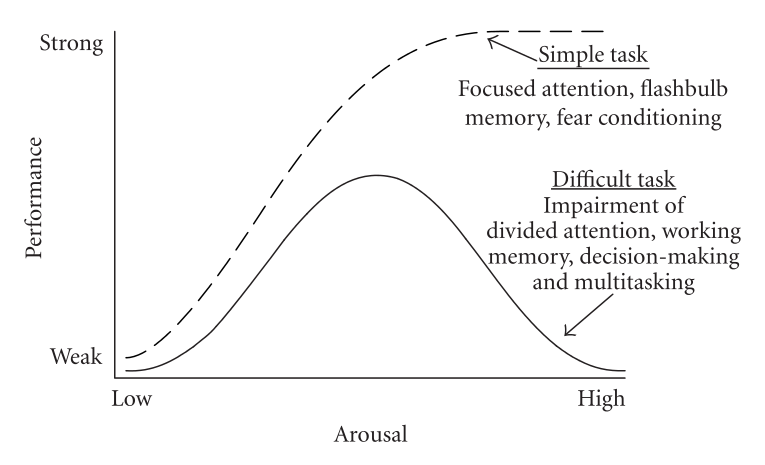
How about that Yerkes-Dodson? The two early 20th century scientists for whom the Yerkes-Dodson Law are named discovered that performance increases with arousal (one might do best to think of this as anxiety level rather than the colloquial use of that word) up to a certain point, beyond which performance either levels off or plummets–depending upon the nature of the objective.  The point is that keeping the training environment too sterile has it’s disadvantages. In free-form practices like sparring, a little nerves can be a good thing, but being overwhelmed can be detrimental.

Yerkes-Dodson Curves. Source: Wikipedia

Yerkes-Dodson Curves. Source: Wikipedia

Adjusting one’s instruction to the abilities of one’s students is challenging. Traditionalists may hold that it’s far more important to keep the tradition intact than it is to cater to the individual needs of students.  That is, said teachers may prefer to focus on the aforementioned high-fidelity transmission of the teachings of the lineage. There was a time during which I probably would have echoed that sentiment. However, it increasingly occurs to me that producing the best and most engaged students is the best way to keep a tradition alive.

6 Science Books That Martial Artists Should Read

When one has a passion for an activity,  it’s easy to get tunnel vision and miss out on the many avenues of information by which one might improve oneself.  I’ve done many posts on martial arts books, but I thought it might be useful to do one about books that aren’t about martial arts per se, but which have none-the-less contributed to my thinking as a martial artist.


1.) On Killing: The Psychological Cost of Learning to Kill in War and Society by LTC Dave Grossman
OnKillingWhat it’s about? Psychologically, it’s a lot harder to kill another human being than one might think. Even when one is a combatant in a just war, the reluctance to kill–even one’s sworn enemy–is intense. Grossman examines the roots of this reluctance, what methods have been employed to get soldiers over it, and what the cost of doing so is.

The book also goes into a topic one might find surprising: video games. Not to give too much away, but military researchers discovered that getting infantrymen to kill required conditioning them to shoot targets that look human. This resulted in moving from bulls-eye targets to silhouettes, pictures of humans, and even Firearms Training Simulators (i.e. FATS, systems that run shoot / no-shoot scenarios on a screen, like an interactive movie.) It turns out that shoot-em-up video games may contribute to a child’s conditioning to be willing to shoot another human being.

Why it’s a good read for martial artists? Martial arts vary radically in realism and relevance to combative situations, but it’s easy for students of the martial arts–even martial arts that seem “hardcore” and self-defense oriented–to have unrealistic notions about the realities of combat. As François de La Rodefoucauld said, “One cannot answer for his courage when he has never been in danger.” By reading this book one might, perhaps, begin to rethink one’s assumptions, and change how one prepares to defend oneself and others.

Further reading on related topics:  I’ve heard good things about the works of Rory Miller–particularly Facing Violence and Meditations on Violence, but I haven’t gotten around to reading his books yet. If you have, please feel free to comment with your thoughts.


2.) The Rise of Superman: Decoding the Science of Ultimate Human Performance by Steven Kotler
RiseOfSupermanWhat it’s about? Kotler examines a state of mind that is widely call “flow,” and how extreme athletes are tapping into flow to achieve unprecedented advances in performance. There are a number of ways by which this state of mind can be defined, e.g. neurochemically (i.e. a neuro-cocktail of serotonin, anandamide, endorphins, dopamine, and norepinephrine), neuroanatomically (transient hypofrontality), neuroelectrically (high theta / low alpha wave–i.e. between meditation and resting wakefulness), or psychologically (intense concentration on a challenge that’s just beyond one’s present skill level.)

Kotler proposes that risk is an important trigger for entering a deep state of flow, and that this is why extreme athletes are proving so much better at achieving these states (and translating them into radically increased performance) than many other groups who seek to master flow.

Why it’s a good read for martial artists? It should be noted that not only is flow not a newly discovered state of mind, but it sounds a lot like the state of mind that martial artists have sought for centuries in the practice of their arts–often in conjunction with disciplines such as Zen or Vajrayana Buddhism. What is new, which makes this book worth reading, is an understanding of the science behind flow states. By moving beyond the hazy mix of truth and falsehood embodied in systems of spirituality, one may be able to find a way to more reliably increase one’s performance.

Further reading on related topics:  Flow in Sports: The Keys to Optimal Experiences and Performances is a book that is co-authored by the granddaddy of flow research Dr. Mihaly Csikszentmihalyi.


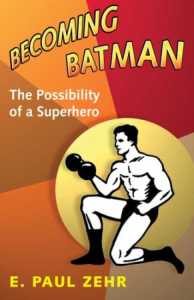
3.) Becoming Batman: The Possibility of a Superhero by E. Paul Zehr
Becomingbatman

What it’s about? (Arguably, this is a martial arts book, but I’m including it because one wouldn’t get that from the title or blurb.) This book’s central question is whether a real life person could achieve the level of crime-fighting bad-assery that is the Batman, and–if so–what combination of genetics, training, and conditioning would be required. It also addresses what would be the cost in terms of wear and tear on one’s body and how long one could be expected to maintain said abilities. (Also, for the martial artists of feminine persuasion, how Batgirl or Catwoman might fair in combat against Batman.)

Why it’s a good read for martial artists?   There is tons of great information relevant to martial artists about the toll of extreme practice and regular fighting on one’s body (e.g. concussions, broken bones, etc.), what the limits of human performance are, by what means those limits are approached, and how realistic it is to have an unreciprocated policy prohibiting lethal weapons.

Further reading on related topics: Actually, if you know of any books on related topics, I’d love to hear about them. There are a number of such books, but they’re on textbook pricing (i.e. insanely expensive.)


4.) Extreme Fear: The Science of Your Mind in Danger by Jeff Wise
ExtremeFear

What it’s about? This book is about the mental and physical effects of mortal peril, and why some people’s performance excels under dire threats while other people just let themselves die while cowering in a fetal ball. The book asks what we can all learn from those people who manage to keep their heads about them when death seems certain.

In the interest of full-disclosure, as of this writing I’ve not completed this book. I just started it and am only in the second chapter. However, so far it’s been both informative and interesting.


Why it’s a good read for martial artists? Much like On Killing, I think this book may be valuable because there are many martial artists with daydream-induced misconceptions about how they will perform in dangerous situations. This book may help one evaluate one’s true state of preparedness, and discover how to go about making changes to improve one’s level of preparedness for a worst-case scenario.

Further reading on related topics:  If you want a scholar’s account, the book Anxious by Joseph E. Ledoux may be more your style. (Wise is a popular science writer.) I see that Ledoux is cited a lot in books I’ve been reading as of late, but I can’t say I’ve read any of his books yet. However,  I know he’s widely regarded as one of the foremost experts on fear. It looks like his book isn’t so much on mortal peril as Wise’s book, and covers all kinds of anxiety and fear.


5.) Faster, Higher, Stronger: How Sports Science is Creating a New Generation of Superathletes–and What We Can Learn from Them by Mark McClusky
FasterHigherStrongerWhat it’s about? The super-long subtitle says it all. It’s about how athletic performance is being improved by bringing scientific methods to the study of sports, and–as the second half of the freakish subtitle suggests–it explains how amateurs can put this information to good use. There are some methods used by elite athletes that aren’t at all suitable to the run-of-the-mill martial artists (e.g. don’t consume mass quantities of baking soda.) However, there are other approaches to nutrition and training that are readily translated to amateurs without much downside.

Why it’s a good read for martial artists? You may or may not think of yourself as an athlete. I can hear some martial artists saying, “I don’t practice a sport, I’m a martial artist. I deal in lethal combat, not games. yada, yada, yada…” Maybe so, but fitness, nutrition, and conditioning matter. If you want to be able to hold your own against more skilled opponents, you need to improve your capabilities and capacities. Fitness matters. If you think technical proficiency will get you through any situation, you haven’t run up against someone who is both technically skilled and highly fit–and when you come up against said person, your disillusionment will be swift.

Further reading on related topics:  As with the Becoming Batman book, most of the books on this subject are textbooks and are outrageously priced. If you know of other books in this vein, I’d love to hear about them.


6.) Buddha’s Brain: The Practical Neuroscience of Happiness, Love, and Wisdom by Rick Hanson et. al.
BuddhaBrainWhat it’s about? This book turns the lens of modern science on the serene, immovable state of mind that martial artists have historically sought out through Buddhist and yogic systems. It discusses how Buddhist practices help people to be more cognitively effective and less prone to emotional manipulation or disturbance.

Why it’s a good read for martial artists?  If one reads the works of warriors–ancient and modern, one will discover that the greatest warriors place a premium on the importance of the mind.

Consider the famous swordsman Miyamoto Musashi. Musashi was exceedingly successful in defeating his enemies by making them angry. He would show up late and behave disrespectfully, and he would make his own mind imperturbable. This allowed him to easily defeat warriors who were considered at least his equal in terms of technique.

Further reading on related topics: There are many books that look at similar questions.  Zen and the Brain is probably a better book in terms of the amount of information / insight provided, but it’s a much more daunting read. I wouldn’t put the latter in the category of “pop science” as much as just “science.”  (Zen and the Brain is also a much older book.)


These are my recommendations, I’d love to hear about yours in the comments section.


3 Levels of Movement Coach

I.) New teachers and coaches often over-rely on their personal experience. In other words, one may think that the skills that came easily for one will be a piece of cake for one’s students as well. Conversely, such a teacher tends to be more sympathetic and lax when it comes to skills that kicked his or her own ass. This may work for some students, but it’ll be way off the mark for others. There’s a risk of pushing students too hard on skills that may be dangerous for them, and / or not helping them achieve a breakthrough that they are capable of because of one’s own baggage.


II.) The next level of coach recognizes that there are different body types. Such teachers put this knowledge to use in determining what skills present greater or lesser risk for a student given the strength, power, speed, flexibility, etc. associated with such a body. This coach will recommend modifications and capacity building exercises based on the student’s body type.


III.) Then there is the coach or teacher who can see the individual idiosyncrasies of a given student’s body and make recommendations based the unique conditions, strengths, and weaknesses of a particular person.

BOOK REVIEW: Becoming Batman by E. Paul Zehr

Becoming Batman: The Possibility of a SuperheroBecoming Batman: The Possibility of a Superhero by E. Paul Zehr

My rating: 5 of 5 stars

Amazon page

[Note: This book is about sport and exercise science, particularly as they pertain to the martial arts. If you’re a martial artist or are interested in fitness and movement arts at the extremes of human capacity, you’re in the right place. If you’re interested in the comics and an overview of topics including how many billions Bruce Wayne needs and what technologies Batman must master, those aren’t questions addressed in this book. Such readers may find the book delving into depths they aren’t interested in on biological science. There are articles on the web that deal with topics like the “Cost of being Batman.”]

Next summer an eagerly awaited movie entitled Batman v Superman: Dawn of Justice hits theaters. Who knows how much screen time will involve the fight between the titular characters, but the same battle has played out a number of times in the comics, and its appeal is clear. What are the limits of human capability given training, technology, and sufficient smarts? Can a man really defeat an alien that’s faster than a bullet and more powerful than a locomotive? A popular fanboy mantra is, “I like Batman, because I could be Batman. Batman has no superpowers.” So, yes, if you were a billionaire, genius, with the physique of a Greek god, and knew 127 martial arts, you too could be Batman. Or could you? That question is at the heart of Zehr’s book.

Becoming Batman is arranged into sixteen chapters divided among five parts. It begins logically with the question of whether Bruce Wayne needs to begin at any particular point to achieve success in transforming himself into Batman? (At the extreme, one probably can’t imagine Bruce Wayne becoming Batman if he was born with one leg a foot longer than the other and with a Quasimodo hump, but given a Bruce who is starting out “average,” what are his limitations.) In other words, how much does genetics come into play. In the first part, Zehr introduces a character, Bob Wayne, who doesn’t appear in the comics. Bob is Bruce’s twin, and is used throughout the book for comparison purposes, i.e. to convey what Bruce Wayne would look like if he didn’t train fanatically to be Batman. The question of how much of Batman is innate and how much is painstaking built by exercise and training is critical to determining how many of those fanboys really could be Batman.

There a series of chapters explaining the mechanism by which stressors result in a stronger, faster, more powerful, and more resilient Batman. The idea is that Mother Nature doesn’t over-engineer. The only way one gets stronger muscles is by overloading them, which triggers a process of rebuilding them bigger and better than before. Wolff’s Law defines the same concept for bones, i.e. bone density increases in response to increased loading. (Incidentally, the same is true of the mind. A more agile mind is achieved only by working it, and zoning out in front of the television results in a dumbening.)

The next section shifts from generic exercise science to questions of Batman’s martial arts training. What kind of martial arts (or arts) would Batman practice? There is an often quoted statement in the comics to the effect that Batman had mastered 127 martial arts. (This is ridiculous, but it does spur the intriguing question of how many systems does Batman need to learn to have a well-rounded skill-base without being a dabbler? Many will say one art—the right one–is enough, others will say that–given the varied cast of villains he must defeat–Batman needs a broader skill-set than any existing art provides.) More to the point, how many hours does one need to practice a technique to ingrain the movements into one (e.g. neurologically it takes repetition to optimize efficiency.) This is among the questions discussed in this book.

The fourth section deals with the ravages of being Batman, and how much any human could be expected to endure. In this section, one will learn about the cumulative toll of concussions, the likelihood of Batman avoiding broken bones and other injuries that would necessarily sideline his crime fighting, and the effect that working the night shift would have. (The latter might seem trivial in comparison to the former two topics, but—in fact—it’s not. It’s well established that night workers have higher incidence of some cancers and other ailments. Furthermore, as Bruce Wayne has to keep appearances up, it means not only fighting circadian rhythm issues, but also frequent sleep deprivation—the hazards of which are even clearer and occur in short order.)

There are a number of interesting topic that aren’t don’t pertain to the core question per se, but which are interesting for fans of the Batman canon and the character’s mythos. Famously, Batman doesn’t use guns or lethal force. This raises the question of how realistic it is to regularly fight hardened knaves and miscreants without killing them. One can only knock out so many of Gotham’s baddies before one doesn’t get up.

There’s a chapter about what a fight between Batman and Batgirl would be like. While strength would definitely be to Batman’s advantage, there are advantages that an equally skilled female fighter might bring to the fight? How would Batgirl (or Catwoman) need to fight to put those advantages to use? Finally, for those of us who are no longer spring chicks, there are chapters about how Batman could expect to age, and how long he could keep performing at a level at which he could defeat his enemies.

I enjoyed this book and found it both educational and interesting. It should be clear that Batman is just a teaching tool used to explore the limitations of the human body and its ability to endure a life of fighting. That said, references to the Batman comic books and movies makes for a readable text. Perhaps what I like most about this book is that most of the books that address these subjects are textbooks that are sold on the textbook pricing model (i.e. we have a limited but captive audience so let’s make them pay top dollar.) This is one of the few books that takes on these topics at the readability and pricing model of a popular science book.

I recommend it for those interested in the science of performance, martial arts, and injury.

View all my reviews

DAILY PHOTO: In the Clinch


Taken in August of 2014 at the Rangsit International Boxing Stadium

Taken in August of 2014 at the Rangsit International Boxing Stadium

IMG_1434 IMG_1542 IMG_1579

BOOK REVIEW: The Pyjama Game by Mark Law

The Pyjama Game: A Journey Into JudoThe Pyjama Game: A Journey Into Judo by Mark Law

My rating: 4 of 5 stars

Amazon page

Mark Law’s book contains two types of book in one volume, unified by the theme of judō. On the one hand, it’s a microhistory of the martial art and sport of judō–and, no, it’s not redundant to say the martial art and the sport because while these aspects overlap they aren’t identical. On the other hand, the book presents a personal account of Law’s experience as a judōka who began his practice at the ripe age of 50. The two elements of the book are interwoven together, and aren’t forced into distinct sections by the book’s organization. The history is obviously organized in a chronological fashion, but personal accounts are peppered throughout, and sometimes stories appear in history chapters.

As a history of judō, Law begins with the pre-history of the art in its ancestor martial art of jujutsu, he travels through the arts influence on off-shoots like Sambo and Brazilian Jujutsu, and he examines how the art has contributed to mixed martial arts—the 800 pound gorilla of present-day combative competitions. Particular emphasis is given to Kanō Jigorō’s role as founder of the art and the evolution of judō as an Olympic sport. Interestingly, besides founding Kodokan Judō, Kanō’s other claim to fame was in being the first Asian member of the International Olympic Committee (IOC). However, he never saw judō become an Olympic event, and—ironically–at least a few among those close to him doubted that Kanō would’ve been pleased with his art’s inclusion in the international games.

While Japan dominated judō when the sport first entered the domain of international competition, it wasn’t long before there were a number of other countries including the Netherlands, Russia, the United Kingdom, France, Cuba, and Korea that were producing first-rate judōka. Law devotes considerable discussion to the global blossoming of this sport, including entire chapters on some of the more prominent nations. The book discusses the double-edged sword that Japan faced. On one hand, the Japanese were heart-broken when other nations started beat them at their own game. On the other hand, it was clear that this had to happen for the sport to retain a global following. (Otherwise, the sport might have gone the way of baseball—being pulled out of the Olympics because only a handful of North American, Caribbean, and East Asian nations had any interest in it.

There are also chapters on women’s judō, a development that no doubt faced a good deal more misogyny than many sport’s bi-genderifications. There’s always been resistance to encouraging women’s participation in combative activities—even judō, a martial art whose dangerous edges were supposed to have been rounded off through rules, equipment (e.g. sprung flooring), weight classes, and close monitoring. Law discusses the hard fought evolution of the women’s side of the sport.

As a personal narrative, Law talks about the lessons he learned from training in judō and from testing for rank—an arduous process that requires beating other rank-pursuers in randori (free-form grappling, i.e. the grappling version of sparring.) Many of these lessons will be familiar to anyone who has practiced a martial art (e.g. while it’s more intimidating to fight someone who’s much more experienced in the art, it’s usually vastly more safe—both because senior players are more in control of their bodies and because they have less need to prove anything—i.e. they won’t injure an opponent to protect a fragile ego), but much of this discussion is specific to the culture and practice of judō.

If you’re interested in the history and development of judō, I’d recommend this book. I found the book to be at its most interesting when it addresses the history and globalization of the sport. However, those who haven’t practiced martial arts may find Law’s personal insight to be useful—particularly if you’re considering taking up judō and all the more if you intend to take it up past mid-life.

It should be noted that—judging by the identical table of contents and subtitle—this book was also released under the title Falling Hard: A Journey into Judo. The book does is annotated and provides references. Law is a journalist, and the niceties of that discipline are followed throughout.

View all my reviews

10 Easy Pieces of Fitness Wisdom: and Why “Fitness Secrets” are Bullshit

A few weeks ago I did a post entitled, 10 Easy Pieces of Wisdom: and Why “Secret Wisdom” is Bullshit. That article’s premise was that understanding what one needs to do to be wise is simple, but the process of doing it is inescapably arduous–often to the point of seeming Sisyphean. (For those who aren’t brushed up on their Greek Mythology, Sisyphus was the guy who was punished by having to roll a rock up to the top of the hill only to let it roll back down, and the repeating the process ad infinitum.) I’m not saying that it’s a Sisyphean task, just that it can feel that way and one has to press forward through that feeling.


This post has the same premise, but applied to fitness. Fitness and wisdom have more in common than you might first think–they are both about improvement of the self. Unfortunately, the commonality that’s relevant here is that both invite crowds who will try to convince you they have an end-run around hard work. One of my past martial arts teachers, who was also in law enforcement, said that “cons only work on people with larceny in their hearts.” So it is that the con-men that are trying to sell “enhanced formula supplements” or “a 15 minute per week workout” can only sell to the people who want something for nothing. (Clue: what you get for nothing is nothing worth having.)


Without further ado, here are the 10 easy pieces:


1.) Know Thyself. This is a two-parter:

First, don’t let your ego write checks your body can’t cash. Some students want to jet right into the most advanced exercises. That’s like a third grader taking trigonometry; it’s ultimately less than productive. These are the individuals who tear ligaments, and who you don’t see again for six months–if ever. For virtually everyone, advanced exercises–be it a muscle-up or a yogasana like Urdhva Dhanurasana (A wheel pose, chakrasana, that is entered from a standing back bend)–require a lot of time spent in capacity building via fundamental exercises.


I’ll give an example, I saw someone on television yesterday doing the most horrendous single-armed push up. The only thing that kept this individual from damaging himself is that his range of motion was so tiny (he may have still injured himself.) His problem is that he heard that single-arm push-ups were cool, and he wanted to get straight to it. In reality, one needs to build into that exercise starting from a good solid standard push up, and then doing preppers (preparatory exercises) that gradually shift the load onto one arm. But maintaining form as well as one can. For example, putting one hand on a block off to the side, and gradually shifting it out to arm’s length.

IMG_3217 IMG_3218 IMG_3219


Second, on the other hand, don’t half-ass everything because you mistake discomfort for agony. This confusion cause people to greatly underestimate their capabilities. While you may think your teacher or trainer is a Sadist (only rarely are they are, really), the fact is that they are trying to give you one of the greatest gifts you can ever receive, which is the realization that you are capable of far more than you think you are–if you’re willing to gut it out through the challenging parts.


2.) Diet is the 800 pound gorilla of cutting weight. The simplified mathematics of this that adding exercise (while critically important to fitness) only marginally adds to the calories burned part of the equation. (Believe it or not one burns a lot of one’s calories just through baseline activities–breathing, walking, sleeping, etc.) However, when you cut caloric intake that’s all reduction from the intake side of the equation. However….


3.) Don’t make your goal weight loss, but rather to have a healthy and more functional body. Weight loss tends to be about external validation. That is, one wants to appear more attractive to someone else (or everybody else.) That’s a sucker’s game. People won’t necessarily notice–depending upon how often they see you and how self-absorbed they are. If you shed pounds at a healthy rate, people around you all the time don’t necessarily notice a day-to-day change.


On the other hand, as one starts feeling healthier and develops movement capacity beyond your previous capability, that can’t be taken away by anyone.


4.) When your body has been properly prepared through fundamentals, advanced maneuvers practically fall into place. I was taught a scorpion prepper  just a couple of weeks ago, and was surprised to find it was much easier than expected. I still have a lot of work to do to take it to the full pose. For example, I’m still using a wall so I don’t over-rotate in the arched back position,  but I bring my heels off the wall once I’m up. Next I’ll do away with the wall. Then it will be time to start bending my knees. My point is that  work on back stretches, core strengthening, and headstands made it relatively easy to get into the first stage.

IMG_3225


5.) Reveling in small victories can kill progress. The handstand provides a classic example. In the beginning, one starts kicking up against a wall. Even this can be a challenge in the beginning. However, as soon as it becomes doable, one should start gradually taking the training wheels off. This may begin as cautiously as pulling one leg away from the wall at a time. Then do away with the wall altogether. Then the suffering begins anew as one sheds the kick up in favor of a more controlled manner of ascent into the handstand.


6.) Don’t be quantitative.  A journalist once asked Muhammad Ali how many sit-ups he did in his training regimen. Ali said, “I have no idea. I don’t start counting until they start hurting.”

I’ve heard guys pleased with themselves because they do “sets of 100 push-ups.” This is often impressive only until you see the person actually do the exercise, and then–more often than not–you notice that they haven’t actually done one push-up. Rather, they’ve done a whole lot of mild elbow bends from a roughly plank-like position. It’s better to do 10 push-ups with a full-range of motion and controlled ascent and descent than to fool yourself with weak form.


7.) Don’t mindlessly workout. Shun the distraction of headphones, television, or cellphones . If you find working out to be so mind-numbingly boring that you need a distraction, you should re-evaluate the nature of your workouts. You should be “listening” to your body throughout the process. If your goal is to have a greater command over your body and its movement, e.g. you are a martial artist, dancer, yogi, etc., then this is particularly important.


First of all, with respect to boredom, boredom is the product of a weak mind. So you might consider working the mind out as well. Secondly, if you are truly bored, you should be upping your game.


While this may be one of my least popular points in this post, if you don’t believe me, ask Al Kavadlo.


8.) Rest is part of the process. It’s not stepping away from the process. As your body rests, your mind should be alert and taking stock of the effect of the practice on your body. Rest breaks aren’t zone out time. Also, part of having a healthy body is building a healthy parasympathic nervous system and immune system. Your body requires rest to heal, and it can heal and fight off infections tremendously effectively if you provide the right conditions.


9.) Exercises that consist of the motions you will need for your particular life are the most important.  The term “functional fitness” is ubiquitous these days, but I first read this advice in Bruce Lee’s Tao of Jeet Kune DoLee said that actions like punching, kicking, and grappling practice should make up the core of a martial artist’s workout. That doesn’t mean one should do away with general fitness activities. (Lee certainly didn’t.) Martial arts provide a prime example of an activity that requires a well-rounded form of fitness. That is, one needs core strength, good range of motion, cardiovascular endurance, and extremity strength and speed.


10.) Don’t agonize over failures. Move onward and, carefully, upward. If you aren’t (safely) failing to achieve an occasional goal, then you need to kick your way out of that box of comfort zone you’re trapped in.


Learning to Leap: Why?

IMG_1631Leaping maneuvers are ever-present in martial arts movies and in some martial arts (e.g. Indian Kalaripayattu and some forms of Kung fu). However, these acrobatic techniques are rarely seen–and are even less often successful–in combative encounters (neither in sport nor in the real world–excepting those sports that highly reward such maneuvers and create rules that make them feasible for entertainment value.)


Why leaping, spinning wildness is popular in movies is easy. We thrill to see extremely demanding action that draws ooohs and ahhhhs. It’s the same reason one wants to watch a parkour runner vault over a car (presuming it’s not one’s car), even when it would be infinitely more practical to walk around it. It’s why we want to see gymnasts tumbling and flipping through the air even though walking across the floor is both easier on the joints and less hazardous.


However, the question of why martial arts that aren’t purely for entertainment practice leaping maneuvers. Even a few of the quintessentially pragmatic Japanese martial arts, which follow the motto “eliminate the extraneous” have some leaping techniques. One of the schools I’ve studied, Kotō-ryū Koppōjutsu has a scroll devoted to leaping techniques, despite the fact that it’s otherwise a grounded system–both literally and figuratively. Muay Thai, which also values tried and true winning basics over snazziness, also has leaping knee strikes in its repertoire, though one doesn’t see them a lot in fights. It’s true that the arts that emphasize practicality but have leaping and spinning techniques tend to have a different approach to them. The Kotō-ryū Hichōjutsu (that school’s leaping techniques) emphasize eliminating big wind-ups, and going straight into the leap from a natural posture. This gives one less air, but is much less obvious. It’s particularly useful if you don’t really want air, but you just want to leap as much as you must.  But why leap at all?

Creating this kind of spring loading of the legs may not fly.

Creating this kind of spring loading of the legs may not fly.

This kind of windup would be anathema to schools.

This kind of windup would be anathema to some schools


There are a number answers to this question. First, while it’s hard to make aerial techniques work, when they work, they can be devastatingly effective. There are few ways to put more power into a strike than to literally put all of one’s body-weight in motion under the force of gravity. There’s understandably something unsatisfying about this explanation. I think it mostly has to do with the dearth of second chances in combative encounters. Few second chances make one want to have the highest likelihood of success on the first go.


Second, while tried-and-true, go-to techniques work because they are hard to defeat and /or they minimize one’s risk of a fight-ending counter, some techniques work because they catch the opponent off-guard. Such techniques work because the opponent can’t believe one is actually trying something so wild on them. However, failing to anticipate the unusual, the opponent hasn’t trained a response into themselves. This answer gets us somewhere in cases where either the situation is dire or one knows something about the opponent.


Third–and I would argue most importantly–these techniques produce explosively powerful legs that are beneficial to a martial artist even when he stays on the ground. In other words, maybe they are more important in the role of capacity building than they are as actual techniques to be emulated.

The split kick allows one to kick two opponents at once--as long as they aren't moving and are  perfectly spaced. However, it does require a multidimensional fitness that's beneficial for martial artists. (Which is why I can't do it well.)

The split kick allows one to kick two opponents at once–as long as they aren’t moving and are perfectly spaced. However, it does require a multidimensional fitness that’s beneficial for martial artists. (Which is why I can’t do it well.)


Finally, there’s one more reason that is important but was last because I didn’t even learn this lesson until I was reviewing the photos for this post, and that’s that these techniques require a whole new level of bodily awareness and control. I would generally be considered to have pretty good bodily awareness. I’ve been doing martial arts a long time, have practiced various kinds of yoga and chi gong, and have done my share of other physical training. Still, when I looked at my photos I found that I often had body parts jutting every which way. While one may argue that one doesn’t need that brand of bodily awareness if one is not using that kind of motion, I think that it probably helps with one’s awareness at high-speed in general and that many arts don’t adequately prepare one for keeping one’s body under control when there are those extra forces (e.g. centripetal & centrifugal, and gravity) acting upon it.

In my mind this looked completely different. I didn't have my arms out to the side like I was on a cross and my heel standing leg heel was still up near my buttock.

In my mind this looked completely different. I didn’t have my arms out to the side like I was on a cross and my heel standing leg heel was still up near my buttock.


One aspect of bodily awareness that is particularly important for these maneuvers is control of the eyes. In the arts I’ve studied, there has always been emphasis on the placement of the eyes. However, given all the little details one had to keep in mind, it was a reality easy aspect to half-ass. However, when one is leaping, and particularly if there is a spinning component, wandering eyes translates to crash and burn.

Entering the spin.

Entering the spin.

Mid spin / mid kick

Mid spin / mid kick. I have no idea why my right index finger is pointed down.


I’m not built for leaping. It’s not so much the leaping, but–in the immortal words of Tom Petty–“Coming down is the hardest thing.” I figured that getting to the level of Kalaripayattu training that involves a lot of leaping would be the end of that art for me. As I mentioned, there are some leaping techniques in the martial art I studied, but I was never particularly good at them. When I was young and had the proper body for it, I didn’t have the right mindset, and when I got older I was lacking the physical capacity for them. However, I’ve learned quite a bit about my body through the practice of these techniques, and I’m interested to see what level I can take it to.

IMG_1654