BOOK REVIEW: The Tibetan Yogas of Dream and Sleep by Tenzin Wangyal Rinpoche

The Tibetan Yogas Of Dream And SleepThe Tibetan Yogas Of Dream And Sleep by Tenzin Wangyal
My rating: 5 of 5 stars

Amazon page

I stumbled upon this book in a used bookstore, and didn’t know what to expect–but was intrigued. It’s a book on the Tibetan Bön approach to dream yoga and sleep yoga, written by a Bön lama (monk.) Dream yoga is a term used in Buddhism and other Eastern traditions to refer to what is called lucid dreaming in Western scientific circles. My review will focus on the more than 3/4ths of the book that deals in dream yoga (lucid dreaming.) The 40-ish pages that deal with sleep yoga are outside my wheelhouse. The author suggests that that part is for initiates who are familiar with certain background concepts. I’m not an initiate, and—in fact—I have no idea whether there is any merit to sleep yoga practice. Lucid dreaming is a well-studied and documented phenomena, but, as far as I know, what the author calls sleep yoga remains unstudied. All I can say is that the part on dream yoga is readily comprehensible, despite much of it being couched in spiritual terms, but a lot of the section on sleep yoga is arcane and ethereal.

As it happens, I was pleasantly surprised with the portion of the book about dream yoga. Having read a number of books dealing with the subject recently, I wasn’t sure whether I would learn anything that was both new and useful. But I was exposed to ideas that were new, useful, and mind-blowing. There were a few ideas for helping one to achieve lucid dreaming—mostly through practices carried out during the day—that I’d not seen in other works, at least not put in such clear terms. Also, while there is a lot of reference to the Bön and Buddhist spiritual traditions, this didn’t result in the explanations being needlessly complicated or arcane. There is a lot of information that one doesn’t need if one is a secular practitioner, but many readers will find it interesting, even if it’s not necessary to advance their practice.

The book is organized into six parts: 1.) The Nature of Dream, 2.) Kinds and Uses of Dreams, 3.) The Practice of Dream Yoga, 4.) Sleep, 5.) The Practice of Sleep Yoga, and 6.) Elaborations. The last part has information pertinent to both dream yoga and sleep yoga.

There are some graphics in the book including photos, line drawings, and tables. Most of these aren’t essential, but some make it easier to imagine what the author is describing (e.g. when he discusses sleeping positions.) The book has a glossary and bibliography. The former is useful, and the latter doesn’t hurt (but it’s only one page and offers only a handful of citations.) The glossary is mostly of foreign terms, but includes English terms specific to the religious traditions discussed. It offers both Tibetan and Sanskrit variants of the word if they exist, which is a nice feature. There is also an appendix which summarizes the crucial practices elaborated upon in the book.

I’d recommend this book for those interested in developing a lucid dreaming practice. I will say that it may not be the best first book to read on the subject, unless you are a practitioner of Bön or intend to be. (For that, I would recommend Charlie Morley’s “Lucid Dreaming: A Beginner’s Guide…” which I recently reviewed.) However, this book makes an excellent follow-up once one has read a book that is couched in simpler terms (i.e. not specific to a certain spiritual tradition) and which reports on the science. I found that the book gave me a number of new ideas, and—in fact—offered some insightful ideas.

View all my reviews

BOOK REVIEW: Lucid Dreaming by Charlie Morley

Lucid Dreaming: A Beginner's Guide to Becoming Conscious in Your DreamsLucid Dreaming: A Beginner’s Guide to Becoming Conscious in Your Dreams by Charlie Morley
My rating: 4 of 5 stars

Amazon page


Lucid dreams are those in which the dreamer is aware he or she is in the dream and can interact with the dreamscape. Most people experience lucid dreaming only as a happy accident. Some people dream lucidly in their youth, but never as an adult. Some people become aware they’re dreaming under specific conditions, e.g. on a certain medication. However, lucid dreaming has been practiced in some traditions for centuries, most notably by Tibetan Buddhists (though chapters 5 & 6 demonstrate that it’s much broader than just the Tibetans.) Furthermore, having confirmed lucidity in dreams in sleep laboratories, scientists have moved to advance our understanding of the phenomena using the scientific method and by taking advantage of the latest brain imaging technologies.

Charlie Morley has written a couple books on the subject as well as giving a well-received TEDx Talk on the subject. Morley studied under a Tibetan lama as well as studying up on the science of the phenomenon.

There are eight chapters in this book. The first three chapters constitute part one, the basics. This part introduces one to the subject of lucid dreaming, considers some of the reasons why people get into it, and explains how to recognize one is in a dream. The remaining five chapters form the second part, which is about going deeper with one’s practice. The second part explores what one may see in a dream, and how one can use the experience of being lucid for self-improvement. Lucid dreaming is one of the few access points to one’s subconscious mind. The second part also charts the development of lucid dreaming in both the West and the East, as well as offering suggestions about how nutrition may help in one’s practice.

The book is written as an instructional manual, and offers “toolboxes” of techniques to help advance one’s lucid dream practice by teaching one to remember one’s dreams, understand the phases of sleep, recognize one is in a dream, achieve lucidity, and know what to do once one is lucid in a dream. These are handy summaries of the lessons taught in greater detail in the text. All of the chapters but 5 and 8 have one of these toolbox summaries. There are also frequent text boxes of strange but true facts about lucid dreaming, tips from experienced lucid dreamers, case studies, and stories used to make relevant points about lucid dreaming. There are no graphics, but they aren’t missed.

I found this book to be useful and interesting. It’s readable and logically organized. I’d recommend it for anyone interested in developing a lucid dreaming practice—particularly if one is starting from scratch. There are a number of books on the subject, but many will be too ethereal to be of value to a new practitioner, but Morley writes in an approachable fashion and organizes the book to help one get into a practice as efficiently as possible.

View all my reviews

Even imaginary monsters get bigger if you feed them

Public domain image sourced from Wikipedia

Public domain image of Epictetus, sourced from Wikipedia

There’s a story about Epictetus infuriating a member of the Roman gentry by asking, “Are you free?”


(Background for those not into Greek and Roman philosophy. Epictetus was a Roman slave who gained his freedom to become one of the preeminent teachers of stoicism. Stoicism is a philosophy that tells us that it’s worthless to get tied up in emotional knots over what will, won’t, or has happened in life. For Stoics, there are two kinds of events. Those one can do something about and those that one can’t. If an event is of the former variety, one should put all of one’s energy into doing what one can to achieve a preferable (and virtuous) outcome. If an event is of the latter variety, it’s still a waste of energy to get caught up in emotional turbulence. Take what comes and accept the fact that you had no ability to make events happen otherwise.)


To the man insulted by Epictetus, his freedom was self-evident. He owned land. He could cast a vote. He gave orders to slaves and laborers, and not the other way around. What more could one offer as proof of one’s freedom? Of course, he missed Epictetus’s point. The question wasn’t whether the man was free from external oppressors, but whether he was free from his own fears? Was he locked into behavior because he didn’t have the courage to do otherwise?


I recently picked up a book on dream yoga by a Tibetan Lama, Tenzin Wangyal Rinpoche. Lucid dreaming has been one of my goals as of late. I wasn’t expecting to learn anything new about practices to facilitate lucid dreaming because I’ve been reading quite a bit about the science, recently. I just thought that it would be interesting to see how the Tibetan approach to lucid dreaming maps to that of modern-day psychology. Tibetan Buddhists are–after all–the acknowledged masters of dream yoga, and have a long history of it. Furthermore, I’ve been doing research about the science behind “old school” approaches to mind-body development, lately. At any rate, it turns out that there were several new preparatory practices that I picked up and have begun to experiment with, and one of them is relevant to this discussion.


This will sound a little new-agey at first, but when you think it out it makes sense. The exercise is to acknowledge the dream-like quality of one’s emotionally charged thoughts during waking life. Consider an example: You’re driving to an important meeting. You hit a couple long red lights. You begin to think about how, if you keep hitting only red lights, you’re going to be late and it’s going to look bad to your boss or client. As you think about this you begin to get anxious.  But there is no more reality in the source of your fear than there is when you see a monster in your dreams. There’s a potentiality, not a reality. Both the inevitability of being late and the monster are projections of your mind, and yet tangible physiological responses are triggered (i.e. heart rate up, digestion interfered with, etc.) It should be noted the anxiety isn’t without purpose. It’s designed to kick you into planning mode, to plan for the worst-case scenario. Cumulatively, one can get caught up in a web of stress that has a negative impact on one’s health and quality of life.  For most people, when they arrive on time, they forget all about their anxiety and their bodily systems will return to the status quo, until the next time (which might be almost immediately.) Some few will obsess about the “close call” and how they should have planned better, going full-tilt into a stress spiral.


Mind states have consequences, whether or not they’re based in reality. I’ve always been befuddled by something I read about Ernest Hemingway. He’d won a Nobel Prize for Literature and was universally regarded as one of the masters of American literature, but he committed suicide because he feared he’d never be able to produce works on the level that he’d written as a younger man. There seems to be more to it than that. Many others managed to comfortably rest on their laurels when writing became hard[er]–including writers with much less distinguished careers.  The monster may be imaginary, but if you feed it, it still gets bigger.


As you go about your day, try to notice your day-dreams, mental wanderings, and the emotional states they suggest. You might be surprised to find how many of them have little basis in reality. They are waking dreams.

BOOK REVIEW: Choke by Sian Beilock

Choke: What the Secrets of the Brain Reveal About Getting It Right When You Have ToChoke: What the Secrets of the Brain Reveal About Getting It Right When You Have To by Sian Beilock
My rating: 4 of 5 stars

Amazon page

“Choke” in this book means to under-perform under high stakes. It doesn’t mean to be a poor performer, generally. This book is designed to help those who perform at a lower level when the pressure is on. It’s a condition that’s even been witnessed in Olympic caliber athletes–world champions who couldn’t get on the podium in the most important games of their careers. The book isn’t just about choking in sports; in fact, much of it is about bombing tests, and it also addresses under-performance in business environments.

“Choke” is organized into nine chapters. The first is called the “curse of expertise,” and it deals with just that—how experts are notoriously bad judges of how successful novices will be. This is because the causes of under-performance aren’t always straight forward. For example, some qualities that serve to make individuals strong contenders under low pressure conditions (e.g. a large working-memory) contribute to the cracking of the same individuals under high stakes. The second chapter explains how practice improves performance. Chapter three investigates why using our Prefrontal Cortex (i.e. our conscious mind) can do us in when the task calls for procedural memory that is unconscious to do its work.

Chapter four delves into the differences between the sexes in academic endeavors. Chapter five is about choking on tests in a scholastic environment, and it deals a lot with why minorities under-perform on standardized tests. Chapter Six presents some activities that have been shown to be successful in reducing choking including therapeutic writing, meditation, and changing one’s mode of thinking. There is a box at the end of the chapter that summarizes many of these cures.

Chapter seven discusses choking in sports. Choking in sports has some common ground with academic under-performance. However, it’s also different in that the object is often to quiet the conscious mind altogether. Some solutions for the yips in sports, such as mantras repeated in one’s mind to let the procedural memory take over, may not be as useful in an academic setting. Chapter 8 presents a range of techniques to prevent choking from practicing under more realistic conditions to getting on with it (i.e. not overthinking or slowing down) to distracting oneself to focusing on the goal (not the process.) The chapter also looks at the flip-side, why those who excel in physical performance often stink at coaching (i.e. they aren’t analytical about how it’s done.) This chapter also has a nice summary box of solutions. The final chapter looks at under-performance in a business setting, which again shares some things in common with choking in other domains, but also presents its own problems.

I found this book to be useful and thought-provoking. The advice is sound.

The discussion of bombing at tests and in the academic setting is largely applicable only to females or minorities as it focuses heavily on the issue of why these groups are disproportionately affected by academic under-performance. With respect to sports and business, the only condition necessary to benefit from the advice is a proclivity to choke or a desire to know how to help oneself or others avoid the fate. So depending upon what domain one is considering and one’s demographic, there may be other books that are either more or less relevant to one’s personal issue.

I’d recommend this book for those interested in the science of human performance.

View all my reviews

BOOK REVIEW: Brainwashing by Kathleen Taylor

Brainwashing: The Science of Thought ControlBrainwashing: The Science of Thought Control by Kathleen Taylor
My rating: 4 of 5 stars

Amazon page

There are few terms more loaded with myth and misunderstanding than “brainwashing.” For many it conjures up images from “The Manchurian Candidate.” [For those who’ve never seen either of the two movies of this name (1962 and 2004, starring Frank Sinatra and Denzel Washington, respectively) or read the Richard Condon novel on which they were based, they involve American POW’s who return home brainwashed—one to commit a political assassination and the others to talk the assassin up so that he’ll be able to gain a position to conduct the murder.] Some think brainwashing is complete bunk and others assume it’s reality just like in the movies. Few know the nuanced truth that’s somewhere in between—brainwashing is real but much less reliable than the movies depict. (Projects like America’s MKUltra proved unsuccessful at producing reliable mind control results.)

Taylor’s book is like a number of others that try to get to the truth about brainwashing. Where her book is unique is in its focus on neuroscience rather than psychology. That fact may make it worth reading even if you’ve read other scholarly works on the subject. The middle section does get technical as it attempts to bring a general readership up to speed on topics like neurotransmitters and neurons.

While one might expect a book on this topic to deal overwhelmingly with entities like the CIA and KGB, readers may be surprised to see how much the book focuses on advertising agencies, religions, and the educational system. While the term “brainwashing” has many nefarious connotations, it’s not unrelated to terms like persuasion and indoctrination. The book does provide many less blasé cases–and even discusses the fact in fictitious works like Orwell’s “1984” and Huxley’s “Brave New World.”

The 15 chapters of the book are organized into three parts. The first part lays the groundwork for understanding what the author does—and doesn’t—mean by brainwashing. This section covers many of the same topics as one would expect from a psychologist writing on brainwashing. The middle part of the book (chapters 7 through 11) delves into neuroscience and how it applies to brainwashing. (The book assumes no particular knowledge of brain science, and so this section begins with a crash course on your brain.) The final part explores some of the ramifications of brainwashing as well as asking the question of the degree to which brainwashing can be resisted (and by whom.)

I found this book interesting on many levels. Even if you’re not so interested in the intricacies of the science of the mind, you may learn something about how susceptible you would be to brainwashing (if you can be sufficiently honest with yourself) and how you might become less susceptible (if that’s your goal.)

I’d recommend this book for readers interested in not only brainwashing, but related topics such as free will, persuasion, and emotion.

View all my reviews

BOOK REVIEW: Dreaming: A Very Short Introduction by J. Allan Hobson

Dreaming: A Very Short IntroductionDreaming: A Very Short Introduction by J. Allan Hobson
My rating: 4 of 5 stars

Amazon page

Dreaming is one of the most interesting and ill-understood activities of human existence. Many of us don’t remember most of our dreams—to the extent that a number of people don’t think they even have dreams (while not completely conclusive, the scientific evidence suggests that all of us dream every night—except people who live on RedBull and 2 hours / night until they tragically die young.) However, when we do remember a dream, it’s often a vivid and profound experience. Some people dream lucidly (are aware they are inside a dream as it occurs), and a few people have lucid dreams on a regular basis. This has led people to draw all sorts of conclusions about dreams existing in a realm beyond the physical, and what not.

While there remains a lot that we still don’t know about dreams, a great deal of science has been advanced in recent decades—enough to take dreamland out of the realm of spiritual mumbo-jumbo and even away from the weak (and largely wrong) science of Freud, and into the realm of legitimate science. This book summarizes much of that science in a concise package. The “A Very Short Introduction” (VSI) series from Oxford University Press offers this type of guide for many subjects. They’re usually about 100 pages long, and give a quick and gritty rundown of the subject at hand.

This book is organized into eleven chapters covering: What is dreaming? Why the Freudian approach (and earlier dream interpretation schemes) failed? How the brain is activated during sleep? What is happening at the level of neurochemistry? Why we dream? What can go wrong with dreams? (i.e. sleepwalking, night-terrors, etc.), How dreaming relates to delirium and mental illness? (i.e. it is, after all, a state of hallucination in which we take often bizarre imagery for granted.) There’s a discussion of the new psychology of dreaming which is based in neuroscience and not on an Austrian with a pipe suggesting that it all comes down to penises and vaginas. (Hobson isn’t anti-Freud, though he does want to make clear that the psychology pioneer was quite wrong on this subject.) There’s a discussion of how learning and memory can (and can’t) be advanced through sleep. Hobson discusses the interaction of consciousness and dreams, e.g. lucid dreaming. And there’s a discussion of interpretation of dreams that is rooted in more modern thought.

An interesting feature of this guide is that the author uses his own dream diary entries as case studies to make points clear. That helps make this VSI guide a little less dry than they tend to be by their nature.

I do enjoy the VSI series. I’ve read quite a few of them, and find they are a good way to study up on a subject with a minimal of effort or pain. I also enjoyed this volume specifically. It’s certainly one of the most fascinating topics on which I’ve read a VSI, and the author doesn’t disappoint in bringing interesting facts and anecdotes to the table.

I’d recommend this book if you want to get up to speed on dreaming in a little over a hundred pages.

View all my reviews

BOOK REVIEW: The Good Psychopath’s Guide to Success by Andy McNab and Kevin Dutton

The Good Psychopath's Guide to Success: How to Use Your Inner Psychopath to Get the Most Out of LifeThe Good Psychopath’s Guide to Success: How to Use Your Inner Psychopath to Get the Most Out of Life by Andy McNab
My rating: 4 of 5 stars

Amazon page

The central premise of this book is that psychopaths have a range of traits that help them succeed. These traits include thick skin, focus, fearlessness, charisma, and coolness under high pressure. The “good” in “good psychopath” is used to describe individuals who have psychopathic characteristics while retaining the ability to play by societal rules—at least to the extent necessary to stay in good stead with the law—as well as to recognize the ramifications of their personalities. If you thought you were going to learn how to get away with a tristate prostitute killing spree, you’re looking into the wrong book. The book does discuss what differentiates good from bad psychopaths, but it’s clearly addressing the former.

Unlike Dr. Dutton’s previous book, “The Wisdom of Psychopaths,” this book is a self-help book rather than pop science. It’s designed to help anyone channel their inner psychopath. If you’re already a psychopath, it may help you think about how you can apply your natural tendencies to getting what you want in life. If you’re not a psychopath, it’ll advise you on how to go about facilitating the growth of characteristics that serve psychopaths. McNab serves as the psychopath in-residence, offering stories and his own experience, while Dutton is the scholar trying to lend a more objective understanding of the subject.

The book’s organization is straight forward, there is a prologue plus three chapters that outline the subject and lay out the key concepts, and then chapters 4 through 10 each address one of the seven essential characteristics of the good psychopath. These include proclivities like non-procrastination, being confident, being oneself, taking criticism with ease, being persuasive, living in the moment, and reducing the influence of emotion in decision-making / behavior. These seven chapters are the heart of the book, and they explain how to think about and advance these personality characteristics.

One strength of the book is the use of stories and jokes to convey ideas in a reader-friendly manner. However, some of these stories are clichéd. On the other hand, a number of them come from the career of McNab, and he—as a former SAS member–had a more fascinating career than most. Also, many of tales and anecdotes come from the interaction of this scholar / warrior duo. The chapters also have quizzes that will help the reader evaluate their level of psychopathy, and the e-version of the book is linked to on-line versions of the quizzes.

I can imagine a range of responses to this book from love to hate. There’s one way to love this book (despite its faults), but two ways to hate it. The most obvious way to dislike it, but probably not the most common way, is substantive. One may object to a range of virtues such as coolness under pressure and living in the moment being labeled psychopathic. However, if this was a problem for the reader, one probably wouldn’t purchase (or, being psychopathic, steal) the book. Reading the blurb would tell one what to expect in that regard.

The more likely reason for hating this book is stylistic. The authors wrote it as though they were speaking to the reader, and we know there are good reasons for one’s written style of communication being different from the spoken word. The first such reason is that spoken language can confuse when one is lacking non-verbal information streams. In this case, there are two authors who haven’t merged into one voice, but instead retain their distinct voices. This means that one may have moments of not knowing who’s speaking. Such confused moments usually don’t last long because the authors work hard to create widely different personas. Dutton is the PhD with an erudite / nerdy bent, but who works to come off as the cool professor whose class one might enjoy taking. McNab is the psychopath, and he’s a soldier to the core. Still, even the occasional half sentence in confusion is distracting.

The second reason for writing differently than speaking is that one doesn’t know to whom one is speaking. Not everybody digs f-bombs and bawdy jokes. Those who do will probably find the style neither distracting nor offensive. Many readers won’t have a problem with the language, but will nonetheless find the authors’ attempts to come off as cool to be distracting or irritating. Working to appear cool wears well on 13 year olds, but seems a little pathetic in grown men talking to an audience of other adults.

I found this book interesting and I’d recommend it for people interested in personal development. However, I can’t say that I didn’t find the style of the book grating on occasion.

View all my reviews

BOOK REVIEW: Buddha’s Brain by Rick Hanson

Buddha's Brain: The Practical Neuroscience of Happiness, Love, and WisdomBuddha’s Brain: The Practical Neuroscience of Happiness, Love, and Wisdom by Rick Hanson
My rating: 4 of 5 stars

Amazon page

This is one of those books whose title leaves one unclear as to the book’s nature. The title has religious connotations, but its subtitle, The Practical Neuroscience of Happiness, Love, and Wisdom suggests a secular and rationalist work. The subtitle might clear things up if it weren’t for the fact that there are so many New Agey, spiritualist types who like to glom onto scientific terminology—presumably in an attempt to lend credibility to ideas that are “out there.” Thus, one may reasonably wonder whether this is just another Biomechanics of Chakra Fluffing style book—actually, I made that one up, but if you can see why such a title would be oxymoronic you know where I’m coming from. Without further ado, let me state that this book is rooted in the science of the brain, and, while it uses its fair share of concepts from Eastern religion as pedagogic devices, it doesn’t presuppose need to believe in anything [or anybody] for which there is no evidence. [What remains less clear is whether this book is properly considered self-help or pop science?] This issue with the title may be why Hanson came out with the more secularly-titled Hardwiring Happiness book a few years later that seems to cover similar territory (though, I’ve not yet read the latter.)

The central premise of Buddha’s Brain is that the brain’s neuroplasticity allows one to change the way one experiences life by changing the way one perceives and responds to life’s little trials and tribulations. Over time, one can become happier, more loving, and wiser—i.e. one can have a brain more like the Buddha’s. “Spiritual” matters are always at the periphery of what Hanson is discussing because this type of practice has historically been in the bailiwick of religious traditions—specifically Eastern (and other mystic) traditions that focus on looking inward to be a more virtuous person. However, where said traditions have often relied on assumptions unsupported by current science—such as the existence of a unitary (i.e. universally interconnected) consciousness, Hanson considers the issue from the perspective of our current understanding of the brain. In particular, he focuses on the fact that we are capable of training our brain to respond more positively to events.

Evolution, beautiful and elegant as it may be, has made us pessimistic and prone to disproportionately focus on the negative. This is because survival depended on being ready for worst case scenarios. So we imagine what that worst case is, and endlessly replay scenarios to prepare ourselves for how to deal with said worst cases. While this approach may have enhanced our ancestor’s survival probability, it can easily get out of hand and for far too many people it has. In the book, Hanson proposes three evolutionary strategies (i.e. creating separations [us / them, I / you, etc.], maintaining stability, and threat avoidance / opportunity seizure) that often end up tainting our worldview, raising our stress levels, and causing declining health and well-being. The book does get into the mechanics of stress reduction as well as how to change the way one experiences the world so as to be exposed to less stress.

Rick Hanson is a psychologist who holds a Senior Fellowship at a center at the University of California at Berkeley. He also founded his own center called The Wellspring Institute for Neuroscience and Contemplative Wisdom.

The book is organized into 13 chapters arranged in four parts. The four parts are: I.) The Causes of Suffering, II.) Happiness, III.) Love, and IV.) Wisdom. These parts are preceded by front matter which includes the first chapter which lays out the basics of the brain in layman’s terms as well as discussing the evolutionary survival strategies that sometimes fail to serve us well in modern living. More detailed discussion of the brain is introduced throughout the book at is relevant to the discussion at hand, but the level of this discussion should be approachable to all readers. Each chapter is divided into many subsections to make the reading easily digestible. One of the nice features of this book is that each chapter has a bullet point summary at the end. Actually, the author uses bullet points prominently throughout the book. There is one appendix which explores questions of nutrition for brain health. There is an extensive reference section containing largely scholarly references, as one would expect of a science book.

I mentioned earlier that I wasn’t certain whether to classify this as a self-help or popular science book. In many ways it’s both. It does give a great deal of practical advice about what one can do to change one’s life. On the other hand, it offers more background into the science than your average self-help book—though always at a layman’s level.

I’d recommend this book if you are interested in self-improvement, the science of the mind, or both.

View all my reviews

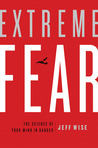
BOOK REVIEW: Extreme Fear by Jeff Wise

Extreme Fear: The Science of Your Mind in DangerExtreme Fear: The Science of Your Mind in Danger by Jeff Wise
My rating: 4 of 5 stars

Amazon page

Extreme Fear examines the science behind fear—particularly the fear of life and death situations. In doing so, the author presents findings from scientific research as well as cases that demonstrate the concepts behind those findings. People are often so close to their fears that they take them for granted, and feel that there’s nothing to be done about them. However, there’s a great deal to be learned about how fear operates and how one can improve one’s performance in fearful situations. By replacing the lens of shame with one of science, one can see what fear is objectively, and make the emotion more of a help and less of a hindrance.

A central idea in the book is that fear evolved to maximize one’s chance of survival against the age-old threats facing mankind. These pre-historic threats were relatively straightforward: saber-tooth tiger attacks, clubbing by members of warring tribes, fire, famine, flood, etc. Ancient threats often called for hauling ass, freezing in place, or getting stabby. The problem is that our present-day threats often call less for gross motor skills (run, kick, or throw) and more for creative or nuanced solutions to technological problems (i.e. sliding cars, falling planes, or malfunctioning assault rifles.)

Motor learning is one means by which this mismatch between what our brain tells our body to do in a stressful situation and what is called for in our modern world. Take the case of the infantryman with the jammed rifle. Without training, he might pick up the rifle like a club, intending to use it to unleash blunt force trauma. That is, if he’s still alive then the enemy gets into cudgeling range. Alternatively, the soldier may drop the rifle and run for his life. However, because he had a drill sergeant who made him practice clearing his weapon over and over, his body can go to that behavior while his conscious mind is blinking out.

Still, motor learning only takes us so far. Sometimes creativity is called for, and that’s a tall order in the face of where our body / brain want to put limited resources. In fact, Wise begins the book with the story of a pilot who was flying an old plane when the wing support broke and the wing flipped up, threatening to rip off. Somehow the pilot figured out—based on a vague memory and lots of experience—that he could flip the plane over and fly it upside-down and the wing would snap back into place. Then he had to figure out how to land: a.) upside-down crash, or b.) try to flip the plane over at the last second. The brain systems that this pilot smoothly accessed are among those that one doesn’t expect to be operating in life or death situations—e.g. those involved with long-term conscious memory and abstract problem solving.

The question of how some people can keep their wits about them, as the above pilot did, while others crash and die is the one that Wise really wants to answer. It turns out that it’s not such and easy question. During World War II, the military conducted studies to try to determine which soldiers could be counted on under life and death stress. The answer didn’t readily present itself. Among the problems in finding an answer is that courage and fearfulness aren’t as unitary or straightforward characteristics as one might think. Wise presents the case of Audie Murphy as a prime example. Murphy was at once one of the most decorated American soldiers in World War II—a man who’d taken on a company of Germans single-handedly—and a man of great social anxiety.

The book’s 13 chapters are divided into three parts. The first part presents fear and its effects. The middle section deals with various forms, aspects, and facets of fear, including: social v. life-and-death fear, choking behavior in sports, and fear of fear v. fear of an outcome. In the last part of the book, Wise suggests how one might achieve better performance in the face of fear.

I found this book to be informative and interesting. Wise did a good job of picking cases to illustrate the concepts discussed in the scientific literature. I’d recommend this book for individuals who are interested in the science of the brain and the ways to achieve ultimate human performance.

View all my reviews

BOOK REVIEW: Wired for Story by Lisa Cron

Wired for Story: The Writer's Guide to Using Brain Science to Hook Readers from the Very First SentenceWired for Story: The Writer’s Guide to Using Brain Science to Hook Readers from the Very First Sentence by Lisa Cron

My rating: 5 of 5 stars

Amazon page

There are countless books offering advice to writers. Some are good. Some are not. Good, bad, or ugly, few of these books offer anything new beyond particularly artful (e.g. humorous or poetic) explanations or superior examples. In other words, if you’ve read five writer’s guides you’ve read five thousand. Cron’s book is the rare guide worth a read even if you’ve read a hundred other such books. It’s not that Wired for Story offers radical or novel advice on story building (its writer’s tips are orthodox.) It’s the way this book couches the arguments for what can admittedly be hackneyed advice. As the title suggests, Cron’s book is about how our brains are wired to love stories–as long as said stories contain certain attributes that the brain finds appealing. (Conversely, there’s a reason why books that go wildly off the reservation with “experimentalism” are doomed.)

While I’ve read many a book on writing, I picked up Wired for Story more out of an interest in the subject of the neuroscience of story. The book doesn’t delve deeply into the science, but it does cite leading thinkers in the field as well as providing a good layman’s overview of the neuroscientific principles that inform the book’s tips. Cron’s background is in publishing and her bona fides to write this book are as someone who came from a career reading and rejecting / accepting manuscripts. However, I believe she did a good job of laying out science.

The central idea is that humans love stories because the narrative structure allows people to simulate a nasty chain of problems without suffering the real world consequences. The brain loathes uncertainty and randomness, and loves whenever it can learn about how to face a problem or make sense of the world. This is why we love conflict, tension, and an unrelenting unfolding of worst case scenarios in our stories even though we tend to hate those characteristics in our own lives. This results in both the tried advice to keep putting the protagonist through the wringer, and the qualifications that a writer should do so in a way that is believable (our brain’s BS-detector is ever on) and which will eventually force the protagonist to change. Cron offers a definition of story that has the usual elements: “A story is how what happens affects someone who is trying to achieve what turns out to be a difficult goal, and how he or she changes as a result.” As with many guides, the definitions of plot, the protagonist’s issue / goal, theme, and tone are elaborated at length—as well as being differentiated because these topics tend to be confused by neophytes—often resulting in a failure to clarify one or more of them.

Stories also give us an opportunity to anticipate what others will do, and forecasting the behavior of others gives one a nice little dopamine dump. The ability to foresee what others will do has always been a powerful evolutionary advantage, and those who did it better passed on their genes more than their oblivious counterparts. Owing to this idea, there is a great deal of advice about what should be in the book (only what is relevant), and how it should be revealed (in a way that eschews attempts to play “gotcha” with your readers.)

One may wonder why I’m so pleased with a writer’s guide that gives common advice about writing–just because it explains said tips in terms of evolutionary biology. The answer is that it’s far easier to keep these lessons in mind when they’re held together by a logic rooted in what all readers have in common (e.g. conscious and unconscious minds, emotions, instinctual drives, etc.) For example, knowing why readers hate an overly simple resolution for a problem that’s presented as insoluble (i.e. robbing them of dopamine reward for figuring it out) helps one better recognize this pitfall in all its forms and to avoid it. Such an approach allows for a deductive approach and is far more useful than having memorized “avoid deus ex machina” as a disparate tip that’s attached to a specific example. In short, it’s both easier to remember and broadly implement these ideas when one understands the rationale from the ground up.

Beyond the reason in the last paragraph, I enjoyed this book for reasons that have little to do with its advice to writers. While I now know that there are other books on the evolutionary biology of story that deal with the subject more from a scientific perspective (while I haven’t read it yet, you might try this book), this was the first book that I stumbled across on that topic. And, it’s a topic that’s well worth understanding whether you’re a writer or not. No matter what one does, understanding the universal appeal of a story can be beneficial, whether it’s in the context of teaching, parenting, or business.

I’d recommend this book for writers—particularly those who think about the world in scientific terms. Beyond writers, if you have cause to construct or use stories in your life—or suspect you should—you can benefit from this book.

View all my reviews