BOOK REVIEW: The Like Switch by Jack Schafer

The Like Switch: An Ex-FBI Agent's Guide to Influencing, Attracting, and Winning People OverThe Like Switch: An Ex-FBI Agent’s Guide to Influencing, Attracting, and Winning People Over by Jack Schafer
My rating: 4 of 5 stars

Amazon page


Written by a former FBI behavior analyst, this book presents tips on how to build rapport — be it with a co-worker, a love interest, or the subject of an interrogation. There’s not a lot of material in this book that’s surprising or unexpected, but the stories of counter-intelligence operations and criminal investigations make for greater intrigue than the typical book of this nature. (Though the most common type of story in it may be the tale of “how I got a free upgrade from an airline employee,” and that’s probably not that different from what one would read in a similar book by a corporate trainer with a more mundane resume.)

One aspect of this book that did seem unique was how much discussion is given to laying the groundwork of a friendship. Schafer emphasizes the need for patience, and he uses an example of cultivating a spy that involved a Special Agent placing himself in proximity to a target day after day before he ever exchanged so much as eye contact, let alone speaking. Interestingly, the epilogue shares a similar story from a historical memoir that shows both how effective these tactics are and how long they’ve been around. I wouldn’t be surprised if a civilian expert on these issues would say, “that’s fine if you need an ultra-light hand to cultivate a spy, but the same tactics may be a little too glacial for finding a mate or building a customer base. Personally, I don’t know how well Schafer’s approach translates to the work-a-day world, but I can imagine that if one parked oneself along a potential love interest’s route for week after week they might form the opinion one is either spineless or a stalker long before one got a chance to share eye contact.

The book consists of eight chapters, plus some front and back matter. The first chapter, entitled “The Friendship Formula,” sets out some banal concepts about the need to put oneself in proximity with one’s “target,” and then to build the frequency, duration, and intensity of said proximity events. However, it goes on to introduce some of the fundamentals that are elaborated upon later.

Chapter two focuses on pre-conversational activities. This largely involves non-verbal facial expressions and body language, but it also gets into issues such as appearance. Chapter three is about a central concept that Schafer calls “the golden rule of friendship,” which is basically the idea that people like individuals who make them feel good about themselves. Of course, people may distrust flatterers, and so the direct approach may not always be the best approach. The chapter therefore addresses pitfalls as well as sound tactics.

Chapter four is about what the author calls “the laws of attraction,” which are a series of ideas used to get the subject to look at one in a favorable light while avoiding the pitfalls of being too ham-handed. These are just ways to seem more appealing, often by capitalizing on (or making clear) existing causes for the individual to like one. But sometimes they involve deck-stacking activities such as in the case of “the law of misattribution.” In misattribution one shows up when an individual has been exercising so that maybe he or she will mistake the exercise-induced endorphin high for positive feelings towards one. There is a mix of ethical and exploitative approaches, and some ideas that might be of benefit for gaining a temporary upper-hand with someone one doesn’t have any long-term concern about might not be wise to employ with someone with which one might want a long-term relationship.

Chapter five is where one gets around to talking to the target of one’s desired rapport. As with the preceding chapters, this is as much about what not to say as it is what to say, but the single biggest point is to do more listening than talking. That is, give the target plenty of opportunity to talk about his- or herself and be cognizant of what they are saying, rather than preparing one’s own words. This is easier said than done given all that one must keep in mind, and the non-verbal cues one is watching for, etc.

Chapter six returns to non-verbal communication territory, and emphasizes testing one’s efforts to build rapport while simultaneously noticing the signs of whether it’s going well or not. This allows one to adjust one’s strategy (or to know it’s time to give up.)

Chapters seven and eight include material that one won’t necessarily see in competing books. Chapter seven is about maintaining the relationship that one has established. A lot of this chapter is about conversational strategies for defusing tense situations, lessening the friction in the relationship, and getting what one wants without building animosity. The last chapter takes one into really different territory by discussing on-line relationships and the building thereof. In large part, this chapter is a cautionary tale of the risks of entering a relationship given the lack of all the non-verbal cues. There are several cases of how individuals managed to portray themselves as something they weren’t.

I found this book interesting and beneficial. Its strengths include a tight focus; it doesn’t blast one with information by fire-hose, but rather offers a few simple ideas to focus on and hammers them home. The organization was logical, basically building up over the course of a relationship / interaction from being in proximity to making eye contact to conversing to weathering an argument. I also found that the book used photographs effectively. Non-verbal communication is much more effectively and efficiently communicated by photograph, and the author used many color photographs for this purpose. There was even a series of plates that acted as a quiz, asking the reader to put the knowledge she’d acquired to use, with an Appendix serving as the quiz key.

I should mention that some jerk tactics are scattered throughout the book – by that I mean approaches designed to dupe and / or manipulate the target. These may be fair game for interrogating criminal suspects or terrorists but some could backfire upon one when put to use in a relationship that demands more trust. Usually, the author isolates himself from these tactics by telling us it was something his student or a suspect once mentioned. For example, he describes pickup artists going to an ATM kiosk, plucking up receipts showing large balances, and then using said receipts when it came time to give a girl his number as a means to subtly plant the lie that he was wealthy. Mostly, the book seemed to separate itself from the many “how to be a successful creep” books that are out there, as is noted by the chapter on fostering long-term relationships.

I’d recommend this book for anyone interested in the dynamics of building relationships.

View all my reviews

5 Myths & Misconceptions About Hypnosis


In a continuing effort to plumb the depths of the human mind, I’ve begun to learn about hypnosis through lessons, books, the practice of self-hypnosis, as well as via internet sources (yeah, dangerous, I know, but I try to be cautious.)


It turns out that there’s a lot to learn, in part, because there are so many misconceptions about what hypnosis is and how it works. Many of these incorrect ideas result from the fact that most people’s experience with hypnosis comes from watching stage hypnotists. I don’t want to suggest stage hypnotists are a disreputable lot, but seeing a show (particularly on the television) is likely to give one many a wrong impression of hypnosis because: a.) one may miss the fact that there is screening process going on (often carried out in an entertaining and interactive fashion so as to be part of the show and including innocent elements like calling for volunteers) to get a very select group on stage who are highly susceptible to hypnotic trance  — and probably more gregarious / free-spirited than average. b.) stage hypnotists (and less reputable therapeutic hypnotists) will occasionally say things that are… strictly speaking… untrue. This isn’t [necessarily] to be conniving or underhanded, but instead to prime subjects to be less resistant and skeptical. c.) what makes for an impressive show isn’t what makes for the most effective hypnotic induction / deepening for the average person (which tends to be a rather dull and drawn out affair.)


5.) A hypnotic trance is an unattentive and zombified state of mind. In a hypnotic trance, one is extremely relaxed physically, but one’s mind is highly focused on one particular stimuli (often this is the hypnotist’s voice but it might be awareness of breath, bodily sensation, imagery, or it might involve systematically cycling through a number of different sensory inputs at the hypnotist’s suggestion.) A common example used to help an individual understand what hypnosis will be like is the condition of being zoned out while driving, arriving with no recollection of the past ten miles because one’s mind was focused elsewhere.


The fact that memory can be impaired (not unlike when one is falling asleep or sleeping) and that suggestion of selective impairment (e.g. forgetting one’s name or a particular number or letter) is a common stage trick, makes people think that the subject has mentally flown the coup.


4.) Every person can be readily hypnotized. There’s a sense in which this may be true, and that’s that everybody seems to fall into a trance now and again. Remember, it’s just like zoning out when one is driving. But what most people are thinking of with this myth is more along the lines that any hypnotist worth his/her salt can drop any random person into a deep trance with the snap of a finger and the word “sleep.” However, the science suggests a bell-shaped curve with a lower 15 %-ish who are extremely hard (if not impossible) to induce into a hypnotic trance and a higher 15%-ish who are a piece of cake to hypnotize. The rest fall in the meaty middle, and can be hypnotized but with greater effort and with lower levels of suggestibility. So when a person says, “Oh, I don’t think I could be hypnotized at all,” the odds are against them.  On the other hand, contrary to Hollywood hypnotism and the wishes of Sidney Gottlieb, anyone can resist hypnosis if they decide to — and, sometimes, if they just can’t help themselves.


3.) Dumb people can’t be hypnotized and smart people are more hypnotically susceptible. I see this a lot on YouTube videos and books by hypnotists, and it sounds good. However, when I looked at the peer-reviewed academic publications, I saw something else. Scholars studying what personality traits correlated with hypnotic susceptibility found no such relationship for intelligence and ease of entering a hypnotic trance.


I don’t think hypnotists are lying for the sake of duplicity. First of all, many are probably parroting a line that they heard, that confirmed their beliefs / wishes, and that they never thought to investigate. Others are just trying to make a hard job easier. Think about it, if you tell your audience that dumb people can’t be hypnotized, and that the smartest people are the most easily hypnotized, people are going to be more eager to appear hypnotizable and will be less resistant. People don’t like to look unintelligent, especially in front of huge groups of strangers.


If you’re interested in knowing what personality trait is the most strongly correlated to hypnotic susceptibility (of the limited set that’s been studied so far,) it’s absorption — i.e. the proclivity to get deeply absorbed in a task. So, if you know a person who consistently has to have his or her name called half a dozen times to pull them out of a zone, there’s a good chance that person would make an awesome hypnotic subject. (Note: we all get that way now and again, we’re talking about someone who is consistently / frequently prone to that state.)


2.) A hypnotist can make a subject do anything he wants. People get this idea from movies and from only hearing half the story of expensive (but largely ineffective) programs like America’s MK Ultra and Soviet Psychotronics. The consensus view is that a hypnotist can get the average subject to do something that they wouldn’t do without suggestion as long as it’s not something that they don’t want to do. So you might get an average person to raise their hand, because it’s not embarrassing, painful, or dangerous — and so they won’t be reticent to do it. Squawking like a chicken? Only if the person is the kind who doesn’t mind hamming it up. Murdering someone Manchurian Candidate-style? That’s pure fiction.


I heard a hypnotist say that gregarious people are more hypnotizable. In accordance with the scholarly findings mentioned in item 3, I suspect it’s more accurate to say that a stage hypnotist wants a subject who is both hypnotically susceptible and gregarious. That’s where selecting for people who are outgoing and who don’t object to hamming it up comes in. I don’t know that its true that outgoing folk are inherently more prone to reach a trance state, but they’ll be more fun to watch on stage because they are likely to follow suggestions to do more flamboyant deeds. Of course, studies of personality traits and hypnotic susceptibility don’t usually involve stage hypnosis, so maybe it is true that people who are more gregarious are more prone to trance (or, probably more accurately, less resistant to it) in that particular environment.


1.) Hypnosis involves a hypnotist taking over the mind of a subject. There’s a common refrain that one hears from hypnotists and that’s that all hypnosis is self-hypnosis. One’s mind remains one’s mind throughout, even if one is more prone to accept suggestions. The confusion arises from the fact that we hear hypnotists making suggestions and see the subject following said suggestions, even when they involve activities we wouldn’t want to (and probably wouldn’t) do. This looks like the subject is under the command of the hypnotist, but they call them “suggestions” for a reason. For reasons that still aren’t entirely understood, people are more prone to respond positively to suggestion while in the hypnotic trance state.


Here’s a video on the science of hypnosis:

BOOK REVIEW: Messy by Tim Harford

Messy: The Power of Disorder to Transform Our LivesMessy: The Power of Disorder to Transform Our Lives by Tim Harford
My rating: 4 of 5 stars

Amazon page


The book’s premise is simple: being neat and tidy isn’t the great virtue you’ve been led to believe, and being messy isn’t inherently a vice. Over nine chapters, Harford explores the various dimensions in which our impulse to toward tidiness can get in our way, and for which a little messiness might be the cure. Each chapter uses a central story or two as exemplars, with other stories and anecdotes providing support.

The book’s introduction sets up the idea by describing a famous concert in Köln (Cologne) by Kieth Jarrett in which the pianist reluctantly agreed to play the concert on a sub-par piano, and (it’s argued because of the limitations of that instrument) went on to produce the best-selling solo jazz album. This tale sets up chapter one, which focuses on creativity, nicely. Creativity may be explicitly the topic of chapter one, but it’s a concept that cuts across the entirety of the book. Tidiness – it is argued — is antagonistic to creativity. In the first chapter, Harford describes how David Bowie partnered up with Brian Eno, and how Eno’s “oblique strategies” – while they annoyed the musicians to no end by throwing monkey wrenches into the act of making music – were highly successful in producing a unique sound.

Chapter two discusses collaboration, which always makes a mess. Central to this chapter is a discussion of the Hungarian mathematician Paul Erdős and the famous Erdős number that virtually all scholars are familiar with — at least those in who work in math, science, engineering, and other disciplines with a quantitative bent. It’s sort of a Kevin Bacon six-degrees-of-separation for those who make mathematics. The number describes how far removed one is from having a paper penned with this notoriously prolific mathematician (co-authored, one removed co-author, etc.,) and everyone publishing quantitative / mathematical scholarship desired a low number. The point made by Harford wasn’t just that collaboration in general is messy, but that working with Erdős, specifically, was, and it required collaborators to adjust to his peculiar, professorial ways.

Chapter three explores how tidy workplaces sometimes hinder productivity. The central case is MIT’s Building 20, which was popped up in record time to meet a wartime demand. The building housed a disproportionate amount of world-class science and engineering, and it’s argued that this was in part because its poor design put random people together on long walks to exits or toilets, and in part because – since it was a hideous monstrosity of a building – no one cared if its labs and offices were a mess or not.

Chapter four delves into the value of mess in improvisation. Of course, Jazz is revisited in this chapter, but the lead story is Martin Luther King Jr.’s most famous speech and how it came out of being forced by circumstance to abandon his usual process of extensive preparation and editing. Chapter five describes messy tactics as winning strategies. Erwin Rommel’s success by disruption and chaos creation is at the heart of this chapter as is the development of Britain’s SAS which sometimes beat Rommel at his own game by using a similar approach using smaller, more agile, and more elite forces. There is also an extensive discussion of how Amazon went from humble beginnings to being the 800 pound gorilla of online shopping.

The sixth chapter investigates the role of incentives. For an economist, this is a fascinating topic as the key to understanding economic behavior is usually to follow the incentives. Of course, unintended consequences often go hand in hand with attempts to produce / manipulate incentives. Much of this chapter describes how attempts to tie up loose ends through regulation have ended up generating worse outcomes than could ever have been anticipated.

The next chapter (ch. 7) is about automation, which could be seen as an attempt to clean up messy activities. Harford discusses the situation with self-driving cars, which it’s hoped will help to make highways safer. However, the case he concentrates on is that of flight Air France 447, which went down in part because its inexperienced pilot at the helm couldn’t cope when the fly-by-wire system designed to anticipate and smooth the pilot’s inputs into the controls suddenly went off-line. In other words, the junior pilot wasn’t used to flying messy.

Chapter 8 is about resilience, and here the author challenges the age-old economic notion that specialization always results in greater productivity. Harford suggests that diversity and intermixing of activities and people – rather than specialization and homogenization – often results in a better outcome. The final chapter takes a wider view at how being messy can help one in life. The author spends a great deal of space to the question of how on-line dating services do such a poor job – spoiler alert – they try to make the messy process of finding a soul mate neat and tidy.

The book has citations and end-notes. In the Kindle edition, these notes are hyperlinked for ease of use. There are no graphics, but they aren’t missed.

I enjoyed reading this book and found it to offer many fascinating cases. I will say, as I was reading these well-researched and interestingly described cases, I sometimes had to think hard (maybe do some mental gymnastics) to make the connection between the case at hand and the book’s central theme – leaving me to wonder if I was missing something or whether there wasn’t some shoe-horning of interesting anecdotes into the book to produce a work that was more about being interesting than about proving a particular point. That said, I would recommend the book, particularly for anyone interested in increasing their creativity, productivity, or both.

View all my reviews

BOOK REVIEW: The Memory Illusion by Julia Shaw

The Memory Illusion: Remembering, Forgetting, and the Science of False MemoryThe Memory Illusion: Remembering, Forgetting, and the Science of False Memory by Julia Shaw
My rating: 4 of 5 stars

Amazon page


Julia Shaw is a psychologist who conducted research into whether (and how) false memories could be “planted” in a person’s mind – and not just any memories, but memories of having committed a crime that one actually didn’t. That research is fascinating, and I think it’s tremendously valuable given the disparity between how accurate people believe their memories are and how fallible they are in practice. This disparity has played a major role in many a miscarriage of justice with eye-witnesses historically being considered the gold standard of evidence in criminal trials. Of course, I’m also a bit uneasy about people learning the recipe for an optimal process of generating false memories as it has the taint of being MK Ultra-level nefarious. (Though it should be pointed out that subjects must be active – if unwitting – participants in creating these false memories, so “planting” memories is an oversimplification.) This book discusses Shaw’s research, but it’s more of an overview of science’s understanding of the limits of memory and how those limits conflict with our beliefs – at least about one’s own memory [we often recognize how fallible other people’s memories are.]

The book consists of ten chapters. Chapter one dives into to one of the most common occurrences of false memory, and that’s the claim by some people that they remember events from their infancy – if not their own birth. Shaw presents the evidence for why such memories aren’t possible. This sets up the whole subject nicely because one must ask how so many people can claim to remember events that are physiologically impossible for them to have remembered, and to frequently be right about most key details. No one is suggesting that such people are liars (not all – or even most — of them, anyway.)

Imagine a school-age child hearing a story about his or her life as a baby. Hearing said story triggers a visualization in this child’s mind, and that visualization might well be filed away in memory, but when that memory is recalled the person in question may not realize she is recalling her imagined image of a story and not the actual event itself. Herein lies the crux of false memory: 1.) anything one visualizes in detail might potentially be stored away and become undifferentiated from the experiencing of an event; 2.) when we recall a memory we are recalling the last time we remembered it and not the event directly, and this can lead to a disparity between the memory and the actual event as it gets tied up with what’s going on in one’s mind at the time.

Chapter two explores perception, and how flawed perceptions may become flawed or tarnished memories. Just as memory isn’t the direct recording of events that we often feel it is, perception isn’t a direct replication of the world but rather a model generated in the brain. Therefore, the limitations and inaccuracies of the mental model are the first line of deviation of memory from reality. Chapter three describes how the brain’s physiology and evolutionary biology produce limitations to our ability to remember – limitations in spite of which we could thrive in the world in which we evolved.

Chapter four begins a series of chapters that take on specific objections that will arise to the ideas about false memory presented in the early chapters. This chapter counters an anticipated objection about people who seem to have perfect memories. In other words, a reader might admit that most people’s memories are crap (and even that his own memory isn’t infallible,) but what about the people with Las Vegas stage shows or the Asperger savant who knows every phone number in the Manhattan White Pages? Surely, these rare cases disprove the general idea of how memory works. Shaw shows that none of these people have perfect memory. Some have spectacular autobiographical memory (memory for their own life events) and others are exceedingly skilled at using mnemonic devices to remember any facts, but they all have limits. There’s also a discussion of how an unusually perfect autobiographical memory is often more of a curse than a blessing. We forget for good reason.

Chapter five examines another common memory fallacy, which is that one can remember best by getting the middleman of the consciousness mind out of the way and feeding data directly into the subconscious. In other words, it takes on subliminal learning. You may be familiar with the idea from ads suggesting that you can learn French in a couple of weeks without cracking a book just by playing audio tracks in one’s sleep and letting oneself learn effortlessly. Like every program that promises growth without effort, this one is debunked. Studies suggest that if one sleeps during such nights, one won’t learn, and if one learns, one isn’t actually sleeping. In other words, learning requires one’s attention.

I will say, the book fell off the rails for me a bit during this chapter. As I wrote in a recent blog post about psychological concepts that even psychologists repeatedly get wrong, Shaw denies the existence of hypnotic trance state as an altered state of consciousness. However, it becomes clear she isn’t arguing against the scientific perspective of what hypnosis is (a physically relaxed but highly mentally attentive state) and is rather denying the misconceived popular notion that seems to involve a person (possibly wearing a glittery cape) taking control of another person’s mind and making them into a zombified drone. She writes in an odd, round-about fashion on this subject as well as the topic of brainwashing – for which she offers her own value-laden definition. I’m not so sure that she didn’t understand hypnosis as much as she wanted to make sure her work was thoroughly distanced from hypnosis and brainwashing. It seems just seems strange and a bit dubious that a scholar studying false memory wouldn’t be thoroughly familiar with the literature on suggestibility and the states of mind most associated with it, i.e. hypnosis. I can only imagine the hoops she had to go through to get her research design through an IRB. (IRB’s are review boards that make determinations about whether a research project is – among other things – ethically defensible. After a series of famous — and ethically questionable — studies by the likes of Stanley Milgram, Ewen Cameron, and Timothy Leary, to name a few, psychology has come under great scrutiny.)

Chapter six asks whywe believe our memories are so awesome despite all evidence to the contrary. This comes down to why most of us unjustifiably judge ourselves superior in most regards. As is true of drivers, almost every person thinks she is better than average in the realm of memory. This is important because it’s not so much that our memory is fallible that leads to problems but that it’s fallible while we think it’s perfect. Chapter seven challenges the belief that there are certain events that are indelibly etched into our brains such as (depending upon age) the Kennedy assassination, the Challenger explosion, or 9/11. Such memories were once considered “flash bulb” memories, perfect renderings of societally traumatic events carved into our synapses. However, once these memories started to be put to the test, it was found that the details — vis-à-vis where one was and what one was doing at the time — are often wrong.

Chapter eight discusses how media and social media mold memories. One element of this is group-think. One’s memories may be molded through manipulation of the fact that people will readily believe that which is consistent with their beliefs while denying that which is inconsistent – regardless of facts and evidence. This chapter also takes on how social media influences memory as a distraction and because of so-called digital amnesia in which people remember less because they figure they can look it up at any time in the vastness of the internet.

Chapter nine proposes that even one’s most traumatic memories aren’t necessarily accurate, and – in fact – might be more likely to be fallacious. This may be the most important chapter of the book because it shows how a confluence of factors (namely, bad questioning tactics and peer / societal pressure) can result in the inadvertent planting of false memories. The chapter focuses on a series of Satanic ritual sexual abuse cases, a number of which were eventually disproved. So eager to build a case to bring believed wrong-doers to justice, law enforcement officers sometimes inadvertently pressured children into making up stories under the guise of trying to get them to open up, stories that sometimes became false memories.

Chapter ten shifts gears to consider what one can do about the issue of faulty memory – in other words how one can avoid being manipulated through exploitation of the limitations of one’s own memory. This is valuable information and not just for legal purposes but for life in general.

The book has a few graphics as necessary throughout the book and has end-notes to provide sources and elaboration on comments in the text.

I found this book to be immensely valuable as food-for-thought. The author presents many fascinating stories and the results of intriguing research studies, all in a readable package. I’d recommend this book for anyone who is interested in the subject of the limits of human memory, how these limits can be manipulated, and how that manipulation can impact the criminal justice process.

View all my reviews

5 Psychological Concepts Psychologists Disagree About [or Just Plain Get Wrong]

Every academic discipline has a concept or two that its scholars disagree upon. In the social sciences, these can even be the fundamentals of the subject, and, sadly, they aren’t always so much disagreements of definition as concepts the experts don’t grasp. In Economics [the discipline I was educated in], there is a famous war over whether economists understand “opportunity cost” — a concept that is raised not only in undergraduate texts but even in high school classes.

That said, Psychology appears to take the cake for being the most internally confused academic discipline. Ever. I first became aware of this problem with respect to a subject I have great personal experience with (by virtue of  being firmly lodged in said category), and that’s introversion.

Recently, this psycho-confusion has come up again as I’ve been reading two books that have major discussions around psychological definitions. One is Dean Haycock’s Murderous Minds, which devotes a whole chapter to the fight over how psychopathy is defined and differentiated from other conditions (in part, because another term — Sociopath — exists to spur confusion, but even without that term [which some psychologists think of as a synonym and others think of existing in another ballpark] there would be a huge gulf in expert opinion.)

The second book is Julia Shaw’s The Memory Illusion, which is a fascinating and generally thought-provoking book. In it, Shaw claims that hypnotism doesn’t exist.  I found this difficult to believe (both because I’ve been in a hypnotic trance state and because there is a well-established literature on the subject [i.e. it’s not like parapsychology concepts, e.g. clairvoyance, which are highly controversial]) until I realized that Shaw’s definition of hypnosis was filled with all the misconceptions that one would expect of an individual entirely unfamiliar with a hypnotic trance — except maybe having seen a stage hypnotist once or twice.

5.) Introversion: Introverts are often confused with those who have social anxiety disorder(severe shyness) — which an introvert may or may not have, but which an extrovert also may or may not have. (While it’s probably true that introverts experience social anxiety disorder at a higher rate than extroverts, there is a big problem with equating the two — not the least of which is that one can beat one’s social anxiety and still be an introvert.) It should be pointed out that Susan Cain’s excellent book Quiet (among others) has done a lot to bring a consensus view to the subject, but one still hears people — even experts — equating shyness and introversion.


4.) Psychopathy: Like many confused topics (including introversion and hypnosis), part of the problem is that everybody has a mental construct of what psychopathy is before they learn anything formally about it, and sometimes those preconceptions survive the presentation of formal knowledge — even, apparently, for the experts.  Maybe a person has read American Psycho or maybe they’ve seen Dexter or the movie Psycho, and so they know very well that a psychopath is a murderous maniac, and, therefore, they may not swallow the information that most psychopaths function just fine in society and aren’t even considered inherently mentally ill.


3.) Schizophrenia (v Split Personality): This is probably one of the most discussed of the confusions in the field. To be fair, this may be largely ironed out these days, but it certainly took long enough. Multiple Personality Disorder (commonly called Split Personality but today called Dissociated Identity Disorder [DID]) is usually a trauma-based disorder that results in schisming of personhood. Whereas, Schizophrenia is a genetically transmitted disorder that involves a disconnect with reality, but not necessarily a separation of personalities.


“Hypnotisk” by Richard Bergh (1887)

2.) Hypnosis: I mentioned Julia Shaw’s statement that hypnosis doesn’t exist. In her book, she mentions several preconceptions about hypnosis that are quite different from my limited (but existent) experience with hypnosis. To be fair, many hypnotists would tell you that the term hypnosis (coined by Scottish surgeon James Braid) is a confusing choice because “hypno” suggests the state is like sleep — which, not so much. First, Shaw calls the hypnotic trance state a non-attentive state. (This comes up because she is making the point that attention is critical to memory formation, which is probably entirely true and I don’t have any dog in the fight of whether hypnosis can help memory.) What I am arguing is that hypnosis is not a non-attentive state. It’s a highly relaxed state, but might be more accurately called a hyper-attentive state. Maybe the confusion is because stage hypnotists frequently successfully suggest participants temporarily forget things in deep trance, but keeping one’s attention focused  (on what may vary, though it’s usually voice) is critical to the hypnotic trance state. Second, she suggests that hypnosis is an act that must hinge on the activities of the hypnotist — i.e. the hypnotist as sine qua non.  I think many, if not all, hypnotists would admit (often begrudgingly) that the hypnotist is the most dispensable element of the process — or, as it’s more commonly phrased, “all hypnosis is self-hypnosis.” Third, she seems to have problem with hypnosis being considered an altered state of consciousness. To my mind, everything but ordinary waking consciousness is an altered state of consciousness. I don’t know of any way in which a hypnotic trance state could be confused with ordinary waking consciousness. (If you’re sure of it, go to a dentist who uses hypnotism for pain reduction and have them yank your tooth in a state of ordinary waking consciousness, and then compare your experience to the individuals who had it done under hypnosis. See here for a related BBC special on the Science of Hypnosis.)


1.) Delirium  (v. Dementia):  To be fair, by the time an individual is in a full-blown state of either, these conditions are nearly impossible to distinguish and have overlap. However, delirium has quick onset, involves severely impaired attention, and can fluctuate greatly from one day to the next. On the other hand, dementia often progresses slowly, begins with mild impairment of attention and focus, and is a far more consistent state.

5 Myths of the Mind


I wrote a post a while back about six persistent brain myths that has some overlapping relevance to this one.

5.) A person is a unitary actor (the spherical cow of social sciences.) When I was a graduate student studying International Relations, a popular theoretical assumption was that nations were “unitary actors.” This meant that no matter how schizophrenic a government (and a nation’s civic institutions) might appear, they ultimately always pursued a national interest via a solitary hand. Like physicists assuming spherical cows, this makes life easier — even if it bears little resemblance to reality.

The full extent of the folly of the rational unitary actor assumption became apparent when I discovered that an individual isn’t even a unitary actor systematically pursuing its best interest. An individual is a collection of impulses, thoughts, feelings, etc. that seems like its under the command of a central authority only because that “central authority” [our conscious mind housed in our Pre-Frontal Cortex (PFC)] is really good at forming post-hoc rationalizations and making up stories that let us feel unitary. The reader may think I’m just talking about some slim segment of the population with a multiple personality disorder, but no. I’m talking about anyone who has ever agonized over whether or not they should have an ice cream treat or take the healthy route. At the end of an internal battle that ends with the levers of action being operated by parts of your nervous system beyond your conscious control, you walk away with your conscious mind building a nice story that explains how it chose to either treat its taste buds or take it easy on its pancreas by keeping insulin production stable.

To consider how the conscious and subconscious mind can be on two entirely different pages on a subject, we’re going to veer into controversial and provocative territory. [So be warned, and if you’re sensitive about sexuality and particularly coercive sexual fantasy, you may want to skip down to the next paragraph.] Across a series of studies, an average of 40% of subjects (generally, or maybe exclusively women) admitted they’d had a fantasy about being raped. Many readers will react with incredulity, perhaps suggesting that there must be something wrong with such a person. However, obviously numbers like that aren’t describing a lunatic fringe. The next response one might here is, “Why doesn’t a person with a rape fantasy know how horrible and decidedly unsexy rape is?” If you’re following my gist, you know the answer is that said person knows very well. Consciously, she is aware that rape is violent and horrific, and moreover she probably even knows that it’s about commanding power rather than sexual desire for the rapist. This knowledge doesn’t undermine the fantasy [unless, perhaps, she really forces herself to think about it intensely] because the arousal is driven by a more visceral part of the mind that FEELS that the act is about the rapist being overwhelmed with sexual attraction even though the person KNOWS that that’s not the case.

[Note: I do realize that it might theoretically be possible that a much more complex collection consisting of many individuals and organizations might behave in a more unitary fashion than an individual. That is, even though a nation his made up of many non-unitary actors, perhaps the nature of the game forces it to behave in a unitary fashion. I don’t buy it. I’ve been reading a great example in a biography by Ingrid Carlberg about Raoul Wallenberg where both the Soviets (who had Wallenberg in custody but wouldn’t admit it) and the Swedes (who didn’t know whether Wallenberg was alive and sent mixed signals) were befuddled by varying actors sending mixed messages and collectively behaving ineffectively. It’s hard to come away thinking that Stalin and his Ministers had a rational and unified decision process. Instead, it seems like a perfect storm of incompetency and incorrect assumptions resulted in an outcome that wasn’t ideal for any of the parties.]


4.) Everyone can be hypnotized via instant induction and then commanded to do anything that’s asked of them.  Hypnosis is among the most misunderstood activities around. There are a couple of reasons for this. One is that hypnosis is a favorite device in movies and fiction, and people draw information from these fictitious sources. The “Now You See Me” movies (see above) offer many such displays of a person being instantaneously hypnotized against his will even when the person is an expert himself, and made to do things against his interests. Misconception also flowers when people hear real or fictitious accounts of Cold War programs like America’s MK Ultra or the Soviet’s psychotronics. The lesson to be taken away from those expensive and morally-dubious programs is that it may be possible to break a person’s mind, but you can’t force someone to do something they abhor while programming them to forget all about it afterwards.

Another reason for the misunderstanding, is that there’s a disreputable group of stage hypnotists and others who love to spread these ideas because it’s more intriguing if people think they can do it to anyone at any time than if they understand that their subjects have been carefully selected to be among the more readily prone to achieve trance states and to be responsive to suggestion. It’s true that most people are hypnotizable and will respond to suggestions to do things they wouldn’t otherwise do (as long as it’s not something that they don’t want to do.) But highly hypnotizable individuals are only about 15% of the population, and there’s another 15% at the other end that are virtually impossible to hypnotize. The video below has more detail on the science.


3.) One has no access to one’s subconscious mind. The conscious mind is like the loudmouthed drunk who swears he invented the potato chip bag clip, the envelope-wetting sponge, and Velcro. That is, it’s hard to hear over the din of incessant yapping, and since the conscious mind claims credit for everything, it’s easy to be fooled that there’s nothing else to listen to in the mind. However, if you can knock the drunk out, you start to become aware of what the subconscious has to say. Those who don’t meditate may be aware of subconscious imagery as they are falling to sleep (the hypnogogic state), as they are waking up (the hypnopompic state), or sometimes even during dreams (i.e. so-called lucid dreams or dream yoga.) Those who do meditate will be well aware of images that spontaneously form and fade in the meditative mind, and which can give rise to conscious thoughts if left unchecked.


2.) Memory is a recording of life events.  I’ve been reading Julia Shaw’s “The Memory Illusion” recently. It’s a fascinating look at false memories. There are many famous cases of false memory, but what is most interesting is Shaw’s success in planting false memories of criminal activity. “Planting” isn’t the best term to describe this. It’s more about getting the subject to visualize events such that they create the false memory. While I stand by what I said about the myths of hypnosis, there have been a number of cases of false memories being implanted while an individual was in a hypnotic trance, and so one shouldn’t disregard the power of hypnosis altogether.  The fact of the matter is that what we remember isn’t the occurrence of the event itself, but the last remembrance of said event. This means that there’s a great deal of room for memory degradation over time, and for a false transcript of events to form in the mind.


1.) Emotions get in the way of good decision making. I just posted a review of Antonio Damasio’s book “Decartes’ Error,” which examines this subject in great detail. Damasio found that patients who had damage to parts of the brain responsible for emotion often became victims of paralysis by analysis. That is, without emotion to give them a kick, they can’t make decisions. Reason doesn’t always provide a clear answer because the world is filled with uncertainty. When there’s not enough information, we still need to make decisions, and this is accomplished by emotional “gut instincts.”

BOOK REVIEW: Descartes’ Error by Antonio Damasio

Descartes' Error: Emotion, Reason and the Human BrainDescartes’ Error: Emotion, Reason and the Human Brain by António R. Damásio
My rating: 5 of 5 stars

Amazon page


I’ve joked that there must be a law requiring any author writing a book on neuroscience for a popular audience to tell the story of Phineas Gage. This book is no exception. Its first couple chapters explore the case of Gage in detail. For those who don’t read much on this subject, Phineas Gage was a foreman for a construction company. By all accounts he was a reliable and solid individual, respected by his employees, trusted by his employer, and beloved by his family. Then one day a four-foot tamping rod was blown through his skull – literally, in one side and out the other. One might think that having a chunk of brain skewered out by a steel rod on a gunpowder-fueled ride through the skull would leave one – at best — a glassy-eyed, drooling, catatonic lump. Surely, a steel rod would wreak more havoc than the narrow needle used in lobotomies? However, what makes Gage’s story fascinating is that the injury resulted in no readily apparent disruption in cognitive function. Gage could still speak fluidly. He retained his memories. He could do math at the same level as before. However, this isn’t to say that the hole through his brain left him unchanged. The even temperament that made him an ideal employee and that endeared him to friends and family was gone. Gage became angry and unreliable.

So what is the relevance of the Gage story to Damasio’s book? Quite a lot, actually. Damasio’s book is about emotion, its influence on decision-making, and how bodily states create emotion. In parts two and three of this three-part book, after introducing the reader to the role of the brain in emotion via the cases of those with selective brain damage, Damasio lays out an argument for what he calls the “Somatic Marker Hypothesis” which says that bodily states are what create the sensations that we associate with emotion. The title-referenced error made by Descartes will be apparent to those familiar with Cartesian dualism. Descartes believed there was a dualism between mind and body – i.e. that there was this physical stuff that got us about from place to place, but there were these intangible thoughts and feelings that were matter-independent that were the makings of mind and which were really you (i.e. you think, therefore you are.) Damasio believes that you cannot separate what it feels like to be you from the body and all its hormones, neurotransmitters, vital statistics, neuronal firing, etc.

The book consists of eleven chapters divided into three parts. In the first part, the author lays out not only the case of Gage, but other examples of individuals who had injury or illness in the brain that disrupted emotion and its influence on decision-making. We learn that an unemotional being isn’t like Spock, but instead is paralyzed by indecision. It turns out that it’s emotion that give us a kick, particularly when he have no sound basis on which to make a rational judgement. The second part draws the connection between body and our emotional self, culminating in a description of the Somatic Marker Hypothesis. The final part describes how the Somatic Marker Hypothesis could be tested and where this line of study seems to be going. The book is annotated and has a bibliography as one would expect of a scholarly work – even one written for a popular audience. The book has a few graphics – graphs, charts, and diagrams, but not very many and of a clear and simple nature.

I’d highly recommend this book for anyone interested in the working of the mind. It’s a thought-provoking look at what it means to be an emotional being and challenges our preconceptions about feelings.

View all my reviews

5 Works of Nonfiction That May Be [at least in part] Fiction

NOTE: There are many famous examples of books presented as nonfiction that turned out to be partially or completely fabricated (e.g. Go Ask Alice, A Million Little Pieces, Three Cups of Tea, The Teachings of Don Juan, and Papillon are examples that spring to mind.) That’s not what I was going for when I started this list. Instead, I was thinking of examples of books that may well be true to the best of the author’s knowledge, but which may also be examples of false memory syndrome. I became interested in this while reading Julia Shaw’s The Memory Illusion, which discusses how faulty memory can be — to the point that people can be led into false memories of something as traumatic as committing crimes that never occurred. Meredith Maran wrote a book entitled My Lie: A True Story of False Memory about what she discovered were false memories of childhood sexual abuse. So, I’m not saying these books are fabrications, and — for all I know — some may be completely true. After all, some of the featured individuals think they were exploited by the MK Ultra mind-control shenanigans, and some of them may have been, but it’s also possible some weren’t.


5.) Secret Weapons by Cheryl and Lynn Hersha: The Hersha sisters say they were in a program that turned them into femme fatales.


4.) Psychic Warrior by David Morehouse: I read about Morehouse in Jon Ronson’s The Men Who Stare at Goats. Sadly, it’s not in question that the military maintained a program of psychics, nor that Morehouse was involved in said program. What is in question is the degree to which the program had successes.


3.) Communion by Whitley Strieber: This is the most famous alien abduction story. I don’t know what really happened, but I seriously doubt it’s what the author proposed.


2.) The Control of Candy Jones by Donald Bain: This is a more well-known case similar to that of the Hersha sisters in which a woman was said to be reprogrammed by a nefarious psychiatrist in a mind control program. Candy Jones was famous as a pin up girl. After she got married, her behavior changed radically, and her husband asked her to participate in sessions of hypnosis which are said to have turned up a buried second personality.


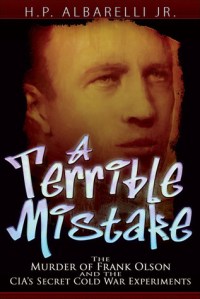
1.) A Terrible Mistake by H.P. Albarelli Jr: This is another example of a case in which there are certain remarkable facts that aren’t in dispute, but the degree to which the fine details are accurate is hard to judge. The fact is that Frank Olson was a biologist in the employ of the government, he was dosed with hallucinogenic substances, and thereafter he took a fatal plunge out of a hotel window. Whether he was murdered as a cover up or just had a bad trip has always been an open question.

BOOK REVIEW: How to Hypnotise Anyone by The Rogue Hypnotist

How to Hypnotise Anyone - Confessions of a Rogue HypnotistHow to Hypnotise Anyone – Confessions of a Rogue Hypnotist by The Rogue Hypnotist
My rating: 4 of 5 stars

Amazon page


This is the first book in a popular eBook series on hypnosis. The series is written by an anonymous hypnotist and neuro-linguistic programming (NLP) practitioner from London. As the first book, it addresses the basics of hypnotic induction, including background about what a hypnotic trance is and how it’s achieved, as well as fundamentals of voice and word choice that can influence the hypnotist’s effectiveness. The book also introduces “convincers” and “deepeners,” practices that help get the subject in the right state of mind for hypnosis and which take them deeper into trance, respectively. [Though, the author argues that the former aren’t really necessary.]

This short book consists of 29 chapters and 5 appendices. The “chapters” are as short as a single paragraph and lay out the concepts, and the appendices are scripts for hypnotic induction or trance deepening. This is a short book, and some have complained that it reads more like a detailed outline than a book. While it’s true that it’s a “just the facts” kind of format, many will find that preferable, depending upon how one likes to take in information. As long as you’re not expecting a lot of narrative examples, you may find it’s just what you are seeking. It’s written in a conversational style as if the author were telling one the information in person.

Given the controversial title, a reasonable question to ask is whether the book is practical or a lot of pie-in-the-sky ramblings by someone who doesn’t know what they are talking about. What’s the controversy? While there are many hypnotists and would-be hypnotists who claim that they can induce a hypnotic trance in anyone, regardless of the individual or the situation, the science suggests that there is continuum of degrees of hypnotizability. The distribution along this continuum follows a bell curve. What’s this mean? Almost everyone can be hypnotized to some degree, but at one tail there are people who are extremely suggestible – however, at the other end there are people who just can’t be induced. Because there are so many Hollywood misconceptions (see: “Now You See Me”) and hypnosis related fantasy and fiction, it’s not surprising that there are a lot of wrong ideas out there. [I should point out that everyone probably achieves a trance state at some point organically, but some people seem unable to be induced into that state because of anxiety, resistance, or otherwise.] Having said all that, it seemed that the author knew of what he wrote and was quite open about the myths, misconceptions, and limitations.

Later titles in this series address such topics as the details of language for hypnosis, escaping cultural hypnosis, applications for anxiety reduction, uses for combating addiction, as well as the more bizarre and arcane side of the subject.

I’d recommend this book for anyone looking for a primer on hypnosis. I was not bothered by the sparse approach. It’s quick and readable, and seemed to offer well reasoned approach to hypnotism.

View all my reviews

BOOK REVIEW: Conversations on Consciousness ed. by Susan Blackmore

Conversations on Consciousness: What the Best Minds Think about the Brain, Free Will, and What It Means to Be HumanConversations on Consciousness: What the Best Minds Think about the Brain, Free Will, and What It Means to Be Human by Susan Blackmore
My rating: 4 of 5 stars

Amazon page


Blackmore gathers together interviews from a veritable who’s who of consciousness experts from neuroscience, philosophy, physiology, psychology, and physics. While the interviews are in part tailored to tap into the special insights of the given expert, a consistent series of questions is asked of each of the interviewees. Each expert is asked what they think is challenging about consciousness, what they think about the feasibility of philosopher’s zombies (a popular thought experiment about an individual who seems to behave like an ordinary human but who has no conscious experience), what they think about the existence of free will, what happens to consciousness after death, and what got them interested in the subject. This makes it easy for the reader to see not just differences in thinking across disciplines, but also different schools of thought within disciplines. There’s enough variety to make for intriguing reading. There is also a mix between individuals who have experience with meditation (e.g. the interviewer) and those who don’t, and so it’s interesting to compare views of those with such insight to those who study consciousness entirely abstractly.

I won’t list all the authors, but they include: David Chalmers (who famously coined the term the “hard problem” of consciousness, which is one of the most widely discussed ideas in the book), Francis Crick (of DNA fame who later shifted focus), Daniel Dennett (a well-known philosopher), V.S. Ramachandran (a neuroscientist famous for work on phantom limbs and behavioral neurology), and Roger Penrose (a physicist who believes that quantum mechanics may prove crucial to figuring out consciousness.)

It’s a straightforward book. There’s an Introduction by Blackmore and then the 20 or 21 interviews (one “chapter” is a married couple – Pat and Paul Churchland — whose insights are presented together.) The only back matter is a glossary, which is quite in-depth and which helps to clarify the many confusing concepts from various disciplines. There are a few cartoon drawings that lighten the tone, but serve no essential purpose.

I enjoyed this book and found it thought-provoking. It’s quite old at this point – having come out in 2005 – but since consciousness is so intractable, it’s not like any of the questions have been cleared up. (If it were a book on AI, I’d probably say it was worthless at this point, but not this book.) I’d recommend it for anyone looking to understand the lay of the land with regards thinking about consciousness.

View all my reviews