BOOK REVIEW: 100 American Poems ed. by Selden Rodman

100 American Poems100 American Poems by Selden Rodman
My rating: 5 of 5 stars

Amazon page


I picked this book up in a used bookshop (the edition is copyrighted 1948) and was excited to get to reading some poems from my native land. However, I was a little off-put when I read this sentence in the editor’s introduction: “… Poe’s ‘The Raven’ and Whitman’s ‘O Captain! My Captain!’ are inferior and unrepresentative poems by any discriminating standard.”

I thought, “Oh, no. This is one of those editors who only likes works that are too cryptic and incomprehensible for the common man (or woman) to enjoy.” The type who’ll rave about Joyce’s “Ulysses,” but will mock Huxley’s “Brave New World” as lowbrow tripe. Surely, being beloved by massive numbers of readers counts for something.

Having read the book, I’m pleased that the editor took the attitude he did — not because it presented me with “better” poems, but because it offered more obscure poems than one would expect to see in most such collections. (And they weren’t particularly arduous or tiresome examples.) The book does include all the poets who one would expect to appear, e.g. Emerson, Longfellow, Poe, Whitman, Dickinson, Frost, Sandburg, William Carlos Williams, T.S. Eliot, and E.E. Cummings, but there are many lesser known (i.e. lesser remembered) poets as well. The 100 poems include works by about 60 different poets. And, while the big names tend to have more poems per poet, their selections almost invariably don’t include the best-known works of the given poet. Long story short, if you get a chance to pick up this collection, you’re likely to find some selections that are more obscure but none-the-less great.

As one can imagine from the fact that it includes examples from those twin pillars of American poetry – Dickinson and Whitman – one can expect both metered / rhymed poems as well as free verse. [More of the former in the early part and the latter among the latter pieces.] Poems that are longer than about three pages are generally excerpted. So, there’s a mix of short and intermediate length poems, but only excerpts of long ones. The only ancillary matter is the Introduction, which does give the reader an overview of not only what he / she will be reading, but also some general information on the flow of the American poetry from colonial times through the first half of the 20th century.

I enjoyed this book and would highly recommend it for readers interested in American poetry from the early 18th through the early 20th centuries.

View all my reviews

5 Haiku on Emptiness

white space,
where readers’ eyes go to
rewrite stories


when thoughts cease,
senseless pictures form;
minds abhor stillness


Plato’s pupil knew:
“nature abhors a vacuum,”
if not much else


the fog wall,
flush with the land’s end,
invites guesses


endless dunes,
stretching far as eyes can see
yet never the same

Nepal Haiku

birthing Buddha,
distant looming mountains
breed wisdom


glassy lake,
mirroring boat hulls,
a world below?


standing aside
as beam-totting porters
pass us on the trail


tea-house quarters
cozy and quaint lodging,
’til snoring starts


cool air in face,
trudging up — oblivious
to cloud-freed snowcap


glacier gone,
scoured trench, gouged in earth —
maybe next year


monkey overlook,
from sacred stupa to
the human warren


5 Haiku on Silence


harsh silence,
lost beats steal word’s
authenticity


silent snows
seen through crossed muntins,
drifting eerily


fog resting on
Coconut Grove’s soil until
chased by dawn’s din


ridge rows,
in waning shades of gray
end in white void


creek burbles
hushed to unheard drips
from icicles

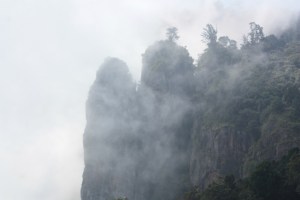
POEM: Pillar Rock

enshrouded in cloud,

a Chinese painting transplanted to India,

gnarled evergreens grow from cracked granite

like the bonsai that twists into a broad bloom of foliage,

i’d have thought the great white space, simple shapes, and gorgeous deformity

wouldn’t appeal to the Indian mindset —

so taken with vibrancy and fullness,

and yet crowds throng round,

staring in wonder,

ensnared by the same scene as

Shen Zhou when he painted, “Poet on a Mountaintop”

or

Fan Kuan as he painted, “Travelers Among Mountains and Streams,”

like two lovers fixated on one moon.

Desolate Snow Haiku

boot crunch
‘a cloudless night,’
he concluded


old coat of snow
nary a track in sight
beauty abandoned


snow blind
trudging and slogging
pure torture


crust of snow
over dry powder
bone cold


drifting flakes
add a wedge wall
to a farmhouse

BOOK REVIEW: Your Soul is a River by Nikita Gill

Your Soul is a RiverYour Soul is a River by Nikita Gill
My rating: 4 of 5 stars

Amazon page


This is a collection of short-form free verse poetry. There is a prose poem or two, but mostly it’s of the sparse line variety that’s popular today. The general approach of the collection is the pep talk, using metaphors from nature to convey to the reader how they should cope with heartbreak and other traumas.

It’s arranged into eight chapters, most of which take a theme from nature to tie the component poems together. The section headings are: “the cosmos,” “fire,” “the storm,” “ache,” “the sea,” “wild,” “the Earth,” and “heal.”

The collection offers some clever use of metaphor and imagery, and it’s quite readable. That said, it’s a little heavy on aphorisms for my taste. Instead of evoking emotion purely through imagery, metaphor, and sound, there are many lines that straight out tell the reader how they should feel – albeit often couched in a moving natural metaphor. In a way, Gill’s poems are the antithesis of haiku. While haiku strips away all the analysis, leaving only pure observation, and putting the conversion of that observation into feelings into the reader’s hands, Gill connects the dots for her readers.

Overall, I enjoyed reading these poems. As I mentioned, there are ways in which they are not my cup of tea, but – of course – I’m not Gill’s intended demographic either.

View all my reviews

POEM: Sinkhole of Now

If you discover an experience for which the mind relentlessly snaps back to the now, do it.

You are that experience. Any fissure between you and it will heal together — a decreasing entropy unseen in mountains. Crevasse. Cleft. Crevice. Scratch. Scar. Smoothness.

If your wild mind becomes ordered by the gravitational pull of the moment — a sinkhole of now formed of a vortex of sensory experience — pursue that thing.

India Haiku


Srinagar,
drifting on Dal Lake,
mirror of mountains


blossomed branch bobs,
twisting on wind as a bee
hovers, seeking sync


hill station hut
rain trounces the ground
lulling reveries


monkeys grooming
in a triangle, and I wonder
will they turn on 3?


from Shimla town
summer leaves hide the giant
orange overseer


POEM: Anti-Solipsist

The world exists, save for me.
I’m a figment floating eternally.
You won’t say that I am not.
But I’m the burning word that time forgot.

I’m a lost watcher, fallen.
Never had either a hope or calling.
Disembodied, feels so real.
I’m the ceaseless turning of dharma’s wheel.