BOOK REVIEW: The Science of Breath by Swami Rama et. al.

Science of BreathScience of Breath by Swami Rama
My rating: 4 of 5 stars

Amazon page


This is an oldie, but a goody. The first edition came out in 1979, but as its intent is to provide an overview of the anatomy and physiology of breath for yoga practitioners, the fact that it doesn’t access the bleeding edge of respiratory science isn’t all that detrimental.

This short book consists of four chapters. Two chapters are by the famous yogi Swami Rama, and the other two are written by medical doctors. The first chapter is an introduction to breath from the yogic perspective. It both explains why it’s so important to understand and work with breath and introduces the mythic physiology (prana, nadi, chakra, etc.) that has historically been used to explain pranayama (breath exercises.)

The second chapter is written by Dr. Alan Hymes and it explains the mechanics of respiration. While Chapter 2 focuses on the anatomy of breathing, it begins with an explanation of cellular respiration to introduce the role of breath in powering muscles. There is a fine explanation of the operation of the diaphragm and the intercostal muscles in breathing.

Chapter 3 is written by Dr. Rudolph Ballentine, and it delves into the role of the nose and nasal cavities in respiration. Breathing through the nose is emphasized in both yoga and many other systems of breath training (e.g. the Buteyko and Wim Hof methods.) This is because the nasal cavities perform many useful functions such as moisturizing and warming air, capturing pollutants, and extract heating and moisture from exhaled breath. Besides exploring nasal anatomy and physiology, Dr. Ballentine describes jala neti shatkarma (nasal cleansing with salt water) and nadi shoudhana (alternate nostril breathing.)

The final chapter, written by Swami Rama, mostly describes various techniques of pranayama (breathing exercises) and related practices bandhas and mudras (locks and seals in which bodily parts are contracted or constricted.) However, the chapter begins with a mix of physiology and mythic physiology. That is, it explains some topics not addressed earlier–such as the interaction between the nervous and the cardiovascular systems as well as chakra.

My standing complaint about books that weave together science and pseudo-science is mitigated a bit herein. My problem with putting these ideas together is that it can be difficult for the reader to determine what concepts reflect reality and which offer models to help one visualize energy. However, except for the last chapter, this book does a good job of keeping these ideas separate. The chapters by the medical doctors present the science with minimal intrusion of unscientific concepts. Swami Rama does present science and mythology together, but not so much scrambled together in a confusing mish-mash.

Chapters 2 through 4 use a number of graphics to help present the material. In the middle chapters these largely consist of line drawings to convey the relevant anatomical features or physical actions. The last chapter adds photographs to demonstrate relevant postures. There is a page of recommended readings, but it’s more of an advertisement for other books put out by the Himalayan Institute than the recommendation of books on the science of breath.

I found this book to be educational. It packs a lot of useful information into a concise package and is readable to a layman. I’d recommend it for yoga practitioners and others who are engaged in breath work.

View all my reviews

5 Reasons to Write Poetry

We’re a week into National Poetry Month. I’ve posted a few poems with more to come, but here I’ll reflect upon the benefits of writing poetry. Some may point out that this is one-sided because the pantheon of poets is littered with opium addicts and suicidal depressives. I read a BBC article citing research showing poets were 20 times more likely to be institutionalized than the non-poet population. I maintain that those bards were broken from the beginning, and that there’s another side to the story.


5.) Poems are puzzles, and puzzles make you problem-solve. This may be more true of structured poetry than free verse, but a poem wrangles words into a relationship designed to create a desired outcome–often an emotional state. With structured poetry one faces a tight puzzle that’s constrained by syllable counts, the relation of stressed and unstressed beats, or rhyme schemes. But even free verse cuts away everything that dampens a desired resonance. That’s done by a series of strategic choices.


4.) Poetry aids emotional management. A study by UCLA researchers found that poetry writing dampens the activity of the amygdala (the brain’s bringer of fear) and, of course, gives the pre-frontal cortex something to do (besides creating catastrophic scenarios–which is its go-to occupation under stress.)


3.) Poetry helps build better prose. Some writers will be more concise and others will be more graphic, but there’s always a benefit to be had. I found a NaNoWriMo blog post that tackles this topic nicely, so I’ll just link.


2.) Poetry activates attentiveness. This is especially true of a form like haiku, which consists of natural observation unembellished by analysis or sentiment. However, all poetry styles require one examine the world intensely enough to see the old anew. This post may be of interest on the topic.


1.) Poetry can access the unconscious. As a practice, I often just put pencil to paper write whatever comes without intervening or directing my conscious mind. Yes, most of it’s crap.  Or not even crap–more like gibberish. But when I go back through these later on, phrases often jump out at me as interesting or evocative, and these often find their way into the heart of actual poems. This is a particularly beneficial practice when one is stuck.

POEM: Eustress


I stress that eustress

is the best stress.

From time to time,

I must confess

I’ve made a mess

 doing more

succeeding less.

In a mad dash to impress,

badgered by self-duress,

taking matters to excess,

brewing up toxic distress.

Assess,

progress,

but don’t obsess.


[Poem 1: National Poetry Month]

5 Hyphenated Yogas That Miss the Point of Yoga

The laissez-faire and easy-going yoga community has spawned some phenomenally ridiculous mergers. I have “yoga” as a term on Google News, and almost every week I get fed a new example. I’m not saying every new approach to yoga is bad, but there’s one disturbing trend–i.e. the distraction yoga.


In the title, I refer to “hyphenated yogas,” but what I’m really ranting about is “distraction yogas.” A distraction yoga is one in which an element is brought into the practice so that one doesn’t have to keep one’s mind on one’s breath, alignment, and / or mental state. (Because who wants to think about that shit when one can be thinking “Wow, that kitten sure is cute.” or–believe it or not–“This beer has hoppy undertones.”)


Now before I get accused of hating puppies or beer, let me point out that nothing could be further from the truth. What I’m ranting against is the notion that you can marry any two good things and make a great thing. If you don’t believe me, please allow me to dip my nachos in your banana split. See, there are plenty of things that are awesome independently that make abominations when forced together.


I’ll include links as I go, lest you think I made this stuff up for hilarity’s sake.


5.) Beer Yoga: This is one of the most recent and intriguing distraction yogas. I’m not saying that one needs to follow a strict Vedic approach to life to practice yoga, but–come on–could you stop drinking for a couple hours to pretend your body is a temple (or at least that it’s not sitting in a trailer park with the windows busted out.) Unless “calf slaughter-yoga” catches on, it’s hard to imagine a less yoga-like practice than consuming intoxicants during the practice of yoga. By the way, there’s also a marijuana yoga, but I’ll lump these together as intoxicant yogas.

beermug


4.) Goat Yoga: This is one of many “animal yogas.” Like the others, the point is to have cute creatures around. How it’s supposed to help one’s yoga, I can’t fathom. Actually, I can fathom the suggested logic, probably something to do with calming and engendering feelings of compassion and well-being. But, ultimately it’s distraction by cuteness. Note: you can also do yoga with cats, dogs, horses, and probably river otters.

goatyoga-461x346


3.) Karaoke Yoga: Talk about distraction–nothing better than pounding music and reading a prompter to keep one’s mind off that ache in one’s hamstring.

karaoke_yoga


2.) Rave Yoga / Club Yoga: This might be a cheat because it’s similar to the previous one on the list, and I’m trying to lump these together so as to not be too repetitive. However, it’s not exactly the same, and is the perfect example of a distraction yoga. (There’s also Harmonica yoga and other musical yogas, but I won’t double-dip anymore.)

bombay_yoga-2e16d0ba-fill-735x490


1.) Tantrum Yoga: It wasn’t easy to determine whether I’d include this one or not. On the one hand, it’s not a distraction yoga in the sense that the others are. On the other hand, it takes the award for being least yoga like on the grounds that it’s not about dispassionately witnessing one’s emotional state but rather feeding one’s negative emotions. Note that I don’t group laughter yoga into the same class. I’m not sure whether laughter yoga is beneficial (or to what degree it’s a yoga), but I know that many people benefit from it because it bolsters positive emotional states.

tantrum


Now, one may have noticed that there are many seemingly strange (hyphenated) yogas that I haven’t mentioned. I haven’t said a thing about surf board-yoga, stripper pole-yoga, or acro-yoga–and I specifically excluded Laughter Yoga from the wrath of my rant. That’s because this isn’t a rant about people being innovative or non-traditional, it’s about people missing the point of what yoga is supposed to be (i.e. a means to quiet the mind.) I don’t know whether I can see myself doing yoga on a surf board or a stripper pole, but I’m certain that one has to give it one’s full attention–it’s not about finding a distraction to make yoga more palatable to hipsters.

BOOK REVIEW: Light on Pranayama by B.K.S. Iyengar

Light on Pranayama: The Definitive Guide to the Art of BreathingLight on Pranayama: The Definitive Guide to the Art of Breathing by B.K.S. Iyengar
My rating: 4 of 5 stars

Amazon page


This is B.K.S. Iyengar’s A-Z guide to breath and breathing exercises (pranayama.) It’s meant to do for pranayama practice what “Light on Yoga” did for asana (postural) practice. That is, it presents all the classic techniques, offers variants to meet individual needs, and provides the background necessary to put pranayama into the context of a balanced yoga practice.

Let me begin by discussing the book’s organization, and this book is organized to the n-th degree. There are parts, sections, chapters, and even the paragraphs are numbered (though–near as I can tell–the latter serves no purpose for a typical reader and may be more for the help of the writer and his assistants. It does create a somewhat biblical scheme, so maybe it was assumed there would be a need to quote this guide “chapter and verse,” as they say in Bible study.)

The bulk of the book consists of the first of two parts, and Part I is divided into three sections. The first of those sections is “The Theory of Pranayama,” and it puts pranayama in the context of yoga’s entirety. If you’ve read other B.K.S. Iyengar titles, much in these nine chapters will be familiar (e.g. discussion of the eight limbs.) However, chapter 4 offers a nice description of the anatomy and physiology of respiration. There are many anatomical drawings and diagrams in it to help convey the complex information. There’s also additional information about the traditional Indian notions of breath encapsulated in the concepts of prana, nadis, and chakras.

Section II is entitled “The Art of Pranayama” and it covers those topics necessary regardless of what technique of breath exercise one is practicing. It includes seated postures, mudras, bandhas, inhalation, exhalation, retention, etc. This section, too, has nine chapters. The final section of Part I describes the various techniques of pranayama. The chapters of this section are arrayed in lists, and they systematically build from the basic technique towards more advanced variations (e.g. by inserting retentions.)

Part II covers meditation (dhyana) and the corpse pose (savasana.) With respect to the former, it suggests how one’s body, mind, and sense organs should be conducted in the act of meditation. In the case of the chapter on corpse pose (after cross-legged seating position, this being the most common position for practice) there’s an extensive look at the details of that pose.

There are a number of helpful features incorporated into the book. In addition to the drawings mentioned in Chapter 4, there are black-and-white photos throughout to clarify the textual instructions. There is also a glossary of Sanskrit terms and an Appendix of courses of pranayama (i.e. recommendations as to how to sequence breathing techniques for optimal results with guidance as to how many sets or repetitions of each to use.)

My major criticism is one I’ve offered about previous books from this author and others. There’s a muddle of science and mythology that makes it hard to know how much weight to give particular instructions. It may be that a given piece of advice (e.g. a contraindication) is based on repeated observations of the physical or mental effects, or on a sound understanding of anatomy & physiology. In which case, it makes sense to heed such advice. However, advice can also be based on myths and the desire to preserve a way of thinking about the human body which is wholly unsupported by evidence. In which case, if one has no dog in the fight to preserve egos, it makes sense to disregard said advice. I suspect the vast majority of statements of what to do (or not to) fall into the first category, but some may fall in the latter, and it’s not easy to tell which is which.

I would recommend this book for students and teachers of yoga. It’s a good reference for one’s pranayama practice.

View all my reviews

5 Courage Building Yoga Practices

Learning to manage and moderate one’s fears and anxieties needn’t involve strapping on a parachute, cold quitting a job, or bare-knuckle boxing in a back alley. In fact, it may be best to begin by quietly watching those anxieties at the other end of the spectrum, the one’s so subtle that conscious awareness of them can be blotted out by the noise of living–but which nevertheless have a physiological impact.


The ability to quietly and non-judgmentally witness one’s emotional state–as is taught in yoga and related practices such as Buddhist meditation–is crucial (and, in my opinion, is one of the most valuable lessons that these systems have to teach.) Crushing or repressing emotions is a demonstrably losing strategy. At best these feelings are tamped into one’s subconscious mind, still adversely affecting one’s outlook and, therefore, indirectly casting a pall over one’s life.


You’ll note that I’ve mentioned courage and moderating fear, but have not mentioned defeating emotions or quelling fear. Wrongly, our archetypes of fearlessness are characters like John McClane (i.e. the “Die Hard” movies), Katniss Everdeen (i.e.”The Hunger Games” trilogy),  or Yoda (i.e. the “Star Wars” movies.)  But neurologists who study patients whose brains have been damaged such that they are literally fearless tell us that the defining characteristic of such individuals is “paralysis by analysis.” In other words, Sheldon Cooper (i.e. “Big-Bang Theory”) is a more apt model. Also, the fearless tend to live short lives because they eventually do something fatally inadvisable.


We need our fear. However, while fear can keep us from doing stupid things, it can also turn us into the worst version of ourselves. Therefore, our fear needs to be moderated with courage and reason (to these, some would add “faith.”)


You may note that I tend toward the intermediate / advanced with the practices I mention. This is, in part, because that’s probably more likely the point at which one is ready to take this on. In beginning a practice, one may have one’s hands full to grasp the basics of alignment and breath.


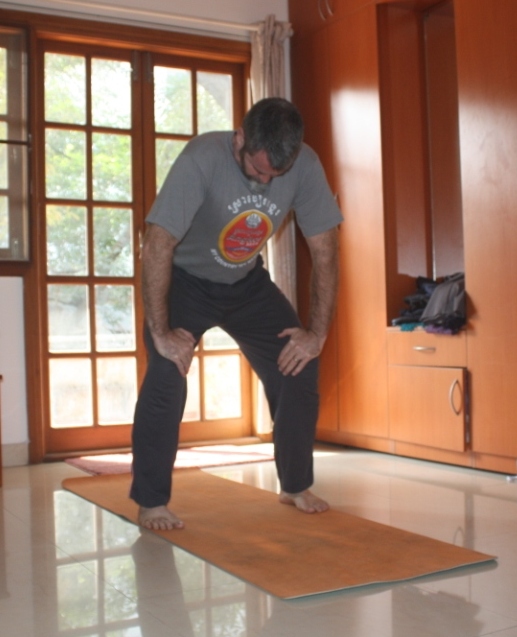
Without further ado, here are a few yoga practices that I’ve used to help me witness my anxieties and learn to moderate them:


1.) Nauli (and other external breath retention [i.e. bāhya kumbhaka] techniques.): Breath retention can produce a subtle anxiety, even when one has full control of the timing of release and the next breath. In fact, subtle anxiety may cause one to have a less robust retention than one might otherwise. Truth be told, this practice has probably been more fundamental than any of the āsana practices that will follow, for me personally.  

Note: external retentions are relatively advanced practice and should only be added to one’s sadhana after one has been taught by an experienced teacher and is somewhat experienced with pranayama.

practicing nauli

practicing nauli


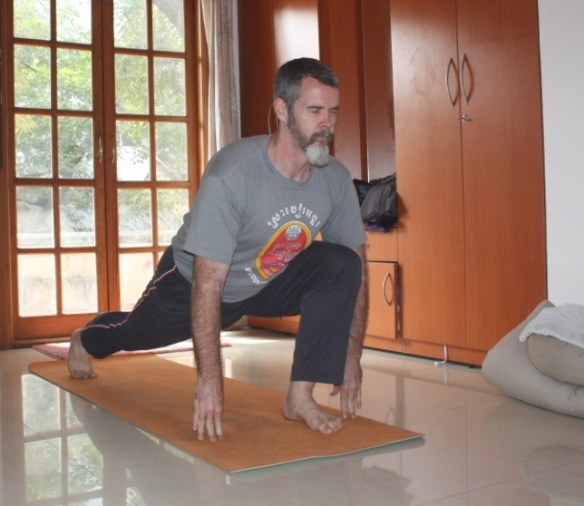
2.) Eyes closed: This is particularly effective with Surya Namaskara (Sun salutations), standing poses, and–at an advanced level–balancing poses. One should make sure that ones balance is solid throughout before attempting with one’s eyes closed. We have redundant systems to help achieve balance (i.e. inner ear, proprioceptive, and visual), but–for the sighted–going without vision can be nerve wracking.

ashwa sanchalanasana in Surya Namaskara

ashwa sanchalanasana in Surya Namaskara


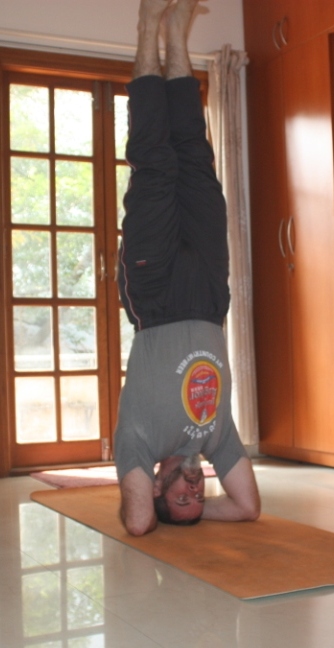
3.) Inversions: Inversions are meant to be calming because when the blood pressure to the head increases, it triggers reactions in the body to reduce it. However, it may take some time before that promised is reached. I’ve done a more extensive post on inversions that can be read here.

shirshasana (headstand)

shirshasana (headstand)


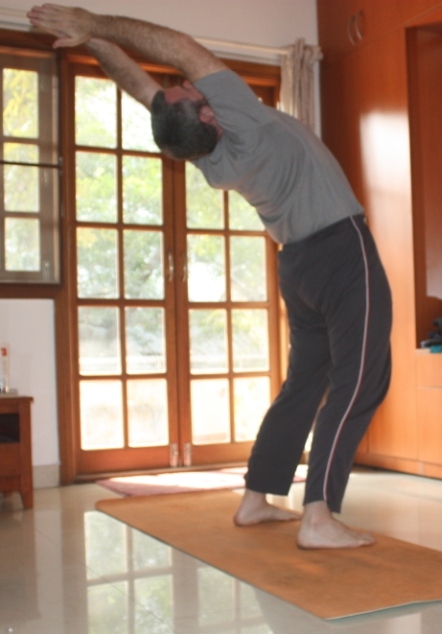
4.) Standing Back-bends: (Ardha Chakrasana / Urdhva Triangmuktasana / full Urdhva Dhanurasana) Simple back-bending can create the feeling that one is about to fall back onto one’s head. One may want to begin with a simple back-bend as one might do in Surya Namaskara before advancing to the complete Urdhva Dhanurasana in which one moves into a wheel pose (Chakrasana) from a standing position. (Urdhva Triangmuktasana is an intermediary in which one’s knees are more deeply bent, and one reaches back towards one’s Achilles tendon.)

ardha chakrasana

ardha chakrasana


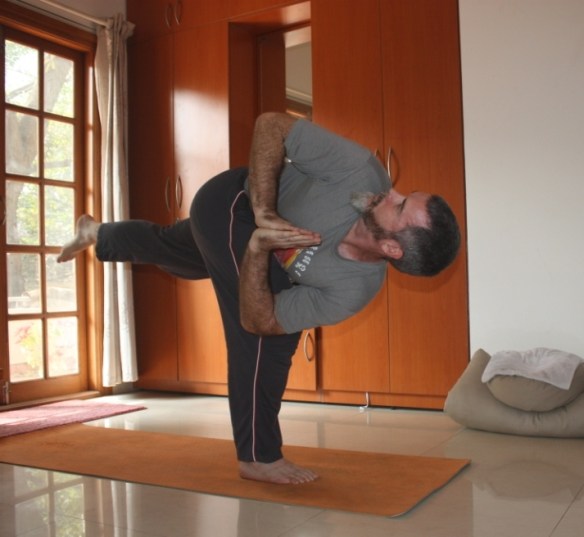
5.) Standing Balances: Depending on one’s level, anything from tree pose (vrksasana) to bound twisted half-moon pose (baddha parivrtta ardha chandrasana) may be applicable. I’ve shown the unbound version of the latter (parivrtta ardha chandrasana.) Twisting and balancing at the same time provides a great challenge, if one is already confident with balances generally.

parivrtta ardha chandrasana

parivrtta ardha chandrasana


Happy practice.

BOOK REVIEW: Altitude Illness by Stephen Bezruchka

Altitude Illness: Prevention and Treatment (Mountaineers Outdoor Expert)Altitude Illness: Prevention and Treatment by Stephen Bezruchka
My rating: 5 of 5 stars

Amazon page


I picked this book up after my third, and most recent, trek at high altitude. On each trek, I felt the altitude at some point along the trail, but the most troubling and persistent issue for me has been sleep disruption—what I learned in the book was called periodic breathing. That was one of several useful lessons I learned from this book.

Altitude illness is an odd affliction. There’s a clear logic to what is happening inside your body. There’s a lack of sufficient oxygen to get said oxygen distributed throughout your body by way of your body’s business as usual operations. Homeostasis is out of whack, and the body does a number of things at once to rectify the problem. Because of this, in practice the ailment is actually a range of disparate illnesses that can seem to act in an arbitrary manner. Different people feel altitude in different ways. Some have no problems if they acclimate a few days, but others hit a ceiling beyond which they can’t travel no matter what. One’s level of fitness has little to do with how well on acclimatizes. For some, like myself, it can be a nuisance, but for others it can turn into a threat to survival in a flash.

This book is a concise introduction to altitude illness that covers: acclimatization / adaptation [ch. 1], the various forms of altitude illness [ch. 2], prevention [ch. 3], diagnosis [ch. 4], treatment [ch. 5], the effects of altitude given common preexisting conditions [ch.6], and a guide to preparing for a high altitude jaunt [ch.7.] In addition to the chapters mentioned above, there are two final chapters that make for nice features. Chapter 8 presents case studies of various true instances of altitude afflictions. The cases not only make for interesting reading, but also may help one connect the dots as to what is happening with oneself or someone in one’s party. The last chapter is a frequently asked questions (FAQ) collection that helps to summarize and restate issues addressed in the main chapters. The FAQ may also help one find needed information more quickly, rather than having to flip through the entire book while someone is having trouble.

There are some graphics in the book. Most of the graphics are photos of high or extreme elevation environments—and mostly the latter. (fyi: The book calls 12,000 – 18,000 feet [3660m to 5490m] high altitude, and over 18,000ft [5490m] is extreme altitude.) There are also several tables and a line drawing or two. There’s a short bibliographic section that is nicely divided into two sections, one for health care professionals and the other for lay readers.

I found this guide to be useful and well-presented. It’s well organized, concise, and easy to navigate (bullet points are frequently used to good effect.) This is the kind of book that is meant to help you get to the information you need quickly. There’s not a lot of use of the narrative approach beyond the case study chapter and a few anecdotes in the chapters to liven the discussion. I don’t mean to make is sound dry, but it’s a book with a purpose and that purpose isn’t entertainment. The lack of extraneous information and the keeping of blocks of text small is a good idea for this kind of guide. Having said all that, it’s quite readable by a layman. Jargon is explained and there is a glossary. (There are only a few medical terms—e.g. edema (fluid build-up), ataxia (incoordination), and syncope (fainting)that one needs to be concerned with repeatedly.)

If you will be traveling at altitude (and remember that may not be high or extreme elevations, some people have problems at as low as 6000ft [1800m.]) I’d highly recommend this book. I’d further recommend one re-read it on subsequent high elevation travels. It’s a short book and is broken up into tight subsections.

View all my reviews

BOOK REVIEW: Brain Rules by John Medina

Brain Rules: 12 Principles for Surviving and Thriving at Work, Home, and SchoolBrain Rules: 12 Principles for Surviving and Thriving at Work, Home, and School by John Medina
My rating: 4 of 5 stars

Amazon page


As the title suggests, this is a book of guidance about how to get the most out of one’s mental life. Medina goes a mile wide, looking at twelve areas in which one can improve the performance of one’s brain, including: exercise, attention, memory, sleep, stress management, sensory integration, and visual acuity. It also has chapters that explain how evolution and gender affect the way in which one’s brain operates.

After an Introduction that sets up the premise of the book, there are twelve chapters. The first chapter explores the well-documented connection between exercise and mental performance, and offers insight into what type of exercise has been shown to be most helpful to the brain. The second chapter pertains to our brain’s evolutionary history. The conscious mind housed in the cortex is but the top floor of a multi-story enterprise, and understanding this has important ramifications for how one gets the most out of one’s brain. Chapter 3 explores the way brains are wired, which turns out to be flexibly and diversely. By flexibly, I mean that brains can be rewired by way of what is called neuroplasticity on the proviso that neurons that fire together wire together. By diversely, I mean that each individual’s brain is a bit different, and these differences can explain how someone gifted in one domain may be an idiot in other aspects of life. The next chapter deals with attention and explains why humans suck at multi-tasking (despite thinking they are the bomb) and why an extended ability to concentrate is essential to success.

The next two chapters both deal with memory, but with different types of memory—each having its own unique considerations. The first, chapter five, describes the peculiarities of short-term memory, that part of the memory that can hold a finite amount of data points at the forefront of our minds for a limited period. Chapter six deals with long-term memory, the part that holds vast stockpiles of information for extended periods (sometimes across a lifetime) but with lower fidelity and accuracy than we generally believe. While the rule offered for both forms of memory is simple—i.e. repetition is key—there is much to consider in the details. For starters, there are many other ways to divide up memory other than with respect to the short-term / long-term dichotomy (e.g. procedural v declarative) and differences in the way these types of memory work affect how they are both optimized.

The influence of sleep on mental performance is the subject of chapter seven. There is a vast pile of research on this subject, including a number of famous cases of extreme sleep deprivation—some of which are touched upon herein. It’s true that there is a great deal of variation in how people sleep (e.g. morning v non-morning people, and those who can power nap and those who can’t.) However, one thing remains unambiguous and that’s that we need sleep and must have full cycles of it in order to not suffer mental degradation. Chapter 8 is about how stress can kill mental performance. Of course, not all stress is the same. When one feels in control, short bursts of stress can be just the motivator one needs, but when feeling out of control stress can become crippling.

Chapters 9 and 10 are both about the senses. The first, nine, explains how one can obtain synergistic outcomes in a multi-sensory environment, and the second focuses on vision—arguably our most dominant sense. Our sensory experience is much more a product of the brain (and much less a pure representation of the outside world) than we tend to believe.

Chapter 11 reports on the gender differences that have been discovered with respect to brains. Before anyone lights a torch or sharpens a pitchfork, this isn’t the old “boys do math and girls do language” line. The differences are more nuanced, and it’s not clear in every case that the differences matter—or how. E.g. Men have bigger amygdala (involved in emotional response) and produce serotonin more quickly. While it’s not clear that these differences make a big difference, it’s know that men and women use their amygdala differently in times of stress, men activate the right amygdala and tend to remember more of the gist of events while women trip the left and remember more emotional details. The last chapter is about our human proclivity to explore, but it focuses heavily on infancy and childhood, during which the world is novel and the impulse to explore is at its height.

Each chapter ends with a summary box that both restates the rule and offers a few bullet points of key takeaway lessons, which may either be more specific guidance or summary of relevant research findings. There aren’t many functional graphics—by functional I mean as opposed to the ornamental drawings used throughout. I only remember one brain drawing. However, the reason for the dearth of graphics may be that there is a link to a 45 minute video that one can access, and the publisher probably thought that was a much more useful way to impart graphic information. It should also be noted that in the Kindle edition that I have, the references are also on-line.

I found this book to be useful. As I mentioned, it’s a broad overview. One can get books that dive more deeply into all of the topics addressed. But this is a nice mix of popular science and self-help. It’s readable, and the summaries and concise statement of rules help make the content stick more effectively.

I’d recommend this book for those who are seeking a book that covers a lot of ground, and which offers practical guidance as to how to put scientific discoveries on the brain into use in one’s own life.

View all my reviews

BOOK REVIEW: Low Back Pain ed. by Jeffrey N. Katz, M.D. [A Harvard Med School Guide]

Low-Back Pain: Healing Your Aching BackLow-Back Pain: Healing Your Aching Back by Harvard Health Publications
My rating: 5 of 5 stars

Amazon page


This guide is one in a series put out by Harvard Medical School. It’s the second one that I’ve read, and I found them both to be beneficial reads. The first was on the health benefits of tai chi chuan (a Chinese martial art / system of health exercise [qi gong.])

Harvard Medical School’s willingness to report findings about unconventional approaches and self-care was part of the appeal of this book. When I first developed lower back problems, I went to the doctor, was diagnosed with arthritis via x-ray, and all I got was an offer for pain killers. To me this was much like going to the mechanic because the check engine light came on, only to be told that all they could do for me is unplug the pesky indicator light. At any rate, that’s why this kind of book can be useful, because one can’t always expect a given doctor within the modern medical establishment to be on top of treatments not involving drugs or surgery. This isn’t to denigrate those options, often times they are the best or only option, and they are covered in this guide as well. However, back pain is one of those rare areas in which sometimes the best option is outside medical norms. Much as many doctors hate having information thrust in front of them by patients, at least Harvard Medical School may garner more respect than a WikiMD post. There’s even a box talking about the mind-body connection, and options in that domain.

Low back pain is both extremely common and often still poorly understood. That’s because there are so many problems that can cause similar symptoms. [I guess this shouldn’t be a surprise because our pelvis had to rotate through evolutionary changes to take us from quadrupedal to bipedal. It makes sense that our nerves and blood vessels might be routed in such a manner as to cause troubles.]

While this guide is short, it does take on a range of issues, including: who’s most at risk, how the spine works [and doesn’t], what the basic categories of back injury are, how one’s specific ailment may be diagnosed, how to evaluate treatment options, what one can do on one’s own to help heal a problem back while preventing future injury, what medicines may be prescribed, what surgical options may be offered, and advice on facilitating a recovery.

As far as ancillary features are concerned, there are a number of line drawings. This artwork is generally either anatomical drawings used to show how the spine works or is injured, or show exercises that one can use to strengthen the back. There are a few pages each of resources and glossary. The resources are not so much printed resources (there’s only one of book, and that one is authored by the editor of this guide,) but rather organizations and even websites.

I found this guide to be informative and helpful. I would recommend it for anyone who has low back problems, or who might benefit from learning more about them (e.g. yoga teachers.)

View all my reviews

BOOK REVIEW: Piriformis Syndrome by Loren Fishman, M.D.

Piriformis Syndrome: Diagnosis, Treatment, and Yoga: Pain in the ButtPiriformis Syndrome: Diagnosis, Treatment, and Yoga: Pain in the Butt by Loren Fishman
My rating: 4 of 5 stars

Amazon page


This short book (<50pp.) describes piriformis syndrome, what causes it and how it’s diagnosed and treated. Piriformis Syndrome is a malady in which a nerve is pinched by the piriformis muscle. Because of the way pain (and other sensations) radiate, it’s not necessarily easy to differentiate this syndrome from a low back injury. However, the descriptions of the specifics of this condition, and the test used to diagnose, it may give one insight as to whether one is looking in the right direction for the cause of one’s butt and leg pain.

One nice feature of this book is that it explains how yoga can be used both as part of the treatment regimen and as a preventive measure. The yogic treatment consists of just four classical postures of Hatha Yoga: Janu Shirshasana (head to knee pose), Parivrtta Trikonasana (twisted triangle pose), Matsyendrasana (a simple twisting pose named for a sage), and Parivrtta Parsvakonasana (twisted side angle pose.) However, yoga teachers who have students who’ve been diagnosed with this condition will find it nice that the book gives modifications and clarifications pertaining to use of the postures to help such people.

There are seven chapters in the book. The first describes the condition and its cause. The second chapter explains the connection between the condition of piriformis syndrome and the symptom of sciatica. Chapter three clarifies the ways in which this condition may be misdiagnosed, and this is followed up by the chapter that shows how it is diagnosed by both physical examination and by imaging technology. Chapter five gives a basic overview of the available treatment options including injections, drugs, physical therapy, surgery, and yoga. The next chapter talks about the state of research. The last chapter explores the yoga asana that can be used to help treat or prevent piriformis syndrome. There are a few graphics. These include line drawings such as of the diagnostic physical exam, and photos of modified versions of the yoga postures.

I’d recommend this book for those who’ve been diagnosed with this ailment, who believe they might have it, but also for yoga teachers who are interested in expanding their understanding of the afflictions of which their students may suffer—so as to be prepared to help them or, at least, not hurt them.

View all my reviews