PROMPT: Beach or Mountains

Daily writing prompt
Beach or mountains? Which do you prefer? Why?

To me, that is much like asking whether I prefer a hammer or a Phillips head screwdriver. They are different tools for different purposes. Good luck if you love your ballpeen hammer so much that it’s the only tool for you but your problem of the moment is a deeply embedded wood screw.

PROMPT: Favorite Month

Daily writing prompt
What’s your favorite month of the year? Why?

Northern or Southern hemisphere? Landlocked or coastal? Temperate or Equatorial? I need more information.

BOOKS: “The Meaning of Travel” by Emily Thomas

The Meaning of Travel: Philosophers AbroadThe Meaning of Travel: Philosophers Abroad by Emily Thomas
My rating: 5 of 5 stars

Publisher Site – OUP

Of late, I’ve been reflecting upon the philosophical divides that exist between travelers and others (I call them “tribals,” but they are by far the majority of people — i.e. those who either don’t travel [unless required to] or who travel only in a tourist-like fashion.) As I’ve done so, I’ve been surprised to find how limited the literature is on the subject. I was, therefore, pleased to find this book. While Thomas confirmed my preliminary findings that there isn’t much of a travel-centric subdiscipline of philosophy, she also shows that it’s not for a lack of philosophers traveling and pondering travel.

While I’ve spent considerable time thinking about a philosophy of travel, I was pleasantly surprised to discover a number of topics in Thomas’s book to which I’d hardly given any thought. These were the most personally fascinating topics because they involved such uncharted territory. They include: maps as propaganda, the importance of travel to scientific discovery, the domination of male perspective in our collective understanding of travel, and the ethics of doom travel (going to vanishing places.)

The book also advanced my understanding of subjects that I’ve often contemplated — e.g. aesthetics and travel, innate / universal ideas v. culturally-tinted ones, and the connection between minimalism and travel.

If you’re interested in philosophy, travel, and the intersect of the two, this book is definitely for you. The author takes a light approach and the book’s readability is high — i.e. while it is thought-provoking, it’s aimed at a general readership rather than a scholarly one.

View all my reviews

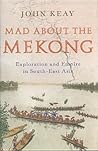
BOOK: “Mad About the Mekong” by John Keay

Mad About The Mekong: Exploration and Empire in South East AsiaMad About The Mekong: Exploration and Empire in South East Asia by John Keay
My rating: 4 of 5 stars

Publisher’s Site

This book is largely, but not exclusively, an accounting of the Mekong Exploration Commission’s two-year (1866-1868) expedition of the Mekong River. The French undertook this expedition in the expectation that the Mekong, like other of the world’s major rivers, would allow ocean-going ships to traverse deep inland — possibly even up into Yunnan, China. The explorers were quickly disabused of this notion, but they relentlessly kept going – despite suffering from disease and the exhaustion of a trip that involved a lot more portaging and other intense physical activities than they’d hoped for.

As I mentioned, Keay doesn’t stick purely to description of the activities of these nineteenth century explorers. Along the way he also brings in fascinating stories from other periods as well as discussion of what the river is like (e.g. its ecology, infrastructure, role in geopolitics, etc.) these days. So, while it would be excessive to call the book a history of the Mekong, it is in some regards — albeit the highlights reel. Some of the diversions were among my favorite parts of the book. Perhaps my favorite was the story of Tony Poe, whose story is said to be the model for Col. Kurtz of Apocalypse Now. I’d long heard that that movie was based on Joseph Conrad’s Heart of Darkness, and it is (the name “Kurtz” is clearly from Conrad’s novella, though Poe’s occupation more closely mirrors the Col. Kurtz character played by Marlon Brando.)

While the book sometimes shines the light more broadly than he Mekong Exploration Commission Expedition, it also narrows its focus much of the way, putting the expedition’s most colorful character, Francis Garnier, front and center. Garnier was not only the most intriguing member of the leadership, he also led the group to what was the end of the line for the expedition, deep in China, when the Captain, Ernest Doudart de Lagree, became incapacitated by disease.

If you’re interested in history, travel, or exploration, I’d recommend this book.

View all my reviews

PROMPT: Favorite Place

Daily writing prompt
Do you have a favorite place you have visited? Where is it?

No. I try to see wherever I’m at as being as good as any other place I’ve been. And, of course, it is — only my perceptions change and can drive value judgements. The places and the peoples are just different. If one starts ranking and rating places, one can kill the ability to see what is beautiful and spectacular about a particular place. If a place didn’t have redeeming features, people wouldn’t live there. And, by the way, if people don’t live there, that’s probably my favorite place on earth.

PROMPT: Favorite Subject

What was your favorite subject in school?

Depends on the year. In twelfth grade, I remember enjoying Physics the most. In Eleventh, Psychology was the best class I attended. There was a year when I got the most out of an English class that focused on Creative Writing. I guess my most longstanding preference was for classes like Geography and Social Studies, wherein we learned about the world outside our world.

PROMPT: Travel (Far from Home)

Daily writing prompt
Share a story about the furthest you’ve ever traveled from home.

That depends on how you define “home.” If by home, one means the place I’ve lived for the past decade [Bangalore, KA, India,] then its antipode is in the eastern Pacific Ocean – off the coast of South America. This would make the farthest I’ve been from home: Lima, Peru. If, however, one means the place I was born and grew up in [i.e. Northwest Indiana in the USA,] its antipode is in the Indian Ocean – west of Australia, and the farthest I’ve been would probably be the southern tip of Bali, Indonesia.

Either way, one could say that I’ve never been far from home (despite having visited 40-some countries over all continents except Australia and Antarctica.)

BOOK REVIEW: Global Catastrophes: A Very Short Introduction by Bill McGuire

Global Catastrophes: A Very Short IntroductionGlobal Catastrophes: A Very Short Introduction by Bill McGuire
My rating: 4 of 5 stars

Amazon.in Page

This book explores a select set climatological, geological, and extraterrestrial impact disasters and their potential planet-wide repercussions. About half of the book deals with climate: global warming and the next ice age. [Those sound like completely unrelated topics, given global climate disruption is largely about a rise in average temperatures (which has been caused by human activities) and the coming ice age is about cooling (which is mostly because of factors outside our control — e.g. our orbital path and axial tilt — but there’s a discussion about how global warming might hasten (rather than stave off) the ice age.]

The other half of the book is about the more dramatic geological and extraterrestrial threats. There’s a chapter (ch.4) about volcanos, earthquakes, and the tsunamis they cause, and the last chapter (ch. 5) is about comet and asteroid impacts.

The book contains a great deal of thought-provoking information. There are two major criticisms to be leveled. First, it leaves some important items undiscussed – e.g. there’s nothing about the solar storms that I’ve heard constitute a planetary risk. (I do understand that technologically induced catastrophes are another book entirely.) Also, there’s little mention of the mitigative activities that are in place and what impact they might have. For example, I know NASA and others have developed technologies to not only monitor but also destroy impactors. (The author mentions monitoring but says nothing of mitigative activities.) I can’t condemn these omissions severely because this is a “very short” guide. The second criticism is potentially more concerning and that is that the tone isn’t the completely objective one we’re used to hearing on scientific subjects. I don’t fault the author for having some angst about climate change or super-volcanoes, but I am left to wonder degree of confirmation bias crept into the selection of research presented. (All “sky is falling” with no discussion of possible mitigative events or best-case scenarios sets my Spidey-sense a tingling.)

This is a fascinating look at catastrophes, though the complete doom and gloom tone of the author made me wonder whether confirmation bias might be at play (or maybe there was a presumption about what people who would read such a guide may want to hear.)


View all my reviews

BOOK REVIEW: Atlas of Improbable Places by Travis Elborough

Atlas of Improbable Places: A Journey to the World's Most Unusual CornersAtlas of Improbable Places: A Journey to the World’s Most Unusual Corners by Travis Elborough
My rating: 4 of 5 stars

Amazon.in Page

This book has entries on about fifty odd and off the beaten path locations. These locales are grouped into six parts that explore: “utopias,” abandoned places, bizarre architecture, islands, otherworldly destinations, and subterranean attractions.

There’s a standard set of graphics for each entry that include: a map that shows where in the world the place is, a photograph at that place, and a closeup map of the site’s immediate environs. The text describes a little about the history of each place and any quirky facts of relevance (such as how a location came to be abandoned.) The text also helps to clarify definitional issues such as what kind of utopian vision was being sought-after for the various [arguably] failed utopias of the first section.

I enjoyed this book. I’ve only visited two of the sites in the atlas (Ross Island and Auroville,) and I’m always excited to learn about more strange and unconventional destinations. I felt the atlas did succeed by presenting so many places I’d not only not visited, but about which I’d not even heard. (There are locations like Puerto Princessa [under-island river in the Philippines], Aokigahara [Japan’s suicide forest,] and “the Palm” [Dubai’s artificial islands] that are well-known to geography buffs, and many of the lesser-known sites are quirky tourist traps (Ten Commandments Mountain in North Carolina,) but –still — there are some fascinating but little-known locations in the book.) There is a disproportionate coverage of North American and European locations, presumably because that’s where the market for English language books disproportionately lies, and little coverage of African or South American locations.

If you’re into strange and remote travel locations, you may want to have a peek at this book.


View all my reviews

BOOK REVIEW: The Ocean of Churn by Sanjeev Sanyal

The Ocean of Churn: How the Indian Ocean Shaped Human HistoryThe Ocean of Churn: How the Indian Ocean Shaped Human History by Sanjeev Sanyal
My rating: 4 of 5 stars

Amazon page


This is a geographic and historical overview of the Indian Ocean from the geological processes that created it to the wave of independence movements that took hold in the wake of the Second World War. The author’s approach is to emphasize the interaction between – rather than within – the various nations of this region. [Though, India in particular, gets a great deal of space devoted to internal happenings. However, given its central location (trading to both the east and the west,) its size, and its cultural influence on the region, it’s not necessarily the case that this is an unfair bias.]

I was happy to find a book that seemed to be just what I was looking for. Having lived in India for more than five years, I’ve often been struck by the intriguing evidence of interconnectedness that I didn’t have the historical background to understand. From a discussion with a Nairobi cab driver who had no idea that chapati (a flat bread common in South Asia, but eaten as far afield as the Caribbean) was anything other than an indigenous Kenyan culinary invention to the fact that Tamil is one of the official languages of Singapore, I’ve often found myself curious about how these connections came to be. This book didn’t disappoint. Sanyal delves right into the fascinating fun facts without getting too bogged down in the who married whom and who fought whom that quickly becomes the tediousness contributing to a lack of enthusiasm for the subject of History among school children. (That said, there is – probably necessarily – some of the stuff that students are forced to memorize, here and there.)

The approach of the book, after an introductory chapter that gives the reader a contextual introduction to the region, is to proceed chronologically. This means the book starts out more geology, geography, and anthropology and gradually becomes more of a history. In the later half of the book, this history is particularly an economic history focused on the products whose trade drove interaction in the region – be it for conflict or for cooperation. Trade is important throughout the region’s history, but we also see a lot the spread of culture earlier, especially the spread of religion. From the spice that was much coveted in Europe to the opium that the British East India Company used to balance its trade with China (resulting in the Opium Wars,) this trade has had a profound impact on the world in which we live.

There are many graphics throughout the book, primarily maps. These are extremely beneficial. The book is annotated with end-notes that provide sources and elaborations.

I found this book to be both interesting and entertaining. The author throws in a one-liner joke now and again, but what I really found humorous were the fictions that were widely believed back in the day. Most of these resulted from merchants telling tall tales to make asking prices more palatable. It’s harder to scoff the price of a diamond if one thinks they were guarded over by gigantic snakes and the only way to get them was to throw meat into a canyon so that Eagles (the only things that could out move the snakes) might snatch up a diamond with its steak. It is also fascinating to learn how the same stories were heard from different sources, suggesting that false information behaving like an infection isn’t new to the internet age.

If I had one criticism of the book, it would be that in the final chapters the author leaves behind the historical objectivity that seems prevalent throughout most of the book. Instead of presenting the information and letting the reader make up their own mind about such events as Subhas Chandra Bose’s (Netaji’s) courting of the Nazis during the Second World War, Sanyal shapes the information he feeds to readers to persuade rather than to inform. I didn’t notice this in earlier parts of the book and suspect it was just easier to be dispassionate about the distant past.

All-in-all, I’d recommend this book for anyone wanting to learn more about history and trade across the Indian Ocean. I learned a great deal, and found the book readable and intriguing.

View all my reviews