BOOK REVIEW: Cabinet of Curiosities by Preston & Child

The Cabinet of Curiosities (Pendergast, #3)The Cabinet of Curiosities by Douglas Preston

My rating: 3 of 5 stars

Amazon page

Cabinet of Curiosities features many of the hallmarks of a Preston and Child novel. First, the lead is FBI Agent Pendergast. Special Agent Pendergast has three things that no FBI Special Agent in the history of the FBI has ever had: 1.) a fortune, 2.) the ability to pick and choose both his assignments and the jurisdiction he works in, and 3.) about 200 vacation days a year to learn things like ikebana and to read random scholarly publications in disparate fields such that he is an expert on the known Universe.

Regardless of the incredulity his character may inspire, Pendergast is a fascinating character. He has a New Orleans accent and an almost albino complexion, which intrigues–and puts him outside the New York / Chicago/ LA nexus in which cop fiction frequently gets stuck. (Don’t worry; the NYPD quota is still met.) Furthermore, his encyclopedic knowledge of everything allows him to constantly get the better of any and all unlikable characters in the book—and, in these books, you are either likable or loathable. It also features other Preston & Child familiars, including Nora Kelly and William Smithback Jr.

Second, it features the supernatural, preternatural, or at least the appearance of the aforementioned. This is all part of a dark and mysterious tone they have down to an art. This goes back to their first book Relic.

Third, one of the likable characters gets killed off.

The title, Cabinet of Curiosities, refers to collections of natural anomalies that were all the rage in the 19th century, and which served as mini museums of natural history. These cabinets (sometimes also called “wonder rooms”) might feature genuine exhibits, fakes, or some combinations thereof.

The novel begins with Agent Pendergast seeking Nora Kelly’s expertise to assist him in investigating a 19th century mass murder. The remains of the deceased were found in a building that’s being torn down to put up a high-rise, but it used to be the basement of a cabinet of curiosities.

We don’t get any clue as to why an active duty FBI agent would take an interest in 19th century murders until late in the book. [Of course, we never find out why Pendergast is allowed to investigate it.] I’ll leave it to readers to determine whether the ultimate explanation makes any sense or not. Needless to say, the murder and mayhem come to the present day over the course of the novel.

While I might sound down on both this book and the series, I’ve read seven of the books jointly authored by Preston and Child (and one or two from each as solo authors.) It’s, therefore, unreasonable to say that I dislike their work. However, I will say that I didn’t like this one as much as some others (e.g. Relic and Still Life with Crows.) I’m not entirely certain whether this one was just not as good, or whether I’ve become a bit jaded from over exposure to their formula. (Maybe doing so many book reviews of late has made me over analytical, and commercial fiction—like popular movies—are easy pickin’s for criticism.)

That said, I have three major criticisms of this book:

First, there’s a critical happening that requires someone so brilliant (yet unknown and working solo) that they could invented a technology in the 19th century that modern scientists couldn’t even fathom duplicating. This is sort of a common theme in some steampunk works (e.g. the Will Smith Wild, Wild West movie). However, steampunk creates its own world, distinct from the world as we know it. I can buy some kinds of “lost knowledge” lines, such as the idea that some plant-based medicinal compounds have been lost due to deforestation and loss of the experience of native peoples (this was the premise in Preston’s solo work, The Codex). However, in Cabinet of Curiosities there is a scientific discovery critical to this novel which is of a complex nature. It’s impossible to believe that it could be done by someone without modern equipment or access to the vast scientific literature of the intervening century.

Second, while I don’t want to sound like someone who poo-poos cross-genre novels, there’s a problem with this book not knowing whether it’s a mystery/thriller or supernatural/horror. In general, I love cross-genre work. However, a thriller needs some sort of realism to pull us in and mysteries call for some sort of rules or the game. If anything can happen (or if we don’t know the rules of what can happen) it’s a bit unsatisfying to try to noodle out whodunit.

Third, the reveal of the villain seems a bit forced. It’s not quite Scooby-Doo because they create several despicable characters to choose from—and not just one grumpy old man who you know is going to be the guy. However, it seems a little like they rolled dice to determine which detestable character would be the villain. In retrospect one can find foreshadowing, but no more for the actual villain then for the others one might suspect.

If you’re willing to suspend a truckload of credulity this is a good read for beaches, airports, and trains. The authors know how to pique your interest and build tension. It’s not their smartest book, but it’s a fast and fun read.

View all my reviews

BOOK REVIEW: Memoirs Found in a Bathtub by Stanislaw Lem

Memoirs Found in a BathtubMemoirs Found in a Bathtub by Stanisław Lem

My rating: 5 of 5 stars

Amazon page

If you enjoyed Joseph Heller’s Catch 22, which is to say you like gallows humor that scoffs at the folly of thinking of “bureaucratic logic” as anything other than an oxymoron, then Stanislaw Lem’s Memoirs Found in a Bathtub will be right up your alley. The premise is that future archeologists are trying to decipher what happened to humanity from a dearth of remaining documentation. One of the best and most extensive of these records is the memoirs of a bureaucrat telling of his experience in a subterranean complex that reads a lot like a spoof on the Pentagon. The 31st century timeline in which a future generation tries to understand the intervening dark ages is only discussed in the prologue, the remainder is the first person account of this bureaucrat of ill-chosen profession.

The narrator tells us about his final assignment, one that was so secret that his superiors couldn’t even tell him what it was. When he finally does get some written guidance, it’s stolen. Throughout the story, the author is shifting through various departments of this complex trying to figure out what is going on and with little initial success. At first he’s trying to figure out what his mission is, but later he’s just trying to figure out what’s real and meaningful–and if those concepts retain any usefulness. Along the way, odd and spectacular events occur that leave him thinking he’s being framed. He doesn’t know if he’s in a test, in the middle of a conspiracy, or amid a collection of lunatics.

There are sections that read quite like a Monty Python sketch, and the absurdist humor is sometimes like that of Douglas Adams–though more sparing and dark. There’s a scene featuring an officer who tries to talk the narrator into confessing, and I could only picture said officer in my mind as Eric Idle. Among the absurdist elements is the explanation of office operations. We are told that command was unable to deal with accurately and swiftly circulating memos because of the volume, and so they took to a random system in which paperwork was indiscriminately circulated until it happened upon the correct desk. There’s an officer who begins to chew and swallow envelopes to prevent information from falling into the wrong hands. One of the best examples of absurdist humor is a conversation with a cryptologist who suggests that everything is a code and, ignoring messages that seem to be of military value and that are not coded, takes to using a machine to “decipher” random literature into nonsensical messages.

Nothing is as it seems in this book, and the humor derives from the narrator being the only individual who insists on the world making sense. If you’ve ever been in a position where you had to interact regularly with a bureaucracy, you’ll understand the value of laughing at such humor to avoid weeping. Much of the humor comes from the desire to keep things secret while trying to know everything there is. The narrator keeps finding not-so-subtle fly-shaped spy devices on his coffee saucer. There are blatant lies about behavior that takes place right before the narrator’s eyes. When he’s institutionalized, it turns out that the other inmates are not at all who they seem to be either.

If Stanislaw Lem is not an author familiar to you (he’s a Polish writer who died in 2006), this is a good work to cut your teeth on. It’s not one of his most well-known pieces, but it’s humorous and easier to follow than Solaris. Fans of Kurt Vonnegut and Robert Heinlein are also likely to enjoy this book. I recommend it.

View all my reviews

2014 Superhero Movies

Here’s an overview of the upcoming year’s superhero movies.


I, FRANKENSTEIN; January 24th

Frankenstein’s monster may not the usual superhero, but it’s based on a graphic novel and the demon-battling premise seems heroic enough.


ROBOCOP; February 12th

This is also one you might not think of this as a superhero movie, I include it because there was a Marvel comic based on the movie and if Iron Man is a superhero…


CAPTAIN AMERICA: THE WINTER SOLDIER; April 4th

The second Captain America installment and the third of the five Marvel Phase II films. After taking on some high level conspiracies, Captain America finds himself battling his old sidekick’s villainous alter ego, i.e. The Winter Soldier.


AMAZING SPIDERMAN 2; May 2nd

The sequel finds Spiderman facing Electro and–to a lesser degree–Rhino.


X-MEN: DAYS OF FUTURE PAST; May 23rd

As the confusing title implies, this is a time travel story in which events in the past must be changed to avert a grim future. Wolverine is sent back to affect this change.


TRANSFORMERS 4: AGE OF EXTINCTION; June 27th
220px-Transformers4_Teaser_Poster
OK, this is more a toy movie than a superhero movie, but cars that turn into robots seem super in my book. That’s not to say there isn’t a better than average chance the movie will stink.


GUARDIANS OF THE GALAXY; August 1st
220px-Guardians_of_the_Galaxy_logo
It’s still early. There’s no trailer out as of this posting.


TEENAGE MUTANT NINJA TURTLES; August 8th
No trailer or images out, and little is known except this is about as ridiculous a premise for a movie as is imaginable.


BIG HERO 6; November 7th
Big_Hero_6_logo
This is an animated Marvel project. A robotics prodigy and his creation team up with amateur crime-fighters to put an end to a nefarious plot.

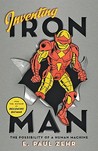
BOOK REVIEW: Inventing Iron Man by E. Paul Zehr

Inventing Iron Man: The Possibility of a Human MachineInventing Iron Man: The Possibility of a Human Machine by E. Paul Zehr

My rating: 4 of 5 stars

Amazon page

As the title suggests, this book examines whether Iron Man could exist in the real world. As with Michio Kaku’s book Physics of the Impossible, answering the question involves defining the various meanings of “impossible.”

One way to parse the question is, “Is Iron Man possible today given the existing state of technology?” In and of itself, this question is of limited interest because the answer is, “no.” There’s certainly a demand, and so if Iron Man could exist given current technology, he probably would. That’s not to say it isn’t interesting to learn about what technologies are holding us back and where the cutting edge of relevant technologies lies—both of which are addressed by the book.

Still, a more interesting inquiry is, “Will Iron Man ever be reality given the physical laws that we know to govern the universe?” While more intriguing, it’s also a harder question to definitively answer. It’s impossible to foresee all the technological developments that might come along to answer the seemingly insurmountable challenges (e.g. Tony Stark’s inevitable Traumatic Brain Injury (TBI).) The book deals with the critical question of what challenges would have to be overcome for Iron Man to be reality.

As Zehr suggests, the appeal of Iron Man is that he’s considered to be among superheroes for the common man. Like Batman, the sufficiently bright and diligent nerd may fantasize that, “That could be me.” You or I can’t be Superman or Wolverine, but given enough money, smarts, and training we could be Batman, or—even better—pilot the Iron Man suit. Put in this light, the book may seem like just another frivolous attempt to capitalize on the popularity of superheroes to sell books. However, there’s actually a great deal of food for thought packed in the book. Like others, I read the book because its title is Inventing Iron Man and not Neuro-motor control of a self-propelled armor system or some other suitably scholarly title.

Dr. Zehr has the bona fides to delve into this topic. He is a Professor who investigates questions of how the nervous system controls movement. That subject may not constitute the sum total of critical concerns, but it’s one of the most important challenges. For Iron Man to move the way he does in the movies and comic books, Tony Stark’s impulses to move have to be transmitted seamlessly to the servo-motors that move the suit. From dodging Col. Rhodes’ (i.e. War Machine’s) punches to ducking RPGs, Stark can’t be quick enough if he has to manually steer the device. Then, of course, there’s the issue of feedback. Any neophyte meditator who’s had his or her foot fall sound asleep will know how difficult it is to walk surefootedly when one can’t feel anything through one’s foot.

[Iron Man 3 spoiler commentary in this paragraph.] One of the most damning challenges for making Iron Man a reality is the high probability of severe concussions. Let’s say you make the suit out of a material that is virtually indestructible? This may be possible. However, the pilot’s mushy brain is still sloshing around inside that impenetrable armor. One can remotely pilot the suit in order to negate this (as has been done in the comic books and the third movie), but—at that point—is it still Iron Man? I know from a writer’s perspective it’s a lot harder to maintain tension if there’s nothing human on the line. In the third movie about 30 autonomously piloted suits get wiped out and the viewer doesn’t care—the only source of tension is that Tony Stark is without armor half the time.

Some of the most interesting discussions are about where the current state of the art lies with respect to: a.) direct mind control over mechanical systems; b.) a “flying suit”; and c.) robotic movement enhancers. Zehr conducts interviews with those engineers and technologists involved in such technologies, and finds out where we are presently. Letter “a” above seems to be the least developed of the three technologies, but they are all active lines of research.

I enjoyed this book and found it interesting. I think anyone who is interested in the state of technology and its limits will find it a nice pop-sci introduction to the subject. The use of superheroes as a pedagogic device may be overdone, but it continues to work because we are fascinated by the edge of possibility, and that’s what superheroes represent.

View all my reviews

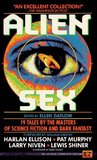
BOOK REVIEW: Alien Sex Ed. Ellen Datlow

Alien Sex: 19 Tales by the Masters of Science Fiction and Dark FantasyAlien Sex: 19 Tales by the Masters of Science Fiction and Dark Fantasy by Ellen Datlow

My rating: 4 of 5 stars

Amazon page

Alien Sex is an anthology of 19 works of short fiction that revolve around sex, attempted sex, or sex-like behavior with non-human entities. While the title leads one to believe the book is specifically about sex with aliens from outer space, that’s not the case in all these stories. There are also stories where the object of affection is a lesser primate, an incubus, a new species, and a biologically-modeled robot. As one would expect with life forms from other worlds, the “sexual” act is not always what we would recognize as sex. (e.g. One planet’s whoopee might be another’s mundane act.) As a last warning about what the book is not, it’s not—on the whole—a collection of sci-fi erotica. A number of the stories probably wouldn’t be arousing to the freakiest of super-freak, and I can only assume weren’t meant to be.

While there’s a unifying theme, the works included cover a lot of ground in terms of style and format. It’s not even true to say it’s 19 short stories because there’s one poem and one chapter that reads more like an essay (i.e. lacks a narrative structure.) Some of the works are written in the language, tone, and style of erotica, but others aren’t. A few of them read like thinly veiled commentary on problems in the author’s own love life—i.e. cheating spouses, feeling a lack of attentiveness, or porn addiction. (Each work has a brief author commentary at the end, and a couple of the authors suggest that what was going on in their own life or those close to them shaped the idea.)

While the appeal of the works varied significantly, overall this was a fun and intriguing read. The works included are as follows:

1.) Her Furry Face by Leigh Kennedy
A primate handler who is in a waning marriage falls for one of his super-intelligent orangutan students.

2.) War Bride by Rick Wilbur
The world is going to end tomorrow unless you’ve been taken as a pet by one of the aliens.

3.) How’s the Night Life on Cissalda by Harlan Ellison
A man sent to investigate an alien race becomes inextricably sexually entangled with one of the aliens. Eventually, he’s forcibly separated from the alien—of a race that are apparently thin-skinned—and lives to see the descent of mankind.

4.) The Jamesburg Incubus by Scott Baker
A teacher in a Catholic school finds that he can make out-of-body nocturnal visits to some of his more attractive female students.

5.) Man of Steel, Woman of Kleenex by Larry Niven
This reads more like an essay than a short story. The work delves into the physics of why sex with Superman would be fatal for Lois Lane.

6.) The First Time by K.W. Jeter
This is a variation on the old coming of age story in which a young man is taken to a brothel for his first sexual encounter. It’s just that this encounter is of the 3rd kind.

7.) The Jungle Rot Kid on the Nod by Philip José Farmer
The premise behind the story is what if William S. Burroughs (author of Naked Lunch) had written the Tarzan stories instead of Edgar Rice Burroughs. In essence, it’s a risqué take on Tarzan.

8.) Husbands by Lisa Tuttle
After the extinction of husbands, a woman develops a new species to serve the companion role.

9.) When the Fathers Go by Bruce McAllister
A husband confesses to his wife that while she was in stasis waiting for him to come back from interplanetary travel, he sired a child with an alien. Furthermore, the child is coming to live with them. But wait there’s more…

10.) Dancing Chickens by Edward Bryant
This story reads more like an overly elaborate joke than a short story. It begins with the question, “What do aliens want?” and ends with a pun punch line. That being said, the lead is an unappealing but intriguing character.

11.) Roadside Rescue by Pat Cadigan
A stranded motorist is made an indecent proposal by a chauffeur on behalf of his alien employer.

12.) Omnisexual by Geoff Ryman
This is about an intergalactic brothel, but it’s the story in the collection that reads most like literary fiction—meant in both the best and worst possible ways.

13.) All My Darling Daughters by Connie Willis
While there are several really good works in this anthology, I’d have to rank this as my favorite—if only by a narrow victory. A sassy, sexually-liberated co-ed has her sex life torn asunder when all the young men come back from break with little, furry creatures in their possession and no interest in the female student body. Besides a neat concept for a story (though it may be implying that men are overwhelmingly rapey), the author does a great job of character development making the lead character both interesting and likable, while juxtaposing her with her apparently goodie two-shoes roommate.

14.) Arousal by Richard Christian Matheson
A woman who cheats on her husband with a stranger is cursed with permanent post-coital euphoria that swamps all interest in her family and life in general.

15.) Scales by Lewis Shiner
A woman’s husband is having an affair with what she thinks is a student assistant, but who turns out to be a soul-sucking seductress from the netherworld.

16.) Saving the World at the New Moon Hotel by Roberta Lannes
A woman waiting for her spouse to meet her at a bar to apologize for his infidelities decides to get a little herself. The man she hooks up with turns out not to be a man at all.

17.) And I Awoke and Found Me Here on the Cold Hill’s Side James Tiptree, Jr.
An experienced man offers advice to a newbie to get away before he ends up seduced by the aliens. This story talks about sex, but is about something much broader.

18.) Picture Planes Michaela Roessner
This one is a poem about alien sex, rather than a story. It stands alone as the only non-prose entry.

19.) Love and Sex Among the Invertebrates Pat Murphy
In a post-apocalyptic world, a dying scientist–who no longer believes in science–creates robots capable of engaging in the act. The creatures she makes are based on a range of real animals which are written about interspersed with the story-line.

I’d recommend this book for those who enjoy science fiction. One need not be into erotica to enjoy the stories and, the more one is seeking erotica, the less appeal the book may have. It’s a collection of big name writers in science-fiction, and the anthology’s diversity makes it particularly interesting.

View all my reviews

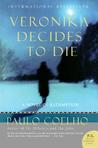
BOOK REVIEW: Veronika Decides to Die by Paulo Coelho

Veronika Decides to DieVeronika Decides to Die by Paulo Coelho

My rating: 4 of 5 stars

Amazon page

Veronika Decides to Die is about a young Slovenian woman, Veronika, who attempts suicide, fails, is institutionalized, and is informed that her attempted suicide damaged her heart and she has only five days to live. In the hospital she has to come to grips with what it means to be dying, but also what it means to be insane.

The book deals with the effect of Veronika’s death sentence diagnosis on her as well as on other patients with whom she interacts. The first patient Veronika comes in contact with is a depressive named Zedka who offers Veronika advice and insight. Then there is Maria, a woman who withdrew from her professional and family life to be institutionalized because she was having inexplicable panic attacks. Finally, there is Eduardo, a schizophrenic who is virtually non-functional when he meets Veronika, but who ends up in a relationship with the young woman nonetheless. These patients come to realize that they are hiding out at the hospital. They stay in the hospital because they are free to defy norms without judgment. When Veronika decides she doesn’t want to die hiding out, it has a profound impact on the others.

The book borrows heavily upon Coelho’s personal experience. He was institutionalized as a young man by parents who were disturbed when he went artsy and began hanging out with undesirables. Interestingly, Coelho has a cameo role in the book as himself. In the book he writes an article that playfully asks the question, “Where is Slovenia?” When Veronika is waiting to die from her overdose, she reads the article and decides to write a letter to the editor claiming that she killed herself because of the depressing effect of Coelho’s suggestion that nobody who’s anybody knows or cares where Slovenia is located.

In the end Veronika finds that she is truly free. Veronika seems to have everything at the beginning of the story: a job, boyfriends, and popularity. However, it’s those things that she comes to feel enslave her, and that’s what leads to the attempted suicide. In a way, Veronika is doubly freed. She is free because she is dying, and what can one do to a dying person. Second, she has been labeled crazy, and, having such a label, people expect her to act oddly. She has the freedom to do those things she has been too frightened to do all her life.

I’d recommend this book. It’s short, readable, and offers clear food for thought.

View all my reviews

BOOK REVIEW: Dawn by Octavia Butler

Dawn (Xenogenesis, #1)Dawn by Octavia E. Butler

My rating: 5 of 5 stars

Amazon page

Dawn is the story of a woman, Lilith, who awakens in the custody of aliens. This is no run-of-the-mill alien abduction. Lilith is one of a small number of human survivors of nuclear holocaust. The aliens are akin to a merchant ship that comes upon the survivor-baring life rafts of a sunken cruise ship—or at least they appear to be. They offer rescue, the hope of survival, and a promise to allow human survivors to rebuild their society in a low-radiation area of Earth when they are sufficiently trained in the necessary survival skills.

However, for Lilith the situation is not akin to shipwreck rescue because there’s a stark in-group / out-group conflict to get over. And it features the most challenging and terrifying out-group imaginable—an intelligent alien race. Lilith instinctively fears and distrusts the aliens. She discovers that she’s been awakened and put back in stasis on more than one occasion. While Lilith’s fear turns out to be unfounded, her distrust proves sound. The aliens genuinely want to help the humans and mean them no harm, but they do have their own plans and see a means to benefit from their interaction with humanity. While the aliens don’t lie, they do withhold information, only gradually doling it out as they see fit. As Lilith’s fear subsides and her trust–at least in a limited sense–grows, this restricted information is a constant source of tension between Lilith and her alien handlers.

While Lilith is initially terrified and completely incapable of interacting with the aliens, she does by gradual turns accept the truth of the situation and begins to interact with the aliens, trying to discover their end-game. Her (relatively) calm and open-minded nature was—in part–why she was chosen. She’s to be a liaison between other newly awakened human survivors and the aliens. She and the humans she has already awakened will be the only beings that the newly awakened humans will see until they are deemed ready by the aliens. Of course, this makes Lilith distrusted among her fellow humans. Most of them are frozen in a Cold War mindset and think they are under the control of the Russians, refusing to believe the “nonsense” about aliens.

The heart of this novel is about Lilith being unwillingly cast as both Uncle Tom and Judas Goat to her fellow survivors. She has powers, albeit limited, granted to her by the aliens, and these only make her more suspect. These include the ability to awaken humans from stasis and to reconfigure the area in which they live, but it also includes rapid healing and enhanced physical capacities. These are given her so she can hold her own against the hostile newly awakened. The aliens know there will be physically violent individuals because they experienced it firsthand. In fact, they are hoping that using Lilith as an intermediary will ease this proclivity. However, it does nothing of the kind, and instead makes Lilith and those who are close to her targets for the rest.

This book is sci-fi because it’s futuristic, speculates about alien life, and proposes a world in which amazing technological advances have been made. However, if there was a genre called psych-fi (psychological fiction), it might be more apropos. The heart of this story is about fear and trust, and how people treat in-group and out-group people and those seen as crossing over. It also addresses the issue of the dissolution of in-group characteristics and the innate fear that creates. What if humanity does not survive, but rather some race that is in large part human, but also inhuman?

Warning to the squeamish, there’s a recurring theme of attempted rape in the book. In the first case, this is visceral and believable. However, there’s a straining of credulity when people later are coming straight out of stasis and succumbing to their most base prurient urges. Sex is a powerful driver, but in such a situation it would seem that more immediate survival drivers would dominate. In other words, it has to be the rare horn-dog who wakes up from a 300 year stasis aboard an alien vessel, and the first thing he thinks of is getting his freak on.

I enjoyed this book and found it quite thought-provoking. The concept hooked me from the start. Butler’s use of language can be beautiful, but she doesn’t go overboard with elaborate language that distracts or bogs down the story.

This book could be enjoyed not only by fans of science fiction, but by those who like a good story in general and, in particular, those who like to think about what makes people tick.

It should be mentioned that this is the first book of a trilogy. The other books are Adulthood Rites and Imago, respectively. The entire trilogy, often called the Xenogenesis trilogy, can be purchased in one volume entitled Lilith’s Brood.

View all my reviews

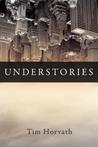
BOOK REVIEW: Understories by Tim Horvath

UnderstoriesUnderstories by Tim Horvath

My rating: 4 of 5 stars

Amazon page

Two traits of Tim Horvath are rapidly revealed in reading the collection of stories entitled, Understories. First, he’s an academic to the core. Second, he loves words and the way they can be jigged around to create not only meaning but feeling. Combined, these characteristics yield both positive and negative outcomes.

On the positive side, Horvath writes what he knows, and this can be seen in tales like: The Understory, The Discipline of Shadows, Tilkez, and even Circulation. Horvath paints a vivid picture of life in academia with The Understory and The Discipline of Shadows in particular, replete with scholarly rivalry and interdepartmental politics. While that may make the book sound stunningly boring, those two stories are among the strongest–in part because the author knows how to build tension and character in this domain. His bookish characters are constructed with wit and depth.

On the other hand, this book is for the ones who love language more than they love story. The readability isn’t high. Horvath peppers the text with words that many of us memorized to take our GRE test but never used after receipt of our acceptance letter. Many avid readers never learned such words in the first place. This is where the Kindle edition, and its capability for instantaneous word lookup, comes in handy. (Though, the author does manage to stymie Kindle’s internal dictionary on a number of cases.) The shorter pieces tended to leave me wondering if Horvath had a point other than to dazzle with verbiage. To be fair, it’s not just monosyllabic and pretentious words that Horvath loves. He has a taste for all sorts of words that are evocative and powerful, be they whimsical, sexual, or emotional.

Understories consists of 21 short stories, but I use the term “story” loosely. Some of the chapters are stories in a conventional sense. That is, they have a beginning, a middle, and an end, and a character who takes some sort of personal journey. Other pieces are the literary equivalent of the masturbatory orgasm; they’re pleasant to experience but beg the question of what the objective is. The contents of the book are below. I’ll restrict my commentary to the more substantial pieces, and leave the reader to figure out what Horvath was trying to get at with the others.

1. The Lobby: This is really an artistic introduction and rules for reading the book.

2. Urban Planning: Case Study #1: This is the first of 8 such “case studies.” With the exception of one, they’re all flash pieces.

3. Circulation: If I had to pick a best story of the anthology, it would be this one. It’s about a man whose eccentric father is in the hospital with mind and body that aren’t what they used to be. The man is Director of Circulation for his hometown library, and the father has one published book and spent much of his life working on an unfinished Atlas of the Voyages of Things. The sub-story about the books as a reflection of the man is what gives this something extra beyond the usual “Cats in the Cradle” (Harry Chapin reference) narrative.

4. Urban Planning: Case Study #2: Another brief piece.

5. The Understory: This is one of the full length stories, and is one of the best pieces. It’s about the bringing together and falling apart of a platonic relationship between two scholars. Set in pre-war Germany, the story opens with a scholarly rivalry between two professors who become good friends. However, one of the men is a Jew and the other is promoted to a Deanship because he has appeal with the Nazis.

6. Urban Planning: Case Study #3

7. The Discipline of Shadows: This is the story of a professor in the Department of Umbrology. What’s Umbrology? It’s the study of shadows. An interdisciplinary department with a unifying theme of shadows provides and intriguing background for a story that’s not so out of the ordinary. The story delves into scholastic politics and a sordid intradepartmental love triangle.

8. Urban Planning: Case Study #4

9. Planetarium: This is story proper. It’s about the reunion of two high school buddies, and their differing recollections of a seminal event of their youth involving shenanigans at a planetarium. The story is an odd sort of confession.

10. The Gendarmes: This story will appeal to lovers of the surreal. It’s about a man who discovers that a team of scientists are playing baseball on his roof.

11. A Box of One’s Own: An eloquent tale of the curiosity inspired by boxes.

12. Internodium: This is another short piece.

13. Urban Planning: Case Study #5: This one probably ties for my favorite flash piece. It’s about a city that evolves into all restaurants.

14. Runaroundandscreamalot!: There’s a lot of humor sprinkled throughout this book, but this is the one story one might put in the humor genre. It’s funny from the title onward, which is the protagonist’s pet name for a generic Chuck-E-Cheese-esque place called “Playalot”—which is a medieval-themed kid’s play palace. The protagonist, a divorced man, takes his daughter there and meets a woman that he proceeds to try to get to know better despite only knowing her as “Hanh’s Mom” for most of the story.

15. Urban Planning: Case Study #6: This is the other tie-holder for best flash piece. It’s about a city in denial.

16. Pocket: A flash piece on, well… pockets.

17. Altered Narrative: A short and experimental piece.

18. Urban Planning: Case Study #7: This is the only one of these “Urban Planning Case Studies” that is a short story in the usual sense. It’s about a [grown man] film projectionist who abandons his post after seeing his wife with another man.

19. The Conversations: There’s a fair amount of surrealism sown throughout this book, but this is one of the more speculative pieces. That said, it’s really just about the death and resurrection of the conversation—along with “mint.” The sci-fi component revolves around speculation about precisely caused it and what the difference is between a “Conversation” and a “conversation.” The latter being what we normally think of (i.e. and informal discussion), and the former being the subject of the story.

20. Tilkez: The protagonist is a creepy little man who writes down everything and the story is about his relationship with both a female and language (I think. The female might be symbolic.)

21. Urban Planning: Case Study #8: One last flash piece.

View all my reviews

BOOK REVIEW: Heart of Darkness by Joseph Conrad

Heart of Darkness Heart of Darkness by Joseph Conrad

My rating: 4 of 5 stars

Amazon page

Heart of Darkness is a story within a story (i.e. a frame narrative) in which the protagonist, Marlow, tells a group of men on a ship on the Thames about his adventures captaining a boat on the Congo River. The use of a frame narrative both gives this novella/ novel a confessional feel, but also imagines Marlow’s audience feeling his tale particularly viscerally as some of them might be caught up in similar intrigues themselves.

Marlow’s job in the Congo is transporting ivory. However, the core of the story revolves around a trip to extract an agent of the ivory trade named Kurtz, and to transport the ill man to medical care. Kurtz is an intriguing character. This isn’t a man one can feel indifferently towards. Some love his intellect, charisma, or even his ruthlessness. Others despise him as the face of villainy. Kurtz represents imperialism at its most vile. Some natives are at war with him. Others respect and fear him. However, he’s willing to destroy them all on a whim to make the flow of ivory come more swiftly.

Marlow isn’t a member of Kurtz’s fan club initially and thinks the agent is completely insane, but he becomes intrigued with him as their journey progresses. In a way, Marlow is the moderate face of Imperialism. He doesn’t like the way the natives are treated, or the power plays and bureaucracy of the trade. However, he’s an active and willing participant, and, ultimately, when given a choice to work against the system or in support of it he chooses the latter. He hands over Kurtz’s report on the “Suppression of Savage Customs.” He also shows his sympathy towards Kurtz through his interaction with the dead man’s fiance.

This is definitely 19th century literature. While the book is very short, it’s readability isn’t high by today’s standards. It’s organized into just three parts or chapters, and the prose isn’t built for speed. Also, while it turns out to be a gripping tale, it’s slow off the blocks. It must also be put in the context of 19th century literature because the themes of imperialism and suppression of “savagery” have long since been settled. Viewed through today’s lens, the story might not ring true. Though I suppose there’s still a heart of darkness in urban environments today, behind walls rather than across seas.

What are the book’s strengths? While it may seem silly, the title is pure-D awesomeness. Also, while it’s not organized or written for readability by today’s standards, by 19th century standards it’s a page-turner. It’s certainly a compact tale. As I indicated, I’m not sure whether to call it a novel or a novella. Reading this book isn’t a major time investment, and it does pay off. Conrad’s use of descriptive language is often beautiful. Conrad’s characters all ring true and serve to sit one in a world of darkness beyond the imaginings of the London elite, where sad and terrible things happen to make their world possible.

Lastly, the book makes one think. Like Kurtz, one is likely to love it or hate it.

View all my reviews

BOOK REVIEW: Rashōmon and Other Stories by Ryūnosuke Akutagawa

Rashomon and Other Stories (Tuttle Classics)Rashomon and Other Stories by Ryūnosuke Akutagawa

My rating: 5 of 5 stars

Amazon page

Six stories make up this brief collection. All six are intriguing, well-written, and shine a light onto the dark side of mankind. The works of Akutagawa collected herein are all morality tales, but aren’t written in a moralistic tone. In fact, it’s not clear that the author wishes to convey lessons on virtue and vice as he’s intrigued with the instant at which an ordinary person turns bad. That instant, and the inflamed passions that often inspire it, is a prevailing theme throughout most of this small anthology. Akutagawa beats AMC by the better part of a century in showing us how bad breaks.

The first story is entitled In a Grove. This is a murder mystery in which we are given conflicting accounts of a man’s murder through the process of the investigation of the act. The final account that we are offered is that of the victim himself–as presented by a psychic medium. [Only two of these stories contain supernatural elements–this one and the last. Most of the collection involves realist premises. One must remember that Akutagawa was writing in the early part of the 20th century, and scientific rationality hadn’t yet gotten as strong a hold as it does today.] In this case, the use of a psychic is really just a plot device to give the reader insight into a truth which couldn’t otherwise be revealed. Having heard the perspectives of the murder and the dead man’s wife, one is left with questions owing to the self-serving nature of those statements. Of course, the final section reveals a twist–that I won’t spoil.

The second story is the title story, Rashōmon. The title is the name of a gate in Kyōto, the largest gate of Kyōto, in fact. However, Kyōto has fallen on hard times, and our protagonist is a newly masterless samurai who has sought the gate’s shelter from the rain. There, he contemplates whether he should take up a life of crime, which seems to be his only means of survival in the current economy given his skill set. The gate has become a repository for the corpses that are amassing as victims of the hard times accumulate. Within the gate, he finds an old hag who loots bodies for a living. His interaction with the old woman helps him to decide his own destiny.

The third story is called Yam Gruel. While “yam gruel” (or anything with the word gruel in it) might not sound appealing given today’s usage, a fact one must know is that during the time of the story it was a highly-prized and rare dish. The story follows a milquetoast administrator who leads a rather pathetic life in which he has but one ambition, to eat his fill of yam gruel. As a member of the samurai class, he’s invited to an Imperial banquet each year. However, because of his low status and the high-value of yam gruel, he never gets more than a taste. One year he openly bemoans the fact that he never gets his fill. A powerful samurai overhears this complaint, and it puts a seed of mischief in his mind. While this tale isn’t about breaking bad, it is about inflamed passions.

The fourth story sticks out as different from the others. While the bulk of the stories center on that moment at which a more-or-less good person goes bad, The Martyr tells us about a protagonist that never goes bad, despite having every right to. This might seem like a sea change in theme, but in reality it’s just another way of shining a light on the dark seed that resides in people. Only this time it does it by way of contrast. All of the other characters are deeply flawed, and we see that most vividly when contrasted against the one who always behaves virtuously. In this case, that virtuous character is Lorenzo, a novice monk who is accused of a severe breach of good conduct. Lorenzo becomes an outcast and a vagrant due to these allegations. Yet, despite all this, he acts heroically–even to assist those who’ve betrayed him.

In the fifth story we revisit the theme of breaking bad. In Kesa and Morito we are presented with two regret-filled accounts of the instant at which an adulterous couple decides to kill the husband of the woman involved in the affair. Each member of the cheating couple thinks that the other desperately wants the killing to go forward. In reality, both consider it a foolish decision driven by a brief moment of passion. This is another tale about letting one’s passions get out of control.

The final work is a retelling of the story of a monk named Hanazō who decides to prank his fellow monks because they chide him about his huge nose. Hanazō sets up a sign that says a dragon will appear from the local lake at a certain time and day to fly up into the heavens. The joke doesn’t turn out at all as the monk intended. I won’t go into the moral of the story to avoid giving too much away, but suffice it to say there is a moral.

I highly recommend this collection. As I’ve suggested, the collection isn’t just a disparate collection of tales, but has an integrating theme. Akutagawa was truly one of the masters of the short story. He wrote 150 stories before dying at the age of 35 in a suicidal drug overdose.

For those who like to see how literature is portrayed in, below one can watch the film version of Rashōmon.

View all my reviews