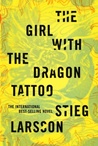
BOOK REVIEW: The Girl with the Dragon Tattoo by Stieg Larsson

The Girl with the Dragon Tattoo (Millennium, #1)The Girl with the Dragon Tattoo by Stieg Larsson

My rating: 4 of 5 stars

A disgraced reporter and an emotionally-troubled/intellectually-gifted ward of the state pair up to solve a forty-year old locked door mystery. In the process of investigating what happened to a young woman who vanished without a trace from an island estate, they end up solving a much bigger set of mysteries– and putting their lives in peril in the process.

Both of the lead characters are well-developed and sympathetic, if not necessarily likable in a conventional sense. Mikael Blomkvist is a bit of womanizer or at least a lady’s man– whatever you wish to call him, he sleeps with at least three major female characters over the course of the book. He is also rash (or, perhaps, aggressive) in his professional life. However, he is also pragmatic and kind. Lisbeth Salander is not just tattooed but also pierced, leather-clad, and goth. Her story of female empowerment may be largely responsible for the wild success of this book. When she finds herself abused and violated, she takes matters into her own hands. Her strength and intelligence, wrapped in a package that suggests neither trait, is beguiling.

The book is obviously highly readable, but it’s oddly structured. It climaxes early, leaving well over a hundred pages at the end to wrap up subplots. This includes the disposition of Blomkvist’s professional predicament and the question of with whom he will ride off into the sunset. These are threads that couldn’t be left hanging, but it begs the question of why one reads to the bitter end– though you certainly will.

I guess I should mention that this isn’t a book for the faint of heart or the puritanical– in case one hadn’t already grasped that. It is graphic and intense in spots.

I did see the Daniel Craig/Rooney Mara version of the movie. I’m told it was not as good as the first film, which was made is Sweden (I should have mentioned the book is set in Sweden.) However, I thought it was quite good, and fairly true to the book given the challenges of turning a 650 page novel into a movie.

View all my reviews

BOOK REVIEW: Dracula by Bram Stoker

DraculaDracula by Bram Stoker

My rating: 4 of 5 stars

Dracula leaves Transylvania to find a new pool of victims, and the only thing standing between him and the people of London is Dr. Van Helsing and his cast of allies.

The novel begins with the arrival in Transylvania of Jonathan Harker, a real estate agent from England. Both Harker and his beloved wife, Mina, play an important role in unraveling the mystery of Dracula. Soon after a ghost ship rams into port, Lucy Westenra (a friend of Mina’s) begins to suffer an unusual illness. A Dr. Seward brings in Dr. Van Helsing who has a rare expertise in her particular ailment. Professor Van Helsing’s knowledge is essential to driving Dracula out of London and back to Transylvania. They pursue the vampire– resulting an a final show down.

Bram Stoker uses a series of journal entries, letters, and memos to convey the story. This is an interesting approach, and popular at that time, but it does have its limitations.

Dracula was written early in the age of science and reason. While it was an age of superstition, there is an attempt to elevate vampirism from a strictly supernatural phenomena to one in which science has something to say.

The 19th century language and approach to tension makes for a less gripping tale than one would likely see today, but it is still a very readable book.

View all my reviews

BOOK REVIEW: The Book of Five Rings by Miyamoto Musashi

A Book of Five Rings: The Classic Guide to StrategyA Book of Five Rings: The Classic Guide to Strategy by Miyamoto Musashi

My rating: 5 of 5 stars

Miyamoto Musashi is probably the most famous swordsman in Japan’s history. Oddly enough,he’s not known for his experience in battle(he lived at the tail end of the Warring States period and was only in a couple of battles), but for his time spent in musha shugyo (warrior’s errantry), during which he engaged in over 60 duels. It is The Book of Five Rings that largely accounts for his continued fame. That being said, Musashi was quite the renaissance man, a painter and sculptor of note. He also left behind a school of swordsmanship, Niten Ichi-ryū.

The Book of Five Rings is divided into five parts: earth scroll, water scroll, fire scroll, wind scroll, and void scroll.

The earth scroll provides an overview of martial science and an introduction to Musashi’s school, which is noted for its simultaneous use of both the large and short sword. A section is devoted the rhythm of martial arts, a crucial topic. It also includes what might be considered Musashi’s 9-point budō kun (a list of warrior precepts.)It’s worth mentioning a couple of these.
#7 Become aware of what is not obvious.
#9 Do not do anything useless.

The Water scroll describes Musashi’s approach to swordsmanship. It covers a range of elements of a martial art including footwork, the focus of one’s eyes, physical posture, mental posture, techniques,kiai (spirit shout), and approaches to cutting and thrusting.

The Fire scroll deals with the strategic or interactive aspects of the battle. Among my favorite quotes from this scroll is, “If your own power of insight is strong, the state of affairs of everything will be clear to you.”

The Wind scroll teaches us about other martial arts. Musashi discusses martial arts that use an unusually long sword, an atypically short sword, that focus on powerful strikes, and those that focus on many rapid strikes. He contrasts other martial arts with his own on subjects such as their focus with the eyes and their footwork.

The void scroll deals with, well, emptiness.

Musashi had great insight into strategy from his career of dueling. His book is worth being read and reread.

View all my reviews

BOOK REVIEW: Secrets of Self-Healing by Dr. Ni

Secrets of Self-Healing: Harness Nature's Power to Heal Common Ailments, Boost Your Vitality,and Achieve Optimum WellnessSecrets of Self-Healing: Harness Nature’s Power to Heal Common Ailments, Boost Your Vitality,and Achieve Optimum Wellness by Maoshing Ni
My rating: 4 of 5 stars

The Secrets of Self-Healing title is a little bit of a misnomer. This book is not so much a collection of secrets as an overview of Traditional Chinese Medicine (TCM.) This is probably not so much an attempt to defraud as it is a sound marketing strategy. In America one can sell something as a “secret” even if it’s been done for 3000 years in the open– if it’s from China.

The book is divided into two parts. The first (between 1/3rd to 1/2 of the book)includes an overview of such topics as yin/yang, the five elements, nutrition, herbs, supplements, exercise [qi gong], and acupressure meridians. It also includes information about how to diagnose problems from external cues (i.e. examining the face, tongue, and hands in particular.)

The second part is an ailment-specific reference section. For 65 of the most common ailments, the book gives six-part advice on diet, home remedies, dietary supplements, herbal remedies, exercise, and acupressure.

It mixes some modern medical science in along the way, where it is useful.

I found this book to be approachable and informative.

View all my reviews

BOOK REVIEW: The Road by Cormac McCarthy

The RoadThe Road by Cormac McCarthy

My rating: 5 of 5 stars

Sparse and haunting.  The Road is about a father and son walking cross-country in search of a safe harbor in a post-apocalyptic world. The story pulls one in and leaves a tightness in one’s gut. Every person the duo comes across on the road must be treated as a dire threat, making them each other’s only thread of connection to humanity. One particularly powerful moment is when they get to the ocean and see nothing but ghost ships lolling in the water. To reach the end of the road, the end of one’s world, without a flicker of hope is crushing, but they make a left turn and keep going.

McCarthy uses description in vivid flourishes, but it’s the spartan dialogue that really creates the tone. I was distracted by the lack of quotation marks and dialogue markers at first, but with only two speaking characters McCarthy’s approach works just fine. One soon gets a feel for the unique voice of each, and then the minimalist approach works.

McCarthy cuts away everything that is non-essential. Some of these non-essentials, like names, we so take for granted that their absence helps create a somber tone.

If you don’t like sad stories, this one won’t be for you. I found the ending to be tragic, but some may see it as hopeful.

I haven’t seen the movie, but from the trailer and what I’ve heard, it’s a bit different. Hollywood not willing to take the risk of stripping it bare.

View all my reviews

BOOK REVIEW: Physics of the Impossible by Michio Kaku

Physics of the Impossible: A Scientific Exploration into the World of Phasers, Force Fields, Teleportation, and Time TravelPhysics of the Impossible: A Scientific Exploration into the World of Phasers, Force Fields, Teleportation, and Time Travel by Michio Kaku

My rating: 5 of 5 stars

Michio Kaku is the master of pop physics writing. While you may find names like Brian Greene or Neil Degrasse Tyson more recognizable, if you haven’t read any of Kaku’s work, this is a good one with which to start.

This book examines the possibility (or lack thereof) of many technologies and scientific concepts prevalent in science fiction.

Why spend time reading about things impossible? It turns out that one’s definition of “impossible” matters greatly. Kaku divides the world of impossible into three classes. The first, and largest class by far, are those technologies that are impossible given today’s capabilities, but aren’t prohibited by the known laws of physics. This class includes technologies that one can readily imagine such as: robots, starships, and phasers. However, it also includes developments that one might think are firmly in the realm of sci-fi, such as: teleportation, telepathy, force fields, and psychokinesis.

Class II impossibilities are those that look impossible now, but which may prove possible as our knowledge increases. They include faster than light travel, time travel, and the existence of parallel universes. The first two require uncovering loopholes in prevailing Einsteinian paradigm. The second also begs the question of why we don’t have time tourists.

Class III impossibilities are those that violate the known, well-established laws of physics. Kaku only puts two items in this bin, perpetual motion and precognition.

Kaku’s book discusses a fascinating topic in a highly readable format and using good science.

View all my reviews

BOOK REVIEW: You Suck by Christopher Moore

You Suck (A Love Story, #2)You Suck by Christopher Moore

My rating: 4 of 5 stars

I haven’t read Twilight or any of the many YA vampire books that have glutted the market in recent years, but You Suck perfectly captures what real teenage vampires would be like. Tommy Flood is not a confident, suave, sexy vampire. He’s an awkward, if likable, dumb-ass. Christopher Moore’s characters are hilarious and, sadly, true to life.

Moore tickles the funny-bone as he tells a love story of a young couple up against an elder vampire, a group of other young idiots, and the cops. The fact that the couple isn’t pitted against each other– despite the fact that the female, Jody, turned Flood into a vampire– is testament to the strength of the relationship. If anything can sour a relationship, it’s one half of the couple turning the other into a vampire (or a Zombie for that matter.)

While the tension is not intense, the humor is ubiquitous. More importantly, one gets food for thought on such mundane vampire questions as:
– how does one recruit a good minion? (Abby Normal holds her own as a font of humor.)
– do cats make suitable substitutes for a blood meal?
– what happens when you bronze a vampire?

I enjoyed this book, and suspect you will too.

View all my reviews

BOOK REVIEW: The Restaurant at the End of the Universe by Douglas Adams

The Restaurant at the End of the Universe (Hitchhiker's Guide, #2)The Restaurant at the End of the Universe by Douglas Adams

My rating: 5 of 5 stars

The adventures of Arthur Dent and company continue as Zaphod Beeblebrox chases after whatever it was that he made himself forget, and the group seeks the question to match the answer to life, the universe, and everything. Neither of these issues is resolved with great satisfaction (leaving plenty to be covered in the remaining three books of this five book trilogy.) However, we do learn why Earthlings are so prone to war and bureaucracy.

Time travel is a key plot device in this book. If hilarity will get you over any hurdle, you’ll love The Restaurant at the End of the Universe. But if you’re the kind who geeks out on the minutiae like the grandfather paradox, this book may drive you crazy. They travel forward through time from a period shortly after the end of Earth until the end of the universe. Then they go back to a period 2 million years before the end of Earth.

Spatially they travel from a Vogon-threatened Heart of Gold (ship) in deep space to the Ursa Minor headquarters of the publishers of Hitchhiker’s Guide to the Galaxy to a planet in the Frogstar system that is home to the Total Perspective Vortex (or so Zaphod thinks) to the Restaurant at the End of the Universe (which, coincidentally, is on the same Frogstar planet) to a planet where a ship full of management specialists and telephone sanitizers (and Arthur Dent and Ford Prefect) crash lands. All the while they run into new puzzles and adventures.

While the book is named for the Restaurant at the End of the Universe, that locale is not especially significant to the story. They visit the restaurant in the middle of the book. The restaurant does provide more than its fair share of gags. For example, the group’s interaction with a cow that is bred to encourage diners to eat it is classic Douglas Adams.

This is definitely a character-driven novel. There’s not much of a plot to speak of, but it is hilarious.

View all my reviews

BOOK REVIEW: Brave New World by Aldous Huxley

Brave New WorldBrave New World by Aldous Huxley

My rating: 5 of 5 stars

In Huxley’s utopianish dystopia, an individual’s fate is determined through a combination of genetic engineering, operant conditioning, and hypnopedia (sleep-teaching.) It’s a different dystopian vision than that of Orwell or Atwood; individuals are drugged and encouraged in unlimited promiscuity in order to pacify them and keep them believing that they are happy (without allowing exposure to alternatives by which they might contrast their lives.) Gone are the arts and religion as we know it, and science exists only as a shadow of its former self.

The book follows the story of a “Savage”, named John, brought from an Indian reservation on which this “Brave new world” is unknown. He cannot understand the “civilized” world, and to its occupants he is an interesting anomaly to be gawked at at cocktail parties.

The book ends on an upbeat note as the reader learns of a third world, a world beyond the Brave New World or the brutally impoverished aboriginal lands.

Everyone should read this book to learn that one can be killed with “kindness” as well as with sternness.

View all my reviews

BOOK REVIEW: Abraham Lincoln Vampire Hunter by Grahame-Smith

Abraham Lincoln: Vampire HunterAbraham Lincoln: Vampire Hunter by Seth Grahame-Smith

My rating: 3 of 5 stars

In this alternative-history / paranormal novel, Abraham Lincoln is re-invented as a man who experiences great tragedy at the hands of vampires and then devotes his life to hunting them- a battle which culminates in the Civil War. In the Civil War of this book, slaves are not just valued as plantation labor but also as vampire food.

Grahame-Smith’s book is written in the mold of Bram Stoker’s, as a series of journal entries, letters, and missives.This helps to give it a feel of authenticity as that seemed to be a common device in the late 19th century.

Lincoln comes into contact with a number of contemporaries, some vampire but most humans knowledgeable about vampires– such as Edgar Allen Poe.

The perspective jumps can be a bit confusion, but all-in-all it is entertaining.

A movie was made about this book, which I haven’t seen.

View all my reviews