BOOK REVIEW: The Body Has a Mind of Its Own by Blakeslee and Blakeslee

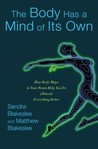
The Body Has a Mind of Its Own: How Body Maps in Your Brain Help You Do (Almost) Everything BetterThe Body Has a Mind of Its Own: How Body Maps in Your Brain Help You Do (Almost) Everything Better by Sandra Blakeslee
My rating: 5 of 5 stars

Amazon page


This book examines the role of the nervous system in movement and bodily activity. It describes how one’s body is able to perform extraordinarily complex maneuvers that we often take for granted because they feel effortless. It investigates some of the ways in which the interface between body and brain go awry, as well as the various effects this can have. It also offers insight into how we can be deceived because we are experiencing the world less directly and more through the shaping activities of the brain than we feel is true.

The book contains ten chapters, plus a little forward and back matter. The first chapter is entitled “the body mandala” and it provides an overview of how the nervous system can be thought of as a series of maps layered upon maps that routes various input from outlying areas to the brain and commands from the brain to the outlying areas. A “mandala” is a symbolic representation of the universe [from Hindu and Buddhist traditions], and this notion is repeatedly revisited throughout the book.

Chapter 2 explores the mapping of the homunculus and its ramifications. If you’ve ever seen a 2-D or 3-D image /model of a human being that has gigantic lips and hands and disproportionately small torso and thighs, you’ve seen said homunculus (as the term is used in neuroscience.) The reason it’s scaled this way is that body part size is reflective of space in the nervous system dedicated to said parts and not their actual size. If you’ve ever seen one of those maps–called cartograms–in which the size of a country reflects a statistic, say, population (thus India, China, and Singapore are much larger than their physical size, but Canada is much smaller than its), you get the drift. This chapter also answers the question everyone wants to ask (and many do) which is “why–if the lips are so large because of their dedicated territory in the brain—are the genitals unexpectedly small in the homunculus?

Chapter 3 describes how body maps can be in conflict and what effect this can have. It talks about why people who lose weight often still feel fat and move in ways that are not reflective of their actual figure. It also gets into anorexia (and the lesser known bigorexia) which reflect mismatches between perceived body image and actual body schema.

Chapter 4 investigates a fascinating phenomenon in which visualization can often result in strength and performance gains. Said gains aren’t on the same scale as among those who actually exercise or practice, but the fact that one can make gains without moving a muscle is certainly intriguing. Of course, the takeaway is that one can get the best of both worlds by augmenting physical conditioning and practice with visualization—one has a more finite number of feasible physical training hours in a day (i.e. there are diminishing returns on physical training at some point.)

Chapter 5 is the first of two chapters that deal with problems related to improper interaction between the nervous system and the body. Here we learn about “the yips” that plague golfers and other occupational dystonias. When one begins practicing any physical activity, the objective is to build up muscle memory so that the movements can be completed purely unconsciously. This works through neuroplasticity—the fact that sequences of neurons that frequently fire together become more strongly linked—but neuroplasticity can have a dark side at the extremes.

Chapter 6 considers the way in which the system of maps can fail such that one fails to recognize one’s own limbs, one recognizes extra ones, or the like. Chapter 7 is about peripersonal space—i.e. the physical bubble of space that one needs to feel comfortable, and which varies both culturally and individually.

Chapter 8 delves into the role that upcoming technology may have in changing how we look at the body-brain connection. Mirror neurons are the subject of the penultimate chapter. You’ve probably heard of these neurons which fire when we see someone else perform an action. Usually there is an inhibitory signal to keep our body from actual mimicry, but sometimes you may find yourself unconsciously mimicking the position or body language of another person when one is engaged in an engrossing conversation. (Yawning contagiousness is a featured example.) Mirror neurons play a role in how we learn so quickly, how we sometimes anticipate the behavior or emotions of others, and deficient activity in these cells has been speculated to be responsible for autism.

Chapter 10 describes the role of the insula in human activities. The insula has been found to be involved in emotion and rewards system by which humans are motivated to engage in a number of bodily activities.

The book has many graphics to clarify technical points, many of these being line drawings of the brain and other physiological structures. There is also a glossary of key scientific terms.

I found this book to be fascinating. It was highly readable despite its technical subject matter, and it described these systems and the research about them in a clear manner. I’d highly recommend it—particularly if one is interested in movement, fitness, and optimal human performance.

View all my reviews

5 Physiological Fun Facts for Yoga Teachers and Practitioners


5.) FACT: People who lose weight often still feel heavy and commonly maintain the body language and movement characteristic of an overweight person.

REASON: A conflict exists between the body schema (which is largely up-to-date on the current state of the body, but is largely unconscious) and body image (which relates to how we feel about our bodies, can lag behind the state of the body, and of which we are conscious.)

RELEVANCE: It may take unconventional activities to help a student realign his or her body schema and body image. e.g. Wobble boards have been shown to be effective.

REFERENCE: “The Body Has a Mind of Its Own” by Blakeslee and Blakeslee


4.) FACT: The busiest skeletal muscles in the body are the extraocular muscles (i.e. more than 100,000 moves per day.)

REASON: We don’t see over a broad area as clearly as we think we do. The illusion that we can is created by rapid saccades by which the eye is constantly moving to take in sights from the point at which our sight is best. You can prove this to yourself by fixing your gaze forward, and then–from the side–draw a playing card at random so the face is towards your cheek while holding the card out to one’s side at shoulder height, and then–eyes still fixed forward–gradually move it in an arc at arm’s length towards one’s center-line until you can make out which card it is. You might think you’d be able to make it out at say a 30-degree angle from center-line, but you’ll find it’s almost directly in front of your eye when you can make it out. If if isn’t: a.) your eyes made a cheating saccade so quickly you didn’t notice it or, b.) you are an android and have eyes (and nervous system interface) that aren’t constructed on the same principles as the human system of vision.

RELEVANCE: One may want to brush up on eye yoga. Yes, there is such a thing.

REFERENCE: There’s a section on exercises for the eyes in Swami Saraswati’s “Asana Pranayama Mudra Bandha” (commonly called APMB.)


3.) FACT: The gut has its own nervous system (i.e. the enteric nervous system) that can interact with our body’s nervous system, and increasing evidence suggests that it’s not always mental stress that causes stomach aches, but sometimes problems in the gut result in mental / emotional turmoil.

REASON: There’s a lot that remains unknown at the moment, but a lot of research is going on in this area. It seems reasonable to guess that there’s probably an evolutionary advantage for the digestive tract to be able to express its dissatisfaction in a way that changes behavior (and emotions are all about behavior change.)

RELEVANCE: Unexplained depression or emotional outbursts may have unexpected origins.

REFERENCE: I can highly recommend “Gut” by Giulia Enders, but I’ve also heard great things about the more recent “I Contain Multitudes” by Ed Young, though I haven’t gotten around to reading it yet myself.


2.) FACT: The problems that can arise due to hyperventilation aren’t about oxygen levels, they are about too little carbon dioxide.

REASON: Lack of carbon dioxide can cause arteries and arterioles of the brain and spinal cord to constrict.

RELEVANCE: Introduce kapalbhati and bhastrika with caution.

REFERENCE: H. David Coulter’s “Anatomy of Hatha Yoga” chapter on breathing (Ch. 2) deals with the physiology of breathing in an excellent fashion.


1.) There are oh-so-many more than five senses in the human body. Within the realm of “felt sensation” alone there’s not only touch (one of the five senses we usually think of), but also: thermoception (sense of temperature), nociception (sensation of pain), proprioception (sense of the location and motion of our various body parts, and balance (which relies on vision and proprioception but also vestibular sensation.)

REASON: Without these sensations we couldn’t function as we do. I don’t have to tell experienced meditators how difficult it can be to simply stand up or walk when proprioception is dampened by the pins-and-needles from sitting cross-legged such that one doesn’t notice one’s drooping foot.

RELEVANCE: At some point one should begin to practice relying on proprioception more and visual confirmation less. (Proper drishti–focal points–rarely allow one to visually confirm one’s position.)

REFERENCE: Besides the book mentioned in #5, check out David J. Linden’s “Touch.” I’ve also begun reading a Harvard Medical School Guide entitled “Better Balance” that gives insight into how to improve the sense of balance–particularly if one serves senior citizen students.


BOOK REVIEW: Low Back Pain ed. by Jeffrey N. Katz, M.D. [A Harvard Med School Guide]

Low-Back Pain: Healing Your Aching BackLow-Back Pain: Healing Your Aching Back by Harvard Health Publications
My rating: 5 of 5 stars

Amazon page


This guide is one in a series put out by Harvard Medical School. It’s the second one that I’ve read, and I found them both to be beneficial reads. The first was on the health benefits of tai chi chuan (a Chinese martial art / system of health exercise [qi gong.])

Harvard Medical School’s willingness to report findings about unconventional approaches and self-care was part of the appeal of this book. When I first developed lower back problems, I went to the doctor, was diagnosed with arthritis via x-ray, and all I got was an offer for pain killers. To me this was much like going to the mechanic because the check engine light came on, only to be told that all they could do for me is unplug the pesky indicator light. At any rate, that’s why this kind of book can be useful, because one can’t always expect a given doctor within the modern medical establishment to be on top of treatments not involving drugs or surgery. This isn’t to denigrate those options, often times they are the best or only option, and they are covered in this guide as well. However, back pain is one of those rare areas in which sometimes the best option is outside medical norms. Much as many doctors hate having information thrust in front of them by patients, at least Harvard Medical School may garner more respect than a WikiMD post. There’s even a box talking about the mind-body connection, and options in that domain.

Low back pain is both extremely common and often still poorly understood. That’s because there are so many problems that can cause similar symptoms. [I guess this shouldn’t be a surprise because our pelvis had to rotate through evolutionary changes to take us from quadrupedal to bipedal. It makes sense that our nerves and blood vessels might be routed in such a manner as to cause troubles.]

While this guide is short, it does take on a range of issues, including: who’s most at risk, how the spine works [and doesn’t], what the basic categories of back injury are, how one’s specific ailment may be diagnosed, how to evaluate treatment options, what one can do on one’s own to help heal a problem back while preventing future injury, what medicines may be prescribed, what surgical options may be offered, and advice on facilitating a recovery.

As far as ancillary features are concerned, there are a number of line drawings. This artwork is generally either anatomical drawings used to show how the spine works or is injured, or show exercises that one can use to strengthen the back. There are a few pages each of resources and glossary. The resources are not so much printed resources (there’s only one of book, and that one is authored by the editor of this guide,) but rather organizations and even websites.

I found this guide to be informative and helpful. I would recommend it for anyone who has low back problems, or who might benefit from learning more about them (e.g. yoga teachers.)

View all my reviews

BOOK REVIEW: Touch by David J. Linden

Touch: The Science of the Sense that Makes Us HumanTouch: The Science of the Sense that Makes Us Human by David J. Linden
My rating: 5 of 5 stars

Amazon page


“Touch” is a neuroscientist’s perspective on the human sense of touch, and the profound impact it has on life in our species.

It’s a short book, only about 200 pages of substantive text, arranged into eight chapters. The first chapter considers the role that our sense of touch plays in our lives as social animals. There are a number of studies described in this chapter, but I’ll cite only two that I think give an idea of what the chapter is all about. The first considers why a person holding a cold coffee is likely to be viewed more negatively than if that same person was holding a hot coffee after a handshake. The second reports that survey takers in a mall were more likely to gain compliance if they engaged in gentle, casual, and non-creepy touch—e.g. fingers to forearm.

The second chapter explores the combination of sensors we have in our skin—particularly in our fingers–that allow us to conduct feats of dexterity that (while we take them for granted) are phenomenally difficult. For all the billions put into robotics research, robots are nowhere close to being able to complete tasks that any five-year old can do. The third chapter examines how humans are uniquely geared to be able to give and recognize a particular type of touch sensation, the caress. Throughout the book there are a number of interesting stories, some of them are scientific case studies and others… not so much. This chapter begins with the story of a man on trial for flying into a rage because his girlfriend couldn’t get the pressure right when engaging in manual stimulation. (The author was actually on the jury.)

The fourth chapter delves more deeply and explicitly into sexual contact. Whereas chapter 3, dealt largely with hand against random skin, this chapter deals in genitals and erogenous zones more specifically. There are also a number of fascinating cases / stories herein. A lot of the chapter deals in how we experience and interpret pleasure.

Chapter five explains a specific type of sensation, that of temperature. It considers why crushed chili feels hot but crushed mint feels cool to the skin. While the focus of the book is on human anatomy, physiology, and social interaction, there are many cases from other species throughout the book. This chapter offers a prime example. It explains how Vampire Bats have a unique ability to sense infrared. This is of benefit to them, since they only take blood meals and, therefore, need to be able to sense where the blood is flowing and has the least insulation (fur) over it.

Continuing the examination of specific kinds of sensation, chapter six is about pain. This is where the neuroscientific perspective offers some interesting insight. In particular, because it considers why soldiers who had multiple gun wounds could do their job on the battlefield with nary a peep of complaint, but then would raise holy hell about a bad blood stick a few days later in the hospital. The case of a medic who was badly shot up but not cognizant of it until later is discussed in some detail.

Chapter 7 deals in the itchy, and asks and answers the question of whether or not itchiness is a particular case of low-intensity pain. By low intensity, I’m not speaking of the compulsive behavior sometimes spurred by such sensations.

Chapter 8 is also highly neuroscience influenced. It deals with various illusions of sensation, and how these illusions come about through the interaction of sense and the brain. While the most famous example of such an illusion is phantom limb pain experienced by amputees, Linden addresses less traumatic and more work-a-day tactile illusions for most of the chapter. (This may be because there are a number of popular works of neuroscience that deal in phantom limbs—most notably V.S. Ramachandran’s books.)

I enjoyed this book. It conveys significant technical detail, but does so in a fashion that is easy for a non-expert to follow both because of readable writing and the use of stories. The author uses frequent graphics to help clarify points, and the graphics (mostly line drawings and graphs) do their job by being easy to follow and interpret.

In short, the book was highly readable, concise, and informative. I’d recommend it for anyone interested in the sense of touch.

View all my reviews

BOOK REVIEW: The Sensual Body by Lucy Lidell

The Sensual Body: The Ultimate Guide to Body Awareness and Self-FulfilmentThe Sensual Body: The Ultimate Guide to Body Awareness and Self-Fulfilment by Lucy Lidell
My rating: 3 of 5 stars

Amazon page

This is a book about body awareness. It explores the subject by presenting tidbits from a range of movement and posture systems.

The book is divided into three parts. The first is a brief overview of the subject of bodily awareness. This section discusses what it means to be aware of the body, how body and mind / emotion are connected, and it sets up the need for the practices described throughout the rest of the book. The second part deals with a series of solitary activities that one can do to improve one’s quality of posture and movement. It forms the bulk of the book. The nine chapters of this portion of the book can themselves be divided in two. Three of them deal in aspects of bodily awareness: breathing / voice-work, grounding, and sensation. These sections borrow and adapt from established systems in a generic sense (e.g. the section on grounding uses a number of techniques drawn from yoga.) The other six chapters each deal with a system of bodywork, including: self-massage, African dance, Tai Chi, Eutony, Kum Nye, and running.

I’ll describe two of these specifically because they aren’t household names. I suspect most readers can imagine what the following look like: self-massage, African dance (even if it’s from a Paul Simon video), Tai Chi (from old folks in the park), and running. However, it’s probably reasonable to assume that some readers will have no idea what Eutony or Kum Nye are. Eutony is a system developed by a Danish teacher, Gerda Alexander, during the 20th century to use explorative movement to work toward more efficient movement. As far as I can discern, the founder is no relation to F. Matthias Alexander who developed–the more famous–Alexander Technique (AT is mostly well-known among actors, actresses, and would-be entertainers.) However, Eutony might be put in the class of techniques like the Alexander Technique and Feldenkrais that were developed last century and work toward improved use of the human body. However, the approach seems much different from Feldenkrais, which is highly structured, while Eutony is apparently not.

Kum Nye isn’t well-known either, but not because it’s a johnny-come-lately, rather because it’s ancient and obscure. Kum Nye is a Tibetan system of yoga. A lot of the techniques shown seem to be designed to help one gain the suppleness needed for extended sitting in meditation, but there are also “flying” techniques and other standing techniques that will help loosen one up, perhaps to free one up for more meditation.

The third part is shorter: three chapters presenting systems of partner-work. The first chapter is on Aikidō. For those unfamiliar, this is a Japanese martial art founded by Morihei Ueshiba that emphasizes harmony and flow. The chapter features a few basic drills from that martial art. The next chapter is on relating to others in a general sort of way, e.g. body language, emotion, etc. The last chapter is about massage.

Graphics are utilized heavily throughout the book. These include color photographs and drawings. Given what the book tries to do–showing these various approaches to movement–the graphics are essential. In the unlikely event that there are any prudes who read my reviews, you may want to make a note that there is a fair amount of nudity throughout the book. It’s not gratuitous or raunchy, but if you’re one of those people freaked out by nudity, this is probably not the book for you (nor the subject to be studying, for that matter.)

The book’s strengths are its valuable subject, its organization, and its use of graphics. Its weakness is in the number of approaches that it examines. There are too many for one to get any great insight into any particular system, but it’s too few if the goal is to give the reader a menu of movement and bodywork systems from which to find on right for them. I guess I wasn’t really clear what the objective was. If it is to show the reader a variety of paths so they can find the one best for them, the menu is too small. However, if it’s to show the reader one path consisting of all these elements, then it’s muddled. Among Western health and fitness purveyors there’s a tendency to think that if you take anything that’s good and ram it together with anything else that’s good, you’ll get something great. This is clearly not true; sometimes you get a pudding sandwich. This book feels a lot like a pudding sandwich.

If you are looking for a limited survey of movement and body awareness systems, and are okay with the list mentioned, you should check this book out. It also has some good general information about body awareness, though it’s a bit pedestrian for experienced practitioners.

View all my reviews

BOOK REVIEW: Kokoro Yoga by Mark Divine

Kokoro Yoga: Maximize Your Human Potential and Develop the Spirit of a Warrior--the SEALfit WayKokoro Yoga: Maximize Your Human Potential and Develop the Spirit of a Warrior–the SEALfit Way by Mark Divine
My rating: 4 of 5 stars

Amazon page

Like many yoga practitioners, I’m never sure whether to be dismayed, amused, or pleased by the explosion of new styles of yoga. It’s nothing new. Yoga has been branching out since its early days. But today’s flavors tend toward the frivolous, usually involve shoving yoga together with something else generally likable, and said two things are in some cases largely inconsistent. There’s marijuana yoga, dog yoga, karaoke yoga, and tantrum yoga. I wouldn’t be surprised if there was a Häagen-Dazs Yoga. Hell, if I was a bit less lazy and more unscrupulous I’d have made a mint from my patented SELFIE YOGA (™ -pending), which involves modifying impressive looking poses so that an individual can take their own pics for FaceBook. (You’re welcome; to whomever the driven sleeze-bag is that turns that idea into a thing.)

I, therefore, tend to approach books like Mark Divine’s “Kokoro Yoga” with a measure of skepticism. That said, I found that this book offered a respectable vision of yoga that might even succeed in bringing a new demographic into the fold. Divine is a former Navy SEAL who developed a fitness empire called SEALFIT, a system that combines fitness ideas from the famous Special Operations unit with ideas from civilian sports and exercise science, such as high intensity interval training (HIIT.)

Incidentally, “kokoro” is the Japanese word for heart / mind (heart and mind were inexorably entwined for Japanese in the era in which the term came into being.) Divine mentions that “Warrior Yoga” would have been his first choice, but that was already taken. The author appeals to warriors with this approach to yoga. He does this in several ways. Firstly, and encouragingly, he doesn’t neglect the mind, but rather puts it front and center by emphasizing the need for mental strength and clarity. My biggest problem with the plethora of new yogas is that they usually forget that it’s ultimately about calming the mind, and instead of providing an environment conducive to looking inward, they embrace or create all sorts of distractions (loud pop music, mirrors everywhere, nudity, animals, ice cream, circus clowns, etc.) Divine doesn’t just make a new fitness fad, he argues for the need for all of the eight limbs of yoga—not neglecting yama and niyama—and emphasizes how yoga served as a calming and clarifying tool for him and not just as a means to be more bendy.

Second, he adds components to balance out the dimensions of fitness. If you are a yogi / yogini, and you want a yoga body; yoga is all you need. However, if you are a martial artist, cop, or soldier, you also need strength, speed (then, by definition, power), and cardiovascular endurance, as well as those aspects yoga offers (e.g. breath control, flexibility, core strength, posture, and mental clarity.) Again, I’m often dismayed by attempts to round out yoga with functional strength building and cardiovascular endurance. I understand the desire to combine them into one workout. Besides the fact that some people need a more balanced approach to fitness, not everybody has time to do multiple workouts multiple times a day. Still, one can’t just ram these components together willy-nilly because if one needs to be in a space to observe one’s breath while being still and one is coming out of having done 100 burpees, it’s probably not going to work so well. I haven’t yet done any of the sequences from the book, but it looks like this shouldn’t a problem, at least not for individuals who are moderately fit. I’m less confident about the value of mixing in elements of chi gong and “cardio kickboxing,” which is suggested by the system. It’s certainly not that I’m opposed to either chi gong or functional martial arts training, but there’s a lot of important detail in those activities and this format risks some horrible half-assery. (Yes, sometimes you get chocolate in peanut butter and get a Reese’s cup, but more often you get sausage in the pudding. Two things being great, by no means ensures they will be great together.)

Finally, Divine puts his approach in the language of soldiers, using concepts like “strategy” and “tactics” and eschewing Sanskrit terminology. The book begins with an anecdote about going into a combat zone as a Reserve officer, which describes his use of yoga to help him get his mind in the right place. He also talks extensively about his practice of martial arts.

There are eight chapters and three appendices to the book. They proceed from the aforementioned story through a look at the general approach, looking at the eight limbs of yoga, before getting into the details. The penultimate chapter sums up research on some of the benefits of yoga, and the last chapter offers advice about how to set up one’s sadhana (personal practice) with the Kokoro Yoga approach in mind. The appendices offer information about functional conditioning exercises, combat conditioning, and module building.

Overall, I think this is a useful book that provides some interesting thoughts on yoga. You may or may not find that it’s the approach for you, but it’s worth checking out. The photos are well-done—though some readers may wish there were more related to the functional conditioning exercises (but he’s got other books for that, it seems.)

I’d recommend this book for those interested in how a yoga practice might be integrated with other aspects of fitness without losing track of the core yogic objectives.

View all my reviews

The Good and Bad News About Yoga for Weight Loss

IMG_2643The good news is that yoga can help one lose weight. The bad news is that the mechanism by which this occurs isn’t what most people expect, and it involves the mind a great deal more than the muscles.


While many people hope for a secret to weight loss, there’s no secret. Weight loss is a function of calories eaten being less than calories burned.  This simple formula means that one can either eat less or exercise more. Both the diet and exercise matter for good health, but the eating part is more important to cutting weight. This statement may be controversial and seemingly gratuitous—particularly for people who think exercise is going to single-handedly shed excess pounds–and so I’ll take some time to try to make my point.


The first thing one should know is that our voluntary activity only accounts for about one-third of calories consumed. The other two-thirds are used whether we move a muscle or not. Between 20 and 25% of our energy consumption is devoted to our brain, and much of the rest is used to keep us at 37°C (98.6°F) because we are, after all, mammals. This means that increasing the intensity or amount of exercise—while it has tremendous health benefits—will achieve only a marginal increase in calories burned. From the Mayo Clinic website, I learned that a 109kg (240lb) individual will burn about 273 calories doing a typical hata yoga class or about 436 calories with Power Yoga. (Compare this to about 327 calories / hr. for tai chi or 654 calories / hr. for hiking.) So your hour of yoga has maybe knocked off a 32oz soft drink or one medium size French fries. Most people have trouble finding more than one hour of time and energy for exercise per day. And as someone who sometimes spends more than an hour a day exercising, I can attest that there is a point of diminishing marginal returns. So while exercise is an important part of weight loss, one can’t go hog-wild in eating just because one exercises.


[One should also note that many yoga practitioners experience a reduced basal metabolic rate (BMR) because of the calming aspect of the practice. A lower BMR means that you burn fewer calories just living and maintaining your metabolism. All things being equal, this makes cutting weight all the more challenging—though the effect is certainly counterweighted by the stress reduction aspect of the practice that will be discussed below.]


To summarize: unless you’re an elite athlete in training for something like the Olympics, the idea that you can eat whatever you please and cut / maintain a healthy weight is likely to result in disappointment.  A common piece of dietary advice for elite athletes is to daily eat one gram of protein for every pound of ideal bodyweight and eight fist-sized servings of vegetables. Beyond that, they can pretty much eat what they want. But with that much slowly digesting material, they’re probably not going to go overboard—even if they weren’t already, almost by definition, very disciplined people.


IMG_2737So if an hour of yoga a day doesn’t even make up for having a Mars bar, what good is it?  For one thing, the yoga student has the opportunity to become more attuned to his or her body and, in doing so, to learn to differentiate physiological hunger from the many other permutations of hunger that overtime merge into a multi-headed hydra of craving. What are these other hungers? First and foremost, there’s psychological hunger, or the use of food as therapy. People use food to reward themselves, to medicate themselves, to take their minds off of their woes. Secondly, there’s sensory hunger in which we have no real need to eat but the food looks or smells too good to avoid.


One of the forms of hunger that often remains hidden is social hunger. That is, one eats to be part of the in-group and to bond. For example, imagine you’ve just eaten, are not hungry, and someone offers you food. Depending upon who it is and what your relationship is that person, you may feel compelled to eat even if you don’t need it. The double whammy is that eating as socializing is so deeply engrained and that we humans—contrary to popular belief—are dismal at multitasking. We can’t converse and be aware of what we are eating, and thus one may overeat because one is so engrossed in the distraction of socializing. This isn’t to say that there is anything inherently wrong with social eating. We all have to do it to some degree or another. One just needs to recognize that if it becomes a habit to be distracted from one’s food, one may have problems.


Relating back to the idea of psychological hunger, yoga helps one destress.  Stress can be a perfectly healthy phenomenon, but when it’s prolonged it can have many adverse consequences. One such consequence is having cortisol levels remain too high, and this has the effect of ramping up the appetite. Your body has been pressed into fight or flight mode, it expects that you’re hauling ass away from a sabretooth tiger or an angry woolly mammoth mamma, and that you’ll soon need to replenish depleted energy stores. Your endocrine system doesn’t know that you’re curled up on the couch with a pint of ice cream… yeah, let’s call it a “pint.” As a form of exercise, yoga helps reduce this problem. However, beyond exercise, yoga offers many relaxation techniques such as yoga nidra, kaya sthairyam, restorative postures, and some forms of pranayama(breathing exercises) that can help you turn off the “fight or flight” and turn on the “rest and digest”—what Herbert Benson called the “relaxation response.” Sometimes you might delve into an intense practice like Ashtanga Vinyasa or Power Yoga, and other times restorative yoga might be just what the doctor ordered. [Disclaimer: “What the doctor ordered” is a figure of speech. I’m not a doctor, and I haven’t even played one on TV.]


IMG_2633There is yet another way in which yoga can help. Yoga helps one dispassionately observe one’s drives and this way one can slowly, over time, rewire one’s attitudes toward food.  One can begin to think of hunger pangs as a sensation, rather than projecting a negative connotation onto them. In this way, one can learn to begin to watch the sensation and learn from it rather than running for the food.


Finally, an important benefit of yoga is in teaching one to be contented with oneself, even if one isn’t content to live with one’s present health or physical capability. Santosa is one of the niyama, and it teaches one to be content with who one is–perhaps even while one is simultaneously practicing the austerities of tapas (another niyama) in pursuit of personal development. If one isn’t contented with oneself, one can fall into a shame spiral that may create the kind of persistent stress that I warned about above. Also, if one is at a healthy weight, but has some deep-seated drive toward “perfection,” the lessons of santosa can inform you as well.


Best of luck in the pursuit of good health.

BOOK REVIEW: Adventures in Human Being by Gavin Francis

Adventures in Human Being: A Grand Tour from the Cranium to the CalcaneumAdventures in Human Being: A Grand Tour from the Cranium to the Calcaneum by Gavin Francis
My rating: 5 of 5 stars

Amazon page

Dr. Francis’s book of essays takes one on a fascinating anatomical cook’s tour—literally from head to toe. The book uses patient case histories, tales from med school, great moments in medical history, and even references to art and pop culture to intrigue the reader with the awesome nature of the human body. This isn’t the kind of book that tries to tell one everything there is to know on a subject. Rather it drills deep on specific subjects, but with humor and readability. While the book examines specific issues pertaining to the body part under consideration, it gives the layman reader the necessary background to comprehend even the most complex topics, often through interesting factoids.

In 18 chapters divided into seven parts by regions of the body, one will learn about topics such as: electroconvulsive therapy (ECT), the almost ancient art of cataract surgery, botoxing of Bell’s Palsy patients, how the Epley manoeuver is used to seemingly miraculously cure vertigo through snappy head movements, why Renaissance thinkers thought the soul resided in the lips, why having one’s blood circulated pulselessly causes problems, how a “Brachial stun” immobilizes an arm, why suicidal wrist slashers rarely succeed, where the nail goes in a proper crucifixion, how kidneys became the gift that keeps giving, how a scratch on the hand almost cost a gardener her life and what her liver did to save her, why your bowel movements matter, how fetoliths (i.e. “stone babies”) come to reside in the abdomens of older women, why–in some cultures–it’s necessary to eat the afterbirth while others insist on burying it under the house, why the hip’s blood supply is lacking, and how the foot is really more specialized and consequential to human existence than our hands and their well-publicized opposable thumbs.

My wife got me this book after seeing it on the list of the best books of 2015 put out by “The Economist” magazine. It was an excellent choice and it moved it quickly to the front of my reading list. I’d highly recommend it for anyone interested in science, medicine, anatomy, physiology, or the human body.

View all my reviews

BOOK REVIEW: Why We Run by Bernd Heinrich

Why We Run: A Natural HistoryWhy We Run: A Natural History by Bernd Heinrich
My rating: 5 of 5 stars

Amazon page

This book is actually several different books woven together. It’s part autobiography of the author’s running life, it’s part a study of comparative biology between various creatures with an endurance bent and humans, it’s part an examination of the evolutionary biology of humanity’s proclivity to run, and it’s part guide to preparing to engage in ultramarathons. Often I pan such books as being unfocused, ill-planned, and—most often—attempts to whip an article’s worth of material into a book length piece. However, Heinrich keeps it interesting enough that I don’t feel it necessary to level these criticisms. Still, my first warning to readers is that one has to read on for quite a while before one gets to the book that one thought one bought—i.e. one that answers the title question of “why WE (i.e. people in general and not the author specifically) run.” In short, you’ll need to have an eclectic set of interests to get through the whole book, but some may find reading only part of it gives them all they wanted from the book.

It should be noted that the book is on its second title. The original title was: “Racing the Antelope: What Animals Can Teach Us about Running and Ourselves.” The author explains in the front matter why the original name was changed (apparently some loud and obnoxious writer had a similarly titled book on a different subject and whined about it.) Changing the title wasn’t required because: a.) titles cannot be copyrighted, and b.) it wasn’t exactly the same title anyway. Still the new, more succinct, title may lead one to expect a succinct book, which this isn’t so much.

Some readers will enjoy Heinrich’s writing style; others will find that it ventures too far into flowery territory on occasion. I did enjoy it. However, I can see how a reader might find some of the descriptive sequences to be excessive–particularly toward the beginning of the book.

While there’s some overlapping and interweaving, one can think of the book in three sections. It’s written in twenty chapters. The first six tell the author’s story of getting into running and his youth. The next eight chapters deal in comparative and evolutionary biology. In general, these chapters look at the biology of other creatures as they pertain to said animals’ ability to engage in running (or activities that are like running in that they involve endurance of muscles and the cardiovascular system.) Also included in this section is the evolutionary biology of humans as it relates to becoming a species of runners. This is the core of the book and was the most interesting section for me. In it, Heinrich considers the endurance activities of insects, birds, antelopes, camels, and frogs. Each of these has a particular relevance. For example, camels are masters of endurance under harsh conditions. Frogs tell the story of the difference between fast and slow twitch musculature (relevant to sprinters versus distance runners.) Antelopes are, of course, the exemplars running in the animal kingdom, but the nature of their running is so different from that of humans (i.e. making quick escapes versus pursuing wounded prey.) The last six chapters can be seen as a guide to preparing for ultramarathon races, but it’s also a continuation of the author’s self-examination of his running life from the time he began ultramarathoning.

I’d recommend this book for readers who are interested in the science of human performance. It’s well written, and the insights it offers into the biology of other animals are fascinating. Whether you read the whole book or just the part that pertains to your interests, you’ll take something away from this book.
View all my reviews

Saving the Knees: Preventing Knee Injuries in the Martial Arts

Public Domain Image from Wikipedia

Public Domain Image from Wikipedia


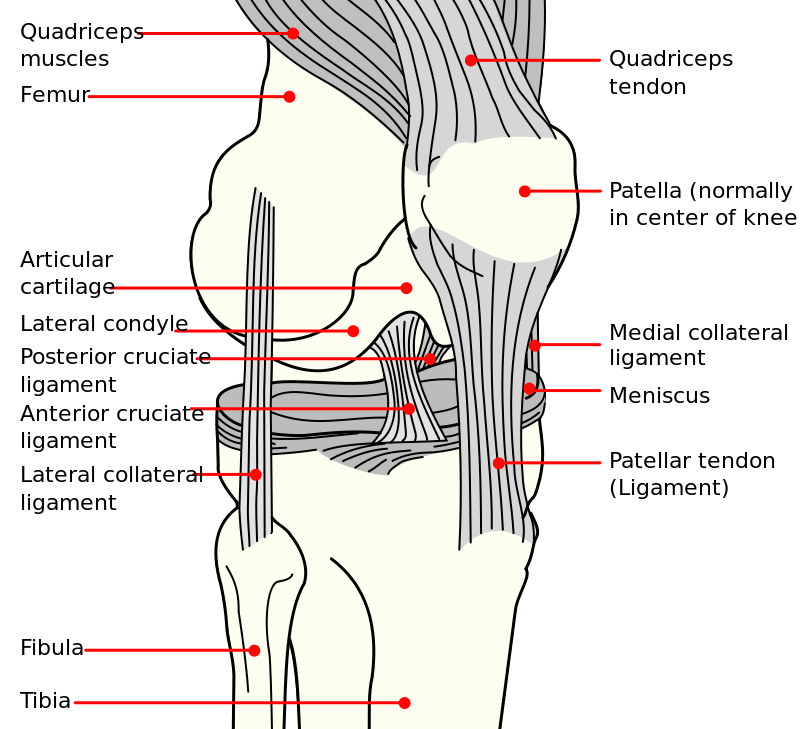
The knee is a hinge joint. It’s designed to flex and extend with the thigh bone (femor) and the shin bone (tibia) in the same plane. A healthy joint can tolerate a certain amount of torquing or poor distribution of the body’s weight on occasion, but repetitive movements of that nature and /or severe uncontrolled movements can lead to permanent damage. Healthy knees are stable when straight (extended), but become slack when bent (flexed.)


Knee damage among martial artists is all too common, and the causes may or may not be self-evident. Martial artists whose practice includes kicks that require pivoting on a support leg or which involve landing leaping maneuvers may be intimately aware of the risks. However, the first martial art that I ever trained in had no twisting / pivoting kicks and few leaps (that were rarely practiced), but knee injuries were epidemic. The culprit in this case was low postures which required the thigh to be turned out (externally rotated and abducted) with the knee deeply flexed.


Well, I should say those postures were the culprit in conjunction with lack of flexibility and/or strength in all the right places. This isn’t to say that the individuals who developed knee problems weren’t strong or flexible, but the areas that needed work weren’t necessarily the big muscle groups that leap to mind when workout time comes around.   Emphasis on the big muscle groups (quadriceps and hamstrings) with neglect of the muscles involved with adduction, abduction, external rotation, internal rotation and stabilization can create some problems. If you’re a runner or a weightlifter (with good form) you may be able to get away with such a stretching and strengthening emphasis. [Note: I’m not advocating such an approach for anyone. What I’m saying is that if your knee is only worked with the knee straight below the hip and pointed forward in a hinge fashion, your risks are not the same as someone who works with a flexed knee with the thigh turned out. The likely injuries are different.]

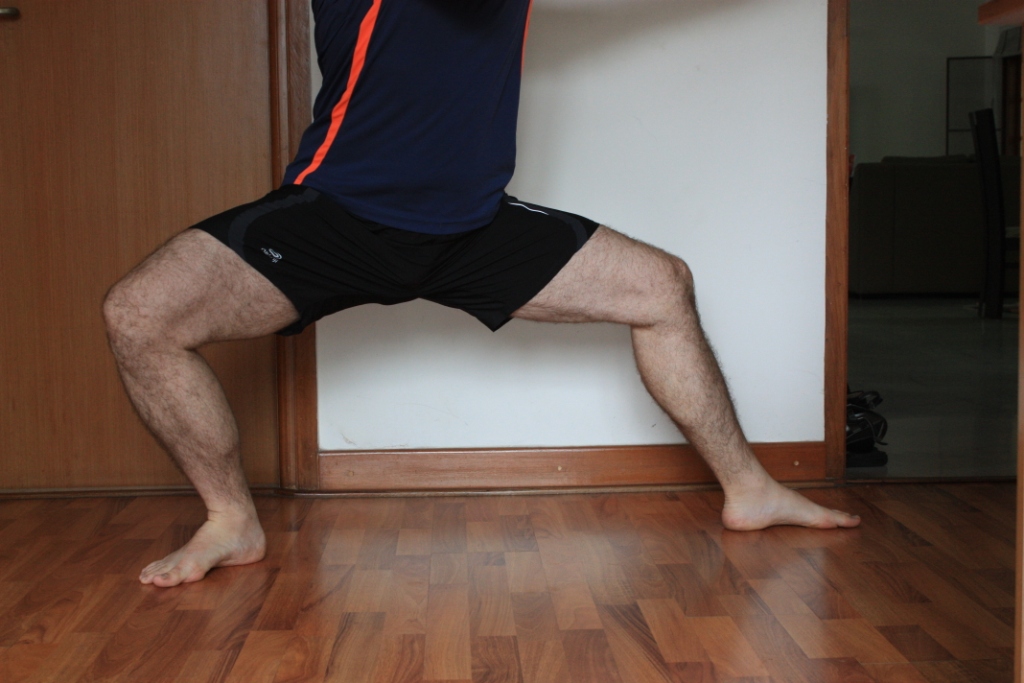
Note: Knees pointing the same direction as the toes. (The back knee might be a little far back but that's an issue for the ankle health post.)

Note: Knees pointing the same direction as the toes. (The back knee might be a little far back but that’s an issue for the ankle health post.)

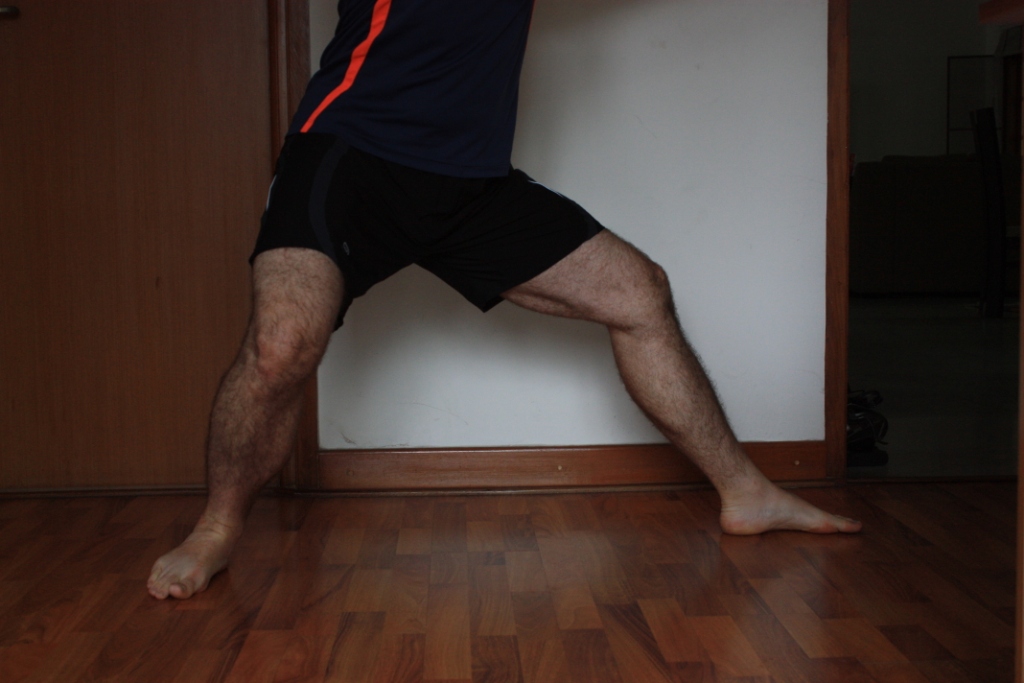
WRONG: Note: if one dropped a line down from the knee it would be well inside the foot. That means the ligaments are having to work too hard and your skeleton isn't doing enough

WRONG: Note: if one dropped a line down from the knee it would be well inside the foot. That means the ligaments are having to work too hard and your skeleton isn’t doing enough


To do a posture like the one above, one needs the flexibility to keep the knee wide enough so that it points the same direction as the toes.  The joint shouldn’t be wrenched or torqued with load on it. The four ligaments (Anterior Cruciate Ligament [ACL], Posterior Cruciate Ligament [PCL], Medial Collateral Ligament [MCL], and the Lateral Collateral Ligament [LCL]) and the surrounding musculature keep the joint snug during movements. And, as mentioned earlier, when the knee is deeply flexed it’s more sloppy than when extended.


-Increase flexibility in the muscles that internally rotate and adduct  the thigh: When one goes into a wide-legged stance, one’s thigh is pulled away from the body’s center-line (abducted) and the thigh externally rotates. If the muscles that act in the opposite direction (pulling the thigh back on center and rolling the thigh inward) are too tight to allow the knee to move into proper position, then the load of the body weight will be going into the ground through a kinked joint. Furthermore, one will end up torquing through the joint as one moves. Below are a few hip openers that will help one achieve the requisite range of motion.

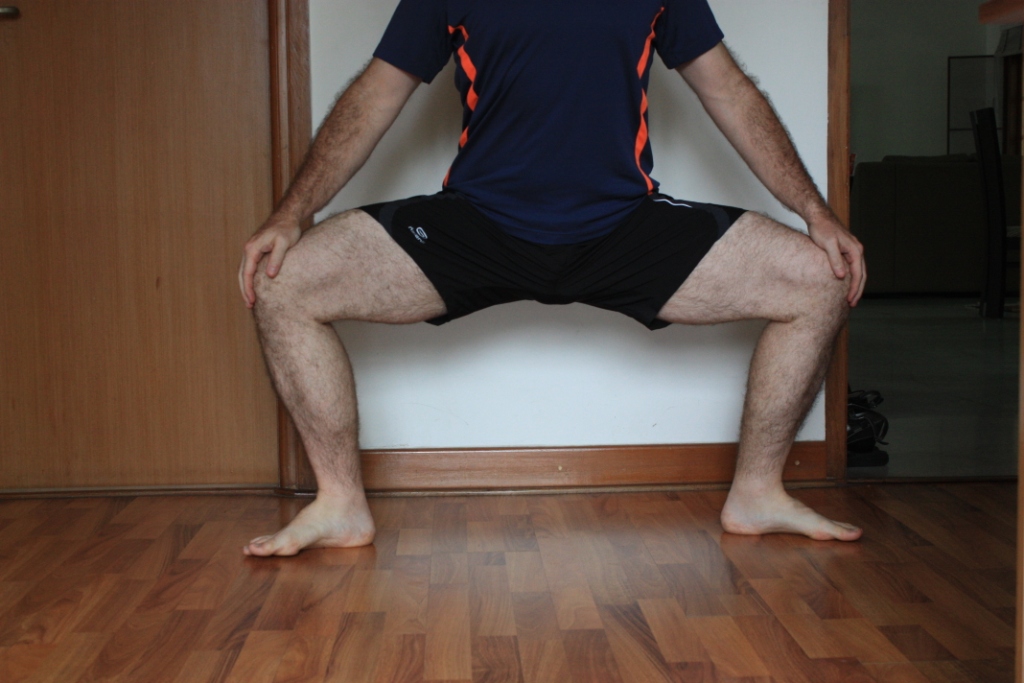
Utkatakonasana (often called goddess pose) variations will show you whether you're getting your knees and toes in line.

Utkatakonasana (often called goddess pose) variations will show you whether you’re getting your knees and toes in line.

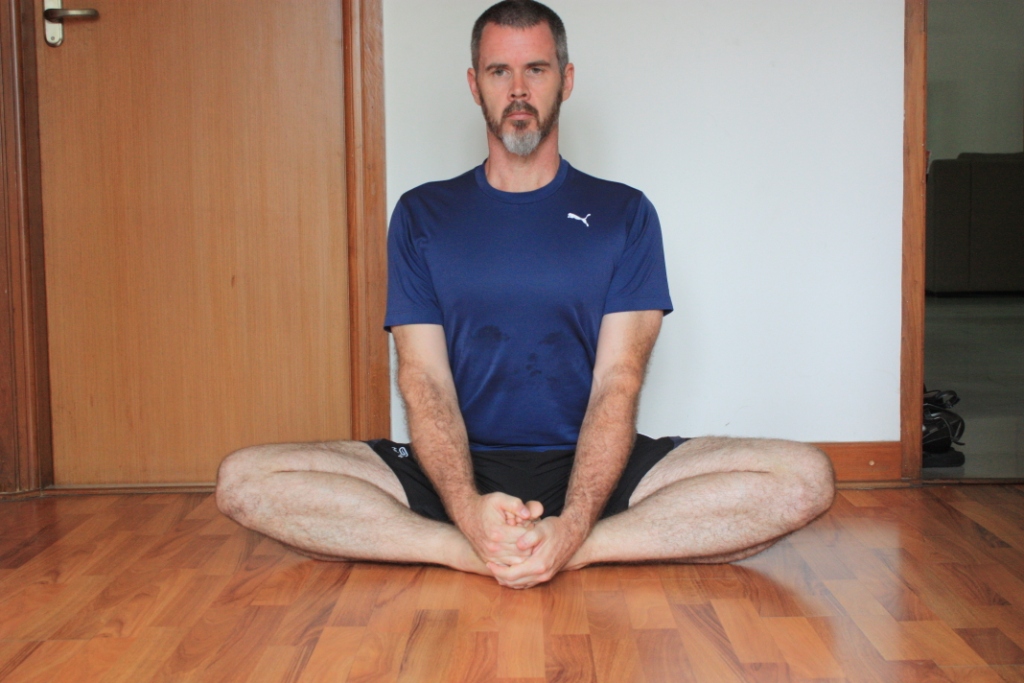
Badhakonasana (often called the butterfly stretch): Work on getting those knees down

Badhakonasana (often called the butterfly stretch): Work on getting those knees down

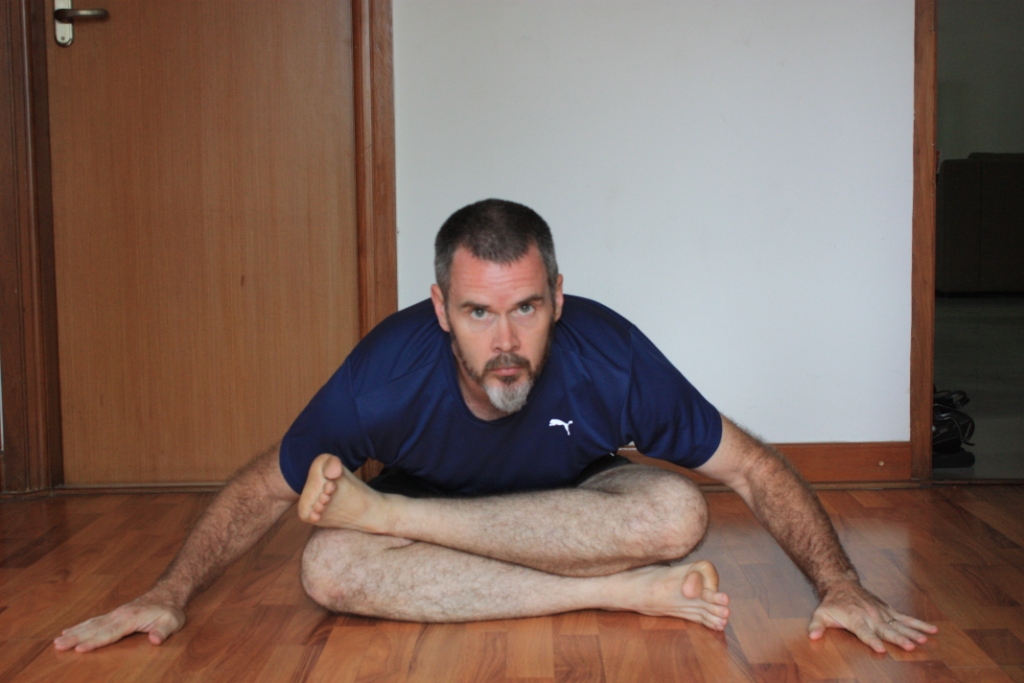
Place one foot on top of the opposite knee (and vice versa for the other side) carefully shift weight forward. This puts an intense stretch on the hip joint to help rotate the thigh sufficiently

Place one foot on top of the opposite knee (and vice versa for the other side) carefully shift weight forward. This puts an intense stretch on the hip-joint to help rotate the thigh sufficiently

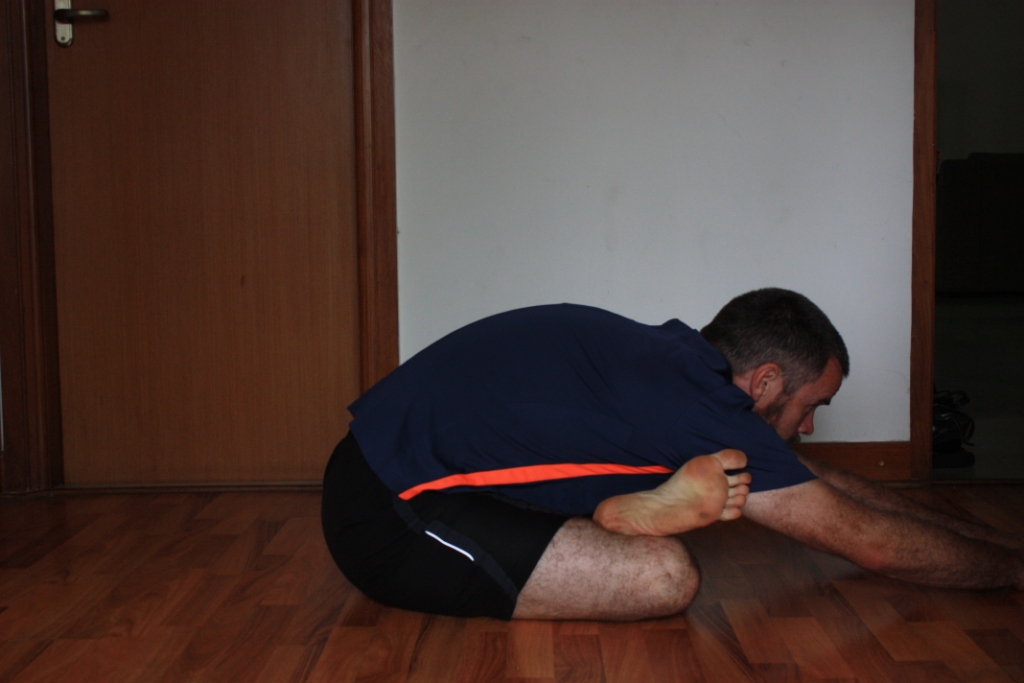
Same as the last from the side

Same as the last from the side

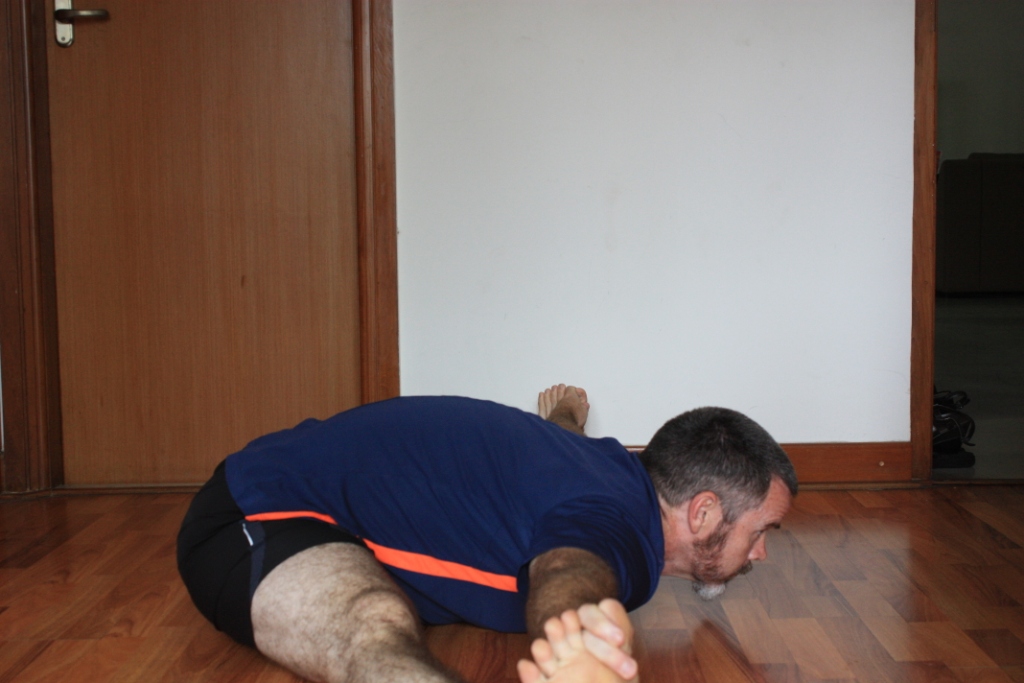
Upavistakonasana: put legs at about 90 degrees relative to each other, and then lean forward with a flat back placing the stomach, chest, and chin on the floor (in that order.)

Upavistakonasana: put legs at about 90 degrees relative to each other, and then lean forward with a flat back placing the stomach, chest, and chin on the floor (in that order.)

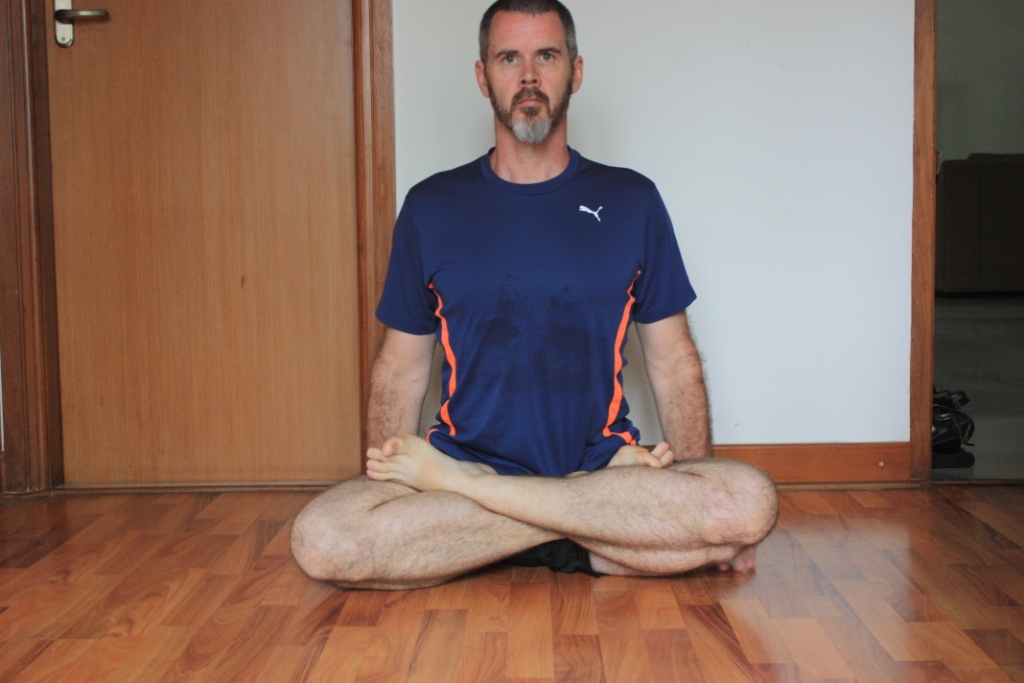
Padmasana (lotus): If you meditate in padmasana, you probably already have the range of motion necessary. Note: if padmasana hurts your   knees, you need to go back to hip openers and discontinue the practice.

Padmasana (lotus): If you meditate in padmasana, you probably already have the range of motion necessary. Note: if padmasana hurts your knees, you need to go back to hip openers and discontinue the practice.


-Strengthen the muscles that stabilize the knee-joint. One begins this process with the usual suspects of leg exercise. One just needs to focus intently upon alignment. Here are a few of the exercises you may already be doing.


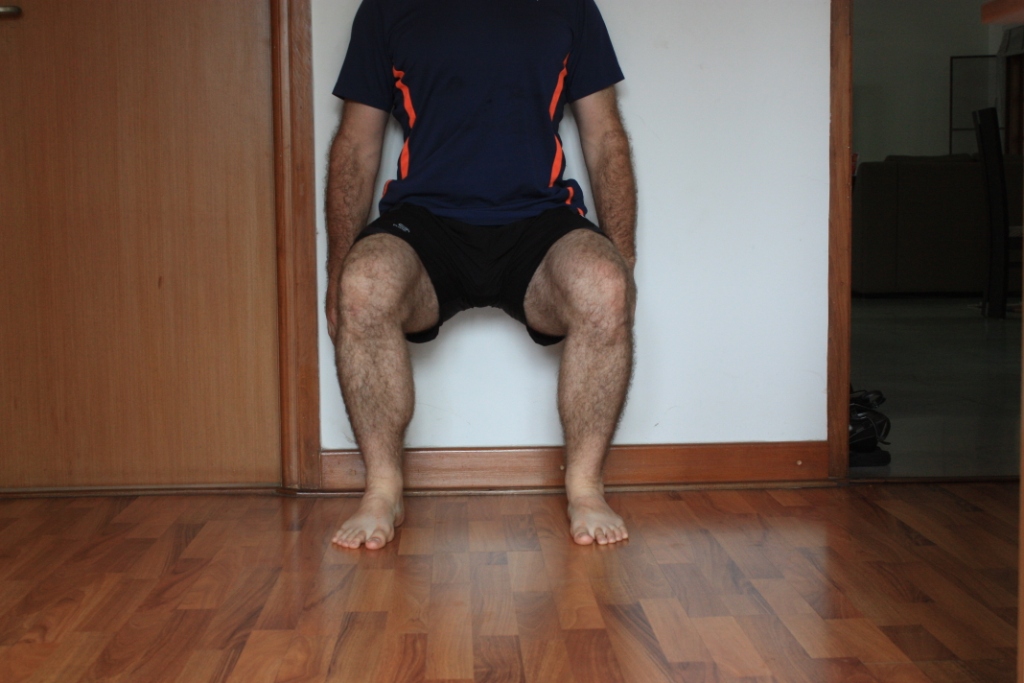
Wall squat: just like sitting on a chair with one's back  to the wall--sans the chair.

Wall squat: just like sitting on a chair with one’s back to the wall–sans the chair.

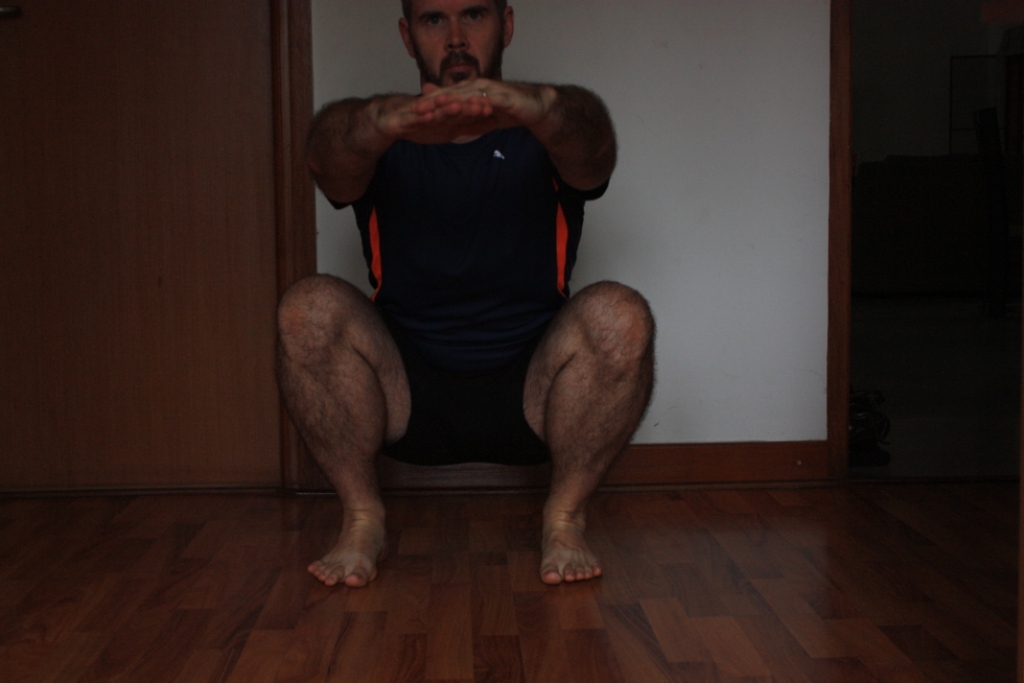
The classic squat

The classic squat

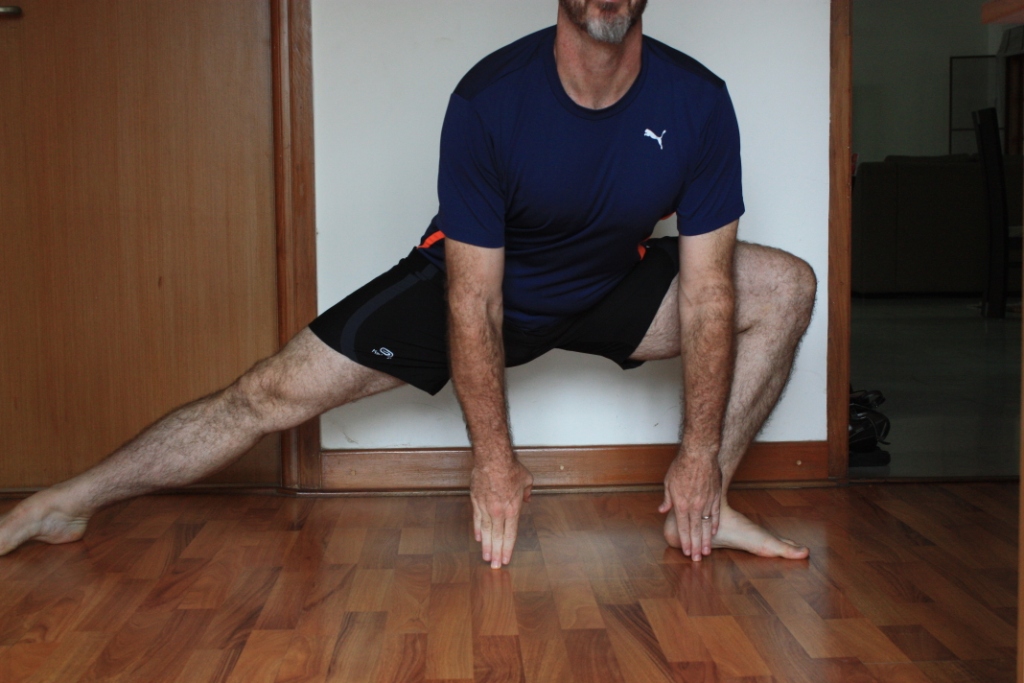
Side lunge: This one is  particularly important to get the knee aligned with the foot.

Side lunge: This one is particularly important to get the knee aligned with the foot.

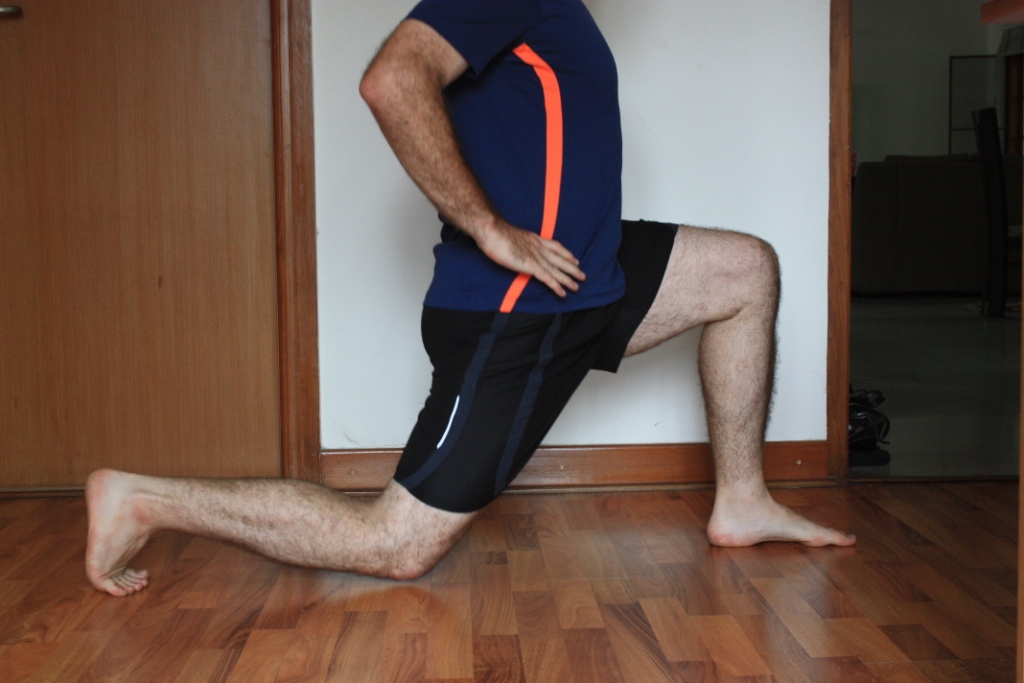
The basic lunge: can be done stepping forward, backward, or both (the latter in an alternating fashion)

The basic lunge: can be done stepping forward, backward, or both (the latter in an alternating fashion)


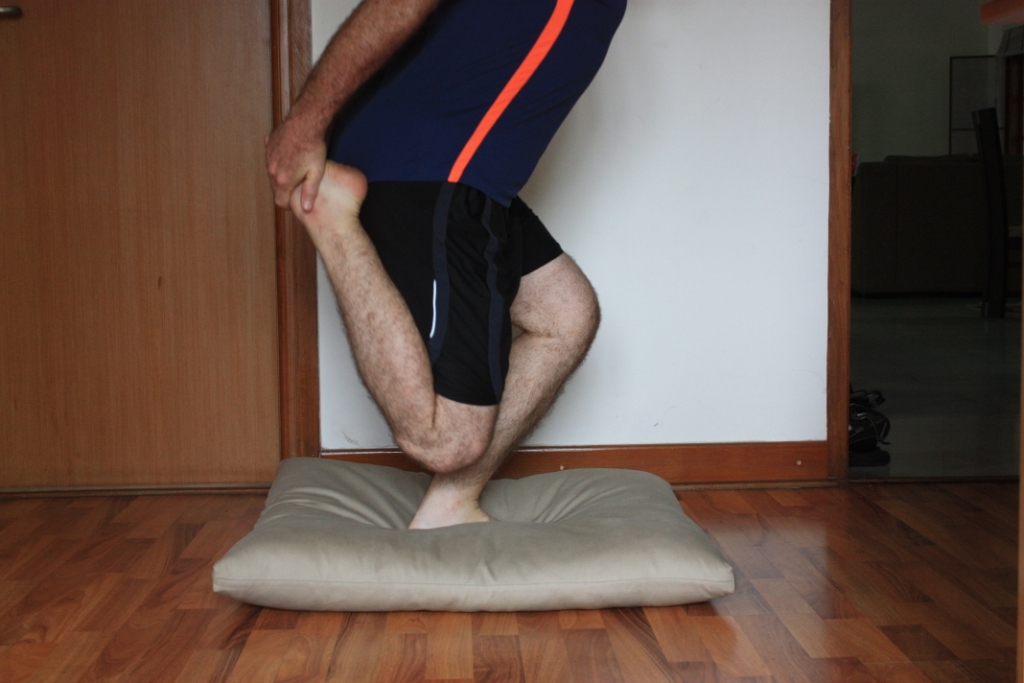
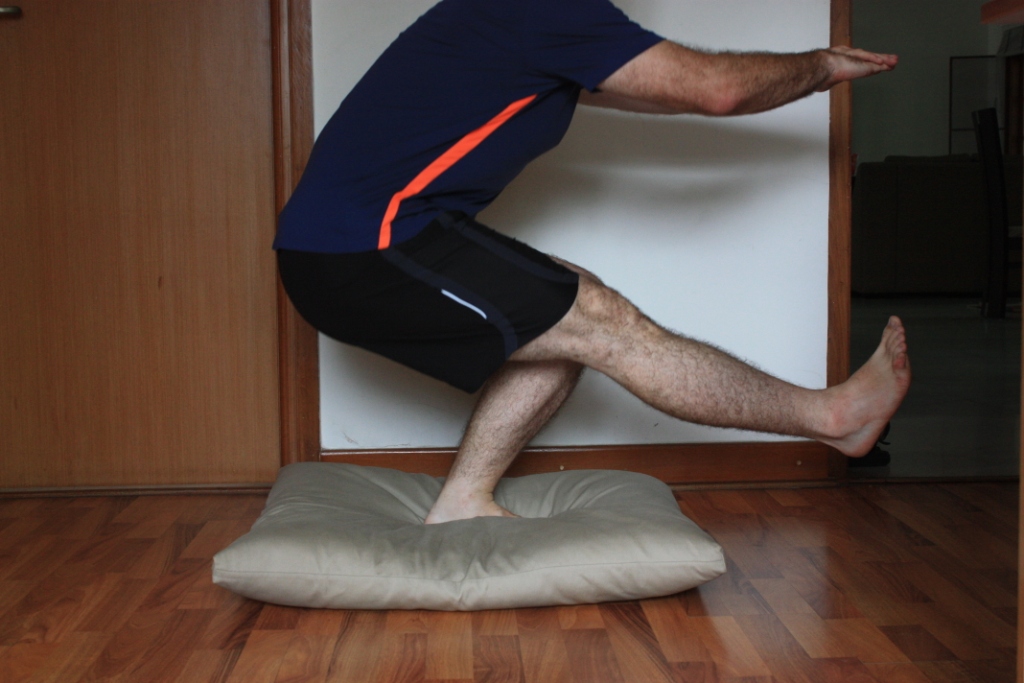
As one needs more challenge, one can achieve it in the usual ways (single-legged, unstable surface, add weight, or combinations thereof.) Below are a couple of variations that combine single-limbed work with an unstable surface.


IMG_1537 IMG_1532


-Save static stretching for after the joint has warmed up. It used to be common to begin a workout with static stretching. While few do this anymore, it’s a practice that needs to be replaced. Stretch warm.


-Don’t neglect the opposing muscle groups: When I said that one needs to increase flexibility in adductors and internal rotators, that doesn’t mean to ignore the opposing muscles. Nothing  good comes of stretching or strengthening in an unbalanced fashion. Your musculature works as a team with agonists, antagonists, and stabilizers all working  in conjunction to produce effective movement.


-Don’t go overboard with stretching: If your aim is to be a contortionist, then by all means go ahead. However, highly flexible martial artists need to be concerned about joint laxity. Laxity is when the joint gets so loose that it’s vulnerable to popping out-of-place.  A martial artist needs a balanced style of fitness. Extreme flexibility results in weakness and lack of joint robustness, just like extreme strength training produces a body that lacks range of motion and stamina.


Most importantly, don’t ignore pain when it’s still at the minor twinge point. If you have knee pain you’re doing something that joint doesn’t like. One should reevaluate your movement and, if necessary, considering stepping back from your current practice to work on capacity building exercises.