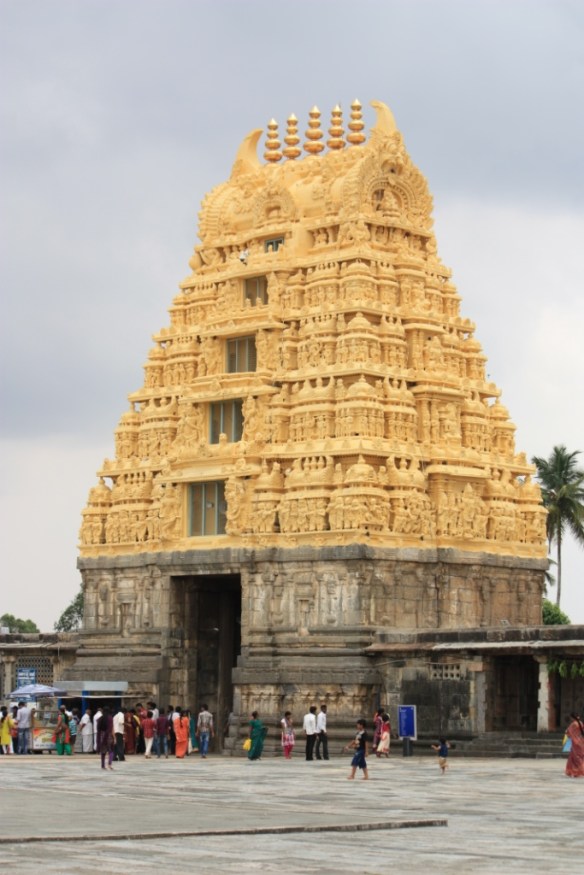
DAILY PHOTO: Chennakeshava Temple at Belur

Taken November 23, 2013 at Belur.

Taken November 23, 2013 at Belur.

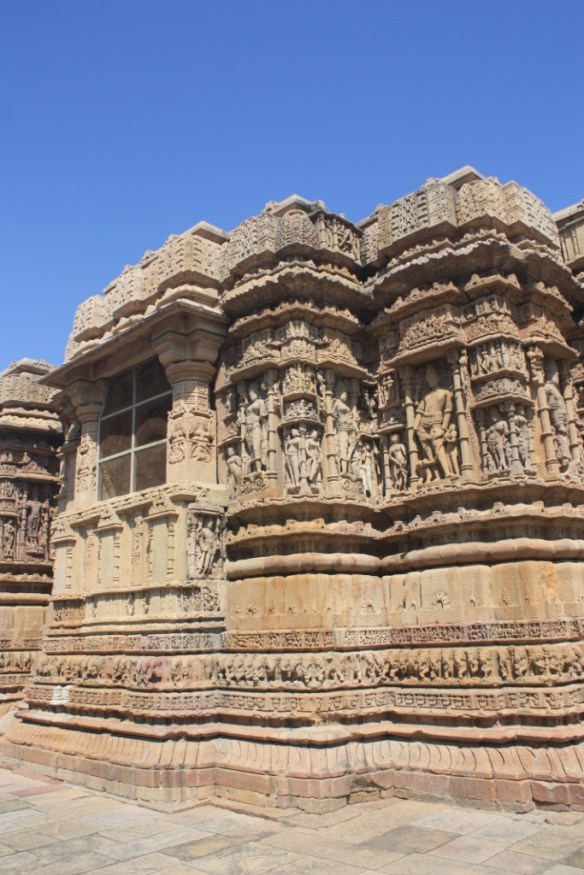
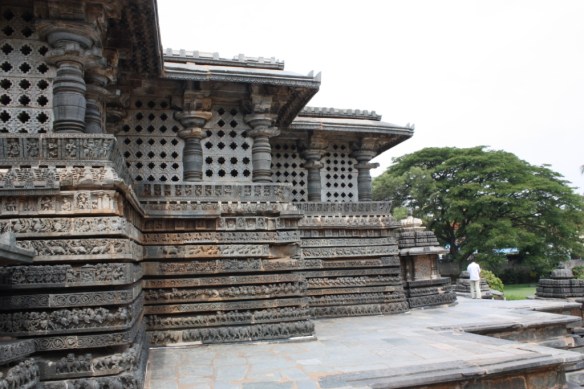
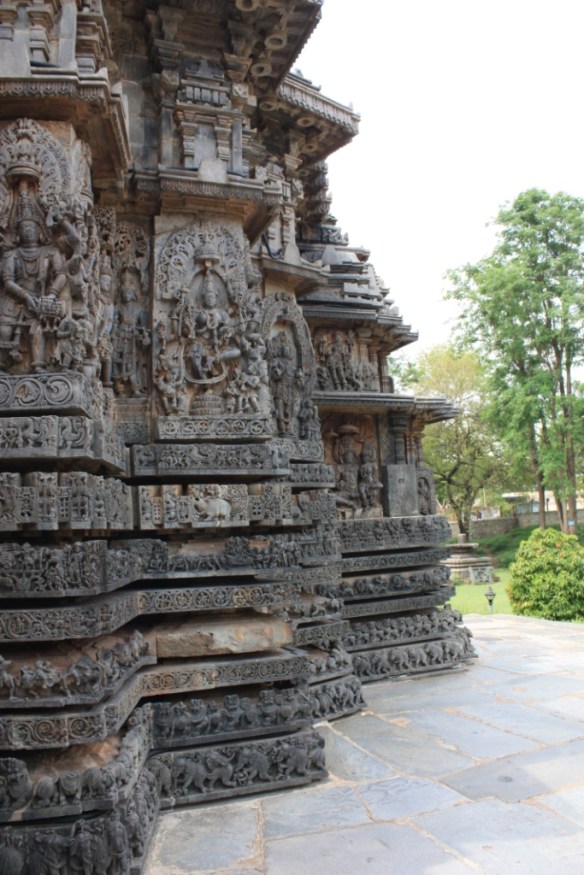
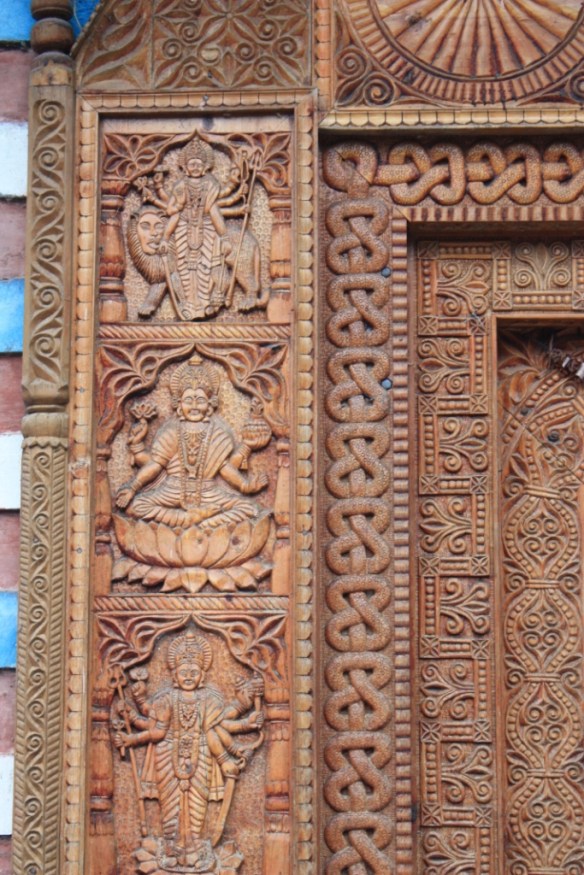
Chennakeshava temple at Belur is a Hoysala era temple to Vishnu–the deity of the Hindu trilogy responsible for processes of sustenance and evolution (as opposed to creation or destruction, which are the bailiwicks of Brahma and Shiva, respectively.)

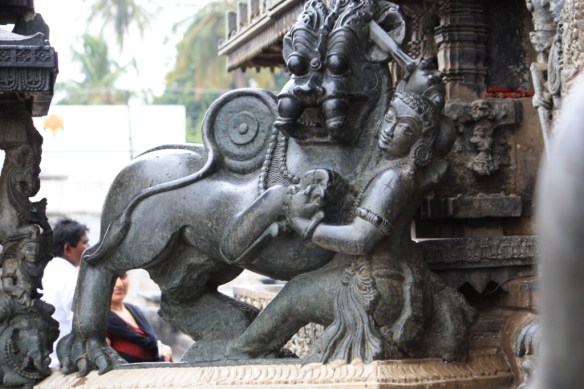
This temple and its sister temple at Halebidu, Hoysaleshwara temple, are probably the most ornate structures I’ve seen anywhere in the world. They are covered with soapstone carvings arranged in several tiers. For example, the bottom layer is a series of elephants, each one unique. There is a layer that tells tales from the Mahabharata in pictures.

Soapstone is soft and easily worked when quarried, but it becomes hard enough to survive everything but looters as it’s exposed to the elements. You’ll note the “windows” carved in the rock to allow in light and breezes.

Close up

Close up


DAILY PHOTO: Lotus Mahal

Taken November 2, 2013 at Hampi

Taken November 2, 2013 at Hampi

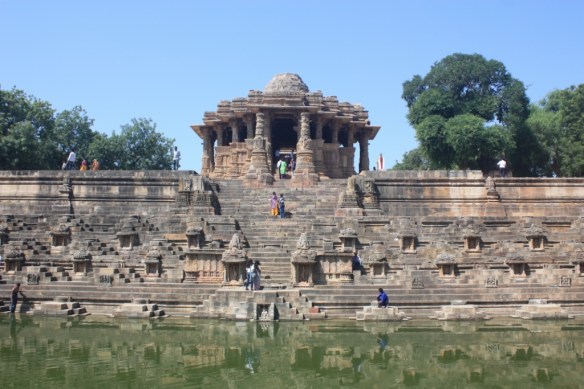
The Lotus Mahal is one of the most popular attractions at Hampi. It’s atypical in that it’s built, in part, in the Indo-Islamic style (note: the arches.) (Hampi [Vijayanagar] was the capital of a Hindu kingdom that was defeated by a confederation of Islamic states. ) While this pavilion is often referred to as the “Lotus Temple,” it was believed to be either a rest-house for visiting royalty or the queen’s recreational building–but not a religious building of any sort. 

We got there with good timing. The beige-pink lime mortar seems to glow in the low, afternoon sunlight.  

The Lotus Mahal is located in the Zenana Enclosure with the Elephant Stables. 

DAILY PHOTO: Red Fort

Taken on October 16, 2013

Taken on October 16, 2013

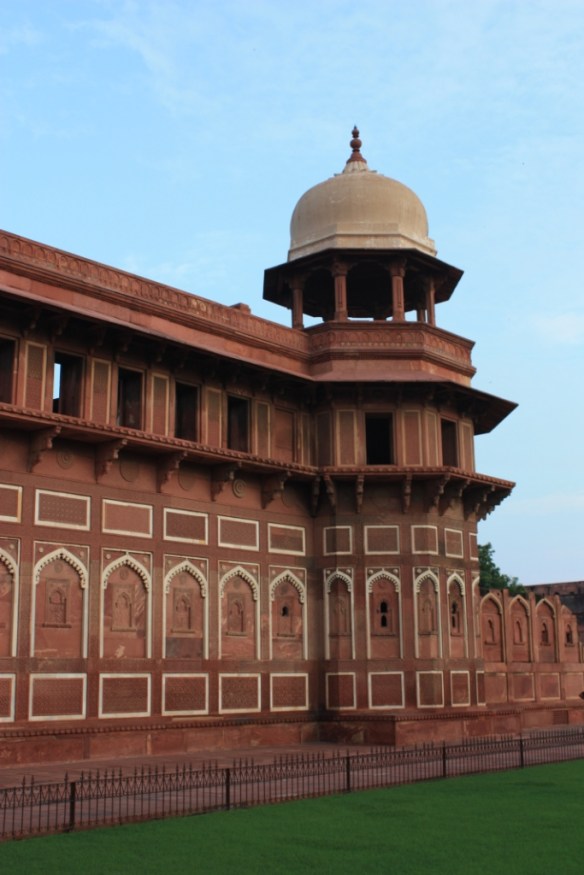
This white marble palace constructed in the Indo-Islamic style is one of the more impressive structures in Old Delhi’s Red Fort.

The Red Fort should be visited before visiting Agra Fort, because it should be seen but it’s not as impressive as its Agra kin. I did it the other way around, and the Red Fort was a disappointment by comparison. The grounds aren’t kept up, most of the semi-precious gemstone inlays are missing from the ornately carved marble, and the fort houses an architectural hodgepodge. That being said, the red sandstone walls are imposing and magnificent and the few historic structures are quite impressive–if not as much so as in Agra.

Close up of the same structure.

Close up of the same structure.

DAILY PHOTO: Jama Masjid

Taken October 14, 2013 in Old Delhi.

Taken October 14, 2013 in Old Delhi.

This is India’s largest mosque. It is capable of holding 25,000 worshipers–mostly in that open courtyard that can apparently be covered as needed.)  It dates back to the rule of Mughal Emperor Shah Jahan–who you may know of from his requisitioning of the Taj Mahal.

It’s located in Old Delhi and is usually matched with trips to the Red Fort and Chandni Chowk (a huge bazaar street), which are both nearby.

It’s mostly Red sandstone with white marble, as was common of Shah Jahan’s other monumental structures.

[I realize it’s a cheat that I’ve posted two “Daily Photos” in a couple of hours of one another, but it’s a new day in the States–and I’ve got a ton of photos from my recent trip.]

DAILY PHOTO: Bangalore Palace

Taken in September of 2013

Taken in September of 2013

DAILY PHOTO: Portico in Sunlight

Taken in the Summer of 2009 at the Monastery at Valladolid.

Taken in the Summer of 2009 at the Monastery at Valladolid.

DAILY PHOTO: Atlanta’s Flatiron Building

Taken in the summer of 2012

Taken in the summer of 2012

DAILY PHOTO: Cambodian Supreme Court

Supreme Court of Cambodia, Phnom Penh

Supreme Court of Cambodia, Phnom Penh

DAILY PHOTO: Temple of Heaven Grounds in Beijing

The pointy-topped building is the Hall of Prayer for Good Harvests

The pointy-topped building is the Hall of Prayer for Good Harvests

The Temple of Heaven is a complex of buildings used for Heaven worship.  It was built in the 15th century, and is a Taoist temple  (Heaven worship predates Taoism–though the Temple doesn’t.) The most distinctive building, the Hall of Prayer for Good Harvests–shown only partially in the picture–was built without any nails or spikes.

It’s  located in a beautiful park south of central Beijing. The park has a rose garden and is a popular hangout for people doing tai chi, playing instruments, and dancing.

DAILY PHOTO: Cambodian National Museum in Phnom Penh

In the courtyard of the National Museum of Cambodia

In the courtyard of the National Museum of Cambodia

The National Museum of Cambodia is picturesque. The collection is small and simple, but impressive in quality. For those of us who run out of “ooh” and “ahh” stamina after a few hundred artifacts, it’s just the right size.  It’s also not stuffy in the usual way of museums– large barred windows are unshuttered while the museum is open. (This is probably less than ideal from both the perspective of security and artifact preservation, but it gives the place a certain ambiance, and maybe helped the exodus of the bats that took up residence during the museum’s dormant period)

It’s great to see what they’ve done with the place considering the state of disrepair it was said to be in after the Khmer Rouge period. With respect to my comment about it not being a large collection, it’s a wonder that any collection exists at all after the wave of lootings from the French through Vietnamese soldiers that took place in the country.

Be forewarned, once one is inside, one will be confronted by Buddhists from a monument preservation society seeking donations at about half a dozen different Buddhas around the museum. If you aren’t a Buddhist, this can be a bit of an annoyance. If you are a Buddhist, you may find their approach disconcertingly unBuddhist. They will try to press incense into one’s palm in order to corner one into paying homage to the Buddha so they can make some dough for their cause. However, they don’t follow one around once refused (as similar individuals have been known to do at Angkor.) It may be a great cause, but they’d probably do better if they restricted it to one per museum and not one per gallery, and just let people drop cash rather than insisting on the idol worship first. I’m nondenominationally happy-go-lucky myself, but I can imagine this being troublesome for some visitors. At any rate, it’s symptomatic of the country’s  poverty and their inability to support their deity at the level to which he has apparently become accustomed.