



 The Way of the Shaman by Michael Harner
My rating: 4 of 5 stars
From tripping on ayuhuasca in Peru to sucking the evil spirits out of patients, Harner offers an overview of shamanic methods and practices. While it would seem like such an undertaking would be a thick tome given the wide variety of cultures in which Shaman are a fixture, Harner suggest that there is a remarkable similarity of methods used by these “medicine men” be they in the Americas, Central Asia, or the South Pacific. Of course, at a tight level of granularity there are differences, and Harner gives examples of such differences here and there – usually using examples of the Shamanic practices he has studied in South and Central America. However, this book is more the high altitude over pass of the landscape.
There are seven chapters. The first couple of chapters both set up the book and hook the reader with a detailed discussion of Harner’s ayuhuasca — and other mind / mood altering substance – experience. It should be pointed out that not all Shaman use psychedelics and Harner describes in detail alternative approaches to achieve altered states of conscious that involve a combination of drumming and meditative practices.
Chapter three discusses altered states of consciousness, and what Harner calls the “Shamanic State of Consciousness” (SSC) which is the altered state that is pursued by medicine men in their practice. Chapter four describes the concept of power animals and the role that they have in health and illness. (i.e. from the Shaman’s view, an illness might be seen as the result of lacking such a “spirit animal.”) The final three chapters discuss practices such as how the Shaman can acquire a power animal for the patient or how he / she might extract a malevolent influence.
I found an interesting corner being turned in this book. In the opening chapters it reads much like an anthropologist’s scholarly account. Even talking about tripping on psychedelic substances, it’s all with the grounded feel of a scientific mind. However, in the latter half of the book, it reads as though Harner truly believes that the altered state of consciousness is actually a sort of parallel dimension with an intrinsic reality unto itself. I don’t know whether this is a tactic to feather it in for skeptical readers or if it reflects Harner’s own internal journey. (It’s definitely a hard line to walk when writing a book that one hopes to be read by both scientific rational skeptics and religious true believers.) At any rate, the book gets a bit wilder as it goes along. In the beginning, the reader might think the book a discussion of how a powerful placebo effect is achieved, but by the latter chapters it seems one is considering how malevolent spirits can be trapped or extracted from a patient.
As for ancillary material, there are line-drawn illustrations, annotations, a bibliography, and two appendices. The first appendix is about drumming and gives details about what kind of drums and rattles the would-be Shaman should seek. (Drumming plays a major role in achieving the proper state of mind.) The second is a detailed description of a game played by the Flathead Indians. I should note that I read the 3rd edition of this book. The original was published in 1980.
I found the book intriguing as one interested in how people of various cultures achieve altered states of consciousness, how they experience such states, and why they pursue them in the first place. I’d recommend it for a reader who is curious about Shamanic practices – even one who, like me, is a complete neophyte to the subject.

Taken in April of 2017 in Chobe National Park (i.e. taken from Botswana looking into Namibia)
 Complete Poetical Works by Edgar Allan Poe
My rating: 5 of 5 stars
The title is self-explanatory with respect the book’s content. However, if one is just expecting all of Poe’s poems bound together, one may be pleasantly surprised by some relevant bonus material in the form of scenes from plays and a few essays on poetry.
The works included are divided into seven sections. The first is entitled “Poems of Later Life” and includes many of the author’s most famous works such as: “The Raven” and “Annabel Lee.” The book then follows an inverse chronological order with the section entitled “Poems of Manhood” coming next. Next there are scenes from a drama entitled “Politian” that emulates classic Greco-Roman plays. Then there are the poems written in Poe’s youth. There are two more sections of poetry with only a few pieces each. The first is the “doubtful poems’’ – i.e. poems that may or may not have been penned by Poe. The last chapter of poetry consists of Poe’s prose poems. Finally, there is a section consisting of three essays about poetry. This is a nice inclusion as it offers the reader insight into Poe’s thoughts on poetry. For example, Poe believed in a poetry Goldilocks zone. That is poems that were too long would not be able to maintain the emotional experience, but one’s that were too short would not be able to convey meaning.
I enjoyed this book. Not all the poems are of the caliber of “The Raven” by any means, but the book is insightful nonetheless, and there’s a mix of Poe’s trademark darkness with pieces that might strike the reader as decidedly uncharacteristic. As I said, it’s fun to have Poe’s essays on poetry next to his poems so that one can consider his verse in that light. The inverse chronological order provides an interesting way to view the evolution of a poet – Benjamin Button style. (Plus it offers one some strong momentum by starting the reader off with some of Poe’s most exceptional work.)
There’s a brief biography in the front of the book, and there are a surprising number of detailed notations for a collection of poetry. That’s all the ancillary matter. There are editions with illustrations, but the edition that I read didn’t have them (i.e. the version on offer from Gutenberg Project .) Amazon seems to have editions both with and without illustrations. (I don’t think they would offer much value-added.)
I’d recommend this for poetry readers and poets interested in Poe’s approach to the art.
 Jnana-Yoga by Swami Vivekananda
My rating: 4 of 5 stars
For those for whom the term “Jnana Yoga” is unfamiliar, it’s one of the three original branches of yoga. Jnana yoga is the path of knowledge, which sounds more scholarly than apropos and so maybe the alternative translations of path of self-realization or of wisdom might be more informative. For the most part, Jnana yoga isn’t about reading books and collecting facts, although studying texts is traditionally a part of the approach, it’s more about turning inward and expanding understanding through practice and personal inquiry. The other two branches are bhakti yoga, which is the path of devotion followed by pious true believers, and karma yoga, which is the path of [unselfish] action or charitable work.
This is a hard book to rate. As a book about yoga and the philosophy thereof, I give it four stars and might even give it five in a gleeful moment. However, if I were to rate it as a book specifically on jnana yoga, I’d give it two. The book reads more like a bhakti yogi’s take on jnana yoga than a book on jnana yoga itself. In other words, Swami Vivekananda devotes a lot of space to telling the reader what they should take on faith and relatively little to discussing how one can glean one’s own insight through practice and introspection. I realize that if I were a bhakti yogi, my perspective would be different and I’d likely see the book as insufficient in its efforts to suggest that the reader should sing the praises of the almighty. But I’m not, and I obtained a book entitled “Jnana Yoga” thinking I would learn about the titular subject and so I was a bit disappointed at the approach of the book. There are some insights into jnana yoga here and there, but it’s not the focus. It’s telling that Chapter one is entitled “the necessity of religion” and that it begins by explaining why the existence of God must be taken as axiomatic.
There are sixteen chapters in the book. The general flow goes: a few chapters on “maya” (which is typically translated as illusion / delusion, but which Vivekananda argues is best thought of in a different light, which he goes on to explain in detail), some chapters on the cosmos and its nature, and the last few chapters are on atman (i.e. the self, sometimes translated as “soul.”) It should be said that these topics are consistent with a consideration of jnana yoga. Jnana yogis concern themselves with these big questions such as the nature of reality, the universe, and the self. However, the approach of saying that this is what the Vedas say (and thus it’s the reader’s truth) is inconsistent with the path of the jnana yogi. Swami Vivekananda is clearly highly knowledgeable and he does bring up some thought-provoking approaches. There are occasional errors on matters of science, but one must keep in mind that it was written before the turn of the twentieth century and so the state of knowledge has changed considerably in the intervening years, and so I don’t discount for them — especially, because one is often surprised by the author’s level of understanding of the science.
The book is straight text. The edition that I read had some annotations, but the book neither has nor needs any ancillary material.
My recommendation would be contingent on what the reader is looking for in a book. If one is seeking a general understanding of yogic thought on the nature of reality, the universe, and the nature of self, then this is an insightful book. If, however, one is interested in the path of the jnana yogi and what it entails, I’d suggest you look elsewhere (e.g. Swami Saraswati’s “Sure Ways to Self-Realization.”)
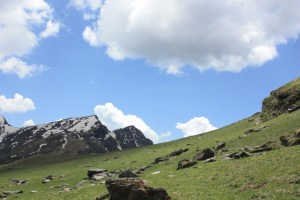
standing under a chalky cliff
losing myself in blue sky
i felt i’d found eternal drift
and looked a myth in the eye
of beasts and blessed fury wrote
the clouds up high above
they told the tale in drift and float
of angst, and war, and love
oh, such weight did escape my bones
that i felt my feet were slipping
i would have drifted to parts unknown
had i not felt the drift forbidding
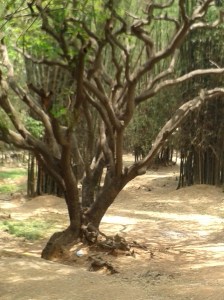
Did you hear that tree speak to me?
It did not make an eager plea
to help it step out to the quay
so it could set off ‘cross the sea.
Tree’s don’t dream of mobility,
except perhaps windward to lee.
Trees seek only food and water,
and hold the hope of harmless squatters.


