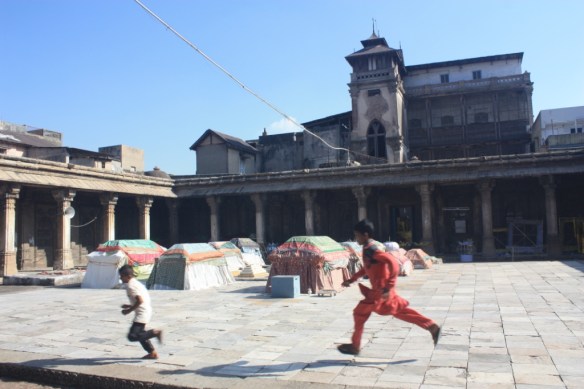
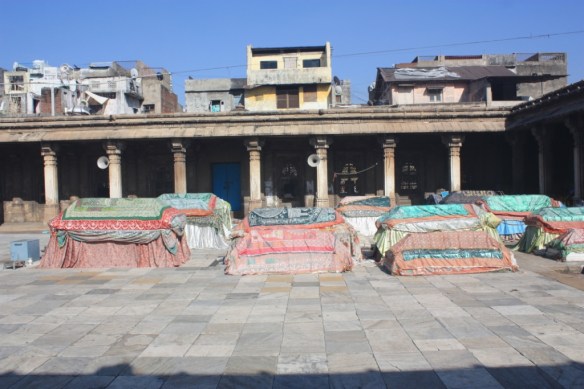
Taken in September of 2017 in Ahmedabad


Source: European Southern Observatory (via Wikipedia)
Let me step up on my soapbox,
tell you about a paradox.
Said a scientist named Fermi,
“Why’ve no aliens made the journey
to bring us a nice fruit basket
or just tell us how fantastic
it is having us in the neighborhood.”
Scientists have racked their brains
considering competing claims:
“Life is hard and smarts is harder.”
“They can’t stock a trans-galactic larder.”
“They’ve come here, but are to small to hear.”
“They are shy, out of wisdom or of fear.”
Or, simply, “They all blow’d themselves to hell.”
I, too, have had reason to ponder
why aliens stifled the urge to wander
into our little neck of the wood,
and I fear we don’t come off so good.
What if, I ask you, heaven forbid
they think of us as the smelly kid?
Are we the seatmate who won’t shut up
about his robotic barbershop startup?
Do humans come across as the kind
to ask a stranger if they wouldn’t mind,
helping us move and antique armoire
or lending us their new flying car?
So when considering whether we’re alone of device or luck,
consider the competing hypothesis that we really suck.
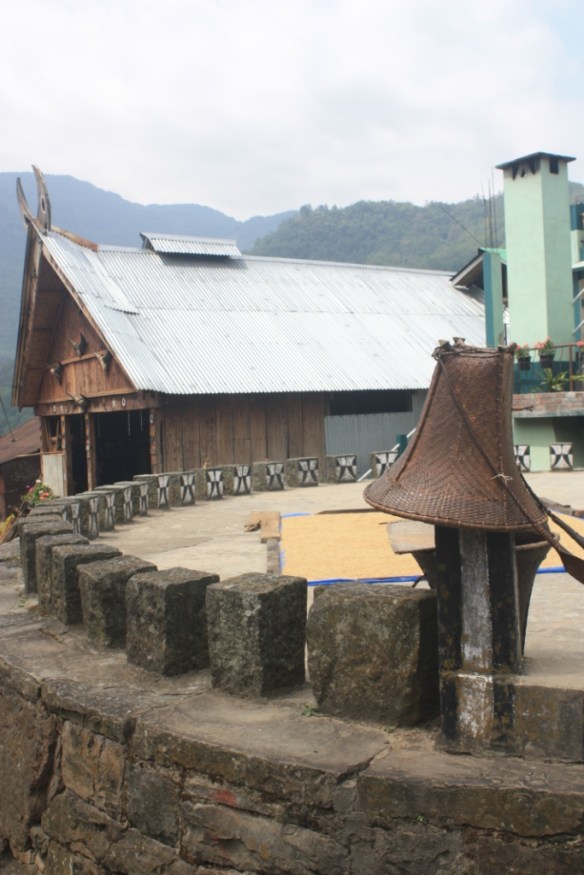
Taken in May of 2017 in Khonoma Village
Wealthy villagers in Nagaland earn merit by constructing circular stages like this one on which festival activities can be conducted. (Or, during non-festival times, grain can be put out to dry as per this photo.) I put “Town Square” in quotes because they are neither square in shape nor are they solitary centrally-located public spaces. Rather there can be several of them– as there are in Khonoma, a village near Kohima — at various locations in and around the village. The little cubic pillars are seats, some of which may be assigned to prominent individuals and others are open seating.
The basket put upside-down on the pillar is typical of the region, and is worn with the band across one’s forehead.
The building in the back is also a public building constructed by a prominent villager.

Taken in August of 2016 in Ladakh

Taken in August of 2016 near Thikse Monastery in Ladakh
 Treasury of Greek Mythology: Classic Stories of Gods, Goddesses, Heroes & Monsters by Donna Jo Napoli
My rating: 4 of 5 stars
This book consists of 25 biographical sketches of figures from Greek Mythology. It’s one of those books that grew on me, and the reason it grew on me was a few of the chapters toward the end were engaging, such as those about Heracles, Jason, and Helen. This also means that the number of stars I gave it is fairly meaningless. It was in no danger of getting 5 stars nor 1, but could’ve been anywhere in between at various points in my reading.
The problem with the book is that the unit of interest isn’t the myth, i.e. not the story, but rather the mythical figure, the various gods and heroes of ancient Greece. Because of this organization, some of the chapters have a tight and memorable story, such as that of Heracles and his 12 labors, while others are just piles of genealogical facts mixed with odd mythical happenings (e.g. who burst from whose forehead) and tossed with that mythical figure’s bit parts in larger myths. The book is a good, solid reference book for schoolkids doing research on Greek Mythology, but much of it’s not very engaging to read.
The graphics are beautiful and colorful, if a bit artsy (not always instantaneously clear in subject.) There are maps, a timeline describing happenings of ancient Greece — real and mythical, a bibliography, and a quick guide to the characters that would make more sense if the book wasn’t a collection of relatively brief biographical sketches to begin with (but repetition has its merits, particularly for children.)
If you’re looking for a collection of biographies of mythical Greeks (i.e. a reference for children,) then this is a good book for you. If you’re looking to get your kids intrigued by the Greek myths, then you might want to shop around. Put another way, if you’re looking for a version of what Neil Gaiman did with this “Norse Mythology,” only for the Greeks, this isn’t it.
 The Unthinkable: Who Survives When Disaster Strikes – and Why by Amanda Ripley
My rating: 5 of 5 stars
Ripley investigates a range of disasters and tragedies – natural and man-made – with an eye toward her sub-titular question of who survives and why. Of course, in the process she answers the [often more interesting] converse question of who dies and why? By that I’m specifically referring to those who die while facing the same situations as survivors. i.e. Who dies having had the capacity to survive? Obviously, some people fail to survive because they face a fundamentally unsurvivable event (e.g. a plane explodes in mid-air with said person in it), but a surprising number die who could have walked to safety if they’d have managed to get moving – and some die because they play out a mental script that makes no sense contextually, e.g. trying to get a carry-on out of the overhead compartment as though one is at the gate at Heathrow Airport when in fact one is sinking into the ocean while the crashed airliner one is in is being buffeted by ocean waves.
Over the course of eight chapters, an introduction, a conclusion, and ancillary material, the author presents cases involving airplane crashes, tsunami, hurricanes, police shootings, hostage situations, fires, stampedes (of humans by humans), and even touches on the psychology of tragedies of a personal [rather than mass] nature (e.g. sexual assault.) A particular emphasis is given to events that the reader will likely be familiar such as 9/11 and Hurricane Katrina, but the book also opens up the reader to events they may have scarcely heard of from the many crushing deaths in Mecca during recent Hajj pilgrimages to the Halifax harbor incident of 1917. Along the way, the reader hears from survivors, heroes, and a wide-range of experts on subjects such as gunfights, risk perception, evacuation dynamics, the physics of crowds, evolutionary psychology, and emotional resilience.
After an introduction that sets the context for the book, the first chapter discusses one of the most salient features of whether ones lives or dies, delay. The case of the evacuation of the World Trade Center (WTC) on September 11, 2001 is used to examine why some people loiter about while others are johnny on the spot to hit the road. The WTC on 9/11 makes an interesting case because there were certainly people who died who could have survived if they’d had better knowledge or training. However, at the same time, it could have also been vastly worse if some of the people didn’t have the training they did (famously, a huge WTC tenant, Morgan Stanley, had a man in charge of emergency procedures, Rick Rescorla, whose persistent drills no doubt saved many lives [though he did not survive, himself.])
Chapter two discusses risk, and the weird way in which human beings perceive and respond to uncertainty. For example, the author describes Kahneman and Tversky’s Prospect Theory, which showed that a person responds to risk much differently if there’s a possibility of losing something rather than only of making gains. (Prior to work of these two social scientists, the prevailing view was that humans were rational actors, i.e. a $100 is a $100.) Prospect theory confirmed that anxiety mattered, and people didn’t just use their clockwork frontal cortex to calculate and compare expected values. (This may seem self-evident, but it began the process of up-ending the precise and predictable rational actor model from classical economics.)
Chapter three is entitled “fear” and it discusses that emotion and the various behaviors (and lack of behavior) that goes hand-in-hand with it, including: distortion of the experience of time, tunnel vision, and self-talk. (Panic and paralysis behaviors are each given their own chapter later in the book.) This chapter presented a fascinating discussion with a man who may have been involved in more shoot outs than any other police officer (the officer, no doubt, having a valuable perspective on how to respond in fearful situations.)
Chapter four is about the personality traits that link to resilience and the survivor personality. There is a fascinating discussion with an undercover agent in Israel, a man who faced a number of situations in which he had to coolly make a life-or-death decision in the way that most of us only experience in Hollywood movies. It should be pointed out that while we all admire such people when they save the day, the personality traits they display aren’t necessarily ones that we find desirable in daily life. Chapter five is entitled “groupthink” and it discusses the role that social dynamics play in survival, which is often considerable. Some survivors are people who would’ve perished if left to their own devices – i.e. if a more resilient stranger hadn’t taken them by the hand or shouted in their face.
The last three chapters discuss three relatively common behaviors that occur in the decisive moment of a tragedy. Chapter six discusses panic behavior. As it happens, there are some types of tragedies in which panic is almost unheard of and others in which it is nearly ubiquitous. Personality does play a role. Just as some people have personality traits that make them more resilient, others have traits that make them more likely to panic. However, researchers also found that there are characteristics – e.g. people feeling trapped but as if there’s a glimmer of hope of escape. [People who know they are unequivocally doomed are often surprisingly calm.] The chapter also offers some useful insights into how crowds kill people that may be useful for those who find themselves in massive crowds like those seen during pilgrimages or at any number of festivals in India (where human stampede deaths are disturbingly common.)
Chapter seven is about “paralysis” behavior. Readers may be familiar that there’s been a tendency of experts to add either one or two new “F’s” to the phrase “fight or flight” – such as “freeze” or “fright” – to describe other extremely common responses to severe sympathetic nervous system engagement. It’s common to dismiss such behavior as that of cowardly or milquetoast people, but the reality is more complex. On the evolutionary timescale, there was one tragedy that counted for an overwhelming percentage of such dire events — being in the jaws of an apex predator. It turns out that if a grizzly bear or lioness is atop you, freezing isn’t a bad strategy. You aren’t going to pop up and out run a tiger or defeat it in unarmed combat, your only hope may be to make it think you are a diseased carcass – i.e. shit yourself and lie limply. One has to train alternative behaviors; otherwise, the body does what is evolutionarily programmed into its genetic code.
The last chapter is on heroic acts and why some people engage in them when most people don’t. (Consider the people in the Titanic lifeboats who listened to people struggle and drown for fear that their [almost empty] boat would be swamped with clawing victims. Or, the case of Catherine Genovese who was screaming bloody murder for half-an-hour while being raped and stabbed to death while none of the 40-ish witnesses so much as called the cops.) As with the question of what makes a survivor, the answer to what makes a hero is a mixed bag. While we tend to idolize people who engage in heroic actions, the evidence suggests that the image of pure beneficence – lacking all self-interest – may be mythical. Many a hero is as much responding with a combination of subconscious mind and genetic programming as is the individual who burns to death 100 feet from an unlocked exit – just to vastly greater adoration.
I found this book to be fascinating. There are many books on this topic, but I think the author did an excellent job of choosing cases and experts to produce an interesting and informative read — even for a reader for whom this literature is not new.
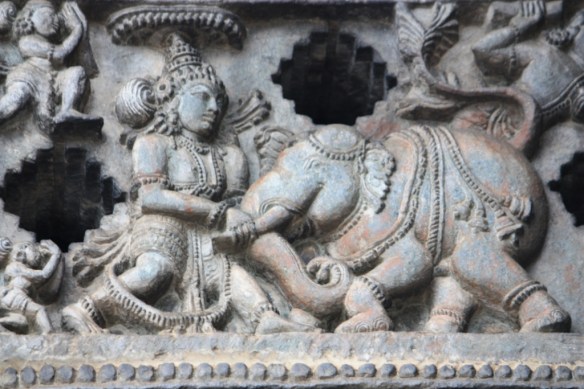
rounding the temple,
walking its plinth,
reading each carving
like solving a labyrinth
battles and bulls
and decrepit hulls
of ships washed ashore
demons and ogres
who’d fought foreign wars
the Tartarus deep
and gods upon high
and mythical beasts
in water and sky
there’s no way this world
could be real or true
a vacuum of cruelty
a fanciful zoo
real enough to be carved in stone
constructs of mind, known but unknown


