Unknown's avatar

About B Gourley

Bernie Gourley is a writer living in Bangalore, India. His poetry collection, Poems of the Introverted Yogi is now available on Amazon. He teaches yoga, with a specialization in pranayama, and holds a RYT500 certification. For most of his adult life, he practiced martial arts, including: Kobudo, Muay Thai, Kalaripayattu, and Taiji. He is a world traveler, having visited more than 40 countries around the globe.

POEM: Pressure [Day 28 NaPoMo: Symbolism]

The overseeing angels-of-the-angry-kind strain, but can’t generate sufficient force of eye. So, they weep in their failure.

Chained to a pillar on the temple mount, the floggings amount to little more than bloodlettings. The thin fluid rolls away, replaced by thicker and more hardy concoction.

Even the ravenous robed one has no pull. He’s too far from the children and too familiar to the elders.

So the scene replays. It’s a dream scene that will roll over into real life, becoming more vivid and closer to true — no longer a dim facsimile.

One’s only hope is that one’s less evil twin isn’t evil enough.

DAILY PHOTO: In the River, High Falls State Park

Taken in the summer of 2013 at High Falls State Park, Georgia

BOOK REVIEW: The Incredible Hulk: Planet Hulk by Greg Pak

The Incredible Hulk: Planet HulkThe Incredible Hulk: Planet Hulk by Greg Pak
My rating: 5 of 5 stars

Amazon.in page


I was pleasantly surprised by the story arc and character development in this volume – which is to say it had both and they were well crafted. I often have a problem with comic books — in particular (and on-going series of any kind, in general,) and that’s that they often fail to be satisfying as self-contained stories. So much effort is put into keeping one reading that the climax and resolution – such as they are – feel like minor speed-bumps on the way to somewhere else. That wasn’t the case here. While the ending leaves open a route of continued story (as one would expect,) one sees the Hulk undergo a transformation across the events of this story. He’s shot away from the Earth, lands on the wrong planet, is forced to fight as a gladiator, escapes, fights his way across a world teeming with harsh adversaries, all the while building the respect of those around him until he is elevated to kingship.

Tough guy characters are notorious for remaining unchanged across a story arc. Hulk, being the ultimate tough guy, seems particularly unlikely to grow or develop. However, the Hulk who begins this story jettisoned into deep space by his superhero colleagues to avoid him causing chaos on Earth, feels different from the Hulk who assumes leadership of the planet Saakar at the volume’s end. Amid monsters, the Hulk is in his element and can be a better version of himself. On Earth he is a bull in a china shop, on Sakaar not everyone he meets is so delicate. Overpowered heroes are often hard to make interesting. However, a couple countervailing features make it easier to make Hulk more interesting than say, Superman. First of all, Hulk is overpowered in one dimension, i.e. power, and might be considered underpowered in other dimensions (i.e. intellect, pettiness, control, etc.) Second, there is an interesting game theoretic condition in which the Hulk just gets stronger the angrier he gets, and so he always presents an object lesson — that is, one can’t just fight fire with fire and get the better of him. Thirdly, and most importantly, no matter who the Hulk is fighting, his story is essentially man versus self. The outward opposition is secondary. Because of his past mindless destructiveness, he is uniquely able to understand the need to let bygones be bygones. This is nicely shown, and eventually challenged.

Movie buffs may wonder what this book has in common with the “Thor: Ragnarok” movie that features common elements. The answer is: not a lot. The Sakaar of the movie seems to be just a huge trash heap and a gladiatorial arena. The Sakaar of the comics is more fleshed out with agrarian areas and various indigenous peoples / species. There are a couple of common characters, including Korg and Miek, but they are only superficially the same character. (Korg is much more serious and Miek is a much more substantially developed character in the comic book.) Also, there is no Thor. The only other familiar hero from other comics that we see on Sakaar is the Silver Surfer – and only early in the story.

Besides the main story, provided by “The Incredible Hulk, #92 – 105” there is a “Planet Hulk Gladiator Guide” for the hardcore nerds the provides all sorts of detail regarding the geography planet Sakaar, biographical sketches of key characters, and the culture of various species on the planet. There is also another issue “Amazing Fantasy #15” that shows Amadeus Cho (on Earth) investigating what happened with his friend, Bruce Banner.

I enjoyed “Planet Hulk” considerably, and I look forward to reading the “World War Hulk” collection that was also written by Pak. The art was generally clear and conveyed action effectively, and I found the story quite intriguing.

View all my reviews

BOOK REVIEW: And the Earth Will Sit on the Moon by Nikolai Gogol

And the Earth Will Sit on the MoonAnd the Earth Will Sit on the Moon by Nikolai Gogol
My rating: 5 of 5 stars

Amazon.in page


This collection contains five short stories by the esteemed 19th century Russian writer, Nikolai Gogol. (According to marketing materials, the finalized edition may have a sixth story located in the book’s second half.) For a small collection, it’s a diverse set of stories including surrealism, speculative fiction, and grim and gritty realism. That said, there is a theme that runs throughout, and it’s the social humiliation and envy of being in the middling territory of a hierarchical / aristocratic society.

The first three stories, which are among Gogol’s best known, are set in Saint Petersburg, and feature low-level bureaucrats. In other words, the bottom tier of the upper crust – not peasants, but poor relative to what they were expected to maintain and lacking status compared to almost everyone around them. Whatever else is going on throughout these stories, these characters are striving to save face — and the odds of doing so are against them.

“The Nose” is a story in which a barber finds a human nose in a loaf of bread he’s eating for breakfast. [Lest this seem gross beyond measure, the story is completely surreal / dream-like and there is no gore.] The barber recognizes the nose as one belonging to a civil servant who is one of his regular customers. The barber panics and pitches the nose in the river, trying to get rid of the evidence. The story picks up with the civil servant who lost the nose, and his attempts to discern its whereabouts.

“Diary of a Madman” is – as the name suggests – a chronicle of a man who descends into madness. Gogol does an artful job with pacing. He begins by establishing a lead character that one might find quirky, but not particularly insane. Then we see the character as he registers a conversation between two dogs in the street. As the story continues, at first the only anomaly is the man’s belief that dogs communicate in words (spoken and written) and that he can uniquely understand them. Then, when the man begins to believe he is the King of Spain, his madness becomes complete and all-encompassing. It’s interesting to see how Gogol communicates this madness, down to the change of sensible diary headings (i.e. the date) to bizarre substitutes.

“The Overcoat” is a story about a poor civil servant whose coat is falling to shreds, so – though he can’t afford it – he invests in a new one. While the story is mostly realistic, it does take turns into speculative territory near the end. However, the themes of envy, obsession, and the glee of apparent upward mobility (even if it’s for something as superficial as a new coat) provide the story’s tension.

The book takes a little turn at this point. The first three stories were set in Saint Petersburg, but the latter stories are set out in rural villages.

“Old World Landowners” is about a cute old couple who owns the lands encompassing a village and surrounding territory. It is Gogol’s take on a myth from Ovid’s “Metamorphoses,” but instilled with a grimmer, more Russian, sentiment. The couple are not only adorable, but are essentially the glue that binds the community.

“The Carriage” is about a gentleman from a small and boring village. At times, a military unit takes up residence in this village, and – when they do – they instill life in an otherwise bleak small town. The gentleman comes to visit the General and his officers — desiring to impress them. He is most proud of a Viennese carriage that he recently acquired. He invites them to lunch the next day, but all does not go as planned and the man is faced with utter humiliation.

I enjoyed this collection immensely. Despite the nineteenth century prose, the stories are readable and engaging. While the stakes are more often saving versus losing face (as opposed to life-and-death) Gogol does a great job of building the feelings of humiliation and woe – even for readers from a very different form of society. The stories may feature uniquely aristocratic Russian circumstance, but they still work because they deal in universal human emotional experiences.

I’d highly recommend the book for readers of fiction.

View all my reviews

BOOK REVIEW: Conversations, Volume 3 Jorge Luis Borges [Int: Osvaldo Ferrari]

Conversations, Volume 3Conversations, Volume 3 by Jorge Luis Borges
My rating: 5 of 5 stars

Amazon.in page


This book of interviews with Jorge Luis Borges has me jonesing to read a collection of his short fiction. I must admit that, despite Borges’ great stature as an author, I’ve only ever read one of his stories, and that was lost amid a huge anthology (also perhaps a poem or so under the same constraints.) However, I was intrigued by the possibility of gaining some insight into the Argentinian author credited as one of the founders of the magic realism genre in Latin America. I not only gained said insight, but I also developed an affinity for Borges as a thinker. These interviews not only discuss literature, but also philosophy, politics, language, and other topics as they interact with the literary world. The chapters, of which there are almost thirty, are topically organized and a few pages each.

The interviews are published as dialogues between Osvaldo Ferrari and Borges. That is to say, they are in transcript form so that one can experience the question and response as if you were witnessing the conversation. I found this worked well, and one could sense a camaraderie between the two men.

Let me answer a few questions about which readers might be interested. First, I came in late to the game, and one might wonder if there was any problem reading this, the third volume, first. It caused me no problems. Once in a while Ferrari would reference something the two discussed at an earlier point, but I didn’t feel any confusion (it was never necessary to have heard what they said earlier to interpret a reply.)

Second, given that the conversation is between two Argentinians, readers from other parts of the world might wonder if there is any difficulty following the discussions if one doesn’t know much about the art and social worlds of Argentina. Again, I would say the answer is no – for the most part. There are brief forays into Argentinian literature and politics, but the bulk of the discussion is cosmopolitan. I’d say there was considerably more page space devoted to Irishmen (e.g. Joyce and Yeats) and Americans (e.g. Emerson and Whitman) than there was to Argentinians.

Finally, if you’re wondering whether the book is highly focused on Borges’ work, the answer to that, too, is no. Borges discusses his own work enough, for example, that I now feel I know where I should begin my reading of him. However, he generally seems reticent to discuss his own work and the interviewer was responsive to that preference and picked his questions carefully.

If you’re interested in literature, I’d highly recommend this book. I found Borges penchant for minimalism and simplicity appealing, and yet he had deep insights to offer into a wide range of topics.

View all my reviews

BOOK REVIEW: The Malevolent Volume by Justin Phillip Reed

The Malevolent VolumeThe Malevolent Volume by Justin Phillip Reed
My rating: 5 of 5 stars

Amazon.in page

Out in India on May 5th. Already out in the US.


This multifarious collection of poetry is stirring and evocative. While much of the poetry is free verse, Reed pays a great deal of attention to structure in his poetry. The overall tone tends toward the dark and somber, and much of the poetry requires intuition rather than intellect to glean nuggets of insight. That said, it’s pleasant to read and employs some stunning use of language.

At times, Reed engages in a kind of dialogue with other poets, which I appreciated. These included the founders of the American poetic tradition, Whitman and Dickinson, and Harlem Renaissance great, Langston Hughes.

I enjoyed this collection. Reed has a message, but it doesn’t come across as whiny or self-obsessed (which are traits I see too often for my own preference in new poetry collections.) Instead, there is a humanity and a depth to the way he makes his points. If you enjoy poetry, this is a great collection and you should check it out.

View all my reviews

DAILY PHOTO: On the Trail

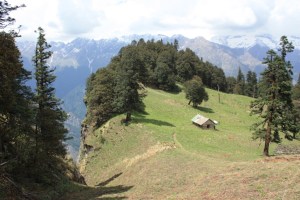
Taken in Himachal Pradesh in June of 2015.

POEM: After the Rains [Day 27 NaPoMo: Eclogue]

[Eclogues are sometimes called bucolics and are in the same vein as the idyll, which I covered on Day 19. They are short poems, set in a rural locale, and are often (but not always) in the form of a dialogue between shepherds or other country folk. There is no set form, though they are normally in metered verse because that was the mode in the days in which this genre was popular.]

Having stormed the night before, all felt clean.
And the grass swelled, deepening in its green.
And the shepherds’ cuffs were damp to dripping,
while lazing sheep partook of puddle sipping.

Two shepherds sat on rocks watching their flocks,
as overhead circled two gliding hawks.
A said to P, “Think new storms are coming?”
P replied, “I hear that distant rumbling.”

“But should we drive our flocks back home?”
“I think I’ll let mine graze and roam.”
“But last night’s winds almost took my roof!”
“They’re wearing wool; they’re waterproof.”

“But we’ll be soaked in this cotton!”
“Wet, yes. But I’ll not go rotten.”
“It could get a lot more frightening,
our sheep could get hit by lightening!
Then what will you say to your pa and mum?”

“I’ll say, ‘Hope you like your mutton well-done.'”

DAILY PHOTO: Rudolfinum, Prague

Taken in Prague in the summer of 2002 (-ish)

POEM: Sound [Day 26 NaPoMo: Lyric]

5D740486-4FD0-4A86-B6FB-85E9FD8A5EFB

Relentless sound, relentlessly pounds —
throbbing throughout the town.
They crank the volume up so loud;
I turn it right back down.

But songs sung in quiet, they grind
on the sour side of mind.
Some lump of cells tries hard to find
the sound below the line.

And when the sound yields to silence,
my brain asks where it went,
and how I sit astride the fence
about rowdy or silent?